
The inverted planetary roller screw (IPRS) represents a highly advanced linear motion actuator, distinguished by its exceptional load-carrying capacity, high precision, long operational life, and compact design. These attributes make it an indispensable component in demanding applications such as aerospace flight control systems, advanced weaponry, high-performance CNC machine tools, and precision robotics. At its core, the IPRS is a sophisticated mechanical system where a planetary arrangement of threaded rollers interacts with a central screw and an outer nut. Unlike its standard counterpart, the IPRS typically features a rotating nut and a translating screw, a configuration that allows for direct integration with rotary motors, enabling highly compact electromechanical actuator designs. A fundamental challenge in the design and reliable operation of any planetary roller screw mechanism is the non-uniform distribution of load among the numerous concurrent thread contacts. This load sharing significantly influences the mechanism’s stiffness, positioning accuracy, and ultimately, its fatigue life. This article presents a comprehensive analytical framework for modeling the load distribution, calculating the axial stiffness, and predicting the contact fatigue life of an inverted planetary roller screw.
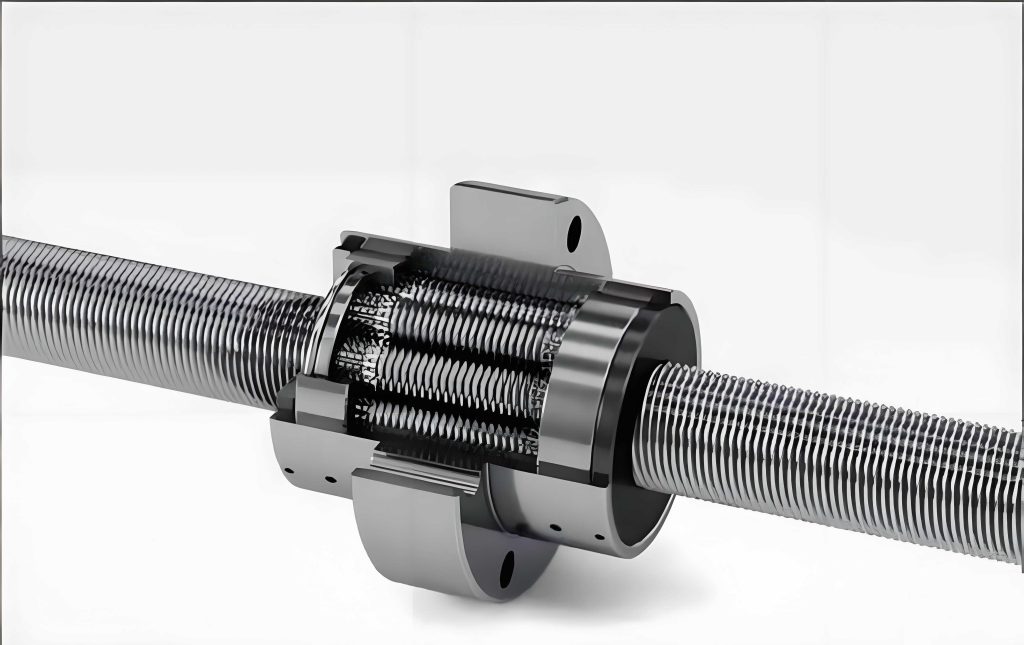
The kinematic principle of the inverted planetary roller screw is unique. When the nut rotates, it drives the planetary rollers, which are constrained by a cage to maintain equal circumferential spacing. The rollers consequently undergo a compound motion: revolution around the screw axis and rotation about their own axes. To maintain pure rolling contact and prevent relative axial slippage, the screw and the rollers are often equipped with timing gears, and the thread starts (or heads) of the nut and screw follow a specific relationship with the number of rollers. This complex interaction among multiple helical surfaces makes accurate performance prediction non-trivial. Previous studies often simplified the contact geometry or load distribution assumptions, leading to models with limited accuracy for precise design and optimization. Therefore, the development of a rigorous model that accounts for precise contact geometry, component compliance, and realistic load-sharing is crucial for advancing the design of reliable and high-performance planetary roller screw systems.
1. Geometric Modeling and Contact Point Determination
Accurate analysis begins with a precise geometric description of the interacting components: the screw, the rollers, and the nut. We establish a cylindrical coordinate system $(r, \theta, z)$ for each component, with the z-axis coinciding with their respective axes of rotation. The thread profiles are typically Gothic arch or modified forms to provide a well-defined contact angle. Let us denote key geometric parameters before defining the surfaces.
| Symbol | Description |
|---|---|
| $r_s$, $r_r$, $r_n$ | Pitch radius of screw, roller, and nut. |
| $p$, $p_n$ | Lead of the roller and the nut/screw (often related: $p_n = (k+2)p$, where $k$ is number of nut/screw thread starts). |
| $\beta_s$, $\beta_r$, $\beta_n$ | Helix angle of screw, roller, and nut threads. |
| $\alpha$ | Nominal contact angle (half of the thread profile angle). |
| $r_c$ | Radius of curvature of the roller thread profile. |
| $(r_0, z_r)$ | Coordinates of the center of the roller thread arc. |
| $z_s$, $z_n$ | Axial intercepts defining the screw and nut thread flanks. |
The helical surface of each component can be mathematically described. For the nut, the upper and lower flanks are given by:
$$\Pi_n(\theta, r) = \left( r\cos\theta,\ r\sin\theta,\ \theta r_n \tan\beta_n \mp (z_n – r \tan\alpha) \right)$$
For the screw thread surfaces:
$$\Pi_s(\theta, r) = \left( r\cos\theta,\ r\sin\theta,\ \theta r_s \tan\beta_s \pm (z_s – r \tan\alpha) \right)$$
The roller surface is described by an arc of radius $r_c$ swept along a helix:
$$\Pi_r(\theta, r) = \left( r\cos\theta,\ r\sin\theta,\ \pm\left(z_r + \sqrt{r_c^2 – (r – r_0)^2}\right) – \theta r_r \tan\beta_r \right)$$
In these equations, the $\mp$ and $\pm$ signs differentiate between the two flanks of the thread.
The precise location of contact points between the roller and the nut, and between the roller and the screw, is fundamental for calculating deformations. Based on the condition of continuous tangency between the meshing surfaces, the angular positions of these contact points within one roller pitch can be derived. Let $\phi_n$ and $\phi_r$ define the contact on the nut-roller interface, and $\phi_s$ and $\phi’_r$ define the contact on the screw-roller interface, measured relative to a reference line connecting the component axes in the transverse plane. The relationships are:
$$\phi_n = \arcsin\left( \frac{r_r (\sin\beta_r + \sin\beta_n)}{r_n – r_r} \right), \quad \phi_r = \arcsin\left( \frac{r_n (\sin\beta_r + \sin\beta_n)}{r_n – r_r} \right)$$
$$\phi_s = \arcsin\left( \frac{r_r (\sin\beta_r – \sin\beta_s)}{r_s + r_r} \right), \quad \phi’_r = \arcsin\left( \frac{r_s (\sin\beta_r – \sin\beta_s)}{r_s + r_r} \right)$$
Knowing these angles and the axial lead relationship, the exact 3D coordinates of all contact points for every engaged thread on each roller can be determined.
2. Hertzian Contact Deformation Calculation
At each contact point, the load is transmitted through a small elliptical area, and the resulting local deformation is governed by Hertzian contact theory. The first step is to compute the principal curvatures of the two contacting bodies at the point of contact. For a parametric surface $\Pi(\theta, r)$, the first and second fundamental forms provide the necessary metrics. The principal curvatures $\rho_1$ and $\rho_2$ are the eigenvalues of the shape operator, found by solving:
$$ \rho^2 – 2H\rho + K = 0 $$
where $H$ is the mean curvature and $K$ is the Gaussian curvature. The principal curvature sum $\sum \rho$ for the contact pair (e.g., roller and nut) is:
$$\sum \rho = \rho_{1}^{I} + \rho_{2}^{I} + \rho_{1}^{II} + \rho_{2}^{II}$$
where superscripts $I$ and $II$ denote the two bodies in contact.
To find the contact ellipse dimensions and the approach of the two bodies (Hertz deformation), we define the curvature difference function $F(\rho)$ and use tabulated elliptic integrals. The contact ellipse semi-axes $a$ (major) and $b$ (minor), and the relative deformation $\delta$ under a normal load $N_n$ are given by:
$$ a = m_a \left[ \frac{3 N_n E_0}{2 \sum \rho} \right]^{1/3}, \quad b = m_b \left[ \frac{3 N_n E_0}{2 \sum \rho} \right]^{1/3} $$
$$ \delta(N_n) = \frac{K(e) \left( \sum \rho \right)^{1/3} N_n^{2/3}}{\pi m_a E_0^{1/3}} \left(1 – \nu^2\right) $$
where $E_0 = \left( (1-\nu_I^2)/E_I + (1-\nu_{II}^2)/E_{II} \right)^{-1}$ is the equivalent elastic modulus, $\nu$ is Poisson’s ratio, and $K(e)$ is the complete elliptic integral of the first kind. The coefficients $m_a$, $m_b$, and the eccentricity $e$ are functions of the curvature difference, obtainable from standard Hertzian contact solutions. The axial component of this deformation, crucial for the overall axial stiffness, is $\delta_{ax} = \delta \cos\alpha \cos\beta$.
3. Load Distribution and Axial Stiffness Model
The planetary roller screw exhibits a complex statically indeterminate load-sharing behavior. When an axial force $F_a$ is applied to the screw, it is distributed among all $n$ rollers and their $m$ actively engaged threads on each side (nut-side and screw-side). We analyze the system by considering the equilibrium and compatibility of deformations for a single representative roller.
Two primary loading configurations exist for the inverted planetary roller screw: same-side loading and opposite-side loading. In same-side loading, the reaction force on the nut acts on the same side as the applied axial force on the screw. In opposite-side loading, the reaction force is on the opposite side. This distinction affects the internal load distribution pattern. We make the following key assumptions: 1) The timing gears do not carry axial load. 2) The number of engaged threads is equal on both sides of the roller. 3) The nominal contact angle remains constant under load. 4) Consecutive contact points on the nut and screw sides are offset by half a roller pitch axially along the roller.
For the $i$-th engaged thread pair, let $N_i$ be the normal load at the nut-roller contact and $N’_i$ be the normal load at the screw-roller contact. The total axial force equilibrium for one roller is:
$$ \sum_{i=1}^{m} N_i \cos\alpha \cos\beta_s = \sum_{i=1}^{m} N’_i \cos\alpha \cos\beta_s = \frac{F_a}{n} $$
The compatibility of deformations links these loads. The total relative axial displacement between the nut and screw at the $i$-th thread location must be consistent through both load paths (nut-roller and roller-screw). This yields a system of equations considering: 1) Hertzian contact deformations $\delta_{ni}, \delta_{si}, \delta_{ri}, \delta’_{ri}$, 2) axial tensile/compressive deformations of the component segments between contact points ($l_{ni}, l_{si}, l_{rni}, l_{rsi}$), and 3) thread tooth bending and shear deflections ($\varepsilon_{ni}, \varepsilon_{si}, \varepsilon_{ri}, \varepsilon’_{ri}$).
The axial deformations of the component bodies, modeled as circular bars, are:
$$ l_{ni} = \frac{4 p_n \cos\alpha \cos\beta_r}{\pi (D_0^2 – d_{ne}^2) E_n} \sum_{j=i+1}^{m} N_j $$
$$ l_{si}^{(\text{opposite})} = \frac{4 p_n \cos\alpha \cos\beta_r}{\pi d_{se}^2 E_s} \sum_{j=1}^{i} N’_j; \quad l_{si}^{(\text{same})} = \frac{4 p_n \cos\alpha \cos\beta_r}{\pi d_{se}^2 E_s} \sum_{j=i+1}^{m} N’_j $$
$$ l_{rni} = \frac{2 p \cos\alpha \cos\beta_r}{\pi d_{re}^2 E_r} \left[ 2\sum_{j=1}^{i}(N_j – N’_j) + N’_i \right] $$
$$ l_{rsi} = \frac{2 p \cos\alpha \cos\beta_r}{\pi d_{re}^2 E_r} \left[ 2\sum_{j=1}^{i}(N_j – N’_j) + N_{i+1} \right] $$
where $d_{se}, d_{re}, d_{ne}$ are effective diameters, $D_0$ is the nut outer diameter, and $E$ denotes Young’s modulus.
The thread deflection $\varepsilon$ is a linear function of the normal load $N$, accounting for bending, shear, and radial effects, and can be expressed using influence coefficients from beam-on-elastic-foundation or finite element analysis. The final compatibility equations for the $i$-th and $(i+1)$-th threads are:
$$ l_{ni} – \delta_{ni} – \varepsilon_{ni} + \delta_{n(i+1)} + \varepsilon_{n(i+1)} = l_{rni} + \delta_{ri} + \varepsilon_{ri} – \delta_{r(i+1)} – \varepsilon_{r(i+1)} $$
$$ l_{rsi} – \delta’_{ri} – \varepsilon’_{ri} + \delta’_{r(i+1)} + \varepsilon’_{r(i+1)} = l_{si} + \delta_{si} + \varepsilon_{si} – \delta_{s(i+1)} – \varepsilon_{s(i+1)} $$
This system, combined with the equilibrium equation and the nonlinear Hertz force-deformation relationship $\delta \propto N^{2/3}$, forms a complete set for solving the load distribution $\{N_i, N’_i\}$. The total axial deformation $\Delta$ at the load application point is then the sum of deformations along any load path from the nut to the screw. For opposite-side loading, it is approximately:
$$ \Delta = \sum_{i=1}^{m-1} l_{rni} + \delta_{nm} + \delta_{sm} + \delta_{rm} + \delta’_{rm} + \varepsilon_{nm} + \varepsilon_{sm} + \varepsilon_{rm} + \varepsilon’_{rm} $$
The axial stiffness is simply $K_{ax} = F_a / \Delta$.
4. Contact Fatigue Life Prediction Model
For a properly lubricated planetary roller screw, contact fatigue (spalling or pitting) is the dominant failure mode that limits its useful life. We adopt the Lundberg-Palmgren theory, which has been the foundation for rolling bearing life prediction, and adapt it to the multi-contact, threaded geometry of the IPRS. The basic Lundberg-Palmgren life equation for a single contact point is:
$$ L = A \left( \frac{1}{\tau_0^c z_0^{h} V} \right)^{1/f} \left[ \ln\left(\frac{1}{S}\right) \right]^{1/f} $$
where:
- $L$: Fatigue life in millions of stress cycles.
- $S$: Survival probability (reliability).
- $V$: Stress volume ($V \approx \pi a b z_0$).
- $z_0$: Depth to the maximum orthogonal shear stress $\tau_0$.
- $c, h, f$: Experimental exponents (typically 31/3, 7/3, 10/9 for point contact).
- $A$: Material and lubrication constant.
The maximum shear stress and its depth for an elliptical contact are:
$$ \tau_0 = \frac{3N_n \sqrt{2t-1}}{4\pi a b t (t+1)}, \quad z_0 = \frac{b}{t+1}\sqrt{2t-1} $$
where $t$ is a parameter related to the ellipse eccentricity, found from $\frac{(t^2-1)(2t-1)}{t^2} = \left(\frac{b}{a}\right)^2$.
A critical adaptation for the planetary roller screw is accounting for the differential rolling and sliding motions. In one complete revolution of the nut, a point on the nut, roller, and screw raceways experiences a different number of stress cycles ($\gamma_n, \gamma_r, \gamma_s$ respectively). Based on the kinematics:
$$ \gamma_n = \frac{k}{2}, \quad \gamma_r = \frac{(k-1)(k+2)}{2(k+2)} = \frac{k-1}{2}, \quad \gamma_s = \frac{k(k+2)}{2(k+2)} = \frac{k}{2} $$
where $k$ is the number of thread starts on the nut/screw. These factors weight the contribution of each contact to the total damage.
The overall system reliability $S_{system}$ is the product of the reliabilities of all its independent critical contacts—every thread engagement on every roller. Assuming a Weibull-type failure distribution, the system life $L_{10}$ (life at 90% system reliability) can be derived. For an IPRS with $n$ rollers and $m$ load-carrying threads per engagement side, the system life is given by:
$$ L_{10}^{system} = A \left[ n \gamma_n^f \sum_{i=1}^{m} \left( \frac{\tau_{ni}^c}{z_{ni}^h} V_{ni} \right) + n \gamma_s^f \sum_{i=1}^{m} \left( \frac{\tau_{si}^c}{z_{si}^h} V_{si} \right) + n \gamma_r^f \left( \sum_{i=1}^{m} \left( \frac{\tau_{ri}^c}{z_{ri}^h} V_{ri} \right) + \sum_{i=1}^{m} \left( \frac{\tau_{ri}’^c}{z_{ri}’^h} V_{ri}’ \right) \right) \right]^{-1/f} $$
This model integrates the non-uniform load distribution $\{N_i, N’_i\}$ calculated previously, as the stress parameters ($\tau_0, z_0, V$) for each contact $i$ are direct functions of the local normal load $N_i$ or $N’_i$.
5. Parameter Sensitivity Analysis and Design Implications
Using the developed models, a comprehensive sensitivity analysis can be performed to understand the influence of key design parameters on the performance metrics of the inverted planetary roller screw. The following table summarizes the general trends for a typical IPRS under opposite-side loading. The index $\kappa = N_{max}/N_{min}$ quantifies load distribution unevenness, and $\zeta = \log(L’/L’_0)$ indicates the relative change in predicted fatigue life.
| Design Parameter | Effect on Load Distribution (偏载率 $\kappa$) | Effect on Axial Stiffness | Effect on Contact Fatigue Life ($\zeta$) |
|---|---|---|---|
| Number of Rollers ($n$) | Increases. More rollers increase load-sharing but also system compliance differences. | Strongly Increases. More parallel load paths. | Increases. Load per contact is reduced, and system redundancy increases. |
| Number of Threads ($m$) | Increases. Longer engagement increases the “lever arm” for deformation mismatch. | Increases initially then may plateau/decrease. More teeth share load, but longer screw/roller compliance reduces gains. | Increases. Load per thread is lower, and the stressed volume is distributed over more cycles. |
| Helix Angle ($\beta$) | Increases. Steeper helix increases axial load component per unit normal force, exaggerating differences. | Has an optimum. Affects load component and thread stiffness. | Minor direct effect. Indirectly affects via load distribution and contact ellipse. |
| Contact Angle ($\alpha$) | Minor effect if constant under load. | Decreases. Larger $\alpha$ reduces the axial component $\cos\alpha$ of the contact force. | Decreases. Larger $\alpha$ increases the normal load $N_n = F_{ax}/(\cos\alpha\cos\beta)$ for the same axial force, raising contact stress. |
| Roller Profile Radius ($r_c$) | Slightly decreases. Larger radius reduces contact pressure and local deformation, improving uniformity. | Slightly increases due to lower Hertzian compliance. | Increases. Larger $r_c$ reduces contact curvature $\sum\rho$, leading to lower $\tau_0$ and larger stressed volume $V$. |
| Nut Outer Diameter ($D_0$) | Decreases. Stiffer nut reduces its axial compliance, improving load distribution. | Increases. Directly increases the cross-sectional area of the nut. | Minor direct increase (stiffer nut improves load distribution). |
Furthermore, analysis consistently shows that the rollers are the most critical components for contact fatigue failure in a planetary roller screw, followed by the screw, and then the nut. This is because the rollers experience stress cycles from both the nut and screw sides and often have the highest contact pressures due to their smaller curvature. The choice of loading configuration (same-side vs. opposite-side) also plays a significant role. Opposite-side loading generally results in a more uniform load distribution and higher stiffness compared to same-side loading for an equivalent geometry, making it the preferred configuration for high-precision, high-stiffness applications.
The models presented provide a powerful tool for the design and optimization of inverted planetary roller screw mechanisms. By accurately predicting load distribution, stiffness, and life, engineers can make informed decisions on parameters such as the optimal number of rollers and engaged threads, the best thread profile, and the required material properties to meet specific application requirements for load capacity, positioning accuracy, and service life.