
In the field of precision motion control and robotics, the strain wave gear, also known as a harmonic drive, stands out for its exceptional capabilities. Its unique operating principle, relying on the elastic deformation of a flexible spline, enables remarkable features such as high reduction ratios, near-zero backlash, compact design, and high torque capacity. A core element of its performance is the controlled meshing interaction between the teeth of the flexible spline (often called the “flexspline” or “柔轮”) and the rigid circular spline (or “刚轮”). This article delves into the detailed mathematical analysis of the tooth profile interaction, specifically focusing on modeling the clearance between conjugate involute profiles, which is fundamental to achieving high-performance, low-backlash strain wave gear systems.
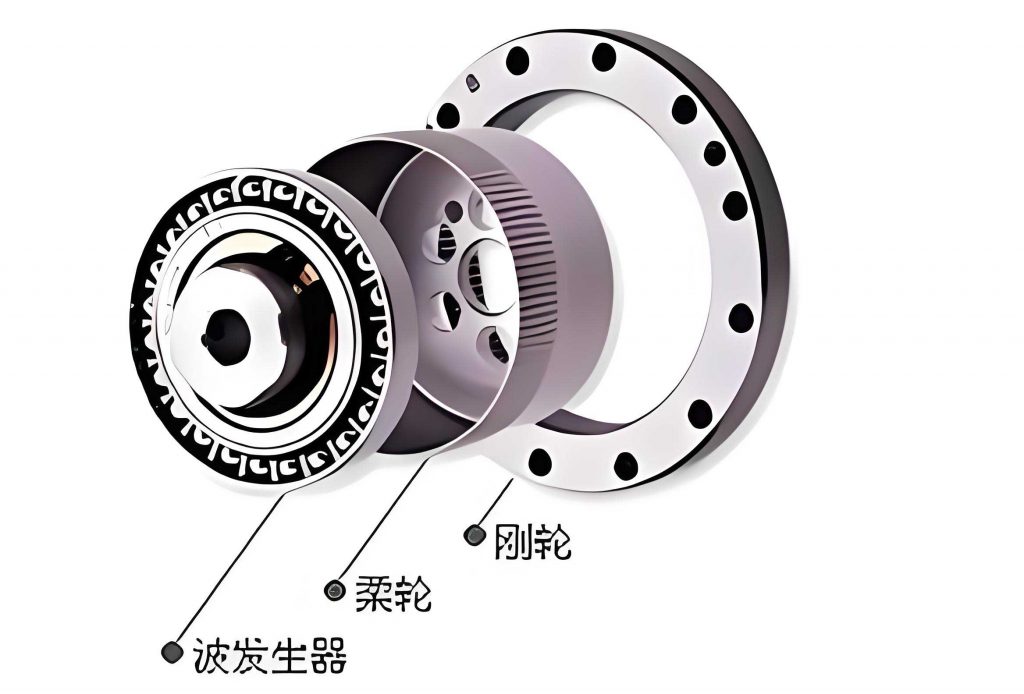
The fundamental operation of a strain wave gear involves three primary components: the wave generator (an elliptical cam), the flexspline (a thin-walled, flexible external gear), and the circular spline (a rigid internal gear). The wave generator deforms the flexspline into an elliptical shape, causing its external teeth to engage with the internal teeth of the circular spline at two diametrically opposite regions. Due to a difference in the number of teeth between the flexspline (with more teeth) and the circular spline (with fewer teeth), a small relative rotation occurs with each wave generator revolution, resulting in a high gear reduction. The quality of this meshing, critical for smooth operation, minimal wear, and positional accuracy, is governed by the precise geometry of the tooth profiles and the calculated clearance between them during operation.
While true conjugate action for the non-circular, deforming flexspline is complex, a highly effective and practical approach is to employ standard involute profiles for both the flexspline and circular spline. This leverages mature, high-precision manufacturing and inspection techniques developed for small-module gears. The key is to strategically select meshing parameters, primarily through profile shift (modification) coefficients, to approximate conjugate action and ensure a minimal, controlled clearance that prevents interference while efficiently transmitting motion and load. This article presents a first-principles derivation of the mathematical models governing the clearance between the involute profiles in a strain wave gear assembly.
Fundamentals of Involute Tooth Profiles
Selecting the involute curve as the tooth profile for strain wave gear components necessitates a thorough understanding of its geometric properties and mathematical representation. This foundation is essential for deriving the coordinates of critical points, such as the tooth tip of the flexspline and circular spline, and ultimately for analyzing their meshing approximation.
Generation and Properties of the Involute
The involute of a circle is defined as the locus traced by a point on a taut string as it is unwound from a base circle. If a straight line (the generating line) rolls without slipping on a base circle, any point on that line describes an involute. This definition leads to several key properties crucial for gear theory:
- The length of the generating line segment from its tangency point on the base circle to the point on the involute is equal to the arc length on the base circle from the start of the involute to that tangency point.
- The generating line is always normal to the involute curve at their point of contact.
- The generating line segment represents the radius of curvature of the involute at that point. The curvature increases (radius decreases) closer to the base circle.
- The shape of the involute is uniquely defined by its base circle diameter. A larger base circle results in a less curved (flatter) involute.
- No involute exists inside the base circle.
Mathematical Description of the Involute
The geometry of an involute is best described using its pressure angle ($\alpha_x$) and the corresponding involute function or unwinding angle ($\theta_x$ or $\text{inv}\,\alpha_x$). For any point on the involute, the relationship is given by:
$$\theta_x = \text{inv}\,\alpha_x = \tan\alpha_x – \alpha_x$$
where $\alpha_x$ is in radians. This function is fundamental to involute calculations.
The coordinates of a point on the involute can be expressed in several forms. The polar coordinates relative to the involute’s starting point are:
$$ r_x = \frac{r_b}{\cos\alpha_x} $$
$$ \theta_x = \text{inv}\,\alpha_x = \tan\alpha_x – \alpha_x $$
where $r_b$ is the base circle radius and $r_x$ is the radial distance to the point.
For design and analysis, Cartesian coordinates are more practical. When the y-axis is aligned with the tooth’s symmetry line, the coordinates $(x, y)$ of a point on the involute are:
$$ x = r_b \left[ \sin(\alpha_x + \theta_x + \beta_b) – (\alpha_x + \theta_x) \cdot \cos(\alpha_x + \theta_x + \beta_b) \right] $$
$$ y = r_b \left[ \cos(\alpha_x + \theta_x + \beta_b) + (\alpha_x + \theta_x) \cdot \cos(\alpha_x + \theta_x + \beta_b) \right] $$
The parameter $\beta_b$ is half the base circle tooth thickness angle, which incorporates the profile shift (modification) and is critical for strain wave gear design:
$$ \beta_b = \frac{1}{2Z}(\pi + 4\xi \tan\alpha_0) + \text{inv}\,\alpha_0 $$
Here, $Z$ is the number of teeth, $\xi$ is the profile shift coefficient, and $\alpha_0$ is the standard pressure angle (typically 20° for strain wave gears). The coordinate $y$ is measured from the gear center, so the actual radial coordinate is $y$ for an external gear.
The key geometric parameters for the flexspline (subscript $R$) and circular spline (subscript $G$) are summarized below:
| Parameter | Symbol | Flexspline (External) | Circular Spline (Internal) |
|---|---|---|---|
| Number of Teeth | $Z$ | $Z_R$ | $Z_G$ $(Z_G < Z_R)$ |
| Module | $m$ | $m$ (Same for both) | |
| Standard Pressure Angle | $\alpha_0$ | $\alpha_0$ (e.g., 20°) | |
| Reference Diameter | $d$ | $d_R = m Z_R$ | $d_G = m Z_G$ |
| Base Circle Diameter | $d_b$ | $d_{bR} = d_R \cos\alpha_0$ | $d_{bG} = d_G \cos\alpha_0$ |
| Profile Shift Coefficient | $\xi$ | $\xi_R$ | $\xi_G$ |
| Addendum Coefficient | $h_a^*$ | $h_{aR}^*$ | $h_{aG}^*$ |
| Tip Diameter | $d_a$ | $d_{aR} = m(Z_R + 2\xi_R + 2h_{aR}^*)$ | $d_{aG} = m(Z_G + 2\xi_G – 2h_{aG}^*)$ |
Mathematical Model for Tooth Profile Clearance
Theoretical analysis and practice indicate that the most critical locations for potential interference or minimal clearance in a strain wave gear occur between the tooth tip of one gear and the flank of its mating gear. Therefore, the selection of profile shift coefficients $\xi_R$ and $\xi_G$ that satisfy non-interference and define a minimal operational clearance can be reduced to calculating the distance from a tooth tip to the mating gear’s profile along the common normal line. This distance must be positive (clearance) and ideally within a specified tolerance.
Clearance from Flexspline Tip to Circular Spline Profile ($H_{RG}$)
This clearance is defined as the distance from the flexspline tooth tip, along the normal to the circular spline involute at the meshing point, to the point of intersection on the circular spline profile. The following derivation assumes a clockwise rotating wave generator with the circular spline fixed.
1. Coordinate Definitions:
First, we establish coordinates for key points in their respective coordinate systems and then transform them into a common frame (typically the circular spline fixed frame $C_G$).
a) Flexspline Tip Coordinates in its own frame ($C_R$):
The coordinates $(x_{aR}, y_{aR})$ of the flexspline tooth tip are given by the involute equations, evaluated at its tip pressure angle $\alpha_{aR}$.
$$ \alpha_{aR} = \arccos\left( \frac{d_{bR}/2}{d_{aR}/2} \right) = \arccos\left( \frac{Z_R \cos\alpha_0}{Z_R + 2\xi_R + 2h_{aR}^*} \right) $$
$$ \beta_{bR} = \frac{\pi + 4\xi_R \tan\alpha_0}{2Z_R} + \text{inv}\,\alpha_0 $$
$$ x_{aR} = r_{bR} \left[ \sin(\tan\alpha_{aR} – \beta_{bR}) – \tan\alpha_{aR} \cdot \cos(\tan\alpha_{aR} – \beta_{bR}) \right] $$
$$ y_{aR} = r_{bR} \left[ \cos(\tan\alpha_{aR} – \beta_{bR}) + \tan\alpha_{aR} \cdot \sin(\tan\alpha_{aR} – \beta_{bR}) \right] – r_R $$
where $r_{bR}=d_{bR}/2$, $r_R = d_R/2$, and $r_{aR}=d_{aR}/2$.
b) Circular Spline Tip Coordinates in its frame ($C_G$):
Similarly, for the circular spline tip $(x_{aG}, y_{aG})$:
$$ \alpha_{aG} = \arccos\left( \frac{Z_G \cos\alpha_0}{Z_G + 2\xi_G – 2h_{aG}^*} \right) $$
$$ \beta_{bG} = \frac{\pi + 4\xi_G \tan\alpha_0}{2Z_G} + \text{inv}\,\alpha_0 $$
$$ x_{aG} = r_{bG} \left[ \sin(\tan\alpha_{aG} – \beta_{bG}) – \tan\alpha_{aG} \cdot \cos(\tan\alpha_{aG} – \beta_{bG}) \right] $$
$$ y_{aG} = r_{bG} \left[ \cos(\tan\alpha_{aG} – \beta_{bG}) + \tan\alpha_{aG} \cdot \sin(\tan\alpha_{aG} – \beta_{bG}) \right] $$
with $r_{bG}=d_{bG}/2$, $r_G = d_G/2$.
c) Flexspline Tip Coordinates transformed to Circular Spline frame ($C_G$):
The flexspline, deformed by the wave generator, undergoes both rotation and translation. For a clockwise rotating wave generator, the transformation from frame $C_R$ to $C_G$ involves a rotation $\psi_G$ and a translation defined by the wave generator’s characteristic curve (elliptical or other) with radial vector $\rho$ and angle $\gamma_G$. The homogeneous transformation matrix is:
$$ M_{RG}^G = \begin{bmatrix}
\cos\psi_G & -\sin\psi_G & -\rho\sin\gamma_G \\
\sin\psi_G & \cos\psi_G & \rho\cos\gamma_G \\
0 & 0 & 1
\end{bmatrix} $$
Thus, the flexspline tip coordinates in the $C_G$ frame are:
$$ \begin{bmatrix} x_{aR}^G \\ y_{aR}^G \\ 1 \end{bmatrix} = M_{RG}^G \begin{bmatrix} x_{aR} \\ y_{aR} \\ 1 \end{bmatrix} $$
leading to:
$$ x_{aR}^G = x_{aR}\cos\psi_G – y_{aR}\sin\psi_G – \rho\sin\gamma_G $$
$$ y_{aR}^G = x_{aR}\sin\psi_G + y_{aR}\cos\psi_G + \rho\cos\gamma_G $$
The parameters $\rho$ and $\gamma_G$ are functions of the wave generator’s geometry and the angular position $\psi_G$.
2. Intersection Point on Circular Spline Profile:
The line normal to the circular spline involute that passes through the point $(x_{aR}^G, y_{aR}^G)$ will intersect the involute at a specific point $(x_{RG}, y_{RG})$. Using the properties of the involute, the coordinates of this intersection point can be derived as:
$$ x_{RG} = r_{bG} \left( T_G \cos T_{aR}^G + \sin T_{aR}^G \right) $$
$$ y_{RG} = r_{bG} \left( T_G \sin T_{aR}^G + \cos T_{aR}^G \right) $$
where the following auxiliary angles are defined:
$$ \theta_G = \arctan\left( \frac{x_{aR}^G}{y_{aR}^G} \right) $$
$$ \delta_G = \arcsin\left( \frac{r_{bG}}{\sqrt{(x_{aR}^G)^2 + (y_{aR}^G)^2}} \right) $$
$$ T_{aR}^G = \frac{\pi}{2} – (\delta_G – \theta_G) $$
$$ T_G = T_{aR}^G + \beta_{bG} $$
3. Clearance Equation ($H_{RG}$):
Finally, the clearance $H_{RG}$ is the Euclidean distance between the flexspline tip and the intersection point on the circular spline profile, with a sign convention indicating the relative position.
$$ H_{RG} = \pm \sqrt{ (x_{aR}^G – x_{RG})^2 + (y_{aR}^G – y_{RG})^2 } $$
The sign is chosen as negative (-) if $|x_{aR}^G| – |x_{RG}| > 0$ or $y_{aR}^G – y_{RG} > 0$, indicating the tip is “outside” the mating profile relative to the center. It is positive (+) if $|x_{aR}^G| – |x_{RG}| < 0$ or $y_{aR}^G – y_{RG} < 0$, indicating the tip is “inside” (which would be interference if the value were negative in this context). For valid design, $H_{RG}$ must be a small positive number representing the operating clearance.
Clearance from Circular Spline Tip to Flexspline Profile ($H_{GR}$)
This is the complementary clearance, measured from the circular spline tooth tip to the flexspline profile along the normal to the flexspline involute.
1. Intersection Point on Flexspline Profile:
The circular spline tip $(x_{aG}, y_{aG})$ is known in the $C_G$ frame. To find the intersection point $(x_{GR}, y_{GR})$ on the flexspline profile, we must account for the flexspline’s deformed position. The transformation offset between the gear centers in the $C_G$ frame is given by $(o_x, o_y)$:
$$ o_x = r_R \sin\psi_G – \rho \sin\gamma_G $$
$$ o_y = -r_R \cos\psi_G + \rho \cos\gamma_G $$
The coordinates of the circular spline tip relative to the flexspline’s center are thus $(x_{aG} – o_x, y_{aG} – o_y)$. The intersection point on the flexspline involute (in a coordinate system aligned with the flexspline’s rotated tooth) is:
$$ x_{GR} = r_{bR} \left[ -T_R \cos T_{aG}^R + \sin T_{aG}^R \right] + o_x $$
$$ y_{GR} = r_{bR} \left[ T_R \sin T_{aG}^R + \cos T_{aG}^R \right] + o_y $$
The auxiliary angles for this case are:
$$ \theta_R = \arctan\left( \frac{x_{aG} – o_x}{y_{aG} – o_y} \right) $$
$$ \delta_R = \arcsin\left( \frac{r_{bR}}{\sqrt{(x_{aG}-o_x)^2 + (y_{aG}-o_y)^2}} \right) $$
$$ T_{aG}^R = \frac{\pi}{2} – (\delta_R – \theta_R) $$
$$ T_R = T_{aG}^R + \psi_G + \beta_{bR} $$
2. Clearance Equation ($H_{GR}$):
The clearance $H_{GR}$ is then calculated as:
$$ H_{GR} = \pm \sqrt{ (x_{aG} – x_{GR})^2 + (y_{aG} – y_{GR})^2 } $$
The sign convention is similarly applied: negative (-) if $x_{aG} – |x_{GR}| < 0$ or $y_{aG} – |y_{GR}| < 0$, and positive (+) otherwise. A valid design requires $H_{GR}$ to also be a controlled positive clearance.
The complete mathematical model for clearance analysis in a strain wave gear is thus defined by the two equations $H_{RG}(\xi_R, \xi_G, \psi_G)$ and $H_{GR}(\xi_R, \xi_G, \psi_G)$. The wave generator angle $\psi_G$ is varied over a cycle to find the minimum clearance values, which dictate the design’s robustness against interference.
Achieving Zero-Backlash Meshing and Selection of Profile Shift Coefficients
The ultimate goal in precision strain wave gear design is often to achieve a theoretical zero-backlash condition under a specified load or at a specific operating position, while maintaining a positive clearance at all other points to prevent binding. This is accomplished through the careful selection of the profile shift coefficients $\xi_R$ and $\xi_G$.
The design process involves solving an optimization or constraint satisfaction problem. For a chosen module ($m$), tooth numbers ($Z_R$, $Z_G$), and pressure angle ($\alpha_0$), the designer seeks the pair $(\xi_R, \xi_G)$ that satisfies the following primary conditions simultaneously:
- Non-Interference Condition: $ \min_{\psi_G} (H_{RG}) > 0 $ and $ \min_{\psi_G} (H_{GR}) > 0 $ for all $\psi_G$.
- Target Clearance/Backlash Condition: Often, one aims for $ \min_{\psi_G} (H_{RG}) \approx 0 $ and/or $ \min_{\psi_G} (H_{GR}) \approx 0 $ at a specific $\psi_G$ (e.g., at the major axis of engagement) to minimize effective backlash.
- Strength and Contact Ratio Conditions: The chosen coefficients should not unduly weaken the flexspline tooth (excessive negative $\xi_R$) or adversely affect the contact ratio.
The relationship between profile shift and clearance is highly non-linear. Generally, a more positive $\xi_R$ (shifting the flexspline tooth outward) and a more negative $\xi_G$ (shifting the circular spline tooth inward) will increase the clearances $H_{RG}$ and $H_{GR}$. The art of strain wave gear design lies in finding the precise balance.
| Component | Typical Shift Coefficient $\xi$ | Design Influence |
|---|---|---|
| Flexspline (External) | Moderately Positive (e.g., +0.5 to +2.0, depending on $Z_R$) | Increases bending strength of the thin-walled flexspline tooth. Tends to increase $H_{RG}$ but decrease $H_{GR}$. Must be optimized for clearance. |
| Circular Spline (Internal) | Zero to Moderately Negative (e.g., 0.0 to -1.0) | Used primarily to fine-tune the meshing clearance and avoid tip interference with the flexspline root. A negative shift increases $H_{GR}$ clearance. |
Case Analysis and Design Considerations
To illustrate the application of the数学模型, consider a common strain wave gear set with the following parameters: $m = 0.2$ mm, $\alpha_0 = 20^\circ$, $Z_R = 200$, $Z_G = 198$, $h_{aR}^* = h_{aG}^* = 1.0$. Assume a standard elliptical wave generator with a nominal radial deformation $w_0$. The characteristic curve is $\rho(\gamma) = r_R + w_0 \cos(2\gamma)$.
We evaluate the minimum clearances over a full wave generator rotation for different profile shift combinations. The calculation involves iterating over $\psi_G$ from $0$ to $2\pi$, computing $\rho$ and $\gamma_G$, transforming coordinates, and evaluating $H_{RG}$ and $H_{GR}$ at each step to find their minima.
| Case | $\xi_R$ | $\xi_G$ | $\min(H_{RG})$ [µm] | $\min(H_{GR})$ [µm] | Assessment |
|---|---|---|---|---|---|
| A | +0.8 | 0.0 | +15.2 | -5.3 (Interference!) | Unacceptable. Circular spline tip interferes with flexspline flank. |
| B | +0.8 | -0.3 | +18.7 | +2.1 | Acceptable. Both clearances positive. |
| C | +1.0 | -0.3 | +22.5 | +0.5 | Acceptable. Very low $H_{GR}$, nearing zero-backlash condition. |
| D | +1.2 | -0.3 | +26.4 | +3.8 | Acceptable but larger clearance, potentially more backlash. |
| E | +1.0 | -0.5 | +25.1 | +4.9 | Acceptable, but both clearances increased. |
From this simplified analysis, Case C ($\xi_R = +1.0, \xi_G = -0.3$) appears promising for a high-precision, low-backlash strain wave gear design, as it maintains positive clearance while minimizing $H_{GR}$ to a very small value. This precise mathematical modeling allows designers to virtually prototype and optimize the tooth geometry before manufacturing, saving significant time and cost. The strain wave gear’s performance is critically dependent on these calculated micro-geometries.
Further practical considerations must be integrated with this geometric model:
- Manufacturing Tolerances: The calculated clearances must account for machining errors, tooth profile deviations, and wave generator imperfection. A minimum safety margin is added to the theoretical $H_{min}$ values.
- Elastic Deformation under Load: The flexspline teeth and body undergo additional elastic deformation under torque load, which can effectively reduce operating clearance. This is often compensated for by pre-setting a slightly negative geometric clearance (preload) in high-stiffness designs.
- Thermal Effects: Differential thermal expansion between the steel flexspline and the aluminum housing (if used) or circular spline can alter clearances and must be considered for applications over a wide temperature range.
Conclusion
The pursuit of optimal performance in strain wave gear systems hinges on a deep and quantitative understanding of the tooth engagement mechanics. By adopting standard involute profiles and employing the rigorous mathematical framework developed here, engineers can accurately model the critical clearances between the flexspline and circular spline. The models for $H_{RG}$ and $H_{GR}$, which are functions of the profile shift coefficients, wave generator geometry, and rotational phase, provide a powerful tool for synthesis and analysis. This enables the strategic selection of $\xi_R$ and $\xi_G$ to approximate conjugate action, eliminate interference, and achieve a target meshing condition—from minimal operational clearance for low backlash to larger clearances for lubricant flow or misalignment tolerance.
This mathematical approach transforms the design of strain wave gears from an empirical art to a predictable engineering discipline. It forms the essential foundation for developing high-precision, reliable, and efficient strain wave gear transmissions that meet the demanding requirements of modern aerospace, robotics, and precision industrial automation. Continued research incorporating elastohydrodynamic lubrication effects and dynamic load distribution into these geometric models will further enhance the design fidelity of these remarkable mechanical components.