
The automation of bulk material handling, particularly in rail transport, is a critical area for improving efficiency and operational safety. A key repetitive and hazardous task in this process is the manual uncoupling, or “unhooking,” of railcar connectors before they are positioned in a rotary wagon tippler. The development of a robotic system to perform this task autonomously is a significant step forward. In this context, the performance of the robotic end effector—the device that physically interacts with the coupler—is paramount. Its design directly dictates the system’s reliability, speed, and adaptability to various railcar types. This article details a comprehensive mechanical design and optimization project for such an end effector, undertaken from a first-person engineering perspective, focusing on achieving a balance between lightweight construction, structural integrity, and high operational success rate.
The core challenge was to create an end effector capable of reliably gripping and manipulating the standard coupler knuckle under real-world conditions. The functional requirements were stringent: a minimum gripping load capacity of 30 kg to handle the knuckle’s mass and potential resistance, operation across a temperature range of -30°C to 50°C, and a positioning accuracy of within ±5 mm for successful engagement. The initial concept, as illustrated below, was developed to meet these needs. It features a modular structure to accommodate different coupler heights (C60, C70, C80 wagon types), an integrated vision system combining 3D cameras and LiDAR for precision guidance, and a robust electric gripper mechanism.
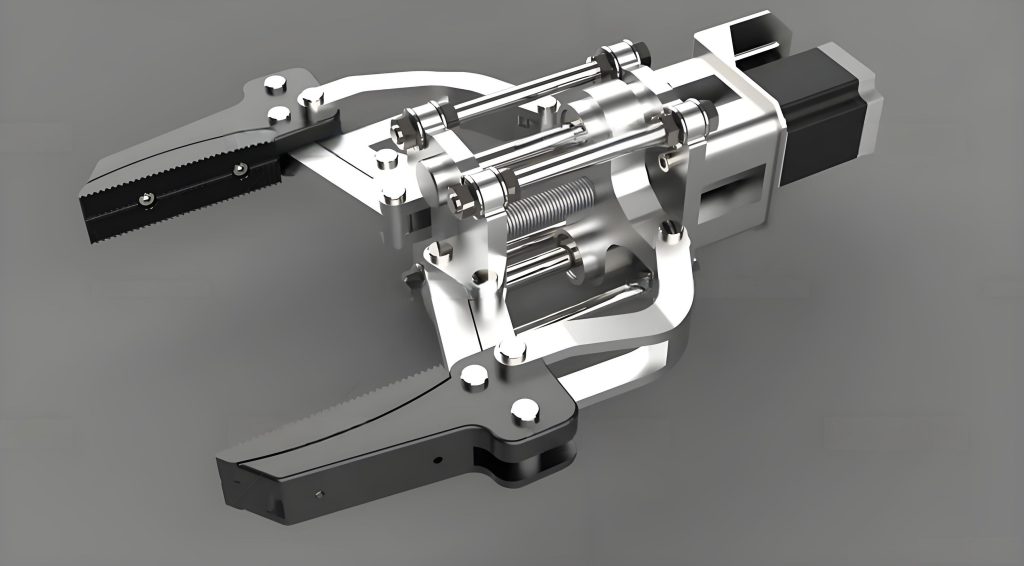
Material selection was the first step in the lightweight design strategy. The main frame and arms of the end effector were designed using 7075-T6 aluminum alloy, prized for its high strength-to-weight ratio. For critical high-stress components like the gripper jaws and pivot points, 42CrMo alloy steel was specified for its superior toughness and wear resistance. A preliminary Finite Element Analysis (FEA) was conducted on this initial design under the full 30 kg operational load. While the stresses (185 MPa) and deformations (0.42 mm) were within safe limits for the materials, the analysis revealed opportunities for mass reduction without compromising performance, providing a baseline for subsequent optimization.
The design process was formally framed as a multi-objective optimization (MOO) problem. The primary goals were to minimize the end effector‘s mass, maximize its unhooking success rate, and minimize the cycle time for a single unhooking operation. These objectives often conflict; for instance, adding material might improve stiffness and success rate but increases mass. This conflict is precisely what MOO addresses by finding a set of optimal trade-off solutions, known as the Pareto front. The optimization was mathematically defined as follows:
$$ \text{Minimize: } f_1(\mathbf{x}) = \text{Mass}(\mathbf{x}) $$
$$ \text{Maximize: } f_2(\mathbf{x}) = \text{SuccessRate}(\mathbf{x}) $$
$$ \text{Minimize: } f_3(\mathbf{x}) = \text{CycleTime}(\mathbf{x}) $$
$$ \text{Subject to: } g_1(\mathbf{x}) = \text{LoadCapacity}(\mathbf{x}) \geq 30 \text{ kg} $$
$$ g_2(\mathbf{x}) = -30^\circ\text{C} \leq \text{OpTemp}(\mathbf{x}) \leq 50^\circ\text{C} $$
$$ g_3(\mathbf{x}) = |\text{PositionError}(\mathbf{x})| \leq 5 \text{ mm} $$
Here, $\mathbf{x}$ represents the vector of design variables, which included geometric parameters (arm length, cross-sectional dimensions of beams, gripper geometry) and material property selections. To solve this MOO problem, the Non-dominated Sorting Genetic Algorithm II (NSGA-II) was implemented. NSGA-II is particularly effective for exploring complex design spaces and converging on a well-distributed Pareto frontier. The algorithm was configured with a population size of 100 and run for 500 generations. Constraint handling was managed using a penalty function method to steer the search toward feasible designs.
Before running the full optimization, a global sensitivity analysis using the Sobol method was performed to understand which design variables most significantly influenced each performance objective. This step is crucial for focusing the optimization effort on the most impactful parameters. The results are summarized in the table below:
| Design Parameter | Sensitivity to Success Rate | Sensitivity to Mass | Sensitivity to Cycle Time |
|---|---|---|---|
| Actuator Arm Length | 0.42 | 0.35 | 0.30 |
| Gripping Force | 0.38 | 0.05 | 0.25 | Main Material Density | 0.03 | 0.56 | 0.02 |
| Servo Motor Power | 0.10 | 0.02 | 0.45 |
| Beam Cross-Section | 0.05 | 0.32 | 0.08 |
The analysis clearly showed that the unhooking success rate was highly sensitive to the actuator’s reach (arm length) and the gripping force. The total mass was dominantly influenced by the density of the primary structural material, validating the initial choice of aluminum alloy. The cycle time was largely dependent on the servo motor’s power. These insights informed the optimization search, allowing for targeted adjustments. For example, the arm length was slightly increased from 800 mm to 850 mm to improve kinematic flexibility, while the gripper force was uprated.
Building upon the optimal design point selected from the Pareto frontier—which balanced a 15% target mass reduction with performance goals—a detailed structural topology optimization was performed. This process algorithmically removes material from areas of low stress, resulting in an organic, lightweight lattice-like structure for non-critical volumes of the end effector arms and mounting bracket. The final, refined CAD model was then subjected to a comprehensive suite of FEA simulations to verify its performance against all criteria.
A high-fidelity mesh with over 450,000 nodes was generated for the model. Static structural analysis under 30 kg load confirmed a maximum von Mises stress of 178 MPa (still safely below the 503 MPa yield strength of 7075-T6) and a reduced maximum deformation of 0.38 mm, indicating improved stiffness. Modal analysis found the first natural frequency to be 85 Hz, sufficiently high to avoid resonance with typical operational vibrations. Transient thermal analysis across the -30°C to 50°C range showed manageable thermal stresses. Finally, fatigue analysis predicted a service life exceeding 1 million cycles.
A functional prototype of the optimized end effector was manufactured using CNC machining for precision. The final assembly mass was 32 kg, representing a 28.9% reduction from the original 45 kg pre-optimization design concept. The prototype underwent rigorous laboratory testing, including load tests up to 40 kg, precision repeatability tests, and a marathon endurance run of 10,000 consecutive cycles. It successfully passed all laboratory benchmarks.
The ultimate validation occurred through a three-month field trial at an industrial site. The robotic system, equipped with the new end effector, performed over 15,000 unhooking operations on various wagon types. The performance data, compared against the original design targets and pre-optimization estimates, demonstrated the success of the project conclusively.
| Performance Metric | Pre-Optimization Baseline | Optimized End Effector (Field Result) | Improvement |
|---|---|---|---|
| Total Mass | 45 kg | 32 kg | 28.9% reduction |
| Unhooking Success Rate | 96.5% | 99.2% | 2.7 percentage points |
| Average Cycle Time | 12.3 s | 8.7 s | 29.3% reduction |
| Positioning Accuracy | ±7.0 mm | ±3.8 mm | 45.7% improvement |
| Energy per Cycle | 0.061 kWh | 0.050 kWh | 18.0% reduction |
The field data confirmed that the multi-objective optimization approach was highly effective. The redesigned end effector not only met but exceeded all key performance indicators. The significant mass reduction lowers the inertial loads on the robot arm, enabling faster and more precise movements while reducing energy consumption. The enhanced stiffness and optimized geometry directly contributed to the higher success rate and shorter cycle time. This project underscores the critical role of advanced design and simulation tools—like FEA and multi-objective genetic algorithms—in developing high-performance robotic components. The resulting end effector provides a robust, reliable, and efficient solution for automating railcar unhooking, forming a solid foundation for the wider adoption of fully automated wagon tippler systems. Future work will explore the integration of adaptive control algorithms and condition monitoring sensors directly into the end effector structure to further enhance its intelligence and operational robustness in unpredictable environments.