
The pursuit of high-ratio, high-precision, and compact power transmission solutions has been a enduring theme in mechanical engineering. Among the various solutions, the strain wave gear (also known as harmonic drive) has occupied a unique niche due to its exceptional qualities: high reduction ratios in a single stage, zero-backlash operation, high positional accuracy, and compact coaxial design. However, the conventional strain wave gear mechanism relies on the elastic deformation of a flexible spline, which inherently limits its torque capacity and power transmission capability due to material fatigue constraints in the flexspline. This fundamental limitation has spurred investigations into novel configurations that retain the core advantages of the strain wave gear principle while circumventing the fatigue-prone flexible element. One such promising avenue is the concept of a strain wave gear system utilizing oscillating teeth, specifically in an end-face engagement configuration. This design philosophy represents a significant architectural departure, aiming to unlock higher power densities for demanding applications in robotics, aerospace, industrial machinery, and heavy equipment where traditional strain wave gear units might be insufficient.
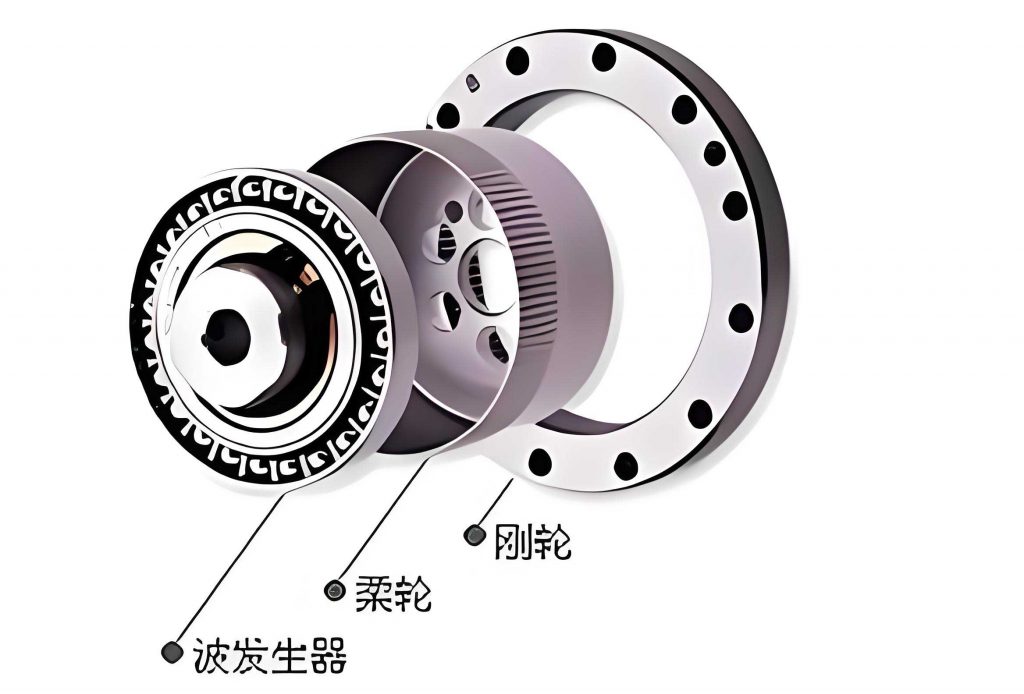
The core innovation of the oscillating-tooth end-face strain wave gear lies in replacing the continuously deforming flexspline with a set of discrete, rigid teeth that undergo controlled axial oscillations. This transformation shifts the working principle from elastic hysteresis to rigid-body kinematics, potentially eliminating the primary bottleneck of power density in conventional strain wave gear systems. The mechanism synthesizes the favorable kinematic characteristics of classical strain wave gearing with the robust force-transmission capabilities of positive-displacement mechanisms like cam-follower systems. Understanding the meshing theory governing this new class of strain wave gear is paramount for its design, optimization, and successful implementation. This article delves into the fundamental working principle, establishes the general mathematical framework for its meshing analysis, and derives specific tooth surface equations under the critical condition of constant instantaneous transmission ratio, thereby laying a theoretical foundation for this advanced strain wave gear variant.
Fundamental Operating Principle
The oscillating-tooth end-face strain wave gear transmission assembly comprises four primary components, as illustrated in the conceptual diagram. The system typically consists of a fixed end-face gear, a wave generator (input), a set of oscillating teeth, and a coaxially mounted槽轮 (often acting as the output element, here referred to as the “slot carrier” for clarity). Unlike a traditional strain wave gear where the wave generator deforms the flexspline, here the wave generator features a special end-face cam profile with a wave number \(U\). As the wave generator rotates, its cam profile acts upon the rear ends of the oscillating teeth. These teeth are housed in radial slots within the slot carrier, constraining them to move primarily in an axial direction relative to the main axis of the gearbox.
The kinematic sequence is as follows: The rotation of the wave generator’s cam displaces the oscillating teeth axially in a precise, periodic pattern. The front ends of these oscillating teeth are shaped to mesh with the static teeth of the end-face gear. The axial motion of each tooth, when combined with its position in the rotating slot carrier, causes it to engage and disengage with the fixed end-face gear in a sequential wave-like pattern—hence preserving the “strain wave” phasing concept, albeit with rigid components. The engagement (meshing-in) of a tooth with the end-face gear is driven by the positive push from the wave generator cam. Its disengagement (meshing-out) is typically facilitated by the reactive force from the opposing flank of the end-face gear tooth or by a return mechanism. The relative motion between the slot carrier (to which the teeth are mounted but can slide) and the fixed end-face gear results in a slow relative rotation between the wave generator (input) and the slot carrier (output), achieving a high reduction ratio. The reduction ratio \(i\) for this strain wave gear design is given by:
$$ i = \frac{\omega_{in}}{\omega_{out}} = \frac{Z_e}{Z_e – U} $$
where \(\omega_{in}\) is the input (wave generator) speed, \(\omega_{out}\) is the output (slot carrier) speed, \(Z_e\) is the number of teeth on the end-face gear, and \(U\) is the wave number of the generator cam. This formula is analogous to that of a classical strain wave gear, reinforcing its kinematic heritage.
General Meshing Theory and Problem Formulation
The meshing action in this oscillating-tooth strain wave gear involves two distinct conjugate pairs, forming a compound kinematic chain. This is a critical aspect of its analysis.
- Meshing Pair A: This is the driving pair between the wave generator cam surface (W) and the rear-end surface of the oscillating tooth. The contact here converts the rotational input into controlled axial oscillation.
- Meshing Pair B: This is the driven pair between the front-end surface of the oscillating tooth and the tooth surface of the fixed end-face gear (E). This pair is responsible for the speed reduction and torque multiplication.
The complete meshing theory for this strain wave gear can be distilled into two fundamental classes of synthesis problems, analogous to those in gear theory but applied to this specific chain.
| Problem Type | Known Surfaces | Target Surface | Purpose & Description |
|---|---|---|---|
| Synthesis Direct Problem | Pair A surfaces (W and tooth rear) are simple/specified. One surface of Pair B (tooth front OR gear E). | The conjugate surface in Pair B. | To determine the geometry of the end-face gear or oscillating tooth front profile based on a prescribed, easy-to-manufacture cam and tooth rear profile. It applies classical envelope theory to Pair B. |
| Synthesis Inverse Problem | Pair B surfaces (tooth front and gear E) are simple/specified. One surface of Pair A (W OR tooth rear). | The conjugate surface in Pair A. | To determine the required wave generator cam profile (or tooth rear profile) based on a desired, high-performance or easily produced geometry for the end-face meshing pair. This is often the design path for optimizing the strain wave gear’s performance. |
Solving these problems requires establishing coordinate systems for each component, defining their relative motions, and applying the fundamental law of gearing: at the point of contact between two conjugate surfaces, their relative velocity vector must be orthogonal to the common normal vector to the surfaces. Mathematically, for any meshing pair with surfaces \(\vec{r}_1\) and \(\vec{r}_2\):
$$ \vec{n} \cdot \vec{v}_{12} = 0 $$
where \(\vec{n}\) is the common unit normal vector and \(\vec{v}_{12}\) is the relative velocity of surface 1 with respect to surface 2 at the potential contact point.
Coordinate Systems and Derivation of Tooth Surfaces
To derive the tooth surface equations, we define right-handed coordinate systems rigidly attached to each component. For the analysis of Meshing Pair A (Wave Generator – Tooth Rear), we primarily need two systems:
- System \(S_1(O_1-x_1, y_1, z_1)\): Fixed to the wave generator. Origin \(O_1\) is on the cam’s axis. The \(z_1\)-axis coincides with the input axis, positive direction from the generator towards the end-face gear. The \(x_1\)-axis is defined along a reference radial line from the axis to a specific point on the cam profile (e.g., the trough of a wave).
- System \(S_2(O_2-x_2, y_2, z_2)\): Fixed to an individual oscillating tooth. In the initial assembly position, \(S_2\) coincides with \(S_1\). The tooth translates along \(z_1\) and may have a small permitted rotation \(\phi_0\).
A key design objective for a functional and efficient strain wave gear is to maintain a constant instantaneous velocity ratio. For this oscillating-tooth configuration, analysis shows this condition is satisfied when a specific relationship holds between the cam’s lead angle \(\theta\) and the end-face gear’s tooth semi-angle \(\alpha\):
$$ \tan \theta \cdot \tan \alpha = C \quad \text{(Constant)} $$
This condition couples the design of Meshing Pair A with the kinematics dictated by Meshing Pair B.
Tooth Surface of the Wave Generator Cam
For manufacturability and to produce a linear axial displacement of the oscillating tooth proportional to the generator’s rotation, the cam surface is chosen as a special type of ruled surface: an Archimedean spiral surface with its generating line perpendicular to the axis. This is a pragmatic and effective choice for this strain wave gear cam. A single-thread Archimedean spiral can be expressed parametrically as:
$$ x = u \cos \varphi, \quad y = u \sin \varphi, \quad z = p \varphi $$
where \(u\) is the radial distance from the axis, \(\varphi\) is the angular parameter, and \(p\) is the pitch constant (\(p = L / 2\pi\), with \(L\) being the lead).
For a wave generator with wave number \(U\), the cam profile consists of \(U\) rising and \(U\) falling spiral segments arranged circumferentially. To satisfy the condition for constant transmission ratio and uniform axial motion, the lead angle \(\theta\) at any radius \(r\) is designed to vary as:
$$ \tan \theta(r) = \frac{h U}{\pi r} $$
where \(h\) is the total axial stroke (cam height) of the oscillating tooth. This relationship leads to the specific cam surface equations.
Let \(R_1\) and \(R_2\) be the inner and outer radii of the cam (matching the gear’s radial span), and \(\psi_W = \pi / U\) be the angular half-period of the cam wave. The equation for a rising (right-handed) segment of the wave generator cam surface in \(S_1\) is:
$$
\begin{aligned}
x_1 &= r \cos \phi_W \\
y_1 &= r \sin \phi_W \\
z_1 &= \frac{h U}{\pi} (\phi_W – 2n \psi_W)
\end{aligned}
$$
for \(n = 0, 1, …, U-1\), \(R_1 \leq r \leq R_2\), and \(0 \leq \phi_W – 2n\psi_W \leq \psi_W\), where \(\phi_W\) is the rotational angle of the wave generator.
The equation for the adjacent falling (left-handed) segment is:
$$
\begin{aligned}
x_1 &= r \cos \phi_W \\
y_1 &= r \sin \phi_W \\
z_1 &= \frac{h U}{\pi} (2n \psi_W – \phi_W)
\end{aligned}
$$
for \(n = 1, 2, …, U\), \(R_1 \leq r \leq R_2\), and \(0 \leq 2n\psi_W – \phi_W \leq \psi_W\).
Tooth Surface of the Oscillating Tooth Rear
The conjugate surface for a spiral surface, when the relative motion is a combination of rotation and proportional translation along the spiral’s axis, is another identical spiral surface. This is a known property: a spiral surface rotating about its axis while simultaneously translating along it with a fixed pitch generates itself as its own envelope. Therefore, the rear surface of the oscillating tooth that maintains continuous line contact with the wave generator cam is a segment of the same Archimedean spiral.
In the tooth’s coordinate system \(S_2\), and letting \(\psi_0 = \pi / Z_0\) (where \(Z_0\) is related to the tooth’s angular span), the rear surface conjugating to the cam’s rising segment is:
$$
\begin{aligned}
x_2 &= r \cos \phi_0 \\
y_2 &= r \sin \phi_0 \\
z_2 &= \frac{h U}{\pi} \phi_0
\end{aligned}
$$
for \(R_1 \leq r \leq R_2\) and \(0 \leq \phi_0 \leq \psi_0\), where \(\phi_0\) is a parameter representing the tooth’s angular orientation within its slot.
The surface conjugating to the cam’s falling segment is:
$$
\begin{aligned}
x_2 &= r \cos \phi_0 \\
y_2 &= r \sin \phi_0 \\
z_2 &= \frac{h U}{\pi} (2\psi_0 – \phi_0)
\end{aligned}
$$
for \(R_1 \leq r \leq R_2\) and \(0 \leq 2\psi_0 – \phi_0 \leq \psi_0\). This completes the definition of Meshing Pair A for this specific, optimized strain wave gear design.
Kinematic Analysis of the Oscillating Tooth
The axial motion of the oscillating tooth is central to the function of this strain wave gear. Given the cam surface equations, we can derive the explicit axial displacement \(s\) of a tooth as a function of the wave generator’s angle \(\phi_W\). For a tooth located at a fixed angular position \(\beta\) relative to the wave generator’s reference, the engagement is periodic. Over one wave period (\(2\psi_W\)), the axial motion is piecewise linear with rotation, creating a quasi-sawtooth waveform. The axial velocity and acceleration are crucial for dynamic analysis and force calculations.
The axial displacement \(s(\phi_W)\) for a tooth engaging with a single rising flank can be approximated from the cam equation:
$$ s(\phi_W) = \frac{h U}{\pi} (\phi_W – \phi_{W,start}) $$
where \(\phi_{W,start}\) is the angle at which engagement begins. The axial velocity \(v_z\) and acceleration \(a_z\) are then:
$$ v_z = \frac{ds}{dt} = \frac{h U}{\pi} \omega_W, \quad a_z = 0 $$
during the rising phase, assuming constant input speed \(\omega_W\). During the transition between rising and falling flanks, a sudden reversal of acceleration occurs, which must be managed through profile blending (e.g., using cycloidal or polynomial modifications) to minimize shock and vibration in the strain wave gear assembly.
| Parameter | Symbol | Influence on Performance | Typical Design Consideration |
|---|---|---|---|
| Wave Number | \(U\) | Determines reduction ratio, number of simultaneously engaged teeth, and cam complexity. Higher \(U\) increases load sharing but complicates cam machining. | Chosen based on required ratio \(i\) and size constraints. Common values are 2, 3, or 4, similar to traditional strain wave gears. |
| End-Face Gear Teeth | \(Z_e\) | Directly sets the reduction ratio \(i = Z_e/(Z_e-U)\). More teeth allow higher ratios but require finer pitch. | Selected to achieve target ratio. Difference \(Z_e – U\) is typically small (e.g., 1, 2, or 4) for high ratios. |
| Tooth Axial Stroke | \(h\) | Affects the size of the cam profile, tooth bending stress, and overall axial length of the assembly. Larger \(h\) increases potential torque via longer lever arm but also increases sliding velocity and inertia. | Optimized based on torque requirement, contact stress analysis, and space constraints. |
| Cam Lead Angle | \(\theta(r)\) | Governs the force transmission efficiency and self-locking tendency. Steeper angles increase axial force component for a given torque. | Designed according to \(\tan\theta = hU/(\pi r)\) to ensure constant transmission ratio. Pressure angle must be checked to avoid jamming. |
| Number of Oscillating Teeth | \(N\) | Determines load distribution and smoothness of operation. More teeth reduce load per tooth and output torque ripple. | Often a multiple of the wave number \(U\) to ensure symmetry and balanced forces. Limited by slot carrier geometry and tooth size. |
Design and Analysis Considerations
The transition from principle to a practical, high-performance oscillating-tooth strain wave gear requires addressing several key engineering analyses beyond basic meshing theory.
Force Analysis and Contact Stresses: In Meshing Pair A (cam-tooth), the contact is typically a line contact between two conjugate spiral surfaces. The normal force \(F_n\) can be resolved into axial (\(F_a\)) and tangential (\(F_t\)) components relative to the tooth. The axial component is balanced by the reaction from the end-face gear mesh, while the tangential component creates a moment on the tooth, which is reacted by the walls of its slot in the carrier. Contact stress in Pair A can be analyzed using Hertzian theory for parallel cylinders. For Pair B (tooth front to end-face gear), the contact is similar to a spur gear mesh but with added sliding due to the axial motion. The contact stress here is often the limiting factor for torque capacity and must be carefully calculated using gear contact stress formulas (e.g., AGMA standards) with appropriate modifications for the sliding action. Lubrication in this strain wave gear is critical, especially for Pair B, which may require grease or oil bath lubrication to manage the combined rolling and sliding wear.
Structural Analysis and Finite Element Modeling (FEM): While the oscillating tooth design eliminates flexspline fatigue, new stress concentrations arise. Critical areas include:
- The root of the oscillating tooth where it experiences bending from the meshing forces.
- The cam surface of the wave generator under high contact pressure.
- The slots in the carrier that experience bearing stress from the oscillating teeth.
Finite Element Analysis is indispensable for optimizing these components, ensuring sufficient fatigue life under cyclic loading, which remains a concern even in this “rigid” strain wave gear variant.
Efficiency and Loss Mechanisms: The overall efficiency of this strain wave gear is influenced by several loss sources: sliding friction in Meshing Pair A and Pair B, bearing friction in the tooth slots, churning losses from lubricant, and sealing friction. A detailed efficiency model would sum these losses:
$$ \eta_{total} = 1 – \sum (P_{loss,A} + P_{loss,B} + P_{loss,bearing} + P_{loss,churn}) / P_{in} $$
Compared to a traditional strain wave gear, the absence of hysteresis losses from the flexspline could be a significant advantage, but sliding friction losses may be higher. Material selection (e.g., hardened tool steel for cams and teeth, bronze or composite for low-friction slots) and surface treatments (e.g., nitriding, DLC coating) are vital for maximizing efficiency.
Advantages, Applications, and Future Development
The oscillating-tooth end-face configuration offers a compelling set of advantages that position it as a viable high-power alternative to conventional strain wave gear technology.
| Feature | Traditional Strain Wave Gear | Oscillating-Tooth End-Face Strain Wave Gear |
|---|---|---|
| Torque/Power Density | Limited by flexspline fatigue stress. | Potentially much higher, limited by contact/bending stress in rigid components. |
| Primary Failure Mode | Fatigue crack in flexspline cup. | Wear of contact surfaces (cam, teeth), tooth bending fatigue. |
| Backlash | Can achieve near-zero backlash. | Requires precise fitting; potential for backlash exists but can be minimized. |
| Stiffness | High torsional stiffness, but radial stiffness of flexspline can be lower. | Expected high torsional and radial stiffness due to rigid construction. |
| Manufacturing Complexity | High-precision flexspline and wave generator bearing. | High-precision cam and multiple oscillating teeth; potentially simpler component geometries. |
| Lubrication & Life | Grease lubrication; life determined by flexspline cycles. | May require more robust lubrication; life determined by surface wear and contact fatigue. |
Potential Applications: This robust strain wave gear design is particularly suited for applications demanding high torque and shock load resistance where traditional strain wave gears might be marginal.
- Robotics: High-payload industrial manipulators, robotic joints in construction or logistics.
- Aerospace: Actuators for control surfaces, landing gear mechanisms, where high reliability and power density are critical.
- Industrial Machinery: High-torque indexers, rotary tables in machine tools, heavy-duty conveyor drives.
- Energy: Drives for solar tracker systems, pitch control mechanisms in wind turbines.
Future Research Directions: To mature this technology, research should focus on:
- Advanced Tooth Profile Synthesis: Exploring non-Archimedean cam profiles (e.g., optimized polynomial curves) to minimize contact stress, improve load distribution, and reduce peak accelerations of the oscillating teeth.
- Dynamic Modeling and Vibration Control: Developing comprehensive multi-body dynamic models to predict and mitigate vibrations caused by the periodic reversal of tooth acceleration, which is crucial for high-speed operation of the strain wave gear.
- Thermal Management: Analyzing heat generation from sliding contacts and developing efficient cooling strategies for continuous high-power operation.
- Integrated Design and Topology Optimization: Using generative design and topology optimization tools to minimize the weight of the wave generator, slot carrier, and oscillating teeth while maintaining stiffness, further improving the power-to-weight ratio of the strain wave gear assembly.
- Prototype Testing and Validation: Building and testing physical prototypes under various load and speed conditions to validate theoretical models, measure actual efficiency, and quantify lifetime wear characteristics.
Conclusion
The oscillating-tooth end-face strain wave gear represents a significant conceptual evolution in the field of high-ratio precision gearing. By replacing the elastic deformation mechanism of a conventional strain wave gear with a system of rigid, axially oscillating teeth, it aims to transcend the inherent power density limitations associated with flexspline fatigue. The meshing theory for this novel strain wave gear configuration can be systematically addressed through two fundamental classes of synthesis problems—direct and inverse—applied to its two conjugate pairs. Under the essential condition for constant instantaneous transmission ratio (\(\tan\theta\tan\alpha = C\)), the wave generator cam and the conjugate rear surface of the oscillating tooth can be effectively realized as segments of a multi-start Archimedean spiral surface, providing a clear path for design and manufacturing. While this specific solution offers practicality, the framework allows for the exploration of more sophisticated, optimized profiles. Successful realization of this strain wave gear technology hinges on rigorous analysis of contact mechanics, structural integrity, dynamic behavior, and efficiency. With continued development, the oscillating-tooth strain wave gear has the potential to expand the application horizon of strain wave gear principles into domains requiring unprecedented levels of torque and power within a compact, precision package, thereby opening new frontiers in advanced mechanical power transmission.