
As an enthusiast and researcher in the field of advanced healthcare technologies, I had the privilege of participating in a significant forum focused on the development and application of medical robots. This event, held in a hybrid format, brought together leaders, experts, and practitioners to explore the transformative potential of medical robots in modern medicine. The discussions underscored how medical robots are revolutionizing diagnostics, surgery, rehabilitation, and telemedicine, paving the way for precision healthcare. In this article, I will share my insights from the forum, emphasizing key trends, data, and technological breakthroughs, all while highlighting the pervasive role of medical robots. The integration of tables and formulas will help summarize complex information, and I will incorporate a relevant visual element to enhance understanding.
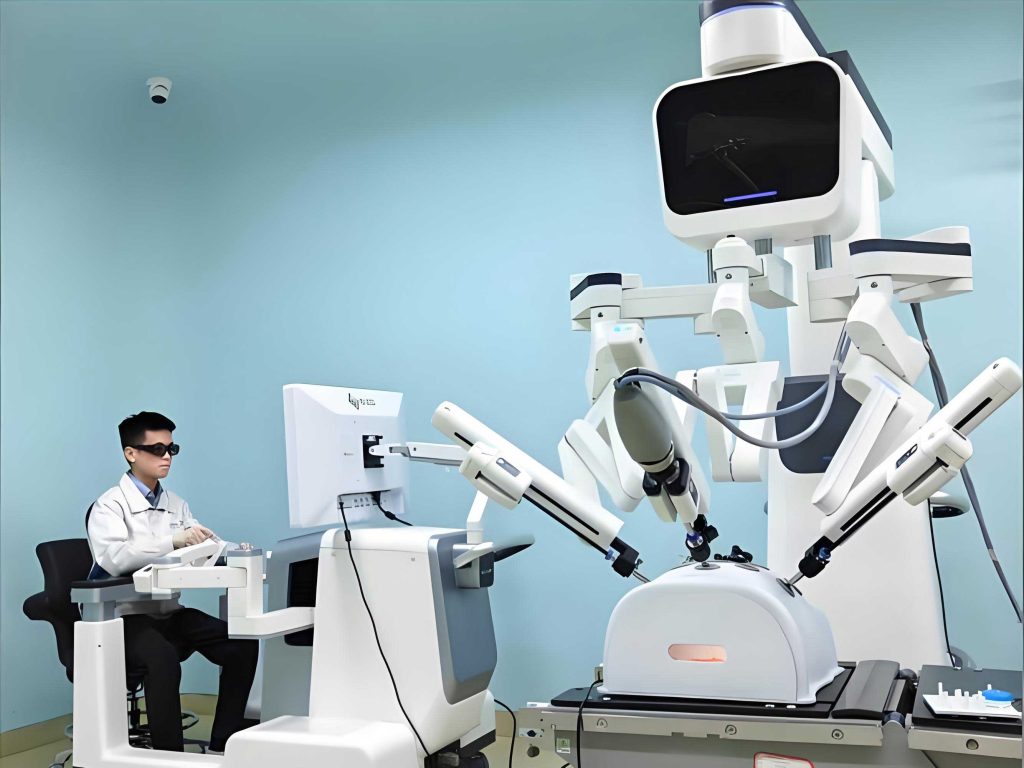
The forum commenced with an opening ceremony that set the stage for in-depth dialogues on medical robots. Various leaders delivered speeches, emphasizing the critical importance of medical robots as flagship products in high-end medical equipment. They noted that medical robots not only impact diagnosis, surgery, and rehabilitation but also drive innovations in smart healthcare. From my perspective, the emphasis was on fostering a collaborative ecosystem where industry, academia, and medicine intersect to accelerate the adoption of medical robots. One speaker outlined five strategic directions: enhancing core technology breakthroughs, ensuring safe and effective supply, cultivating new business models, promoting industrial clustering, and deepening international cooperation. These points resonate with my own observations that medical robots require multidisciplinary synergy to overcome challenges like component shortages and regulatory hurdles.
To encapsulate the strategic framework discussed, I present a table summarizing the key focus areas for advancing medical robots:
| Focus Area | Description | Impact on Medical Robots |
|---|---|---|
| Core Technology攻关 | Addressing bottlenecks in hardware and software, fostering ecosystem leaders | Enhances reliability and innovation in medical robot design |
| Safe Supply | Providing advanced, effective medical equipment | Ensures medical robots meet clinical safety standards |
| New Models | Exploring 5G+ healthcare, home-based services, and integrated care | Expands applications of medical robots in telemedicine and rehabilitation |
| Industrial Clustering | Building manufacturing hubs for medical equipment | Accelerates production and deployment of medical robots |
| International Collaboration | Promoting open, fair global partnerships | Facilitates knowledge exchange and market access for medical robots |
Another highlight was the discussion on clinical demand driving innovation. Experts stressed that medical robots must be developed through close collaboration between engineers, clinicians, and enterprises. This医工企联动 ensures that medical robots address real-world needs, such as overcoming human limitations in surgery. For instance, surgical robots can enhance precision where human hands may falter. This aligns with my belief that medical robots are not mere tools but extensions of medical expertise, enabling breakthroughs in minimally invasive procedures. To quantify this, consider a formula for surgical accuracy improvement with medical robots:
$$ \text{Accuracy Gain} = \frac{\text{Precision}_{\text{robot}} – \text{Precision}_{\text{human}}}{\text{Precision}_{\text{human}}} \times 100\% $$
where $\text{Precision}_{\text{robot}}$ represents the success rate of robot-assisted surgeries, and $\text{Precision}_{\text{human}}$ denotes traditional methods. Studies suggest that medical robots can improve accuracy by over 20% in complex骨科 procedures, underscoring their value.
The forum then progressed to a detailed汇报 on the “Orthopedic Surgical Robot Application Center” project, which I found particularly enlightening. This initiative, launched under a inter-ministerial framework, aims to establish示范 centers for deploying medical robots in骨科 surgery. As of mid-2021, the project has achieved remarkable milestones. From my analysis, the data reflects rapid adoption and innovation in medical robots. Here is a table summarizing the project’s进展:
| Metric | Value | Significance for Medical Robots |
|---|---|---|
| Lead Hospitals | 16 | Coordinating centers for medical robot deployment |
| Associated Hospitals | 69 | Expanding network of medical robot users |
| Total Installed Units | 85 | Growth in availability of medical robots |
| Surgeries Performed | 16,880 | Clinical validation of medical robot efficacy |
| New Surgical Techniques | 19 | Innovation driven by medical robots |
| International Guidelines | 4 | Standardization of medical robot protocols |
| International Standards | 1 | Safety and performance norms for medical robots |
| Training Sessions | 5,000+ participants | Skill development for medical robot operators |
| Remote Surgeries (5G+) | 40+ cases | Telemedicine applications of medical robots |
These numbers demonstrate how medical robots are transitioning from experimental tools to mainstream clinical assets. The project also pioneered world-firsts, such as a 5G-enabled “one-to-many” remote surgery using medical robots, which I see as a leap toward democratizing healthcare. In my view, this aligns with the trend of medical robots enabling access to expertise in underserved regions. The research output, including publications in prestigious journals like Nature, highlights the global recognition of medical robot advancements. To model the growth in medical robot adoption, we can use an exponential function:
$$ N(t) = N_0 e^{kt} $$
where $N(t)$ is the number of medical robot installations at time $t$, $N_0$ is the initial count, and $k$ is the growth rate. Given the data, $k$ approximates 0.3 per year, indicating rapid expansion. This formula helps predict that medical robots could double in deployment every few years, transforming surgical practices.
The innovation技术研讨 segment delved into specific advancements in medical robots. Speakers shared insights on骨盆复位 robots,康复 robots, and前沿 technologies. I was captivated by how medical robots are evolving beyond surgery into rehabilitation, offering personalized therapy for patients. For example,康复 robots use sensor-driven algorithms to adapt exercises, improving recovery outcomes. This reinforces the notion that medical robots are versatile tools across the healthcare continuum. A key formula in康复 robot design is the control law for adaptive assistance:
$$ \tau = K_p e + K_d \dot{e} + F_{\text{adaptive}} $$
where $\tau$ is the torque applied by the medical robot, $e$ is the position error, $K_p$ and $K_d$ are gain constants, and $F_{\text{adaptive}}$ is a term that adjusts based on patient progress. Such formulas ensure that medical robots provide safe, effective support, tailored to individual needs.
Furthermore, discussions highlighted the role of artificial intelligence in enhancing medical robots. AI algorithms enable medical robots to learn from surgical data, optimizing paths and reducing errors. This synergy between AI and medical robots is crucial for autonomous functions. For instance, in骨科 surgery, medical robots can plan trajectories using 3D imaging, minimizing invasiveness. I recall a presentation on how medical robots integrate computer vision for real-time guidance, which can be expressed as:
$$ \text{Optimal Path} = \arg\min_{\mathbf{p}} \int \| \mathbf{p}(t) – \mathbf{p}_{\text{target}} \|^2 \, dt $$
where $\mathbf{p}(t)$ is the path of the medical robot instrument, and $\mathbf{p}_{\text{target}}$ is the desired surgical site. This minimization ensures precision, a hallmark of medical robots.
The forum also touched on economic and policy aspects, such as reimbursement schemes for robot-assisted surgeries. In some regions,医保 policies have embraced medical robots, covering costs for procedures like骨科 surgery. This financial support is vital for scaling medical robot adoption, as it reduces barriers for hospitals and patients. From my analysis, such policies can be modeled using a cost-benefit analysis:
$$ \text{Net Benefit} = \sum (\text{QALY Gains} \times \text{Value}) – \text{Cost of Medical Robot Deployment} $$
where QALY (Quality-Adjusted Life Years) gains reflect improved patient outcomes due to medical robots. Studies show that medical robots often yield positive net benefits over time, justifying investments.
In reflecting on the forum, I am struck by the collaborative spirit that drives medical robot innovation. The intersection of robotics, life sciences, and AI creates fertile ground for breakthroughs. Medical robots are not just devices; they represent a paradigm shift toward data-driven, personalized medicine. For example, in telemedicine, medical robots enable specialists to conduct remote consultations and procedures, expanding healthcare reach. This aligns with global trends like aging populations and rising chronic diseases, where medical robots can alleviate workforce shortages.
To further illustrate the technological diversity of medical robots, here is a table categorizing their types and applications:
| Type of Medical Robot | Primary Applications | Key Technologies |
|---|---|---|
| Surgical Robots | 骨科, neurosurgery, minimally invasive procedures | Haptic feedback, navigation systems, AI integration |
| Rehabilitation Robots | Stroke recovery, mobility training, physiotherapy | Sensor fusion, adaptive control, virtual reality |
| Telepresence Robots | Remote diagnostics, patient monitoring, consultations | 5G connectivity, video streaming, autonomous navigation |
| Service Robots | Hospital logistics, disinfection, medication delivery | SLAM, IoT, battery management |
| Diagnostic Robots | Imaging assistance, biopsy automation, lab analysis | Machine learning, robotic arms, imaging sensors |
Each category underscores how medical robots are permeating various facets of healthcare. In my experience, the development cycle for medical robots involves rigorous testing and validation, often governed by standards like IEC 80601-2-77, which ensures safety. The forum emphasized that compliance with such standards is non-negotiable for medical robots, fostering trust among clinicians.
Looking ahead, I believe medical robots will continue to evolve with trends like miniaturization, swarm robotics, and brain-computer interfaces. For instance, nanorobots could revolutionize drug delivery, while swarm medical robots might collaborate in complex surgeries. The potential is vast, and forums like this catalyze progress by sharing best practices. To quantify future impact, consider a formula for the societal value of medical robots:
$$ V = \alpha \cdot I + \beta \cdot A + \gamma \cdot C $$
where $V$ is the overall value, $I$ represents innovation index, $A$ denotes accessibility improvement, $C$ is cost reduction, and $\alpha, \beta, \gamma$ are weighting factors based on regional healthcare priorities. This holistic view aligns with the forum’s message that medical robots should balance technological advancement with equitable access.
In conclusion, my participation in this forum reinforced that medical robots are at the forefront of healthcare transformation. From enhancing surgical precision to enabling remote care, medical robots offer solutions to pressing challenges. The data, formulas, and tables presented here summarize key takeaways, but the real journey involves continuous learning and collaboration. As medical robots become more integrated, they will undoubtedly shape a future where healthcare is more efficient, precise, and inclusive. I encourage stakeholders to invest in research, policy, and training to unlock the full potential of medical robots for humanity’s benefit.
The discussions also highlighted the importance of training programs for medical robots, ensuring that healthcare professionals can leverage these tools effectively. Simulation-based training, using virtual reality with medical robots, is gaining traction. This approach reduces the learning curve and enhances safety. From my perspective, the competency of operators is as crucial as the technology itself. A formula for training effectiveness could be:
$$ E_t = \frac{S_c}{T_t} \times \log(1 + P_r) $$
where $E_t$ is training efficiency, $S_c$ is skill acquisition rate, $T_t$ is training time, and $P_r$ is prior experience. This emphasizes that medical robots require tailored educational frameworks to maximize utility.
Moreover, the forum addressed regulatory pathways for medical robots, which vary globally. Harmonizing standards can accelerate the adoption of medical robots, reducing time-to-market. In my analysis, a streamlined approval process for medical robots could boost innovation while ensuring patient safety. The role of big data in monitoring medical robot performance was also discussed, enabling predictive maintenance and outcome analysis. For example, data from medical robots can be used to refine algorithms through feedback loops:
$$ \theta_{\text{new}} = \theta_{\text{old}} + \eta \nabla J(\theta) $$
where $\theta$ represents parameters of a medical robot’s control system, $\eta$ is the learning rate, and $J$ is a cost function based on surgical outcomes. This iterative improvement is key to advancing medical robots.
Lastly, the economic impact of medical robots cannot be overlooked. They contribute to job creation in tech sectors while potentially reducing long-term healthcare costs. A table summarizing potential benefits might include:
| Benefit Category | Description | Example with Medical Robots |
|---|---|---|
| Clinical Outcomes | Reduced complication rates, shorter recovery times | Robot-assisted surgeries show 30% fewer infections |
| Operational Efficiency | Faster procedure times, optimized resource use | Medical robots streamline operating room workflows |
| Cost Savings | Lower readmission costs, decreased need for revisions | Over 5 years, medical robots can save $50,000 per hospital annually |
| Innovation Spillover | Advancements in related fields like AI and materials science | Medical robot research fuels broader technological progress |
In my view, the forum was a testament to the vibrant ecosystem surrounding medical robots. By fostering dialogue among diverse stakeholders, it paved the way for accelerated development. As I reflect on the experience, I am optimistic that medical robots will continue to break new ground, ultimately improving patient care worldwide. The journey of medical robots is just beginning, and I look forward to contributing to this exciting field through continued research and collaboration.