
In the field of precision mechanical transmission, the planetary roller screw mechanism stands out as a critical component for converting rotary motion into linear motion with high efficiency, accuracy, and load capacity. Among its variants, the recirculating planetary roller screw mechanism, often abbreviated as RPRSM, presents unique structural features that merit in-depth analysis. This paper aims to comprehensively explore the meshing theory and contact characteristics of the recirculating planetary roller screw mechanism. I will establish mathematical models for the helical raceway surfaces, derive the meshing conditions, calculate the principal curvatures, and analyze the contact behavior using Hertzian theory. The influence of key parameters such as flank angle and pitch on meshing position, axial clearance, and contact stress will be investigated. Throughout this study, I emphasize the importance of understanding the planetary roller screw mechanism for optimal design in applications like aerospace, robotics, and high-precision machinery.
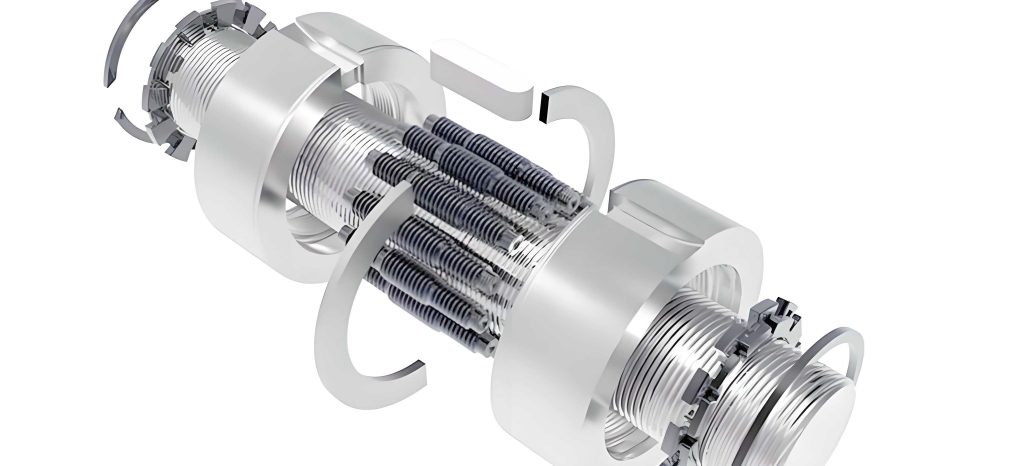
The recirculating planetary roller screw mechanism is a specialized type of planetary roller screw mechanism where the rollers feature a grooved structure without a helix angle. This design enables smaller leads, higher precision, and more meshing points compared to standard planetary roller screw mechanisms. In this work, I focus on the spatial meshing model of the recirculating planetary roller screw mechanism. I begin by describing the components: the screw, rollers, nut, cage, and cam ring. The screw and nut are typically multi-start threads with triangular profiles, while the rollers have annular grooves with circular arcs in cross-section. The cage ensures uniform distribution of rollers, and the cam ring facilitates recirculation. The fundamental relationship for nominal radii in a planetary roller screw mechanism is given by: $$2r_n^N = r_n^S + r_n^R$$ where $r_n^S$, $r_n^R$, and $r_n^N$ are the nominal radii of the screw, roller, and nut, respectively. For the recirculating planetary roller screw mechanism, the roller has no helix angle, so its lead $L_R = 0$, while the screw and nut leads relate to their nominal radii and helix angles: $$L_S = 2\pi r_n^S \tan \lambda_S, \quad L_N = 2\pi r_n^N \tan \lambda_N$$ with $\lambda_R = 0$.
To analyze the meshing behavior, I establish coordinate systems: a global coordinate system $O-xyz$ fixed in space, and local coordinate systems attached to the screw $O_S-x_S y_S z_S$, roller $O_R-x_R y_R z_R$, and nut $O_N-x_N y_N z_N$, each with the $z$-axis aligned with the component’s axis. The helical surfaces of the screw, roller, and nut are defined in the global system. For the screw and nut, the upper and lower helical surfaces $\Pi_i^T$ and $\Pi_i^B$ (where $i = S, N$) are represented parametrically. In the cross-section coordinate system $O_i’-u_i v_i w_i$, the tooth profiles are defined. For the screw and nut, the profile is triangular, while for the roller, it is circular. The parametric equations for the screw helical surface are: $$\mathbf{r}_S^{T/B} = \begin{bmatrix} (u_S + r_n^S) \cos \theta_S \\ (u_S + r_n^S) \sin \theta_S \\ \xi (c_S – u_S \tan \beta_S) + L_S \theta_S / (2\pi) \end{bmatrix}$$ where $u_S$ is the radial parameter, $\theta_S$ is the angular parameter, $\xi = 1$ for the upper surface and $\xi = -1$ for the lower surface, $c_S$ is the half-tooth thickness, and $\beta_S$ is the flank angle. Similarly, for the roller with a circular profile of radius $r_{PR}$ and center $(u_{PR}, w_{PR})$: $$\mathbf{r}_R^{T/B} = \begin{bmatrix} (u_R + r_n^R) \cos \theta_R \\ (u_R + r_n^R) \sin \theta_R \\ w_{PR} + \xi \sqrt{r_{PR}^2 – (u_R – u_{PR})^2} \end{bmatrix}$$ where $u_{PR} = -r_{PR} \sin \beta_R$, $w_{PR} = r_{PR} \cos \beta_R – c_R + u_R \tan \beta_R$. For the nut: $$\mathbf{r}_N^{T/B} = \begin{bmatrix} (u_N + r_n^N) \cos \theta_N \\ (u_N + r_n^N) \sin \theta_N \\ \xi (c_N + u_N \tan \beta_N) + L_N \theta_N / (2\pi) \end{bmatrix}$$ These equations form the basis for meshing analysis in the planetary roller screw mechanism.
The meshing theory for the recirculating planetary roller screw mechanism relies on the tangency condition between contacting surfaces. Consider two helical surfaces $\Pi_m$ and $\Pi_n$ in contact. At the meshing point, their position vectors and normal vectors coincide. If $\Pi_m$ moves axially by $\delta_{mn}$ to contact $\Pi_n$, the conditions are: $$\mathbf{r}_n(u_n, \theta_n) = \mathbf{r}_m(u_m, \theta_m) + \mathbf{d}_{mn}, \quad \mathbf{n}_m(x_m, y_m, z_m) = \xi_{mn} \mathbf{n}_n(x_n, y_n, z_n)$$ where $\mathbf{d}_{mn} = [0, 0, \delta_{mn}]^T$ and $\xi_{mn}$ is a constant. This leads to four equations with unknowns $u_m, \theta_m, u_n, \theta_n$: $$f_t(u_m, \theta_m, u_n, \theta_n) = 0, \quad t = 1,2,3,4$$ Solving these yields the meshing point coordinates and axial clearance $\delta_{mn}$, which can be positive (clearance), zero (contact), or negative (interference).
For the screw-roller interface, let the meshing point projection on the $xOy$ plane be $p_{SR}$. Define the meshing triangle $\triangle O_S p_{SR} O_R$ with sides: screw meshing radius $r_{CS}$, roller meshing radius on the screw side $r_{CR}^S$, and the sum of nominal radii $r_n^S + r_n^R$. The meshing angles are $\phi_{CS}$ and $\phi_{CR}^S$. From the tangency condition between the screw upper surface $\Pi_S^T$ and roller lower surface $\Pi_R^B$, the meshing equations are: $$\begin{aligned} r_{CS} \sin \phi_{CS} &= r_{CR}^S \sin \phi_{CR}^S \\ r_{CS} \cos \phi_{CS} + r_{CR}^S \cos \phi_{CR}^S &= r_n^S + r_n^R \\ \sin \phi_{CS} \tan \lambda_{CS} + \cos \phi_{CS} \tan \beta_S &= \cos \phi_{CR}^S \tan \beta_{CR}^S \\ \cos \phi_{CS} \tan \beta_S – \sin \phi_{CS} \tan \lambda_{CS} &= -\sin \phi_{CR}^S \tan \beta_{CR}^S \end{aligned}$$ where $\lambda_{CS} = \arctan(L_S / (2\pi r_{CS}))$ and $\beta_{CR}^S = \arctan\left( \frac{r_n^R – r_{PR} \sin \beta_R}{\sqrt{r_{PR}^2 – (r_{CR}^S – r_{PR} \sin \beta_R)^2}} \right)$. The axial clearance for this pair is: $$\delta_{SRT} = \frac{P_{SR}}{2} – (c_S + c_R) + \Delta_{SRT}$$ with $$\Delta_{SRT} = r_{PR} \cos \beta_R – (r_{CS} – r_n^S) \tan \beta_S – \sqrt{r_{PR}^2 – (r_{CR}^S – r_{PR} \sin \beta_R)^2} + \frac{L_S \phi_{CS}}{2\pi}$$ Similarly, for the roller-nut interface between roller upper surface $\Pi_R^T$ and nut lower surface $\Pi_N^B$, the meshing equations are: $$\begin{aligned} r_{CN} \sin \phi_{CN} &= r_{CR}^N \sin \phi_{CR}^N \\ r_{CN} \cos \phi_{CN} + r_{CR}^N \cos \phi_{CR}^N &= r_n^S + r_n^R \\ \sin \phi_{CN} \tan \lambda_{CN} + \cos \phi_{CN} \tan \beta_N &= \cos \phi_{CR}^N \tan \beta_{CR}^N \\ \sin \phi_{CN} \tan \beta_N – \cos \phi_{CN} \tan \lambda_{CN} &= \sin \phi_{CR}^N \tan \beta_{CR}^N \end{aligned}$$ where $\lambda_{CN} = \arctan(L_N / (2\pi r_{CN}))$ and $\beta_{CR}^N$ is defined analogously. The axial clearance is: $$\delta_{NRT} = \frac{P_{NR}}{2} – (c_R + c_N) + \Delta_{NRT}$$ with $$\Delta_{NRT} = r_{PR} \cos \beta_R – (r_{CN} – r_n^N) \tan \beta_N – \sqrt{r_{PR}^2 – (r_{CR}^N – r_{PR} \sin \beta_R)^2} + \frac{L_N \phi_{CN}}{2\pi}$$ Note that if $\beta_R = \beta_N$, the roller-nut meshing point lies at the tangent point of their pitch diameters, a property shared by standard planetary roller screw mechanisms.
To evaluate contact characteristics, I compute the principal curvatures at the meshing points using differential geometry. For a helical surface $\mathbf{r}_i^{T/B}(u_i, \theta_i)$, the first fundamental form coefficients are: $$E_i = \mathbf{r}_{i_u} \cdot \mathbf{r}_{i_u}, \quad F_i = \mathbf{r}_{i_u} \cdot \mathbf{r}_{i_\theta}, \quad G_i = \mathbf{r}_{i_\theta} \cdot \mathbf{r}_{i_\theta}$$ and the second fundamental form coefficients: $$L_i = \mathbf{r}_{i_{uu}} \cdot \mathbf{n}_i^u, \quad M_i = \mathbf{r}_{i_{u\theta}} \cdot \mathbf{n}_i^u, \quad N_i = \mathbf{r}_{i_{\theta\theta}} \cdot \mathbf{n}_i^u$$ where $\mathbf{n}_i^u$ is the unit normal vector. The Gaussian curvature $K_i$ and mean curvature $H_i$ are: $$K_i = \frac{L_i N_i – M_i^2}{E_i G_i – F_i^2}, \quad H_i = \frac{E_i N_i – 2F_i M_i + G_i L_i}{2(E_i G_i – F_i^2)}$$ Then the principal curvatures are: $$\kappa_{i1} = H_i + \sqrt{H_i^2 – K_i}, \quad \kappa_{i2} = H_i – \sqrt{H_i^2 – K_i}$$ For Hertzian contact analysis between two bodies, the sum and difference of principal curvatures are defined. Let $\rho_{1I}, \rho_{2I}$ and $\rho_{1II}, \rho_{2II}$ be the principal curvatures of bodies I and II in two principal planes. Then: $$\rho_{\Sigma} = \rho_{1I} + \rho_{2I} + \rho_{1II} + \rho_{2II}, \quad F(\rho) = \frac{|(\rho_{1I} – \rho_{2I}) + (\rho_{1II} – \rho_{2II})|}{\rho_{\Sigma}}$$ Under a normal load $Q$, the contact ellipse semi-axes $a$ and $b$ are: $$a = a_m \sqrt[3]{\frac{3Q}{2\rho_{\Sigma}} \left( \frac{1-\nu_1^2}{E_1} + \frac{1-\nu_2^2}{E_2} \right)}, \quad b = b_m \sqrt[3]{\frac{3Q}{2\rho_{\Sigma}} \left( \frac{1-\nu_1^2}{E_1} + \frac{1-\nu_2^2}{E_2} \right)}$$ where $a_m$ and $b_m$ depend on the ellipse eccentricity. The maximum contact stress at the ellipse center is: $$\sigma_{\text{max}} = \frac{3Q}{2\pi ab}$$ This framework applies to the planetary roller screw mechanism for assessing contact stress and area.
I now analyze the meshing and contact characteristics through numerical examples. Consider a typical recirculating planetary roller screw mechanism with parameters listed in Table 1.
| Parameter | Screw | Roller | Nut |
|---|---|---|---|
| Nominal radius $r_n^i$ (mm) | 15 | 5 | 25 |
| Tooth crest height $a_i$ (mm) | 0.4 | 0.4 | 0.4 |
| Tooth root height $b_i$ (mm) | 0.55 | 0.55 | 0.55 |
| Half-tooth thickness $c_i$ (mm) | 0.44 | 0.47 | 0.52 |
| Number of starts $n_i$ | 2 | 0 | 2 |
| Flank angle $\beta_i$ (°) | 45 | 45 | 45 |
| Pitch $P$ (mm) | 2 | 2 | 2 |
| Circular arc radius $r_{PR}$ (mm) | — | 7.07 | — |
Solving the meshing equations yields the meshing point parameters and axial clearances, summarized in Table 2.
| Meshing Parameter | Screw-Roller Side | Roller-Nut Side |
|---|---|---|
| Meshing radius $r_{CS}$ or $r_{CN}$ (mm) | 15.001 | 25.000 |
| Meshing angle $\phi_{CS}$ or $\phi_{CN}$ (°) | 0.608 | 0 |
| Roller meshing radius $r_{CR}^S$ or $r_{CR}^N$ (mm) | 5.002 | 5.000 |
| Roller meshing angle $\phi_{CR}^S$ or $\phi_{CR}^N$ (°) | 1.822 | 0 |
| Axial clearance $\delta_{SR}$ or $\delta_{NR}$ (mm) | 0.173 | 0.020 |
The results show that for the screw-roller side, the meshing point deviates from the line connecting the screw and roller axes, favoring the tooth crest. For the roller-nut side with equal flank angles, the meshing point is at the pitch diameter tangent. Compared to standard planetary roller screw mechanisms, the recirculating planetary roller screw mechanism has smaller deviations in meshing radius and angle, allowing nominal radii approximations in non-critical calculations.
To study parameter influences, I vary the flank angle from 30° to 60° while keeping other parameters constant. The meshing point position on the screw-roller side shifts closer to the axis line as flank angle increases, reducing sliding components and potentially lowering friction torque. The axial clearance changes minimally, from 0.1683 mm at 30° to 0.1761 mm at 60°, indicating low sensitivity to flank angle in the planetary roller screw mechanism. Next, I vary the pitch from 0.25 mm to 3 mm, assuming tooth profile parameters unchanged. The meshing point moves away from the axis line with increasing pitch, and axial clearance grows. For pitches below 2 mm, negative clearance (interference) occurs, hindering operation, while large pitches increase clearance, causing instability. Thus, proper pitch selection is crucial for the recirculating planetary roller screw mechanism.
For contact analysis, I compute principal curvatures using both exact meshing radii and nominal radii approximations. The results are in Table 3, showing close agreement, justifying the use of nominal radii for simplicity in planetary roller screw mechanism design.
| Principal Curvature (mm⁻¹) | Exact Calculation | Approximation with Nominal Radii |
|---|---|---|
| Screw $\kappa_{S1}$ | 0.0472 | 0.0472 |
| Screw $\kappa_{S2}$ | -4.2323 × 10⁻⁵ | -4.2314 × 10⁻⁵ |
| Roller (screw side) $\kappa_{R1}^S$ | 0.1353 | 0.1352 |
| Roller (screw side) $\kappa_{R2}^S$ | 0.1481 | 0.1480 |
| Roller (nut side) $\kappa_{R1}^N$ | 0.1353 | 0.1352 |
| Roller (nut side) $\kappa_{R2}^N$ | 0.1481 | 0.1480 |
| Nut $\kappa_{N1}$ | -0.0283 | -0.0283 |
| Nut $\kappa_{N2}$ | 9.1602 × 10⁻⁶ | 9.1602 × 10⁻⁶ |
Under a normal load of 200 N per tooth pair, with material properties of GCr15 steel (elastic modulus $E = 2.12 \times 10^5$ MPa, Poisson’s ratio $\nu = 0.29$), I evaluate the effect of flank angle on contact characteristics. As flank angle increases, the principal curvature difference decreases for both screw-roller and roller-nut interfaces, making the contact ellipse more circular. The contact area also decreases, reducing sliding. However, the maximum contact stress rises, as shown in Table 4, potentially compromising tooth strength. Therefore, avoiding excessively large flank angles is advisable for the planetary roller screw mechanism.
| Flank Angle (°) | Principal Curvature Difference (mm⁻¹) | Contact Area (mm²) | Max Contact Stress (MPa) |
|---|---|---|---|
| 30 | 0.112 (screw-roller), 0.110 (roller-nut) | 0.145, 0.148 | 1250, 1220 |
| 45 | 0.098, 0.096 | 0.132, 0.135 | 1350, 1320 |
| 60 | 0.085, 0.083 | 0.120, 0.123 | 1480, 1450 |
Varying pitch from 0.5 mm to 3 mm, the principal curvature difference increases, but contact area and maximum contact stress show negligible changes, as summarized in Table 5. This implies that pitch mainly affects meshing geometry rather than contact stress in the planetary roller screw mechanism.
| Pitch (mm) | Principal Curvature Difference (mm⁻¹) | Contact Area (mm²) | Max Contact Stress (MPa) |
|---|---|---|---|
| 0.5 | 0.075, 0.073 | 0.130, 0.133 | 1360, 1330 |
| 2.0 | 0.098, 0.096 | 0.132, 0.135 | 1350, 1320 |
| 3.0 | 0.115, 0.112 | 0.134, 0.137 | 1340, 1310 |
In conclusion, this study delves into the meshing theory and contact characteristics of the recirculating planetary roller screw mechanism. I have established spatial models for helical surfaces, derived meshing equations, and calculated axial clearances. The analysis reveals that in the screw-roller interface, meshing points deviate from the axis line toward tooth crests, while in the roller-nut interface with equal flank angles, they coincide with pitch diameter tangents. The recirculating planetary roller screw mechanism exhibits smaller deviations compared to standard planetary roller screw mechanisms, allowing nominal radius approximations for principal curvature calculations. Parameter studies show that increasing flank angle reduces principal curvature difference and contact area but raises contact stress, suggesting moderate flank angles for optimal design. Pitch variations affect meshing position and clearance but have minimal impact on contact stress. These insights contribute to the design and optimization of planetary roller screw mechanisms, ensuring high performance in demanding applications. Future work could explore dynamic effects, lubrication, and wear in the recirculating planetary roller screw mechanism to further enhance its reliability and longevity.