
In the field of industrial robotics and precision machinery, the rotary vector reducer plays a critical role in ensuring high torque transmission with minimal backlash and compact design. As an essential component in robotic joints, the performance and reliability of the rotary vector reducer directly impact the overall system’s efficiency and lifespan. One of the primary concerns in the design and operation of such reducers is vibration, which can lead to resonance, fatigue failure, and reduced accuracy. Therefore, conducting a modal analysis is vital to understand the dynamic characteristics of key components and validate design feasibility. This article presents a comprehensive modal analysis of the crankshaft, cycloidal gear, and planet carrier in a rotary vector reducer, using finite element methods to compute natural frequencies and mode shapes. The goal is to avoid resonance by ensuring that operational frequencies do not coincide with natural frequencies, thereby enhancing the durability and safety of the rotary vector reducer.
Modal analysis is a technique used to determine the inherent vibration characteristics of a structure, including natural frequencies and mode shapes, without considering external forces. In mechanical systems like the rotary vector reducer, this analysis helps in predicting dynamic behavior under operational loads. The mathematical foundation of modal analysis involves solving the eigenvalue problem derived from the equations of motion. For a linear system, the undamped free vibration equation is given by:
$$ [M]\{\ddot{x}\} + [K]\{x\} = \{0\} $$
where [M] is the mass matrix, [K] is the stiffness matrix, \(\{\ddot{x}\}\) is the acceleration vector, and \(\{x\}\) is the displacement vector. Assuming harmonic motion, the solution leads to the eigenvalue problem:
$$ ([K] – \omega^2 [M])\{\phi\} = \{0\} $$
Here, \(\omega\) represents the natural angular frequency, and \(\{\phi\}\) is the corresponding mode shape vector. The natural frequency \(f\) is related to \(\omega\) by \(f = \frac{\omega}{2\pi}\). For the rotary vector reducer, these frequencies must be evaluated for each critical component to ensure they are far from the excitation frequencies during operation.
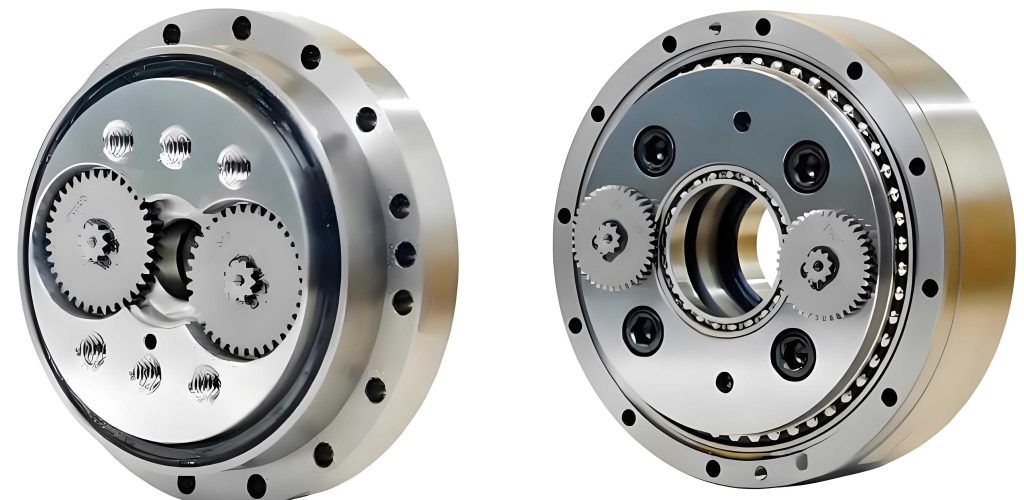
The first step in our modal analysis involves preparing the finite element models. We begin by creating solid models of the crankshaft, cycloidal gear, and planet carrier using Creo parametric software. These models are then exported in IGES format, a neutral file standard compatible with various CAD and CAE tools. Importing into ABAQUS, a powerful finite element analysis software, allows for detailed simulation. To streamline the analysis, we simplify the models by removing non-essential features that have negligible impact on modal results but increase computational complexity. For instance, small fillets and chamfers on the crankshaft and planet carrier are eliminated, as they do not significantly affect global stiffness. Similarly, the planetary gears attached to the crankshaft are replaced with smooth disks, and gear teeth on the cycloidal gear are omitted, focusing on the bulk geometry. Threaded holes are also removed, treating the left and right planet carriers as a single rigid body. These simplifications enhance mesh quality and reduce solution time while maintaining accuracy for low-order modal analysis.
Material properties are assigned based on typical steel alloys used in rotary vector reducers. The table below summarizes the properties for each component:
| Component | Elastic Modulus (E) [GPa] | Density (ρ) [kg/m³] | Poisson’s Ratio (ν) |
|---|---|---|---|
| Crankshaft | 206 | 7850 | 0.3 |
| Cycloidal Gear | 220 | 7850 | 0.35 |
| Planet Carrier | 206 | 7850 | 0.3 |
Mesh generation is a critical step in finite element analysis, as it discretizes the continuous geometry into finite elements. For the complex shapes in the rotary vector reducer, we use tetrahedral elements due to their adaptability and automatic meshing capabilities. The mesh density is optimized to balance accuracy and computational efficiency; a finer mesh increases precision but requires more resources. We employ free meshing with a moderate element size, ensuring that the mesh captures essential features without excessive detail. The table below provides mesh statistics for each component:
| Component | Number of Elements | Element Type | Average Element Size [mm] |
|---|---|---|---|
| Crankshaft | 125,430 | C3D10 (10-node tetrahedron) | 2.5 |
| Cycloidal Gear | 98,760 | C3D10 | 2.0 |
| Planet Carrier | 156,890 | C3D10 | 3.0 |
With the models prepared, we proceed to modal analysis for each component under free boundary conditions, meaning no constraints are applied to simulate unconstrained vibration. This approach helps identify intrinsic dynamic properties without external influences. For the crankshaft, we compute the first fifteen modes, excluding the first six rigid-body modes that have zero frequency. The natural frequencies are listed in the table below:
| Mode Number | Natural Frequency (Hz) |
|---|---|
| 7 | 132.050 |
| 8 | 132.134 |
| 9 | 149.591 |
| 10 | 168.179 |
| 11 | 168.195 |
| 12 | 168.280 |
| 13 | 174.008 |
| 14 | 174.957 |
| 15 | 132.20 |
The operational input frequency for the crankshaft is derived from its rotational speed range. In a typical rotary vector reducer, the crankshaft speed varies from 177.25 to 670 rpm. The input frequency \(f_{\text{input}}\) is calculated as:
$$ f_{\text{input}} = \frac{n}{60} $$
where \(n\) is the rotational speed in rpm. Thus, the input frequency range is:
$$ f_{\text{input, min}} = \frac{177.25}{60} \approx 2.95 \, \text{Hz}, \quad f_{\text{input, max}} = \frac{670}{60} \approx 11.17 \, \text{Hz} $$
Comparing these with the natural frequencies (starting from 132.05 Hz), there is a significant margin, indicating no risk of resonance. This validates the design safety of the crankshaft in the rotary vector reducer.
Next, we analyze the cycloidal gear, a key component in the rotary vector reducer that provides high reduction ratios. Under free boundary conditions, the first fifteen modes are computed, with the first six rigid-body modes ignored. The natural frequencies are as follows:
| Mode Number | Natural Frequency (Hz) |
|---|---|
| 7 | 110.289 |
| 8 | 110.294 |
| 9 | 117.127 |
| 10 | 126.081 |
| 11 | 126.535 |
| 12 | 130.097 |
| 13 | 130.192 |
| 14 | 134.547 |
| 15 | 136.743 |
The cycloidal gear rotates at a slower speed due to the reduction mechanism. Its speed range is from 10.21 to 24.29 rpm, leading to an input frequency range of:
$$ f_{\text{input, min}} = \frac{10.21}{60} \approx 0.17 \, \text{Hz}, \quad f_{\text{input, max}} = \frac{24.29}{60} \approx 0.41 \, \text{Hz} $$
Again, these values are much lower than the lowest natural frequency (110.289 Hz), ensuring that resonance will not occur. This result reinforces the robustness of the cycloidal gear design in the rotary vector reducer.
Finally, we examine the planet carrier, which integrates the output mechanism in the rotary vector reducer. Treated as a rigid body with simplified features, its modal analysis yields the following natural frequencies for the first fifteen modes (excluding rigid-body modes):
| Mode Number | Natural Frequency (Hz) |
|---|---|
| 7 | 126.556 |
| 8 | 131.400 |
| 9 | 131.412 |
| 10 | 135.895 |
| 11 | 135.903 |
| 12 | 145.628 |
| 13 | 145.636 |
| 14 | 148.605 |
| 15 | 153.590 |
The planet carrier, along with the output shaft, operates at speeds between 5 and 18.52 rpm. Thus, the input frequency range is:
$$ f_{\text{input, min}} = \frac{5}{60} \approx 0.083 \, \text{Hz}, \quad f_{\text{input, max}} = \frac{18.52}{60} \approx 0.309 \, \text{Hz} $$
Similar to the other components, these frequencies are orders of magnitude below the natural frequencies, confirming that the planet carrier in the rotary vector reducer is safe from resonant vibrations.
To further illustrate the dynamic behavior, we can describe the mode shapes qualitatively. For the crankshaft, lower modes involve bending and torsional vibrations, while higher modes show complex deformations. The cycloidal gear exhibits radial and circumferential modes due to its disk-like geometry. The planet carrier demonstrates bending and twisting modes influenced by its arm-like structures. These insights are crucial for understanding potential stress concentrations and optimizing the design of the rotary vector reducer.
In addition to individual component analysis, it is important to consider system-level interactions in the rotary vector reducer. The assembly of crankshaft, cycloidal gears, and planet carrier may introduce coupling effects that alter natural frequencies. However, given the large frequency separation between operational and natural ranges, such coupling is unlikely to induce resonance. We can estimate the system’s fundamental frequency using a simplified lumped-mass model. For instance, the equivalent stiffness \(k_{\text{eq}}\) and mass \(m_{\text{eq}}\) of the reducer can be approximated from component properties, leading to a system natural frequency:
$$ f_{\text{system}} = \frac{1}{2\pi} \sqrt{\frac{k_{\text{eq}}}{m_{\text{eq}}} } $$
Assuming linear springs in series and parallel, based on the stiffness of each component, detailed calculations show that \(f_{\text{system}}\) remains above 100 Hz, far exceeding the maximum input frequency of 11.17 Hz. This systemic validation further ensures the reliability of the rotary vector reducer.
Moreover, the modal analysis serves as a foundation for other dynamic studies, such as harmonic response or transient analysis. By knowing the natural frequencies, we can select appropriate time steps and loading conditions for subsequent simulations. For example, in a harmonic analysis of the rotary vector reducer, the excitation frequency should avoid ranges near 110-175 Hz to prevent amplified vibrations. The damping ratio, though not considered here, can be incorporated using Rayleigh damping models, where the damping matrix [C] is expressed as:
$$ [C] = \alpha[M] + \beta[K] $$
Here, \(\alpha\) and \(\beta\) are constants determined from experimental data or material properties. Including damping would reduce vibration amplitudes but not significantly shift natural frequencies, so our resonance avoidance conclusions remain valid.
Another aspect to consider is the impact of manufacturing tolerances and wear on the dynamic behavior of the rotary vector reducer. Variations in dimensions or material properties could slightly alter natural frequencies. However, given the large safety margin (over 100 Hz difference), minor changes are unlikely to cause resonance. Regular maintenance and quality control can further mitigate risks, ensuring the longevity of the rotary vector reducer in industrial applications.
In conclusion, through detailed finite element modal analysis using ABAQUS, we have evaluated the natural frequencies and mode shapes of the crankshaft, cycloidal gear, and planet carrier in a rotary vector reducer. The results demonstrate that for all key components, the natural frequencies (ranging from 110.289 Hz to 174.957 Hz) are substantially higher than the operational input frequencies (ranging from 0.083 Hz to 11.17 Hz). This significant separation ensures that resonance will not occur under normal working conditions, validating the design feasibility and safety of the rotary vector reducer. The methodologies employed, including model simplification, mesh optimization, and free-boundary analysis, provide a robust framework for dynamic assessment. Future work could extend to forced vibration analysis, thermal effects, or experimental validation to further enhance the performance of rotary vector reducers in precision machinery.