
The modern textile industry faces significant challenges, including rising labor and material costs alongside intensifying global competition. Automation through robotics presents a compelling solution, offering a path to enhanced productivity, cost reduction, and improved operational resilience. While conventional industrial robots with simple, dedicated end-effectors are prevalent, their application in handling delicate, non-rigid materials like fabrics remains limited due to inflexible grasp modalities and poor adaptability. A dexterous robotic hand, serving as a highly adaptable end-effector, can fundamentally address these limitations. Inspired by the human hand’s versatility, a dexterous robotic hand can, in theory, grasp objects of arbitrary shape and apply controlled forces and moments from various directions. This research proposes and investigates the use of a dual-fingered dexterous robotic hand for the specific task of grasping and manipulating flexible fabrics, a critical step towards intelligent automation in textile manufacturing.
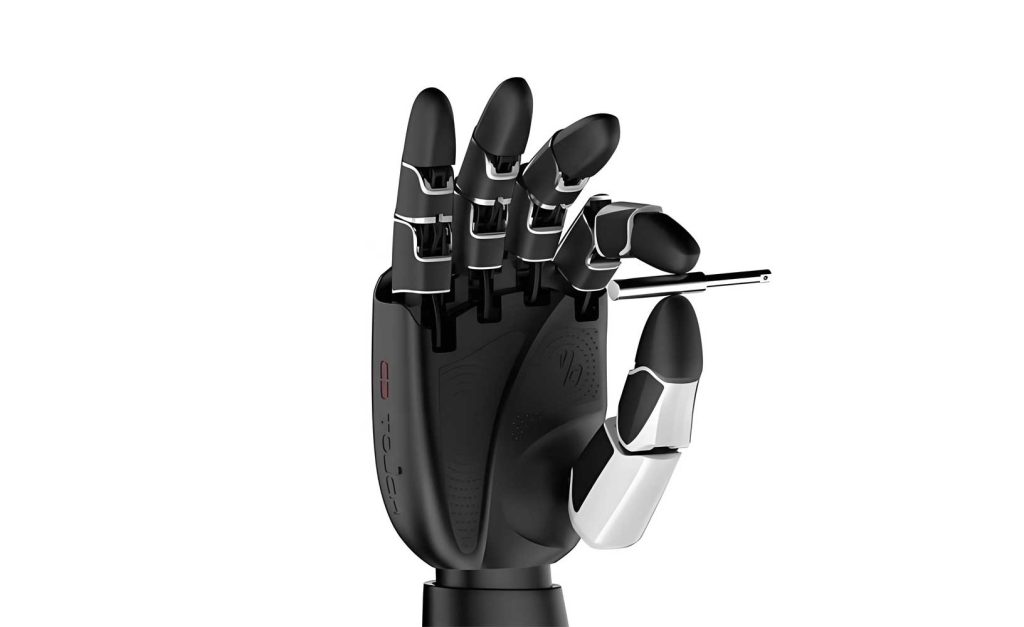
Given the complexity and cost associated with physical prototypes of a multi-degree-of-freedom dexterous robotic hand, this study adopts a model-based simulation approach. We first establish a precise kinematic model for the dual-fingered dexterous robotic hand using the Denavit-Hartenberg (D-H) convention. Subsequently, a smooth and continuous trajectory planning algorithm based on quintic polynomials in joint space is developed to govern the hand’s motion during a fabric grasp. Finally, the proposed models and algorithms are rigorously validated through comprehensive simulations in the MATLAB/Simulink environment. This methodology provides a robust theoretical foundation for the eventual development of a physical dexterous robotic hand system for textile applications.
Kinematic Modeling of the Dexterous Robotic Hand
Kinematic analysis forms the cornerstone for controlling any robotic manipulator, including a dexterous robotic hand. It describes the geometric relationship between the joint variables and the position and orientation (pose) of the end-effector—in this case, the fingertip. For a dual-fingered dexterous robotic hand designed to conform to the variable geometry of fabrics, each finger must possess sufficient degrees of freedom (DOF). In this model, each finger of the dexterous robotic hand is designed with three revolute joints, providing the necessary dexterity for enveloping and pinching grasps on flexible materials.
Forward Kinematics using D-H Parameters
The Denavit-Hartenberg (D-H) method provides a systematic procedure for assigning coordinate frames to the links of a robotic manipulator and deriving the homogeneous transformation matrices between them. For the studied dexterous robotic hand, the two fingers are kinematically identical. Therefore, the analysis focuses on a single finger, with the understanding that the model applies symmetrically to both.
The D-H parameters for one finger of the dexterous robotic hand are defined as follows:
| Link i | $\alpha_{i}$ (twist angle) | $a_{i}$ (link length) | $d_{i}$ (link offset) | $\theta_{i}$ (joint angle) |
|---|---|---|---|---|
| 1 | 0 | $L_1$ | 0 | $\theta_1$ |
| 2 | 0 | $L_2$ | 0 | $\theta_2$ |
| 3 | 0 | $L_3$ | 0 | $\theta_3$ |
Where $L_1$, $L_2$, and $L_3$ represent the lengths of the proximal, medial, and distal phalanges (links), respectively. All joints are revolute, making $\theta_i$ the joint variable, while the link offset $d_i$ is zero for a simplified planar finger structure.
The general form of the homogeneous transformation matrix from frame $\{i-1\}$ to frame $\{i\}$ is given by:
$$^{i-1}\mathbf{A}_i =
\begin{bmatrix}
\cos\theta_i & -\sin\theta_i \cos\alpha_i & \sin\theta_i \sin\alpha_i & a_i \cos\theta_i \\
\sin\theta_i & \cos\theta_i \cos\alpha_i & -\cos\theta_i \sin\alpha_i & a_i \sin\theta_i \\
0 & \sin\alpha_i & \cos\alpha_i & d_i \\
0 & 0 & 0 & 1
\end{bmatrix}$$
Substituting the D-H parameters from the table into this general form yields the specific transformation matrices for each joint of the dexterous robotic hand finger:
$$^{0}\mathbf{A}_1 =
\begin{bmatrix}
\cos\theta_1 & -\sin\theta_1 & 0 & L_1 \cos\theta_1 \\
\sin\theta_1 & \cos\theta_1 & 0 & L_1 \sin\theta_1 \\
0 & 0 & 1 & 0 \\
0 & 0 & 0 & 1
\end{bmatrix}$$
$$^{1}\mathbf{A}_2 =
\begin{bmatrix}
\cos\theta_2 & -\sin\theta_2 & 0 & L_2 \cos\theta_2 \\
\sin\theta_2 & \cos\theta_2 & 0 & L_2 \sin\theta_2 \\
0 & 0 & 1 & 0 \\
0 & 0 & 0 & 1
\end{bmatrix}$$
$$^{2}\mathbf{A}_3 =
\begin{bmatrix}
\cos\theta_3 & -\sin\theta_3 & 0 & L_3 \cos\theta_3 \\
\sin\theta_3 & \cos\theta_3 & 0 & L_3 \sin\theta_3 \\
0 & 0 & 1 & 0 \\
0 & 0 & 0 & 1
\end{bmatrix}$$
The complete forward kinematics, describing the pose of the fingertip (frame {3}) relative to the finger base (frame {0}), is obtained by sequentially multiplying these matrices:
$$^{0}\mathbf{T}_3 = ^{0}\mathbf{A}_1 \cdot ^{1}\mathbf{A}_2 \cdot ^{2}\mathbf{A}_3$$
Carrying out this multiplication gives the final pose matrix:
$$^{0}\mathbf{T}_3 = \begin{bmatrix}
\cos\theta_{123} & -\sin\theta_{123} & 0 & L_1\cos\theta_1 + L_2\cos\theta_{12} + L_3\cos\theta_{123} \\
\sin\theta_{123} & \cos\theta_{123} & 0 & L_1\sin\theta_1 + L_2\sin\theta_{12} + L_3\sin\theta_{123} \\
0 & 0 & 1 & 0 \\
0 & 0 & 0 & 1
\end{bmatrix}$$
where $\theta_{12} = \theta_1 + \theta_2$ and $\theta_{123} = \theta_1 + \theta_2 + \theta_3$. The upper-left 3×3 submatrix defines the orientation of the fingertip, while the upper-right 3×1 vector $[P_x, P_y, P_z]^T$ defines its Cartesian position relative to the base. For the planar case considered, the position simplifies to:
$$P_x = L_1\cos\theta_1 + L_2\cos(\theta_1+\theta_2) + L_3\cos(\theta_1+\theta_2+\theta_3)$$
$$P_y = L_1\sin\theta_1 + L_2\sin(\theta_1+\theta_2) + L_3\sin(\theta_1+\theta_2+\theta_3)$$
$$P_z = 0$$
This forward kinematic model is fundamental for determining where the fingertip of the dexterous robotic hand will be located given a set of joint angles.
Inverse Kinematics Consideration
Inverse kinematics involves finding the set of joint angles required to achieve a desired Cartesian pose of the fingertip. While the forward kinematics of this dexterous robotic hand model yields a unique solution, the inverse kinematics problem is often more complex, potentially yielding multiple solutions or no solution at all. For the purpose of this study, which focuses on trajectory planning directly in the joint space, explicit inverse kinematic solutions are not required. By planning the path in terms of joint angles, we circumvent the computational complexity and potential ambiguities associated with Cartesian-to-joint space conversion, leading to faster and more deterministic control algorithms for the dexterous robotic hand.
Trajectory Planning in Joint Space for the Dexterous Robotic Hand
Trajectory planning defines the desired motion of the dexterous robotic hand as a function of time. For a smooth and stable grasp of delicate fabrics, the generated trajectories for each joint must be continuous not only in position but also in velocity and acceleration to avoid abrupt movements that could cause fabric slippage or deformation. Planning in the joint space is particularly advantageous for a dexterous robotic hand as it allows direct specification of the actuator commands and naturally avoids issues like algorithmic singularities that can arise in Cartesian space planning.
A quintic polynomial trajectory is chosen for its ability to satisfy boundary conditions on position, velocity, and acceleration at both the start and end of the motion. This ensures a smooth start and stop, which is critical for precise manipulation with a dexterous robotic hand. The general form of a quintic polynomial for a joint angle $\theta(t)$ is:
$$\theta(t) = a_0 + a_1 t + a_2 t^2 + a_3 t^3 + a_4 t^4 + a_5 t^5$$
Its first and second derivatives, representing joint velocity and acceleration, are:
$$\dot{\theta}(t) = a_1 + 2a_2 t + 3a_3 t^2 + 4a_4 t^3 + 5a_5 t^4$$
$$\ddot{\theta}(t) = 2a_2 + 6a_3 t + 12a_4 t^2 + 20a_5 t^3$$
For a motion from an initial joint angle $\theta_0$ to a final joint angle $\theta_f$, with specified durations $t_0$ and $t_f$, we impose the following boundary conditions for a smooth stop-and-go motion:
$$\theta(t_0) = \theta_0, \quad \theta(t_f) = \theta_f$$
$$\dot{\theta}(t_0) = 0, \quad \dot{\theta}(t_f) = 0$$
$$\ddot{\theta}(t_0) = 0, \quad \ddot{\theta}(t_f) = 0$$
Applying these six conditions to the polynomial and its derivatives allows us to solve for the six coefficients $a_0$ to $a_5$. For simplicity, assuming $t_0 = 0$ and the total motion time is $t_f = t_d$, the solved polynomial takes the form:
$$\theta(t) = \theta_0 + \frac{10(\theta_f – \theta_0)}{t_d^3} t^3 – \frac{15(\theta_f – \theta_0)}{t_d^4} t^4 + \frac{6(\theta_f – \theta_0)}{t_d^5} t^5$$
The corresponding velocity and acceleration profiles for each joint of the dexterous robotic hand are therefore:
$$\dot{\theta}(t) = \frac{30(\theta_f – \theta_0)}{t_d^3} t^2 – \frac{60(\theta_f – \theta_0)}{t_d^4} t^3 + \frac{30(\theta_f – \theta_0)}{t_d^5} t^4$$
$$\ddot{\theta}(t) = \frac{60(\theta_f – \theta_0)}{t_d^3} t – \frac{180(\theta_f – \theta_0)}{t_d^4} t^2 + \frac{120(\theta_f – \theta_0)}{t_d^5} t^3$$
By applying this quintic polynomial planning algorithm independently to each of the three joints of both fingers in the dexterous robotic hand, a coordinated, smooth, and collision-free grasping trajectory can be generated. The joint angles at every time instant are defined by $\theta(t)$, which can then be used with the forward kinematic model to compute the precise Cartesian path of the fingertips, offering full predictability and controllability of the dexterous robotic hand‘s motion.
Simulation, Verification, and Analysis of the Dexterous Robotic Hand System
To validate the kinematic model and the trajectory planning algorithm for the dual-fingered dexterous robotic hand, a comprehensive simulation environment was constructed using MATLAB, leveraging its Robotics Toolbox for visualization and kinematic computation.
Model Construction and Workspace Visualization
The three-link finger model was implemented programmatically. A key advantage of a dexterous robotic hand over traditional grippers is its flexible grasp modality. By coordinating the joint angles of the two opposing fingers, the dexterous robotic hand can perform various grasp types, such as a precision pinch or an enveloping grasp, to securely hold fabrics of different shapes and thicknesses. The simulation visually confirms this capability, showing the fingers moving from an open pose to a closed, grasping pose around a virtual fabric region.
Forward Kinematics Validation
The accuracy of the derived forward kinematic equations was rigorously tested. Specific joint angle sets $(\theta_1, \theta_2, \theta_3)$ were input into both the analytical model (Equation derived for $^{0}\mathbf{T}_3$) and the MATLAB kinematic model. The Cartesian fingertip positions $(P_x, P_y)$ computed by both methods were compared. A sample of the validation data for one finger is presented below, demonstrating the agreement between the theoretical model and the computational simulation for the dexterous robotic hand.
| Joint Angles (rad) | Fingertip Position X (units) | Fingertip Position Y (units) | ||
|---|---|---|---|---|
| $\theta_1, \theta_2, \theta_3$ | Model | Simulation | Model | Simulation |
| 0.000, 0.000, 0.000 | 4.350 | 4.350 | 0.000 | 0.000 |
| 0.108, 0.063, 0.082 | 4.287 | 4.287 | 0.696 | 0.696 |
| 0.529, 0.311, 0.405 | 2.948 | 2.948 | 2.962 | 2.962 |
| 0.955, 0.562, 0.730 | 0.604 | 0.604 | 3.761 | 3.761 |
| 1.068, 0.628, 0.817 | -0.015 | -0.015 | 3.680 | 3.680 |
The near-perfect match across multiple test configurations confirms the correctness and reliability of the derived D-H parameter-based kinematic model for the dexterous robotic hand.
Trajectory Planning Simulation Results
The quintic polynomial trajectory planner was implemented for a grasp sequence. The initial and final joint angles for both fingers were defined, and the trajectories were computed over a specified duration. The resulting plots provide a complete motion profile for the dexterous robotic hand:
1. Cartesian Trajectory: The path traced by the fingertips in the operational space is smooth and converges as expected towards the grasp point, demonstrating coordinated motion.
2. Joint Space Profiles: The plots for joint displacement, velocity, and acceleration over time are the most critical validation. For every joint of each finger in the dexterous robotic hand, the following is observed:
- Displacement ($\theta(t)$): The curves are smooth S-shaped profiles, starting and ending at the specified angles.
- Velocity ($\dot{\theta}(t)$): The curves are bell-shaped, starting and ending at zero velocity. The peak velocity occurs in the middle of the motion, ensuring smooth acceleration and deceleration.
- Acceleration ($\ddot{\theta}(t)$): The curves are continuous and smooth, starting and ending at zero. This confirms the absence of infinite jerk (derivative of acceleration), which is essential for preventing vibrations and ensuring stable, precise control of the dexterous robotic hand actuators.
The continuity and smoothness of all these profiles validate that the quintic polynomial planning algorithm successfully meets all boundary conditions. This guarantees that the dexterous robotic hand will move without abrupt starts or stops, a prerequisite for reliably grasping a flexible fabric without causing it to slip or be ejected due to sudden acceleration.
Conclusion and Future Perspectives
This study has presented a complete theoretical framework for modeling and planning the motion of a dual-fingered dexterous robotic hand intended for flexible fabric manipulation. The systematic D-H parameter modeling provided an accurate forward kinematic description, which is essential for predicting fingertip position. The joint-space quintic polynomial trajectory planning algorithm generated smooth, continuous, and controllable motion profiles that satisfy critical boundary conditions for velocity and acceleration. Comprehensive simulation results verified both the kinematic model’s accuracy and the trajectory planner’s effectiveness, confirming that a dexterous robotic hand can execute the complex, coordinated motions required for adaptive fabric grasping.
The implications for the textile industry are significant. The inherent flexibility of a dexterous robotic hand, as demonstrated in this model, can overcome the limitations of traditional rigid grippers. It enables a single robotic system to handle a wide variety of fabric types, weights, and shapes—from delicate silks to heavy denims—using different grasp strategies programmed via trajectory planning. This adaptability is key to automating complex tasks such as picking and placing cut fabric pieces, folding garments, or presenting fabrics to sewing machines.
Future work will build upon this robust simulation foundation. The immediate next step involves the design and fabrication of a physical prototype of the dexterous robotic hand, incorporating actuators, sensors, and a real-time control system. The integration of tactile or force sensing at the fingertips will be crucial for implementing reactive grasp control algorithms that can modulate grip force based on fabric texture and weight, preventing damage and ensuring secure holds. Furthermore, integrating the dexterous robotic hand with a robotic arm and machine vision system will create a fully automated cell capable of locating, identifying, and manipulating fabrics in unstructured environments. Advanced planning algorithms, potentially incorporating machine learning to optimize grasp strategies for different fabric properties, can be developed and tested first within the validated simulation environment established here. In conclusion, the research provides a solid theoretical and methodological groundwork for the development of intelligent, flexible automation solutions using dexterous robotic hand technology, paving the way for their successful adoption in the modern textile industry and beyond.