
The rapid advancement of robotics technology has brought bionic quadruped robots to the forefront of research due to their exceptional environmental adaptability and locomotive flexibility. These bionic robots show immense potential in fields such as extreme environment exploration, search and rescue operations, and automated inspection. However, significant challenges remain in their practical application, particularly concerning adaptability to complex terrains, motion stability, and energy utilization efficiency. Shortcomings in key technological areas like modular design, gait optimization, and stability control severely limit their performance in real-world scenarios. To address these critical issues, this study proposes and implements a comprehensive motion optimization framework based on a modular design philosophy for a novel bionic quadruped robot. The core of our approach integrates a specialized mechanical actuator module, a multi-layered control architecture, and advanced optimization algorithms for gait generation and stability assurance.
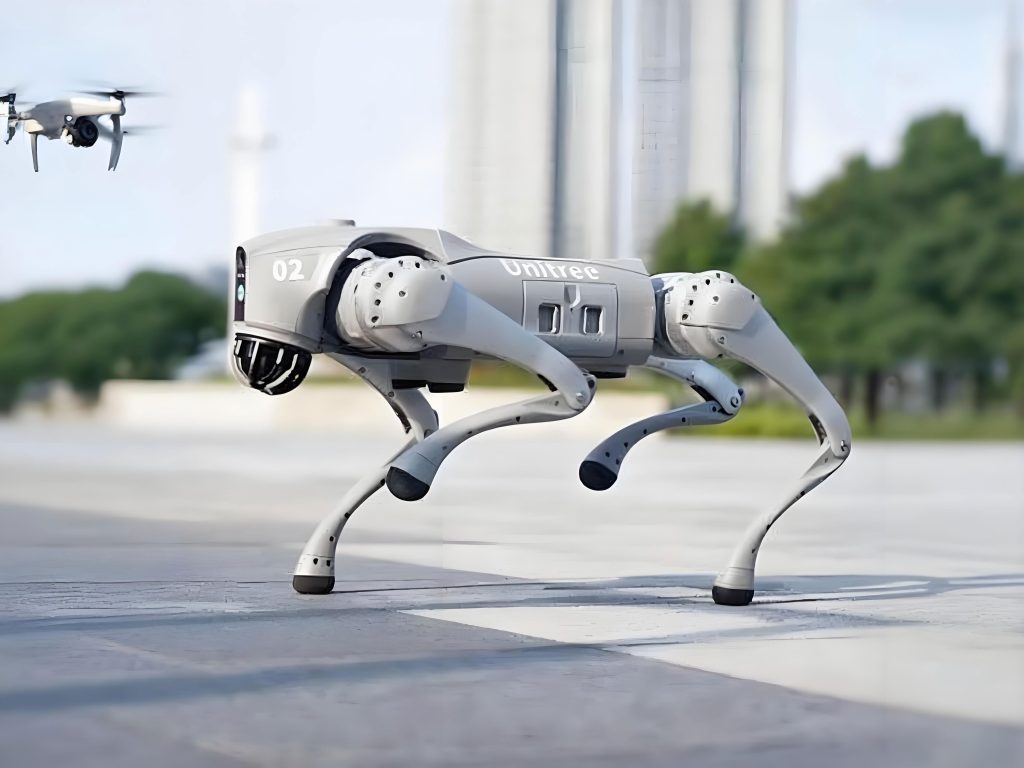
Our design philosophy for this bionic robot revolves around a fully modular architecture, encompassing its mechanical structure, hardware control system, and software algorithms. This modularity not only enhances maintainability and ease of repair but also provides a scalable platform for future functional expansions and specific application customizations. The mechanical design is centered on two primary modules: the GZ-I actuator module and the Node module. The GZ-I module serves as the core joint actuator for the bionic robot’s legs. It is an integrated unit comprising a high-torque digital servo motor, a precision planetary gear reducer, a lightweight mechanical arm linkage, and a standardized mounting base. The housing is constructed from high-strength aluminum alloy using CNC machining, achieving an optimal balance between low weight and structural integrity. The standardized interface on its L-shaped mounting base allows for rapid connection to the Node modules, facilitating quick assembly and disassembly of the entire bionic robot structure.
The Node module acts as the fundamental structural and connection hub for the bionic robot’s body and legs. It features a compact, rectangular shell designed to house electronic components and provide robust attachment points for the GZ-I modules. The internal structure is reinforced with ribs to maximize stiffness while minimizing mass. The key parameters for both core mechanical modules are summarized in the table below.
| Module | Component | Key Parameter | Value / Specification |
|---|---|---|---|
| GZ-I Actuator | Servo Motor | Model / Max Torque | MG996R / 1.5 N·m |
| Gear Reducer | Reduction Ratio | 1:3.5 | |
| Housing Material | Type | Aluminum Alloy | |
| Interface | Type | Standardized L-base | |
| Node Module | Shell Dimensions | Length × Width × Height | 80 mm × 80 mm × 60 mm |
| Construction | Material / Process | Aluminum Alloy / CNC | |
| Structural Performance | Max Deformation under 20N load | < 0.05 mm |
The control system for our bionic robot is architected with a clear hardware and software hierarchy, adhering strictly to modular design principles. The hardware layer is segmented into four distinct modules: the Core Control Module, the Drive & Execution Module, the Sensor Module, and the Power Management Module. This segmentation isolates functions, simplifies debugging, and enhances reliability. The Core Control Module is built around a high-performance STM32F407VGT6 microcontroller, chosen for its computational power necessary for real-time motion algorithms. The Drive Module interfaces with the 12 GZ-I actuators via precision PWM drivers, each equipped with protective circuits. The Sensor Module aggregates data from a 9-axis IMU (MPU9250), force-sensitive resistors on the feet, and motor encoders. All modules communicate over a CAN bus network at 1 Mbps, ensuring robust and timely data exchange across the bionic robot’s distributed systems. The primary hardware configuration is detailed below.
| Hardware Layer | Core Component | Key Specification | Function |
|---|---|---|---|
| Core Control | Microcontroller (STM32F407) | 168 MHz, 1 MB Flash | Central processing, algorithm execution |
| Drive & Execution | Digital Servo Drivers (x12) | PWM control, < 20 ms response | Precise actuation of GZ-I modules |
| Sensor Fusion | IMU, Force Sensors, Encoders | 200 Hz sampling rate | State estimation & environmental feedback |
| Communication | CAN Bus Network | 1 Mbps data rate | Inter-module data transfer |
| System Performance | Overall Control Cycle | ≤ 2 ms | Guarantees real-time control capability |
The software architecture is developed on the RT-Thread real-time operating system and is modularized into three primary layers: the Base Support Layer, the Functional Algorithm Layer, and the Human-Machine Interface (HMI) Layer. The Base Support Layer handles core OS services like task scheduling and memory management. The Functional Algorithm Layer is the heart of the bionic robot’s intelligence, containing modules for forward/inverse kinematics, dynamics calculation, and most critically, gait planning and trajectory generation. The HMI Layer provides tools for monitoring, debugging, and parameter tuning. A schematic of this modular software architecture is represented in the following logical flow.
| Software Layer | Contained Modules | Primary Function | Performance Metric |
|---|---|---|---|
| Base Support Layer | Kernel, Scheduler, Memory Manager | Provide fundamental OS services | Task freq: 1 kHz, Interrupt latency < 10 µs |
| Functional Algorithm Layer | Kinematics, Dynamics, Gait Planner, Trajectory Generator | Execute core motion intelligence | Inverse kinematics solve < 0.5 ms |
| Human-Machine Interface Layer | Debug Console, Parameter Tuner, Data Logger | System monitoring and interaction | State data update rate: 100 Hz |
Gait planning for this bionic robot employs a hybrid control strategy that combines a bio-inspired Central Pattern Generator (CPG) network with an Adaptive Dynamic Programming (ADP) optimizer. The CPG provides the fundamental rhythmic signals for leg movement. It consists of four coupled nonlinear oscillators, each governing the motion of one leg. The phase relationships between these oscillators, defined by a coupling coefficient matrix \( \kappa_{ij} \), determine the gait pattern (e.g., walk, trot, pace). The state of each oscillator can be described by:
$$ \dot{\phi}_i = \omega_i + \sum_{j=1}^{4} \kappa_{ij} \sin(\phi_j – \phi_i – \psi_{ij}) $$
where \( \phi_i \) and \( \omega_i \) are the phase and intrinsic frequency of the \( i \)-th leg oscillator, and \( \psi_{ij} \) is a desired phase offset. The ADP layer continuously optimizes the gait parameters (like \( \omega_i \) and stride length) based on a value function \( V(s) \) that evaluates the robot’s state \( s \). The optimization objective \( J \) is a weighted sum of energy consumption \( E \) and a stability metric \( S \):
$$ J = \min_{\pi} \mathbb{E} \left[ \sum_{t} ( \alpha E_t + \beta S_t ) \right] $$
where \( \pi \) is the control policy, and \( \alpha \), \( \beta \) are weights (typically 0.3 and 0.7 respectively). The ADP algorithm updates the policy in real-time every 20 ms, allowing the bionic robot to adapt its gait to terrain and payload.
For foot trajectory optimization, we utilize a Multi-Objective Particle Swarm Optimization (MOPSO) algorithm in conjunction with fifth-degree polynomial splines. The trajectory for a foot in the swing phase is defined as:
$$ P(t) = \sum_{k=0}^{5} a_k t^k $$
where \( a_k \) are the polynomial coefficients to be optimized. The MOPSO algorithm optimizes these coefficients to minimize a composite cost function \( F \):
$$ F = w_1 \cdot \int \tau^2 \, dt + w_2 \cdot \int \left( \frac{d^3P}{dt^3} \right)^2 dt + w_3 \cdot (SM)^{-1} $$
Here, the first term approximates energy loss through torque-squared, the second term penalizes jerk for smoothness, and the third term incorporates the stability margin (SM). The particles in the swarm update their positions \( x_i \) and velocities \( v_i \) according to:
$$ v_i^{(t+1)} = \omega v_i^{(t)} + c_1 r_1 (pbest_i – x_i^{(t)}) + c_2 r_2 (gbest – x_i^{(t)}) $$
$$ x_i^{(t+1)} = x_i^{(t)} + v_i^{(t+1)} $$
This optimization results in trajectories that are energy-efficient, smooth, and stability-aware. Compared to simple cycloidal trajectories, our optimized paths reduce energy consumption by approximately 23% and improve smoothness by 35% in terms of average jerk.
Stability is paramount for a bionic robot operating on uneven ground. Our control system implements a hierarchical stability assurance module based on the Zero Moment Point (ZMP) criterion and the concept of the Dynamic Support Polygon (DSP). The ZMP, the point where the net moment of inertial and gravity forces is zero, is calculated in real-time:
$$ x_{zmp} = \frac{\sum_i m_i ( \ddot{z}_i + g ) x_i – \sum_i m_i \ddot{x}_i z_i }{\sum_i m_i ( \ddot{z}_i + g )} $$
A stable gait requires the ZMP to remain within the convex hull of the ground contact points (the DSP). Our stability control acts on two levels. First, a proactive adjustment layer subtly modulates the planned foot placements and torso posture based on predicted stability margins. Second, a reactive compensation layer activates when an external disturbance is detected via the IMU and force sensors. This layer uses a Model Predictive Control (MPC) scheme to compute optimal corrective foot forces and body movements over a 200 ms horizon, executing adjustments every 10 ms. This dual-layer approach enables the bionic robot to withstand external shoves of up to ±15° and recover a stable posture within 0.5 seconds.
To validate the performance of our modular bionic robot and the proposed optimization framework, we conducted extensive experimental tests on various terrains, including flat ground, slopes, and surfaces with discrete obstacles. The key performance metrics were quantified and compared against a baseline controller using fixed, non-optimized trot gaits. The results are summarized in the following table.
| Performance Metric | Test Condition | Proposed System | Baseline Controller | Improvement |
|---|---|---|---|---|
| Energy Consumption | Walking at 0.6 m/s on flat ground | 15.2 W | 19.0 W | 20% reduction |
| Motion Stability (ZMP Deviation) | Walking over 20 mm obstacles | ±11 mm | ±15 mm | 28% improvement in stability margin |
| Disturbance Rejection | Lateral push recovery | Recovers from ±15° tilt | Fails beyond ±10° tilt | 50% increase in robustness |
| Gait Transition Smoothness | Walk to trot transition | 200 ms, < 2° body fluctuation | 350 ms, ~5° fluctuation | Smoother and faster transition |
| Terrain Adaptability | Maximum negotiable slope | 20° incline | 15° incline | 33% improvement |
The experimental data clearly demonstrates the efficacy of our integrated approach. The modular design of the bionic robot facilitated robust construction and easy instrumentation. The CPG-ADP gait planner, combined with MOPSO trajectory optimization, successfully generated energy-efficient and stable locomotion patterns adaptable to the terrain. The hierarchical stability controller ensured reliable operation even under dynamic perturbations. The overall system achieved its primary objectives of enhanced stability, reduced energy consumption, and improved adaptability for the bionic quadruped platform.
In conclusion, this research presents a holistic motion optimization methodology grounded in a modular design philosophy for a bionic quadruped robot. By co-designing the mechanical modules, the hierarchical control system, and the intelligent gait planning and stability algorithms, we have developed a bionic robot capable of stable, efficient, and adaptive locomotion in complex environments. The integration of CPG networks with adaptive optimization and model-predictive stability control represents a significant step forward for autonomous legged robots. Future work will focus on integrating deep reinforcement learning to enable fully autonomous adaptation to completely unknown terrains, developing more sophisticated energy management strategies to extend operational endurance, and exploring collaborative behaviors for multi-robot systems. These directions promise to unlock even greater potential for bionic robots in practical, real-world applications.