
In the realm of marine operations, the inspection and maintenance of subsea infrastructure such as offshore drilling platforms and underwater cables are critical tasks. Failures in these systems can lead to significant economic losses and environmental disasters. Traditional methods, including manual inspections or combined use of Autonomous Underwater Vehicles (AUVs) and Remotely Operated Vehicles (ROVs), present substantial limitations. Manual interventions are fraught with high risks, while AUV-ROV collaborations suffer from inefficiencies, high costs, and complex coordination challenges. Specifically, the delay between an AUV detecting a target and a ROV being deployed from a mothership often allows the target to drift, and ROVs have limited mobility for re-acquisition. This gap underscores the urgent need for an integrated solution that merges long-range cruising with precise定点作业 capabilities. To address this, we have developed a novel underwater bionic robot that combines the巡航 prowess of AUVs with the定点作业 functionality of ROVs, thereby streamlining operations and enhancing adaptability in dynamic underwater environments.
Our design philosophy centers on creating a versatile bionic robot that seamlessly transitions between swimming and crawling modes. We recognized that legged robots excel in terrestrial locomotion but lag in underwater speed, while body-wave propulsion mechanisms, inspired by fish, offer superior aquatic mobility but poor performance on rugged terrain. By hybridizing these approaches, we aim to leverage the strengths of both: the efficiency and机动性 of fish-like swimming and the stability of insect-like crawling on uneven surfaces. This multi-modal capability allows our bionic robot to navigate open waters swiftly and then maneuver precisely on seabeds or structures, reducing dependency on specific environmental conditions. The integration of advanced control systems, Central Pattern Generator (CPG) algorithms, and target recognition features further enhances its autonomy and operational stability. Through this holistic approach, we envision a bionic robot that not only addresses current limitations but also opens new avenues for underwater exploration and maintenance.
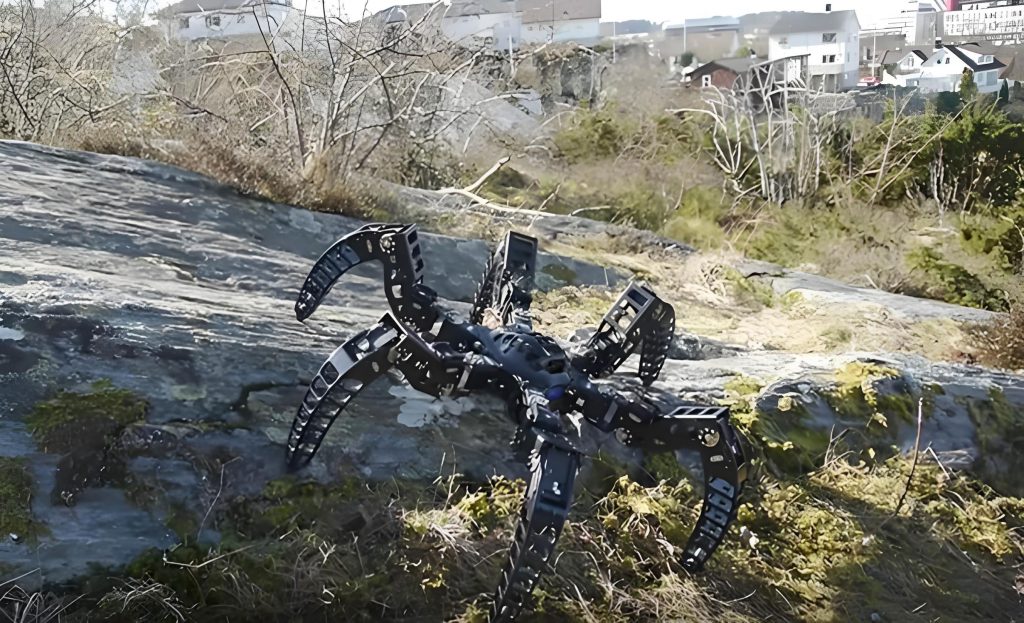
The mechanical architecture of our bionic robot is engineered to facilitate smooth mode switching. In swimming mode, the robot employs a bio-inspired mechanical tail that generates propulsive forces through body-wave oscillations, mimicking the efficient locomotion of fish. This design minimizes energy consumption and noise, making it ideal for long-duration巡航. When approaching a target for定点作业, the robot transitions to crawling mode: lateral fins retract beneath the body, and mechanical legs extend from internal compartments. These legs are configured for stable, six-legged crawling, enabling precise positioning on complex substrates. The transition mechanism involves servo-actuated joints and waterproof seals to ensure reliability in harsh marine conditions. We conducted extensive simulations to optimize the kinematics, ensuring that the bionic robot maintains balance and agility during mode changes. This dual-mode system exemplifies how bionic principles can be applied to create adaptable robotic platforms for diverse underwater tasks.
Hardware integration is crucial for the functionality of our bionic robot. The system is built around a mission computer and an underlying controller. The mission computer utilizes an NVIDIA Jetson TX2 development board, chosen for its high processing power and efficiency in running machine learning algorithms for target recognition. The底层控制器 is based on an STM32H7 microcontroller, which handles real-time servo control and sensor data acquisition. To mitigate interference from high-current servo operations, we implemented a modular design that isolates control circuits from power驱动 circuits. Servo motors are powered by a dedicated circuit with anti-reverse protection, preventing damage from power surges. Communication interfaces include USB for上位机 commands and RS485 for robust serial communication with peripherals. This hardware框架 ensures that the bionic robot can execute complex tasks while maintaining low electromagnetic interference, enhancing overall reliability in underwater applications.
Software control algorithms are the brain of our bionic robot, enabling intelligent behavior in both swimming and crawling modes. For crawling, the robot simplifies to a hexapod configuration. We define a tripod gait where legs are grouped into two sets: legs 1, 4, and 5 form one group, and legs 2, 3, and 6 form another. The 18 joints across the legs are similarly grouped into six sets for synchronized control. A gait matrix governs the motion sequence, with entries indicating joint states: 1 for positive rotation, -1 for negative rotation, and 0 for no movement. The gait matrix for a slow tripod gait is represented as:
$$G = \begin{bmatrix}
0 & 0 & 0 & 0 & 0 & 0 & 0 & 0 & 0 & 1 & 0 & 0 & 0 & 1 & 0 & 0 & 0 & 1 & 0 \\
0 & 0 & 1 & 0 & 1 & 0 & 1 & 0 & 0 & 0 & 0 & 0 & 0 & 0 & 0 & 0 & 0 & 0 & 0 \\
0 & 0 & 0 & 0 & 0 & 0 & 0 & 0 & 0 & 1 & 0 & 0 & 0 & 1 & 0 & 0 & 0 & 1 & 0 \\
0 & 0 & 0 & 0 & 0 & 0 & 0 & 1 & 0 & 0 & 0 & 1 & 0 & 0 & 0 & 1 & 0 & 0 & 0 \\
0 & 0 & 1 & 0 & 1 & 0 & 1 & 0 & 0 & 0 & 0 & 0 & 0 & 0 & 0 & 0 & 0 & 0 & 0 \\
0 & 1 & 0 & 1 & 0 & 1 & 0 & 0 & 0 & 0 & 0 & 0 & 0 & 0 & 0 & 0 & 0 & 0 & 0 \\
0 & 0 & 0 & 0 & 0 & 0 & 0 & 1 & 0 & 0 & 0 & 1 & 0 & 0 & 0 & 1 & 0 & 0 & 0 \\
0 & 0 & 0 & 0 & 0 & 0 & 0 & 0 & 0 & 1 & 0 & 0 & 0 & 1 & 0 & 0 & 0 & 1 & 0 \\
0 & 1 & 0 & 1 & 0 & 1 & 0 & 0 & 0 & 0 & 0 & 0 & 0 & 0 & 0 & 0 & 0 & 0 & 0
\end{bmatrix}$$
Here, each row \(r_i\) corresponds to a step in the gait cycle, and each column \(c_j\) represents the state of a joint. We validated this through simulations in ADAMS, where the model demonstrated stable locomotion over a周期 of 8 seconds, advancing 55 mm per cycle. The hexapod bionic robot benefits from redundant limb structures, allowing continued operation even if some legs are compromised, thereby increasing system robustness. Control is implemented using a hierarchical behavior-based architecture, where higher-priority layers can modulate lower-priority outputs, ensuring adaptive responses to environmental stimuli.
For swimming control, we modeled the tail and fin mechanisms using kinematic analyses. The tail comprises three joints with oscillatory motions driven by servo motors. Simulation results in ADAMS confirmed a摆动周期 of 2 seconds, with joint angles符合设计值: joint 1 rotates 30°, joint 2 rotates 20°, and joint 3 rotates 10°. The motion can be described by sinusoidal functions:
$$\theta_1(t) = 30^\circ \sin(2\pi t / T)$$
$$\theta_2(t) = 20^\circ \sin(2\pi t / T + \phi)$$
$$\theta_3(t) = 10^\circ \sin(2\pi t / T + 2\phi)$$
where \(T = 2\) seconds is the period, and \(\phi\) is a phase shift optimized for thrust generation. This CPG-based approach enables efficient propulsion by emulating the natural undulations of fish, reducing drag and energy consumption. The integration of swimming and crawling controls allows our bionic robot to switch modes autonomously based on sensor inputs, such as depth cameras or sonar data for target detection.
To quantify the performance of our bionic robot, we conducted extensive testing under simulated marine conditions. The results are summarized in the table below, highlighting key metrics that underscore the robot’s capabilities as a versatile underwater platform.
| Parameter | Value |
|---|---|
| Average System Power Consumption | 450 W |
| Stabilization Time | 2.5 s |
| Endurance | 13 hours |
| Maximum Cruising Speed | 3 knots |
| Maximum Crawling Speed | 0.5 m/s |
| Positioning Accuracy | 8.6 cm |
| Turning Radius | 0.2–0.3 m |
These metrics demonstrate that our bionic robot achieves a balance between efficiency and precision. The low power consumption extends operational duration, while the fast stabilization time ensures quick mode transitions. The cruising speed is comparable to conventional AUVs, and the crawling speed allows meticulous inspection tasks. The positioning accuracy is sufficient for most定点作业 scenarios, such as cable repair or sample collection. Furthermore, the compact turning radius enhances机动性 in confined spaces, a critical feature for navigating around underwater structures. This performance profile validates our design choices and positions the bionic robot as a competitive solution for modern marine challenges.
The applications of our multi-mode bionic robot are vast and impactful. In offshore industries, it can perform routine inspections of pipelines and platforms, detecting cracks or corrosion early to prevent failures. For environmental monitoring, the robot can collect water samples or assess marine life without disturbing ecosystems. In search and rescue operations, its ability to crawl over debris makes it invaluable for locating submerged objects or individuals. Additionally, the bionic robot can be deployed in aquaculture for net inspection and maintenance, reducing labor costs and improving safety. The integration of machine learning algorithms enables autonomous decision-making, such as identifying anomalous patterns or prioritizing tasks based on urgency. As underwater technology advances, our bionic robot serves as a platform for further innovations, including enhanced sensor suites or collaborative swarming behaviors with other robotic units.
Looking ahead, we plan to refine the bionic robot by incorporating adaptive materials that change stiffness based on mode, further optimizing energy efficiency. We are also exploring advanced CPG networks that can generate更复杂的 gait patterns for uneven terrains. Collaboration with marine biologists will inform more biomimetic designs, potentially incorporating features from其他 aquatic organisms like rays or crabs. The scalability of the platform allows for customization to specific missions, such as deep-sea exploration or shallow-water interventions. By continuing to iterate on this bionic robot, we aim to push the boundaries of what is possible in underwater robotics, contributing to safer, more sustainable ocean operations.
In conclusion, the development of this multi-mode underwater bionic robot addresses critical gaps in current marine inspection and maintenance methodologies. By融合 the巡航 efficiency of AUVs with the定点作业 precision of ROVs, our design offers a unified solution that enhances operational flexibility and reduces costs. The mechanical, hardware, and software integrations demonstrate how bionic principles can be leveraged to create robust, adaptable systems. Performance data confirms that the robot meets practical demands for endurance, speed, and accuracy. As we advance this technology, we envision a future where bionic robots play a central role in ocean exploration, conservation, and industry, ultimately supporting global efforts toward海洋强国战略. The journey of innovation continues, driven by the endless possibilities inspired by nature and engineered for human benefit.