
In the field of industrial robotics, the RV reducer plays a critical role due to its high transmission ratio, smooth operation, and compact structure. As a researcher focused on improving mechanical transmission systems, I have explored various optimization techniques to enhance the performance of the RV reducer. This article presents a comprehensive multi-objective optimization design method based on the Analytic Hierarchy Process (AHP) and Genetic Algorithm (GA). The goal is to achieve a more compact structure, higher transmission efficiency, and stronger load-carrying capacity for the RV reducer. By integrating AHP to assign weights to multiple objectives and using GA for solving the optimization problem, we can transform complex multi-objective issues into a single-objective function, leading to practical improvements in real-world applications.
The RV reducer, as a key component in robotic joints, consists of a two-stage transmission system: a first-stage involute gear train and a second-stage cycloid-pin gear transmission. Its compact design is essential for limited installation spaces, while high efficiency and durability are crucial for operational reliability. Traditionally, optimization efforts have focused on single objectives, such as minimizing mass or reducing contact stress, but this often compromises other performance aspects. Therefore, a multi-objective approach is necessary to balance competing goals. In this work, we target three primary objectives: minimizing the volume of the RV reducer, maximizing its transmission efficiency, and minimizing the maximum contact stress on the cycloid gear. These objectives are quantified mathematically, and their interdependence is addressed through a systematic weighting scheme using AHP.
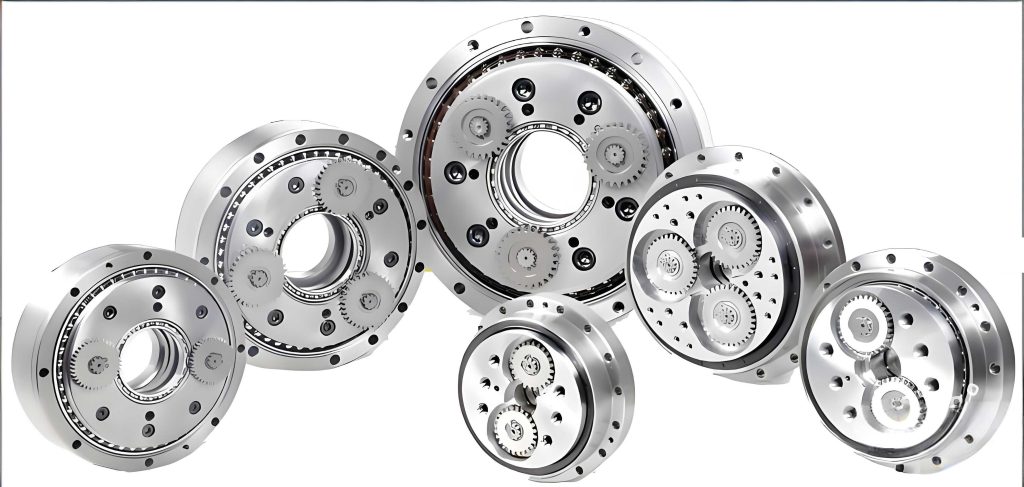
To begin, let’s analyze the structural components of the RV reducer. The RV reducer includes an input shaft, a sun gear, planetary gears, crankshafts, cycloid gears, a pin gear housing with pin teeth, an output plate, and an output shaft. The power flows from the input shaft through the involute gears to the crankshafts, which drive the cycloid gears in an eccentric motion. The cycloid gears then mesh with the pin teeth, transferring power to the output plate. This configuration necessitates careful consideration of geometric parameters to optimize overall performance. For instance, the volume of the RV reducer can be approximated by summing the volumes of key parts like the sun gear, planetary gears, pin gear housing, pin teeth, and cycloid gears. The transmission efficiency depends on the啮合 efficiency of both gear stages and bearing losses, while the load-carrying capacity is largely determined by the maximum contact stress on the cycloid gear teeth during operation.
We formulate the optimization problem by defining the objective functions, design variables, and constraints. The volume \( V \) of the RV reducer is expressed as:
$$ V = \frac{\pi}{4} m^2 b \left( Z_a^2 + 3 \left( \frac{Z_a (i – 1)}{Z_p} \right)^2 \right) + \frac{\pi}{4} (D_p + D_{ap} + 2\Delta)^2 (2B + \delta) $$
where \( m \) is the module of the sun gear, \( b \) is the face width of the sun gear, \( Z_a \) is the number of teeth on the sun gear, \( i \) is the transmission ratio (fixed at 101 in this case), \( Z_p \) is the number of pin teeth, \( D_p \) is the pitch circle diameter of the pin gear, \( D_{ap} \) is the diameter of the pin tooth, \( \Delta \) is the wall thickness of the pin gear housing (taken as 2 mm), \( B \) is the thickness of the cycloid gear, and \( \delta \) is the gap between two cycloid gears (taken as 2.5 mm). The transmission efficiency \( \eta \) is derived from the efficiencies of the cycloid-pin gear transmission and the involute gear transmission, along with bearing losses. It can be computed as:
$$ \eta = \left( \tau_1 \cdot \tau_2^i \right)^2 \times 0.992 $$
with \( \tau_1 \) and \( \tau_2 \) given by:
$$ \tau_1 = 1 – (1 – i) \left[ 1 – 0.0805 \left( i – 1 + \frac{Z_p}{Z_a (i – 1)} \right) \right]^3 $$
$$ \tau_2 = \frac{Z_p – 0.035(5.6 – 4.2K_1)}{Z_p + 0.035(Z_p – 1)(5.6 – 4.2K_1)} $$
Here, \( K_1 \) is the short-width coefficient of the cycloid gear. The maximum contact stress \( \sigma_{Hmax} \) on the cycloid gear is calculated using the Hertzian contact theory, with an equivalent factor \( Y_i \) (typically 1.25) to simplify the iterative process for finding the maximum stress point. The formula is:
$$ \sigma_{Hmax} = 0.418 Y_i \sqrt{ \frac{E_c}{B} \left( \frac{F_i}{\rho_{ei}} \right)_{max} } $$
where \( E_c \) is the equivalent elastic modulus, \( F_i \) is the force between the pin tooth and cycloid gear at a given meshing position, and \( \rho_{ei} \) is the equivalent curvature radius. The force \( F_i \) depends on the maximum torque \( T \) and geometric parameters, as detailed in the original study.
The design variables are selected as the independent parameters that influence these objectives. They are represented as a vector \( \mathbf{X} \):
$$ \mathbf{X} = (m, b, Z_a, D_p, K_1, B, Z_p, D_{ap})^T $$
To ensure practical feasibility, we impose a set of constraints based on parameter ranges, strength checks, and structural limitations. These constraints include conditions on gear module, tooth width, short-width coefficient, pin tooth distribution, bending strength of pin teeth, and diameter ranges for the pin gear pitch circle. For example, the gear module must be greater than 1, the short-width coefficient \( K_1 \) must fall within recommended ranges based on the number of cycloid gear teeth, and the pin tooth diameter must allow for proper spacing without interference. The constraints are expressed as inequality functions \( g_i(\mathbf{X}) \leq 0 \) for \( i = 1, 2, \dots, 15 \), such as:
$$ g_1(\mathbf{X}) = 1 – m \leq 0 $$
$$ g_2(\mathbf{X}) = r_{rp} – \frac{(1 – K_1)^2}{Z_p K_1 – 1} r_p < 0 $$
and so on, where \( r_{rp} \) is the radius of the pin tooth and \( r_p \) is related to \( D_p \).
With multiple objectives, directly optimizing them simultaneously is challenging due to conflicting nature. We introduce a comprehensive performance improvement rate \( f \) to combine the three objectives into a single metric. Let \( V_0 \), \( \eta_0 \), and \( \sigma_0 \) be the initial values of volume, transmission efficiency, and contact stress, respectively. Then, \( f \) is defined as:
$$ f = \lambda_1 \cdot \left( \frac{V_0 – V}{V_0} \right) + \lambda_2 \cdot \left( \frac{\eta – \eta_0}{\eta_0} \right) + \lambda_3 \cdot \left( \frac{\sigma_0 – \sigma}{\sigma_0} \right) $$
where \( \lambda_1 \), \( \lambda_2 \), and \( \lambda_3 \) are weight coefficients for volume, transmission efficiency, and load-carrying capacity (inversely related to contact stress), respectively. These weights sum to 1 and are determined using the Analytic Hierarchy Process (AHP) to avoid subjective bias. The overall optimization objective is to minimize \( F(\mathbf{X}) = 1 – f \), effectively maximizing the performance improvement rate.
The Analytic Hierarchy Process (AHP) is a systematic method for decision-making that breaks down complex problems into a hierarchy of criteria and alternatives. In this context, we apply AHP to evaluate the relative importance of the three optimization objectives. The hierarchy model consists of three levels: the goal level (optimal RV reducer design), the criterion level (volume, transmission efficiency, and load-carrying capacity), and the alternative level (various design parameter sets). By constructing pairwise comparison matrices based on expert judgments, we can derive quantitative weights for each criterion.
First, we establish a pairwise comparison matrix \( \mathbf{A} = (a_{ij})_{n \times n} \) for \( n = 3 \) criteria. The elements \( a_{ij} \) indicate the relative importance of criterion \( i \) compared to criterion \( j \), using a scale from 1 to 9 (e.g., 1 for equal importance, 3 for slightly more important, 5 for strongly more important, etc.). For instance, if transmission efficiency is considered slightly more important than volume, the corresponding entry might be 3. To aggregate multiple expert opinions, we average their judgments to form a consolidated matrix. Below is an example table summarizing the scale used for pairwise comparisons:
| Scale | Meaning |
|---|---|
| 1 | Equal importance |
| 3 | Slightly more important |
| 5 | Strongly more important |
| 7 | Very strongly more important |
| 9 | Absolutely more important |
| 2,4,6,8 | Intermediate values |
Next, we calculate the weight vector \( \mathbf{W} = (w_1, w_2, w_3)^T \) using the geometric mean method (also known as the root method). For each criterion \( i \), compute the geometric mean of the row elements in the comparison matrix:
$$ \bar{w}_i = \sqrt[n]{\prod_{j=1}^{n} a_{ij}} $$
Then, normalize these geometric means to obtain the weights:
$$ w_i = \frac{\bar{w}_i}{\sum_{k=1}^{n} \bar{w}_k} $$
To ensure the consistency of the judgments, we perform a consistency check. Calculate the maximum eigenvalue \( \lambda_{max} \) of the comparison matrix, then compute the consistency index \( CI \):
$$ CI = \frac{\lambda_{max} – n}{n – 1} $$
Compare \( CI \) with the random consistency index \( RI \), which depends on \( n \). For \( n = 3 \), \( RI = 0.52 \). The consistency ratio \( CR \) is:
$$ CR = \frac{CI}{RI} $$
If \( CR < 0.1 \), the matrix is considered consistent; otherwise, the judgments need revision. In our case, after aggregating inputs from multiple experts, we obtained a consistent matrix with weights as shown in the table below:
| Criterion | Weight (\( \lambda \)) |
|---|---|
| Volume | 0.22 |
| Transmission Efficiency | 0.39 |
| Load-Carrying Capacity | 0.39 |
These weights reflect that transmission efficiency and load-carrying capacity are deemed equally important and slightly more critical than volume reduction for the RV reducer in typical applications. With the weights determined, the multi-objective problem is transformed into a single-objective optimization: minimize \( F(\mathbf{X}) = 1 – f \), where \( f \) incorporates the weighted contributions of each criterion.
To solve this optimization problem, we employ the Genetic Algorithm (GA), a population-based metaheuristic inspired by natural selection. GA is well-suited for handling nonlinear constraints and multiple design variables, as it explores a broad search space through operations like selection, crossover, and mutation. We implement the AHP-GA algorithm in MATLAB, with the following steps: encode the design variables using binary representation, initialize a population of candidate solutions, evaluate each individual’s fitness based on \( F(\mathbf{X}) \) and constraints, then iteratively apply genetic operators to evolve the population toward better solutions. The algorithm parameters include a population size of 300, maximum generations of 100, crossover rate of 0.6, and mutation rate of 0.01.
As a case study, we apply this method to the RV-550E reducer model. The initial design parameters are: \( m = 3 \, \text{mm} \), \( b = 20 \, \text{mm} \), \( Z_a = 14 \), \( D_p = 330 \, \text{mm} \), \( K_1 = 0.8 \), \( B = 25 \, \text{mm} \), \( Z_p = 60 \), and \( D_{ap} = 10 \, \text{mm} \). The corresponding initial performance values are volume \( V_0 = 5.14 \times 10^6 \, \text{mm}^3 \), transmission efficiency \( \eta_0 = 0.799 \), and contact stress \( \sigma_0 = 878.5 \, \text{MPa} \). Running the AHP-GA optimization, we obtain 50 sets of solutions due to the stochastic nature of GA, and select the one with the highest performance improvement rate (i.e., lowest \( F(\mathbf{X}) \)). The optimal design variables and resulting performance are summarized in the table below:
| Design Variable | Initial Value | Optimized Value (Raw) | Optimized Value (Rounded) |
|---|---|---|---|
| \( m \) (mm) | 3 | 1.506 | 1.5 |
| \( b \) (mm) | 20 | 7.75 | 8 |
| \( Z_a \) | 14 | 24.99 | 25 |
| \( D_p \) (mm) | 330 | 349.42 | 349 |
| \( K_1 \) | 0.8 | 0.849 | 0.85 |
| \( B \) (mm) | 25 | 20.11 | 20 |
| \( Z_p \) | 60 | 75.46 | 75 |
| \( D_{ap} \) (mm) | 10 | 7.63 | 8 |
| \( V \) (mm³) | 5.14e6 | 4.43e6 | 4.43e6 |
| \( \eta \) | 0.799 | 0.827 | 0.827 |
| \( \sigma_{Hmax} \) (MPa) | 878.5 | 797.43 | 797.52 |
| \( f \) (Improvement Rate) | 0 | 0.0804 | 0.0801 |
The results demonstrate significant improvements: the volume of the RV reducer decreases by approximately 14.0%, transmission efficiency increases by 2.8%, and the maximum contact stress reduces by about 9.2%, leading to an overall performance enhancement of 8.0% based on the weighted metric. Although the pin gear pitch circle diameter \( D_p \) increases slightly, the reductions in axial dimensions (e.g., smaller face width and cycloid gear thickness) contribute to a more compact design. The increase in sun gear teeth \( Z_a \) and pin teeth \( Z_p \) improves meshing conditions, boosting efficiency, while the adjusted short-width coefficient \( K_1 \) enhances load distribution, reducing contact stress.
To further analyze the sensitivity of the optimization, we examine how each design variable affects the performance improvement rate. The relationships are plotted through parametric studies, showing that variables like module \( m \) and face width \( b \) generally have negative correlations with the improvement rate, whereas parameters such as \( Z_a \), \( D_p \), \( Z_p \), and \( K_1 \) show positive correlations. For instance, the cycloid gear thickness \( B \) has a non-linear impact: initially, increasing \( B \) improves load-carrying capacity but eventually increases volume, leading to an optimal point in the trade-off. These insights help in understanding the design trade-offs and guiding future optimizations for the RV reducer.
In conclusion, the proposed AHP-GA multi-objective optimization method effectively enhances the comprehensive performance of the RV reducer. By systematically weighting objectives through AHP and searching for optimal parameters via GA, we achieve a balanced improvement in compactness, efficiency, and durability. The RV-550E case study validates the approach, showing tangible benefits that align with industrial requirements. This methodology can be extended to other RV reducer models or similar mechanical systems, providing a robust framework for engineering design optimization. Future work could explore dynamic effects, thermal considerations, or multi-disciplinary optimizations to further advance the capabilities of RV reducers in robotic applications.
The integration of advanced algorithms like AHP and GA into mechanical design not only improves product performance but also reduces development time and cost. As the demand for high-precision robotics grows, such optimization techniques will become increasingly vital. Through continued research and application, we can push the boundaries of what RV reducers can achieve, contributing to more efficient and reliable automation systems worldwide.