
As I stepped onto the bustling grounds where history was being made, the air buzzed with a palpable mix of human excitement and the whirring of actuators. I was there, a firsthand observer and participant in what would be heralded as a landmark moment for technology. The event was the world’s first half-marathon exclusively for humanoid robots, a spectacle that drew global attention. My mission was to document not just the race, but the profound implications of this convergence of robotics, AI, and human ambition. Throughout my experience, the term ‘humanoid robot’ echoed constantly, a testament to the dream of creating machines in our own image. This narrative will delve deep into the technical marvels I witnessed, analyze the data, and reflect on the broader industry movements, including a significant hospitality sector assembly that intersected with this technological tide.
The morning of the event was crisp, with thousands of spectators and media professionals gathered. The unique “human-humanoid robot co-run” track model was a sight to behold. Physically separated lanes ensured safety, but the symbolic并肩起跑 of 2000 human athletes and nearly 20 teams of metallic counterparts was awe-inspiring. My focus was intensely on the humanoid robot competitors. These machines, ranging in design and capability, represented years of research. The winner, a remarkable humanoid robot developed by a leading innovation center, completed the 21.1 km course in 2 hours, 40 minutes, and 42 seconds. Its performance was staggering, with an average speed of approximately 10 km/h and peaks reaching 12 km/h. To understand this, consider the basic kinematic relation for linear motion: $$v_{avg} = \frac{\Delta x}{\Delta t}$$ where for this champion humanoid robot, \(\Delta x = 21.1 \text{ km}\) and \(\Delta t \approx 2.68 \text{ h}\), yielding \(v_{avg} \approx 7.87 \text{ km/h}\) for the entire duration, though its sustained running pace was higher. The real challenge lay in dynamic stability and energy efficiency over such a distance.
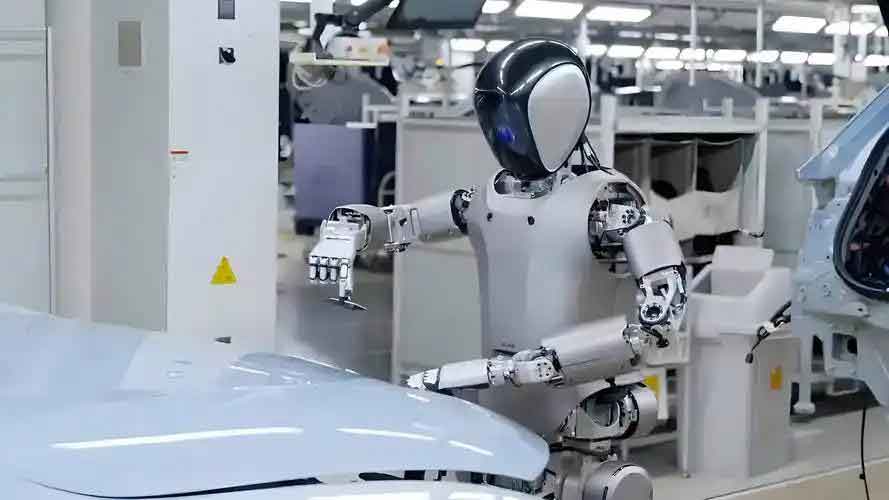
Observing the humanoid robot contestants up close was transformative. The winning unit stood 1.8 meters tall, its design a marvel of integration. The team had solved critical hardware challenges and optimized motion control algorithms. Its low-inertia leg structure combined with high-power integrated joints allowed for efficient, forceful strides. The embodied intelligence platform governing its actions was the core of its adaptability. This experience cemented my belief that the evolution of the humanoid robot is not incremental but exponential. Every humanoid robot on that track was a testbed for theories in biomechanics and control systems. For instance, the torque \(\tau\) required at a joint for a humanoid robot to maintain dynamic balance during a stride can be modeled using a simplified equation: $$\tau = I \alpha + m \times g \times d \times \sin(\theta) + F_{ext} \times r$$ where \(I\) is the moment of inertia, \(\alpha\) angular acceleration, \(m\) mass, \(g\) gravity, \(d\) center of mass offset, \(\theta\) joint angle, \(F_{ext}\) external forces, and \(r\) moment arm. Teams minimized \(I\) and optimized \(\theta(t)\) trajectories to reduce energy expenditure.
The diversity of humanoid robot models was astonishing. To encapsulate the technological landscape, I’ve compiled data from observations and post-race analyses into the following table. It highlights key parameters and innovations among several prominent humanoid robot types that participated or are representative of the field.
| Humanoid Robot Model (Representative) | Height (m) | Key Structural Innovation | Notable Performance Feature | Estimated Power Density (W/kg) |
|---|---|---|---|---|
| Alpha-Type (e.g., Winner) | 1.80 | High-power integrated joints, low-inertia legs | Average speed ~10 km/h, long endurance | ~250 |
| Beta-Type (Lightweight Agile) | 1.65 | Composite plastic structure, modular battery bay | Fast battery swap, reduced weight for efficiency | ~220 |
| Gamma-Type (Bio-inspired) | 1.75 | Elastic joint actuation, dynamic center-of-mass control | Human-like gait, terrain adaptation, energy recovery | ~235 |
| Delta-Type (General Purpose) | 1.70 | Standardized actuator modules, robust sensing suite | Balanced performance across metrics | ~200 |
This table underscores that every humanoid robot is a unique solution to the trilemma of stability, speed, and stamina. The power density, calculated as $$P_d = \frac{P_{max}}{m}$$ where \(P_{max}\) is maximum actuator power output and \(m\) is total mass, is a critical figure of merit. Higher \(P_d\) often correlates with better dynamic performance, but thermal management and control complexity increase. The race was a brutal test of these parameters. For a humanoid robot to sustain running, its total energy consumption \(E_{total}\) over distance \(d\) can be approximated by: $$E_{total} = \int_{0}^{t} \sum_{i=1}^{n} (P_{joint,i}(t) + P_{compute}(t)) \, dt $$ where \(P_{joint,i}\) is the power at the i-th joint (a function of torque and velocity), and \(P_{compute}\) is the power for the AI platform. Teams minimized this integral through hardware-software co-design.
The implications of this humanoid robot marathon extend far beyond a sporting event. It served as a massive, open-air laboratory. Each stride taken by a humanoid robot generated terabytes of data on locomotion dynamics. The collective learning from this event will accelerate algorithms for balance, navigation, and energy management. The humanoid robot platform is poised to revolutionize sectors from logistics to elderly care. Witnessing this, I reflected on the parallel developments in other industries. Shortly before the marathon, I attended a high-level international hospitality alliance meeting. While focused on tourism and hotel management, the underlying themes of technological integration, service automation, and global cooperation resonated deeply. Discussions there hinted at future intersections where humanoid robots could serve as concierges, porters, or maintenance staff. The convergence is inevitable.
Delving deeper into the technicalities, the control architecture of a modern humanoid robot is hierarchical. At the lowest level, joint servo control ensures precise torque output. This can be modeled with a PID controller law: $$u(t) = K_p e(t) + K_i \int_{0}^{t} e(\tau) \, d\tau + K_d \frac{de(t)}{dt}$$ where \(u(t)\) is the control signal (e.g., motor current), \(e(t)\) is the error between desired and actual joint angle, and \(K_p, K_i, K_d\) are tuning gains. For a running humanoid robot, these gains must adapt in real-time to ground impact forces. At a higher level, the gait pattern generator uses algorithms like Zero Moment Point (ZMP) or Model Predictive Control (MPC). The ZMP condition for dynamic stability is that the ground reaction force must intersect the support polygon. For a bipedal humanoid robot, this is a constant optimization challenge during the single-support phase.
Energy efficiency was a decisive factor in the marathon. Some humanoid robot designs incorporated passive elastic elements and regenerative braking in joints, effectively recycling kinetic energy. The energy recovery efficiency \(\eta_{rec}\) can be expressed as: $$\eta_{rec} = \frac{E_{recovered}}{E_{dissipated}} \times 100\%$$ where \(E_{dissipated}\) is the energy normally lost as heat during deceleration or foot strike. Advanced humanoid robot platforms achieved \(\eta_{rec}\) estimates of 15-25%, significantly extending operational time. This is crucial for practical deployment. The marathon also highlighted software brilliance. The embodied AI platform, which I learned integrates multi-sensor fusion (IMU, vision, force/torque) and real-time trajectory planning, was the “brain” of the champion humanoid robot. Its state estimation filter, likely an extended Kalman filter (EKF), fused data to estimate the humanoid robot’s pose and velocity in world coordinates.
To further quantify the progress, consider the historical context. A decade ago, a humanoid robot walking a few kilometers was breakthrough news. Today, a humanoid robot completing a half-marathon marks a paradigm shift. The table below contrasts key endurance and mobility metrics for humanoid robots across eras, based on published research and this event’s data.
| Era / Benchmark | Typical Operational Time (hours) | Typical Continuous Travel Distance (km) | Dominant Locomotion Mode | Key Limiting Factor |
|---|---|---|---|---|
| Early Generation (pre-2020) | 0.5 – 1 | < 1 | Static walking, flat surfaces | Battery capacity, actuator overheating |
| Current State-of-the-Art (2025) | 2 – 4 | 10 – 25 | Dynamic running, mild terrain | Energy efficiency, joint durability, control stability |
| Projected Next-Generation (2030+) | 8+ | 50+ | Adaptive running, complex terrain | AI reasoning, material science, power density |
The trajectory is clear. Each iteration of the humanoid robot brings us closer to machines capable of sharing our physical spaces seamlessly. The marathon was a stress test for reliability—every kilometer logged by a humanoid robot under race conditions provides invaluable failure mode data. This accelerates the design feedback loop. The mathematical modeling of a humanoid robot’s thermal management is also critical. The heat generation \(Q_{gen}\) in an actuator is roughly proportional to the square of the current: $$Q_{gen} \propto I^2 R t$$ where \(I\) is current, \(R\) resistance, and \(t\) time. Over a 2.7-hour race, managing \(Q_{gen}\) to prevent performance degradation or shutdown is a feat of thermal engineering.
The societal and economic dimensions are equally profound. Events like this humanoid robot marathon dramatically raise public awareness. Seeing a humanoid robot persevere over 21 kilometers shatters preconceived limitations. It sparks imagination about applications in disaster response, where a humanoid robot could traverse rubble; in exploration, where a humanoid robot could operate in environments designed for humans; or in daily life, as a companion or helper. The hospitality meeting I attended, while not directly about robotics, was permeated by discussions on smart hotels and automated services. It’s not a leap to imagine a future where a sophisticated humanoid robot handles check-ins, luggage, and even personalized guest interactions. The synergy between these fields—advanced robotics and service industries—will be a powerful driver for commercialization.
From a research perspective, the marathon provided a standardized benchmark. Performance can now be measured in a unified way: distance, time, energy consumed, number of falls, etc. This allows for direct comparison between different humanoid robot architectures. For example, we can define a ‘Marathon Performance Index’ \(MPI\) for a humanoid robot as a combined metric: $$MPI = \frac{d}{t \cdot E_{total}} \cdot \frac{1}{N_{falls}+1}$$ where \(d\) is distance completed, \(t\) is time, \(E_{total}\) is total energy consumed, and \(N_{falls}\) is the number of falls. A higher \(MPI\) indicates a more efficient, stable, and capable humanoid robot. Such metrics drive competition and innovation.
My personal reflection is one of optimism tempered by realism. The humanoid robot I saw triumph is a masterpiece of engineering, but it is still a specialized machine. The path to a general-purpose humanoid robot that can perform a wide array of tasks in unstructured environments is long. Key challenges remain: dexterous manipulation, human-robot interaction safety, cost reduction, and the development of truly common-sense AI. However, the progress displayed was undeniable. The collaboration between universities, research institutes, and companies was evident at the event. This ecosystem is vital. Just as the hospitality alliance meeting fostered partnerships across borders, the humanoid robot community is increasingly global, with knowledge sharing accelerating progress.
In conclusion, my firsthand experience at the inaugural humanoid robot half-marathon was a window into a rapidly approaching future. The relentless advance of the humanoid robot as a platform is a story of interdisciplinary triumph—mechanical engineering, electrical systems, computer science, and AI converging. The formulas and tables I’ve included only scratch the surface of the underlying complexity. Every humanoid robot on that track was a testament to human ingenuity. As these machines become more capable, affordable, and integrated into our socioeconomic fabric, they will transform work, aid society, and perhaps redefine our relationship with technology. The race was not just about which humanoid robot reached the finish line first, but about how fast the entire field is moving forward. And from where I stood, the pace is breathtaking.