
The atmosphere at a major global robotics exhibition is always one of palpable anticipation. Visitors stream past booths showcasing robotic arms welding with uncanny precision, agile quadrupeds navigating obstacle courses, and autonomous vehicles. Yet, a distinct buzz consistently gathers around a particular exhibit: the humanoid robot. There, a machine with a familiar bipedal form engages with attendees, perhaps delivering a speech with expressive gestures or carefully handling objects. Observers aren’t just watching a machine perform a task; they are glimpsing a potential future where machines share our morphology and, to some extent, our space. One such platform, a notably advanced humanoid robot capable of complex manipulation and interaction, recently drew significant attention and praise from industry leaders for its capabilities and design. This moment was not an isolated incident but a signpost, indicating that the long-anticipated surge in humanoid robot development is transitioning from laboratory dreams to tangible, competitive prototypes. Analysts project that by 2030, the annual shipment volume of humanoid robots in China could reach several hundred thousand units, representing a market valued in the tens of billions of dollars. Many experts now concur that the industry stands on the precipice of an explosive growth phase.
Our journey to this point has been one of persistent, incremental progress—an eighteen-year odyssey of focused research and development. The foundation was laid not with grand, human-scale machines, but with a more modest goal: a 60-centimeter-tall humanoid robot designed for soccer. The challenge of dynamic balance, perception, and coordinated movement in a competitive environment provided a perfect testing ground. Success in this arena, marked by consistent national championships and notable international performances, validated core algorithms for locomotion and real-time control. This long-term commitment, a true “grinding of the sword” over nearly two decades, established the essential bedrock of expertise in legged mobility and system integration.
The evolution from a soccer-playing robot to a general-purpose platform required significant leaps. The next milestone was a humanoid robot capable of playing table tennis, capable of hundreds of sustained rallies and adapting to different spins and shots. This breakthrough demanded not just stable walking, but dynamic, full-body coordination, rapid response from visual sensors to actuators, and sophisticated trajectory planning. The algorithms developed here, particularly those fusing model-based control with learning-based adaptation, became a cornerstone of our approach. The formula governing the robot’s planned striking trajectory, considering the ball’s incoming spin and velocity, can be simplified as finding the optimal joint angles $\theta^*$ to intercept the ball at position $\mathbf{p}_{ball}$ with the paddle orientation $\mathbf{R}_{paddle}$:
$$\theta^* = \underset{\theta}{\arg\min} \left( \| \text{ForwardKinematics}(\theta) – \mathbf{p}_{ball} \|^2 + \lambda \| \mathbf{R}_{paddle}(\theta) – \mathbf{R}_{target} \|^2 \right)$$
where $\lambda$ balances the position and orientation objectives. This work on fast, adaptive movement paved the way for more generalized operation.
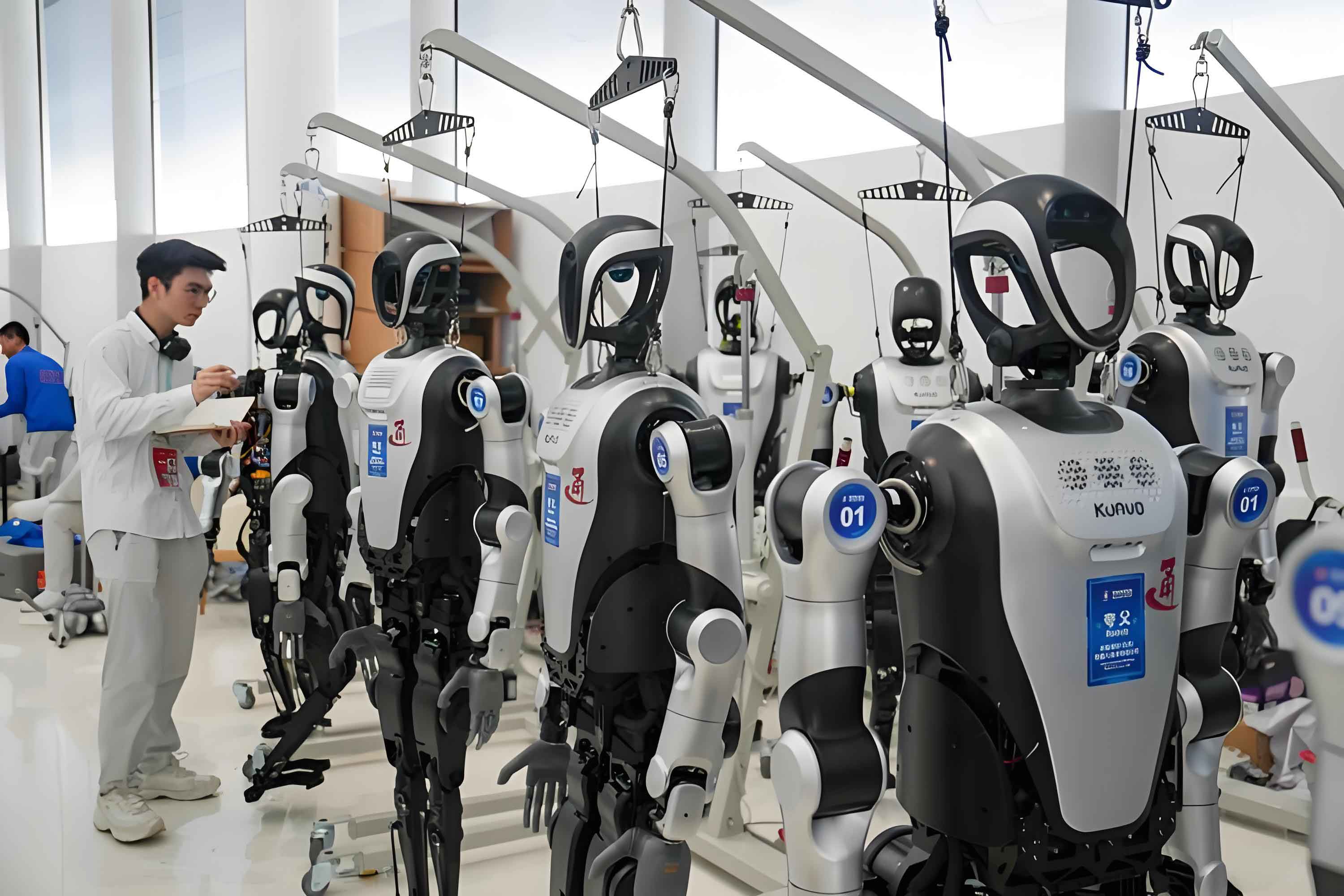
The first major manifestation of this accumulated knowledge was the debut of “Pioneer 1.” Standing 150 cm tall and weighing 50 kg, this humanoid robot represented a fully self-developed system, from its hardware architecture to its core control algorithms. Its capabilities were demonstrated through practical tasks: wiping a table, serving drinks, and lifting objects with both hands. The public unveiling, where two units interacted seamlessly with guests, was a definitive statement. The robot’s stability and dexterity were the direct result of our “mechanism-learning fusion” control methodology. This approach combines the predictable stability of physics-based dynamic models with the adaptability of machine learning. The fundamental equation for whole-body dynamics control is:
$$\mathbf{M}(\mathbf{q})\ddot{\mathbf{q}} + \mathbf{C}(\mathbf{q}, \dot{\mathbf{q}}) + \mathbf{G}(\mathbf{q}) = \boldsymbol{\tau}_{cmd} + \boldsymbol{\tau}_{ext}$$
where $\mathbf{M}$ is the inertia matrix, $\mathbf{C}$ represents Coriolis and centrifugal forces, $\mathbf{G}$ is gravity, $\mathbf{q}$ denotes joint angles, and $\boldsymbol{\tau}_{cmd}$ and $\boldsymbol{\tau}_{ext}$ are the commanded and external torques, respectively. Our innovation lies in using deep reinforcement learning to refine the torque command $\boldsymbol{\tau}_{cmd}$ to compensate for the inevitable inaccuracies in the modeled dynamics $\mathbf{M}, \mathbf{C}, \mathbf{G}$, especially during complex contact-rich manipulations.
Momentum accelerated rapidly following this proof-of-concept. Critical support arrived through strategic partnerships and investment from industrial automation leaders. These allies provided not just capital—with significant funding rounds valuing the endeavor highly—but also indispensable industrial-grade software expertise, rigorous reliability standards, and access to vast application scenarios. This synergy between academic research and industrial pragmatism is vital for transitioning a humanoid robot from a lab prototype to a field-ready platform.
The fruits of this collaborative push were unveiled just months later with “Pioneer 2.” This next-generation humanoid robot, taller and more refined, was designed to be more capable and human-like. The specifications marked clear progress across the board, as summarized in the table below.
| Feature | Pioneer 1 | Pioneer 2 |
|---|---|---|
| Height / Weight | 150 cm / 50 kg | 165 cm / 60 kg |
| AI Compute (GPU) | ~50 TeraOPS | 275 TeraOPS |
| Arm Payload (per arm) | 3 kg | 5 kg |
| Arm Positioning Accuracy | 0.5 mm | 0.1 mm |
| Hand Dexterity (Fingertip Force) | ~5 N | 10 N |
| Key Technological Focus | Full-body motion, basic manipulation | Embodied AI, imitation learning, robust navigation |
The performance leaps are underpinned by specific technological pillars. The first is Whole-Body Coordinated Stable Locomotion. Achieving natural, robust walking over uneven terrain remains a supreme challenge for any humanoid robot. Our control stack integrates a hierarchical scheme: a high-level planner generates footstep locations, a model predictive controller (MPC) solves for optimal body trajectory and foot forces over a horizon, and a low-level whole-body controller (WBC) maps these to precise joint torque commands in real-time. The MPC optimization at time step $k$ can be formulated as:
$$\min_{\mathbf{u}_{k:k+H}} \sum_{i=k}^{k+H} \left( \| \mathbf{x}_i – \mathbf{x}_i^{ref} \|_{\mathbf{Q}}^2 + \| \mathbf{u}_i \|_{\mathbf{R}}^2 \right)$$
$$\text{subject to: } \mathbf{x}_{i+1} = f(\mathbf{x}_i, \mathbf{u}_i), \quad \mathbf{u}_{min} \leq \mathbf{u}_i \leq \mathbf{u}_{max}, \quad \mathbf{C}(\mathbf{x}_i, \mathbf{u}_i) \leq 0$$
where $\mathbf{x}$ is the state (e.g., center-of-mass position/velocity, torso orientation), $\mathbf{u}$ is the control input (e.g., footstep positions, ground reaction forces), $H$ is the prediction horizon, and $\mathbf{C}$ represents constraints like friction cones and joint limits.
The second pillar is Imitation and Reinforcement Learning for Manipulation. Programming a humanoid robot for every conceivable task is impossible. Instead, we employ imitation learning, where the robot learns skills from human demonstration data (motion capture), and reinforcement learning (RL), where it optimizes policies through trial-and-error in simulation. The policy $\pi_\phi(\mathbf{a}_t | \mathbf{o}_t)$, parameterized by $\phi$, maps observations $\mathbf{o}_t$ to actions $\mathbf{a}_t$. It is trained to maximize the expected cumulative reward:
$$J(\phi) = \mathbb{E}_{\tau \sim p_\phi(\tau)} \left[ \sum_{t=0}^{T} \gamma^t r(\mathbf{s}_t, \mathbf{a}_t) \right]$$
where $\tau = (\mathbf{s}_0, \mathbf{a}_0, \dots, \mathbf{s}_T)$ is a trajectory, $\gamma$ is a discount factor, and $r$ is a reward function engineered to encourage successful, energy-efficient, and safe task completion. This data-driven approach is key to enabling generalizable manipulation.
The third pillar is Embodied AI Navigation. For a humanoid robot to operate autonomously in human environments, it must understand and navigate its surroundings. This goes beyond simple SLAM (Simultaneous Localization and Mapping). It involves a multi-modal perception system (cameras, LiDAR, IMU) feeding into an embodied AI model that maintains a semantic understanding of the world—identifying doors, chairs, tables, and obstacles. Navigation then becomes a task of planning a collision-free path through this understood space while considering the robot’s unique kinematics and dynamics, a significant step beyond wheeled robot navigation.
Despite these advances, the path to ubiquitous humanoid robot adoption is fraught with challenges. The primary hurdles can be categorized and are driving our current research and collaboration efforts.
| Challenge Category | Specific Issues | Current Focus & Collaborative Needs |
|---|---|---|
| Hardware & Cost | High-performance actuators, durable yet lightweight materials, low-cost high-precision sensors (force/torque, tactile). High unit cost inhibits scaling. | Partnering with component manufacturers for customized, volume-production-ready designs. Exploring novel actuator designs (e.g., series elastic actuators, hydraulic/electric hybrids). |
| Software & Intelligence | Robust real-time control under uncertainty, generalizable task learning, long-horizon planning, safe human-robot interaction. | Developing foundation models for robotics, simulation-to-real transfer techniques, and standardized middleware for easier software development. |
| Power & Endurance | Energy density of batteries limits operational time. Efficient locomotion and manipulation are critical. | Research into dynamic walking gaits that minimize energy consumption per distance traveled, and smart power management systems. |
| Safety & Certification | Establishing safety standards for close human interaction, fail-safe mechanisms, ethical operation guidelines. | Working with regulatory bodies and standards organizations to define testing protocols and safety requirements for humanoid robots. |
Confronting these challenges cannot be done in isolation. It requires a robust ecosystem. This understanding led to the establishment of a regional humanoid robot industry alliance, co-founded by our center alongside leading research institutes and technology companies. The alliance’s goal is to break down silos, synchronize R&D roadmaps, and accelerate the maturation of the entire supply chain. Furthermore, strategic framework agreements have been signed with major industrial groups, spanning sectors from electronics and aerospace to automotive, to ensure the technology is developed with real-world application demands in mind.
This ecosystem thrives on strong regional foundations. Our base is located in a city with a remarkably mature robotics supply chain. It is one of the few regions domestically with a complete layout covering the three core components of robotics: precision reducers, servo motors, and controllers. Furthermore, it hosts a diverse array of manufacturers producing industrial, service, and special-purpose robots. This dense industrial cluster provides an unparalleled advantage. Over half of the upstream suppliers we are engaging with for component development and integration are located within this metropolitan area, enabling rapid prototyping, iterative testing, and close collaboration. The table below outlines the synergistic ecosystem.
| Ecosystem Layer | Regional Strengths & Entities | Contribution to Humanoid Robot Development |
|---|---|---|
| Core Components | Manufacturers of RV/harmonic reducers, high-torque-density servo motors, motion controllers. | Provides foundational hardware. Collaborative R&D is crucial for developing actuators meeting the unique size, weight, and power (SWaP) requirements of humanoid robots. |
| Perception & AI | Nearby hub with world-class universities and AI companies specializing in computer vision, sensor fusion, and machine learning algorithms. | Provides the “brain” software. Collaboration focuses on embodied AI, real-time perception, and robust navigation algorithms tailored for a bipedal platform. |
| System Integration & Manufacturing | Established industrial robot integrators and advanced manufacturing facilities. | Provides expertise in system reliability, quality control, and eventual scalable production processes for humanoid robot assembly. |
| Application Pilots | Diverse local industries: automotive, electronics, home appliances, port logistics, healthcare. | Provides real-world testing grounds and defines concrete use cases, from high-precision assembly and warehouse logistics to patient care assistance. |
This “dual-city” dynamic—where one area excels in hardware manufacturing and industrial integration, and the other in software intelligence—creates a powerful, complementary force. It catalyzes the entire humanoid robot industry value chain, from core components and algorithm development to system integration and final application. Our role is to sit at the nexus of this ecosystem, integrating the best hardware with the most advanced AI to create a truly capable and useful general-purpose humanoid robot.
The road ahead is long. The vision of a humanoid robot seamlessly assisting in every home and factory is a decades-long endeavor. However, the convergence of sustained academic research, strategic industrial investment, a supportive policy environment, and a mature regional supply chain has created a unique moment of opportunity. The “pre-eruption” phase is characterized not by quiet, but by intense activity—rapid prototyping, forging strategic partnerships, solving critical technical bottlenecks, and exploring initial commercial applications. We are no longer just building robots; we are actively participating in the construction of an entire new industry. Each step forward in locomotion stability, each successful demonstration of dexterous manipulation, and each new industrial partner brought into the fold brings the era of the practical, widespread humanoid robot closer to reality.