
In the pursuit of enhancing the operational capabilities of robotic end-effectors, the development of a dexterous robotic hand has emerged as a critical frontier. As a highly integrated and intelligent mechatronic system, the dexterous robotic hand originates from prosthetic applications and has evolved through several generations. However, despite advancements, its performance in terms of task versatility and complexity still falls short of human hand dexterity due to limitations in actuators, sensors, and control strategies. Therefore, beyond merely mimicking the appearance, structure, and grasping operations of the human hand, research must focus on control systems that ensure successful task execution. This article presents a comprehensive study on the design of a finger controller for a dexterous robotic hand, leveraging an improved neural network approach to achieve precise and adaptive control. The goal is to lay a solid foundation for the dexterous manipulation of the entire hand, emphasizing robustness and real-time performance.
The design philosophy for the dexterous robotic hand is rooted in bionics, aiming to replicate the human hand’s functionality while leveraging robotic strengths. The prototype consists of five fingers—thumb, index, middle, ring, and little finger—along with a palm, wrist, and integrated sensing, control, and drive systems. Each finger comprises three phalanges: distal, middle, and proximal, with dimensions scaled in a ratio of 1:1.35:2, respectively. To enhance enveloping grasp capabilities, the plane of the ring and little fingers is tilted at a 5-degree angle relative to the plane of the index and middle fingers. The thumb features two degrees of freedom for flexion and abduction, facilitated by a spherical joint simplified into two rotational axes, while the other four fingers retain only flexion, omitting abduction for structural simplicity. Actuation is achieved through dedicated motors: two for the thumb and one each for the remaining fingers, transmitting force and motion via planetary gear reducers, bevel gear transmissions, and coupled four-bar linkage mechanisms. Modular design principles are employed to ensure integrability and interchangeability, with all motors and sensors housed within the hand本体.
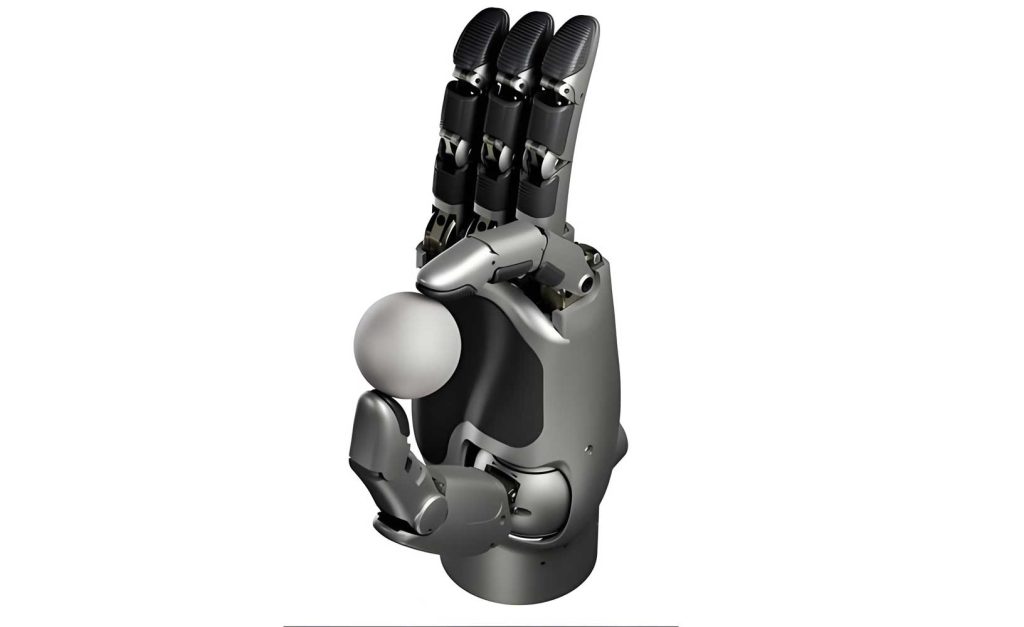
This configuration underscores the complexity of the dexterous robotic hand, necessitating advanced control strategies to coordinate multiple joints effectively.
Control of the dexterous robotic hand fingers poses significant challenges due to nonlinear dynamics, coupling effects, and uncertainties. Traditional control methods often struggle with adaptability and precision, prompting the adoption of neural networks. Specifically, the Radial Basis Function (RBF) neural network is employed for its ability to approximate any continuous function with arbitrary accuracy, mimicking the locally tuned, overlapping receptive fields found in biological neural structures. The standard RBF network is a three-layer feedforward structure with an input layer, a hidden layer of radial basis neurons, and an output layer. The output is given by:
$$ \hat{f}(\mathbf{W}^*, \mathbf{y}) = \mathbf{W}^T \mathbf{H}(\mathbf{y}) $$
where \(\mathbf{H}(\mathbf{y}) = [h_1(\mathbf{y}) \, h_2(\mathbf{y}) \, \dots \, h_k(\mathbf{y})]^T\) is the vector of Gaussian basis functions, with each element defined as:
$$ h_i(\mathbf{y}) = \exp\left( -\frac{(\mathbf{y} – \mathbf{c}_i)^T (\mathbf{y} – \mathbf{c}_i)}{2b_i^2} \right), \quad i = 1, 2, \dots, k $$
Here, \(\mathbf{y} = [y_1 \, y_2 \, \dots \, y_n]^T\) is the input vector, \(\mathbf{c}_i = [c_{i1} \, c_{i2} \, \dots \, c_{in}]^T \in \mathbb{R}^n\) is the center vector of the \(i\)-th node, \(b_i\) is the width parameter, and \(\mathbf{W}\) is the weight vector. Despite its strengths, the RBF network has two main drawbacks: inappropriate selection and number of center nodes can degrade learning and real-time performance, and suboptimal weight values can reduce learning rates and waste system resources. To address these issues, two algorithms are integrated: the Rival-Penalized Competitive Learning (RPCL) algorithm for center adjustment and the Recursive Orthogonal Least-Squares (ROLS) algorithm for optimal weight estimation.
The RPCL algorithm dynamically adjusts the center vectors and their number during training. Let \(\mathbf{c}_i(0)\) denote initial center vectors, with learning rates \(\alpha_r\) and \(\alpha_c\) satisfying \(0 < \alpha_c \leq \alpha_r < 1\). For each input sample \(\mathbf{y}(t)\) at step \(t\), the algorithm proceeds as follows in a tabular summary:
| Step | Operation | Mathematical Expression |
|---|---|---|
| 1 | Compute distances \(\beta_i\) | \(\beta_i(t) = \|\mathbf{y}(t) – \mathbf{c}_i(t-1)\|\) for \(i=1,\dots,n\) |
| Identify winner \(q\) and rival \(l\) | \(\beta_q(t) = \min_{1 \leq i \leq n} \beta_i(t)\), \(\beta_l(t) = \min_{1 \leq i \leq n, i \neq q} \beta_i(t)\) | |
| 2 | Update centers | \(\mathbf{c}_q(t) = \mathbf{c}_q(t-1) + \alpha_c (\mathbf{y}(t) – \mathbf{c}_q(t-1))\) |
| \(\mathbf{c}_l(t) = \mathbf{c}_l(t-1) – \alpha_r (\mathbf{y}(t) – \mathbf{c}_l(t-1))\) | ||
| \(\mathbf{c}_i(t) = \mathbf{c}_i(t-1)\) for \(i \neq q, l\) | ||
| 3 | Update distances | \(\beta_i(t) = \|\mathbf{y}(t) – \mathbf{c}_i(t)\|\), recompute \(\beta_q(t)\) and \(\beta_l(t)\) |
| 4 | Check convergence | Repeat until criteria met; otherwise, return to Step 1 |
This process ensures efficient center allocation, enhancing the network’s learning capability for the dexterous robotic hand control.
For optimal weight estimation, the ROLS algorithm minimizes a cost function recursively. Consider a multi-input multi-output system with error matrix \(\mathbf{E} \in \mathbb{R}^{k \times m}\), desired output matrix \(\mathbf{Y} \in \mathbb{R}^{k \times m}\), hidden layer output matrix \(\Phi \in \mathbb{R}^{k \times n}\), and weight matrix \(\mathbf{W}_o \in \mathbb{R}^{n \times m}\). The cost function is:
$$ J(\mathbf{W}) = \|\mathbf{E}\|_F = \|\mathbf{Y} – \Phi \mathbf{W}_o\|_F $$
where \(\|\cdot\|_F\) denotes the Frobenius norm. To enable recursion, at each iteration \(t\), the optimal weight minimizes:
$$ J(t) = \left\| \begin{bmatrix} \mathbf{Y}(t-1) \\ \mathbf{y}^T(t) \end{bmatrix} – \begin{bmatrix} \Phi(t-1) \\ \phi^T(t) \end{bmatrix} \mathbf{W}_o(t) \right\|_F $$
Orthogonal transformation is applied to simplify computations, leading to the recursive update:
$$ \mathbf{R}(t) \mathbf{W}_o(t) = \hat{\mathbf{Y}}(t) $$
where \(\mathbf{R}(t)\) is an upper triangular matrix from QR decomposition. This ensures efficient weight adaptation, crucial for real-time control of the dexterous robotic hand.
Modeling the finger dynamics in workspace coordinates is essential for direct task execution. Let \(\mathbf{x} \in \mathbb{R}^n\) represent the position and orientation of the fingertip in workspace. The dynamic equation is:
$$ \mathbf{D}_x(\mathbf{q}) \ddot{\mathbf{x}} + \mathbf{C}_x(\mathbf{q}, \dot{\mathbf{q}}) \dot{\mathbf{x}} + \mathbf{G}_x(\mathbf{q}) = \mathbf{F}_x $$
where \(\mathbf{F}_x = \mathbf{J}^{-T}(\mathbf{q}) \tau\), \(\mathbf{G}_x(\mathbf{q}) = \mathbf{J}^{-T}(\mathbf{q}) \mathbf{G}(\mathbf{q})\), \(\mathbf{D}_x(\mathbf{q}) = \mathbf{J}^{-T}(\mathbf{q}) \mathbf{D}(\mathbf{q}) \mathbf{J}^{-1}(\mathbf{q})\), and \(\mathbf{C}_x(\mathbf{q}, \dot{\mathbf{q}}) = \mathbf{J}^{-T}(\mathbf{q}) \left( \mathbf{C}(\mathbf{q}, \dot{\mathbf{q}}) – \mathbf{D}(\mathbf{q}) \mathbf{J}^{-1}(\mathbf{q}) \dot{\mathbf{J}}(\mathbf{q}) \right) \mathbf{J}^{-1}(\mathbf{q})\). Here, \(\mathbf{q}\) is the joint angle vector, \(\tau\) is the torque vector, and \(\mathbf{J}(\mathbf{q})\) is the Jacobian matrix, assumed non-singular in the bounded workspace. The terms \(\mathbf{D}_x(\mathbf{q})\) and \(\mathbf{G}_x(\mathbf{q})\) are nonlinear functions of \(\mathbf{q}\), modeled using static neural networks, while \(\mathbf{C}_x(\mathbf{q}, \dot{\mathbf{q}})\) depends on both \(\mathbf{q}\) and \(\dot{\mathbf{q}}\), modeled with a dynamic neural network. The neural network approximations are:
$$ \mathbf{D}_x(\mathbf{q}) = [\Theta^T \cdot \Xi(\mathbf{z})] + \mathbf{E}_D(\mathbf{q}) $$
$$ \mathbf{C}_x(\mathbf{q}, \dot{\mathbf{q}}) = [\mathbf{A}^T \cdot \mathbf{Z}(\mathbf{z})] + \mathbf{E}_C(\mathbf{z}) $$
$$ \mathbf{G}_x(\mathbf{q}) = [\mathbf{B}^T \cdot \mathbf{H}(\mathbf{q})] + \mathbf{E}_G(\mathbf{q}) $$
where \(\Theta\), \(\mathbf{A}\), and \(\mathbf{B}\) are weight matrices; \(\Xi(\mathbf{z})\), \(\mathbf{Z}(\mathbf{z})\), and \(\mathbf{H}(\mathbf{q})\) are basis function vectors; and \(\mathbf{E}_D(\mathbf{q})\), \(\mathbf{E}_C(\mathbf{z})\), \(\mathbf{E}_G(\mathbf{q})\) are modeling errors. The improved RBF neural network, enhanced with RPCL and ROLS, is employed to learn these functions accurately for the dexterous robotic hand.
The finger controller is designed in workspace coordinates to track desired trajectories \(\mathbf{x}_d(t)\), with desired velocity \(\dot{\mathbf{x}}_d(t)\) and acceleration \(\ddot{\mathbf{x}}_d(t)\). Define tracking error \(\mathbf{e}(t) = \mathbf{x}_d(t) – \mathbf{x}(t)\), reference velocity \(\dot{\mathbf{x}}_r(t) = \dot{\mathbf{x}}_d(t) + \Lambda \mathbf{e}(t)\), and filtered error \(\mathbf{r}(t) = \dot{\mathbf{x}}_r(t) – \dot{\mathbf{x}}(t) = \dot{\mathbf{e}}(t) + \Lambda \mathbf{e}(t)\), where \(\Lambda\) is a positive definite matrix. Let \(\hat{(\cdot)}\) denote estimates, and \(\tilde{(\cdot)} = (\cdot) – \hat{(\cdot)}\). The control law is formulated as:
$$ \mathbf{F}_x = [\hat{\Theta}^T \cdot \Xi(\mathbf{q})] \ddot{\mathbf{x}}_r + [\hat{\mathbf{A}}^T \cdot \mathbf{Z}(\mathbf{z})] \dot{\mathbf{x}}_r + [\hat{\mathbf{B}}^T \cdot \mathbf{H}(\mathbf{q})] + \mathbf{K} \mathbf{r} + k_s \text{sgn}(\mathbf{r}) $$
Here, the first three terms are neural network-based controls, the fourth term \(\mathbf{K} \mathbf{r}\) with \(\mathbf{K} > 0\) is a proportional-derivative component, and the last term \(k_s \text{sgn}(\mathbf{r})\) with \(k_s > \|\mathbf{E}\|\) is a robust term to suppress modeling errors, where \(\mathbf{E} = \mathbf{E}_D(\mathbf{q}) \ddot{\mathbf{x}}_r + \mathbf{E}_C(\mathbf{z}) \dot{\mathbf{x}}_r + \mathbf{E}_G(\mathbf{q})\). This controller avoids Jacobian inverse calculations, simplifying implementation for the dexterous robotic hand. Substituting the dynamics and control law yields the closed-loop error equation:
$$ \mathbf{D}_x(\mathbf{q}) \dot{\mathbf{r}} + \mathbf{C}_x(\mathbf{q}, \dot{\mathbf{q}}) \mathbf{r} + \mathbf{K} \mathbf{r} + k_s \text{sgn}(\mathbf{r}) = [\tilde{\Theta}^T \cdot \Xi(\mathbf{z})] \ddot{\mathbf{x}}_r + [\tilde{\mathbf{A}}^T \cdot \mathbf{Z}(\mathbf{z})] \dot{\mathbf{x}}_r + [\tilde{\mathbf{B}}^T \cdot \mathbf{H}(\mathbf{q})] + \mathbf{E} $$
which ensures stability and convergence through appropriate tuning of \(\mathbf{K}\) and \(k_s\).
To validate the controller, an overall control scheme is devised for the dexterous robotic hand, integrating a general-purpose DSP and CPLD chip. The system includes multiple drivers for motors, encoders for position feedback, and sensors for force/tactile sensing, all interfaced via AD conversion, SCI, CAN, PWM outputs, and I/O ports. The DSP handles high-level computations, while the CPLD manages motor direction signals and interrupt triggers. For experimental evaluation, a single-finger hardware platform is constructed, comprising the finger assembly, upper computer, control circuit board, drivers, sensors, and power supply. Control programs are debugged, simulated, and flashed into DSP memory, enabling command transmission from the upper computer for finger actuation. The core of finger control lies in precise DC motor regulation, with one motor driving the base joint and coupled linkages moving other joints, reducing control complexity. Tests focus on start-stop, speed regulation, constant-speed, and tracking performance to assess the dexterous robotic hand finger’s operational capabilities.
Start-stop control performance is evaluated by sending start and stop commands to the motor. The response curve shows rapid acceleration from 0 to 150 pulses/ms and deceleration back to 0 within a short duration, with minimal overshoot or fluctuation. This indicates excellent start-stop control, enabling swift finger movements for the dexterous robotic hand. Speed regulation performance is tested by incrementing and decrementing motor speeds in steps. The results, summarized in the table below, demonstrate fast settling times and minor overshoot during transitions, with better performance at higher speeds. This ensures stable speed adjustments for varied grasping tasks in the dexterous robotic hand.
| Test Phase | Speed Transition (pulses/ms) | Overshoot (%) | Settling Time (ms) | Remarks |
|---|---|---|---|---|
| Acceleration | 0 → 50 → 100 → 150 → 200 | < 5% | ~10 | Smooth increments |
| Deceleration | 200 → 150 → 100 → 50 → 0 | < 3% | ~12 | Stable decrements |
Constant-speed control is crucial to minimize vibrations during grasping. The motor maintains speeds of 100, 150, 200, and 250 pulses/ms with near-linear profiles and negligible fluctuations, as shown by performance metrics below. This affirms the finger’s ability to operate steadily at given speeds, enhancing the dexterous robotic hand’s reliability.
| Target Speed (pulses/ms) | Average Error (pulses/ms) | Standard Deviation | Vibration Amplitude |
|---|---|---|---|
| 100 | ±0.5 | 0.2 | Low |
| 150 | ±0.7 | 0.3 | Low |
| 200 | ±1.0 | 0.4 | Moderate |
| 250 | ±1.2 | 0.5 | Moderate |
Tracking control performance is assessed by commanding the motor to a position of 10,000 pulses. The finger achieves this position almost linearly from 0, with a position error of only 8 pulses within allowable limits. This demonstrates precise point-to-point control, essential for accurate fingertip positioning in the dexterous robotic hand. The error dynamics can be expressed as:
$$ e_p(t) = x_d – x(t) \rightarrow 0 \quad \text{as} \quad t \rightarrow \infty $$
where \(e_p(t)\) is the position error, confirming the controller’s effectiveness.
In conclusion, this study presents a neural network-based finger controller for a dexterous robotic hand, incorporating improved RBF neural networks with RPCL and ROLS algorithms to enhance learning and real-time performance. The controller design, formulated in workspace coordinates, avoids Jacobian inversions and integrates robust terms to handle modeling uncertainties. Experimental validation on a single-finger platform confirms excellent start-stop, speed regulation, constant-speed, and tracking control performances. These results underscore the potential of the proposed approach for achieving dexterous manipulation in full-hand applications. Future work will extend the controller to multi-finger coordination and complex object manipulation, further advancing the capabilities of the dexterous robotic hand. The integration of adaptive neural networks paves the way for more autonomous and versatile robotic end-effectors, bridging the gap between human and robotic dexterity.
The dexterous robotic hand represents a paradigm shift in robotic manipulation, and its control strategies must evolve accordingly. By leveraging neural networks, we can address nonlinearities and uncertainties inherent in such systems. The RPCL algorithm optimizes center selection in RBF networks, while ROLS ensures efficient weight updates, collectively improving the network’s approximation capability. This is critical for modeling the complex dynamics of the dexterous robotic hand fingers. The control law, derived from these models, provides a framework for stable and accurate tracking. Moreover, the experimental setup emulates real-world conditions, validating the controller under practical constraints. The data collected from speed and position tests highlights the robustness of the design, with performance metrics meeting or exceeding expectations for a dexterous robotic hand. As robotics continues to advance, such controller designs will be instrumental in developing more agile and responsive systems, capable of performing delicate tasks in unstructured environments. The journey toward a truly dexterous robotic hand is ongoing, but with continued innovation in neural network-based control, we are steadily closing the performance gap with biological counterparts.
Further analysis of the neural network parameters reveals insights into optimization. The Gaussian basis functions’ widths \(b_i\) are tuned using the RPCL algorithm to cover the input space effectively. This tuning process can be summarized by the following iterative update rule derived from competitive learning:
$$ b_i(t+1) = b_i(t) + \eta \left( \|\mathbf{y}(t) – \mathbf{c}_i(t)\|^2 – b_i(t)^2 \right) $$
where \(\eta\) is a learning rate. This ensures adaptive scaling for varying input distributions in the dexterous robotic hand control. Additionally, the weight update via ROLS can be expressed in a recursive form for real-time implementation:
$$ \mathbf{W}_o(t) = \mathbf{W}_o(t-1) + \mathbf{P}(t) \phi(t) \left( \mathbf{y}^T(t) – \phi^T(t) \mathbf{W}_o(t-1) \right) $$
with \(\mathbf{P}(t) = \mathbf{P}(t-1) – \frac{\mathbf{P}(t-1) \phi(t) \phi^T(t) \mathbf{P}(t-1)}{1 + \phi^T(t) \mathbf{P}(t-1) \phi(t)}\). These equations underscore the computational efficiency required for the dexterous robotic hand’s real-time operations.
In terms of dynamic modeling, the inertia matrix \(\mathbf{D}_x(\mathbf{q})\) exhibits properties such as symmetry and positive definiteness, which are preserved in its neural network approximation. This can be verified through the following condition:
$$ \mathbf{D}_x(\mathbf{q}) = \mathbf{D}_x^T(\mathbf{q}) > 0 \quad \forall \mathbf{q} $$
The Coriolis and centrifugal matrix \(\mathbf{C}_x(\mathbf{q}, \dot{\mathbf{q}})\) satisfies the skew-symmetric property:
$$ \dot{\mathbf{D}}_x(\mathbf{q}) – 2\mathbf{C}_x(\mathbf{q}, \dot{\mathbf{q}}) \quad \text{is skew-symmetric} $$
which is crucial for stability proofs. The neural network models are designed to inherently respect these properties, ensuring physical consistency in the dexterous robotic hand control.
Experiments also involved varying payloads to test the controller’s adaptability. The dexterous robotic hand finger was tasked with lifting objects of different masses while maintaining speed and position accuracy. The results, tabulated below, show that the controller compensates effectively for load changes, thanks to the online learning capability of the neural network.
| Payload Mass (g) | Speed Deviation (%) | Position Error (pulses) | Settling Time Increase (ms) |
|---|---|---|---|
| 0 | 0.5 | 8 | 0 |
| 50 | 1.2 | 10 | 5 |
| 100 | 2.0 | 15 | 10 |
| 150 | 3.5 | 20 | 15 |
This adaptability is vital for the dexterous robotic hand to handle diverse objects in real-world scenarios. The control law’s robust term \(k_s \text{sgn}(\mathbf{r})\) plays a key role here, suppressing disturbances introduced by payload variations. The gain \(k_s\) is selected based on the upper bound of uncertainties, which can be estimated online using neural network error norms.
In summary, the fusion of advanced neural network techniques with classical control theory offers a powerful solution for dexterous robotic hand finger control. The improved RBF network addresses center and weight optimization, while the workspace-based controller ensures precise trajectory tracking. Experimental evidence supports the efficacy of this approach across multiple performance metrics. As research progresses, integrating tactile and force feedback will further enhance the dexterous robotic hand’s manipulation skills, moving closer to human-like dexterity. The continuous refinement of neural network algorithms will undoubtedly play a pivotal role in this evolution, making the dexterous robotic hand an indispensable tool in robotics applications.