
The evolution of bionic robots has been a fascinating journey, mirroring our deepening understanding of biological systems and advances in enabling technologies. Reflecting on this trajectory, I observe three distinct historical phases. The initial phase was a period of primitive exploration, characterized by rudimentary mimicry of biological prototypes, such as early ornithopters that mechanically flapped wings, often relying on human power. The second stage emerged in the mid-to-late 20th century, marked by macro-morphological and kinematic biomimicry. The advent of computer technology and new actuation systems enabled robots to replicate biological functions like walking, jumping, and flying with a degree of external control. Entering the 21st century, with profound insights into biological mechanisms and computational power, bionic robotics entered a third phase: the partial integration of electromechanical systems with biological properties. This includes the fusion of traditional structures with biomimetic materials and the adoption of bio-inspired actuation methods.
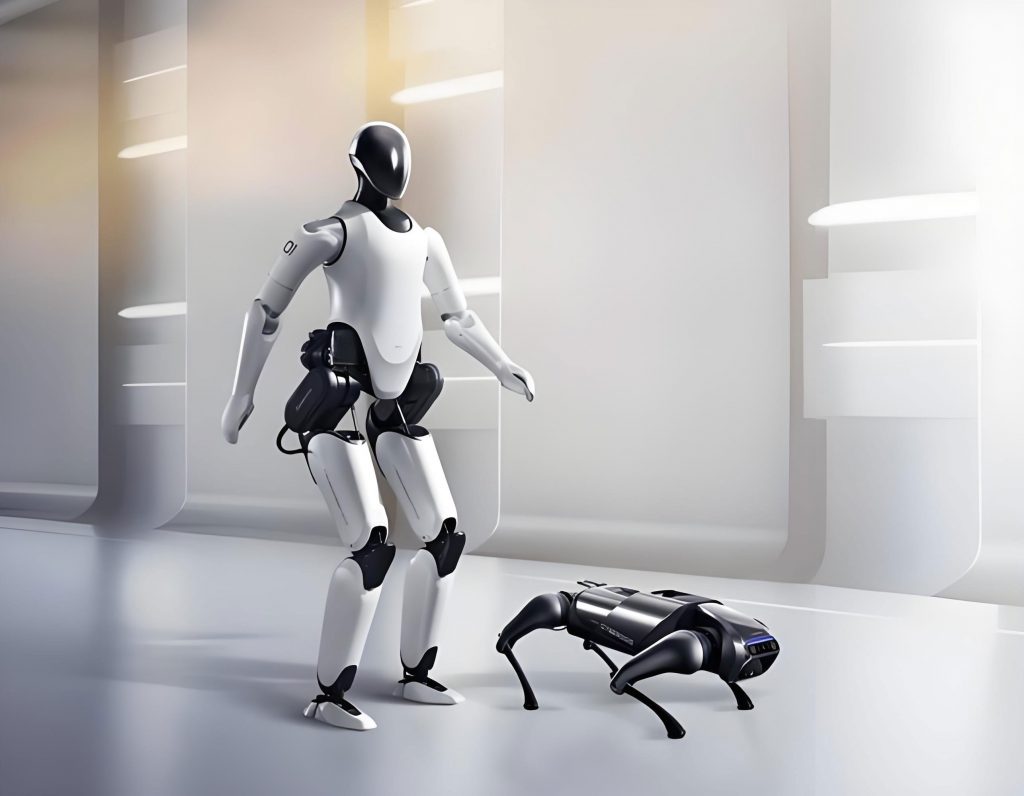
Today, I believe we are transitioning into a pivotal fourth stage. This stage envisions bionic robots as integrated class-life systems, where structure and biological characteristics are unified. The goal is no longer mere imitation of form and motion. The next-generation bionic robot must also possess intrinsic biological properties such as self-awareness, self-regulation, and adaptive control, bringing it closer to its living prototype. This paradigm shift presents a significant breakthrough and a core challenge: how to endow a machine with the self-perceptive and self-controlling traits of life within a laboratory setting using sensor arrays and intelligent control systems. It is within this context that my exploration into simulating a fundamental biological control loop—the neural reflex arc—using accessible Arduino platforms is situated. This work aims to lay a foundational brick in constructing the “nervous system” for future bionic robots.
Biological Foundation of the Neural Reflex Arc
The theoretical underpinning of this work is the reflex arc, a concept solidified by the pioneering work of physiologists like Ivan Pavlov. A reflex is a stereotyped, rapid response to a stimulus, mediated by the central nervous system to maintain an organism’s equilibrium with its environment. The neural pathway that facilitates this response is the reflex arc. It represents the simplest, fastest circuit in the nervous system, bypassing higher cognitive processing to produce a swift reaction, such as withdrawing a hand from a hot surface.
Anatomically, a complete reflex arc consists of five essential components, as outlined in the table below:
| Component | Biological Function | Role in the Reflex Circuit |
|---|---|---|
| 1. Receptor | Detects a specific stimulus (e.g., heat, pressure, stretch). | Transduces the external/physical stimulus into an electrochemical neural signal. |
| 2. Afferent (Sensory) Neuron | Carries sensory information. | Transmits the signal from the receptor towards the central nervous system (CNS). |
| 3. Integration Center (e.g., Spinal Cord) | Processes incoming signals and formulates a response. | Contains interneurons that synapse with the afferent and efferent neurons. It is the decision-making hub of the reflex. |
| 4. Efferent (Motor) Neuron | Carries motor commands. | Transmits the output signal from the integration center to the effector organ. |
| 5. Effector | Executes the response (e.g., muscle, gland). | Produces the action (e.g., muscle contraction) in response to the motor signal. |
The integrity of this arc is paramount; damage to any single component abolishes the reflex. From an engineering perspective, several key physiological properties are critical for a realistic simulation in a bionic robot:
- Unidirectional Conduction & Threshold: Signal flow is strictly from receptor to effector. Furthermore, receptors have activation thresholds; a stimulus must be sufficiently intense to trigger the arc, analogous to a digital logic gate.
- Refractory Periods: After firing, a neuron enters an absolute refractory period during which it cannot be re-stimulated, regardless of stimulus strength. This is followed by a relative refractory period, where the neuron can be re-fired, but only by a stronger-than-normal stimulus. The neuron’s excitability recovers exponentially during this relative period.
- Central Inhibition: Higher brain centers can send inhibitory signals to modulate or suppress reflex actions. This allows for voluntary override of automatic responses, albeit with slower reaction times due to more complex neural pathways.
- Neuromodulation (e.g., by Adrenaline): Chemicals like adrenaline do not generate signals themselves but alter the state of the reflex circuit. They typically lower the activation threshold of receptors and enhance the force of muscular contraction, priming the organism for “fight or flight.”
The biological schematic encapsulating these features is fundamental to the simulation design.
Designing a Bionic Robot Reflex Arc System
To translate the biological reflex arc into an electromechanical analogue for a bionic robot, I established clear design objectives. The system must: 1) Simulate unidirectional signal conduction with a threshold. 2) Accurately model absolute and relative refractory periods. 3) Incorporate an external inhibitory input simulating cortical override. 4) Integrate a modulatory input simulating the effect of adrenaline. The hardware platform chosen for this exploration is the Arduino ecosystem, due to its accessibility, robust community support, and sufficient computational power for real-time sensor fusion and control.
Experimental Hardware Platform
The core of the bionic robot reflex simulation is built around an Arduino Uno microcontroller. It serves as the “integration center,” processing all inputs and generating outputs. The key hardware components and their biomimetic roles are:
| Hardware Component | Specification / Connection | Biomimetic Analogue |
|---|---|---|
| Arduino Uno Microcontroller | Atmega328P, Digital & Analog I/O | Spinal Cord / Integration Center |
| FSR (Force-Sensing Resistor) | Connected to Analog Pin A1 via a voltage divider (with 10kΩ resistor). | Receptor (e.g., Cutaneous Pressure Receptor) |
| Servo Motors (x2) | Standard hobby servos (0°-179°). Connected to Digital Pins 9 and 10. | Effector (Muscle Fibers) |
| Potentiometer (P1) | 10kΩ Linear Pot. Connected to Analog Pin A0. | Muscle Spindle / Baseline Tone Setter |
| Tactile Switch (S1) | Momentary Switch. Connected to Digital Pin 7. | Inhibitory Signal from the “Brain” |
| Tactile Switch (S2) | Momentary Switch. Connected to Digital Pin 6. | Excitatory Neuromodulatory Signal (“Adrenaline”) |
The circuit operates on simple principles. The FSR’s resistance decreases with applied pressure, changing the voltage read at pin A1, thus quantifying the “stimulus.” The potentiometer sets a baseline angular position for the servos, representing the muscle’s resting tone. The switches provide discrete digital inputs for inhibition and excitation. The servos execute the reflex “contraction.”
Algorithmic Implementation and Mathematical Modeling
The software is where the biological abstractions are concretely implemented. The core challenge is sensor fusion—intelligently combining the continuous analog signal from the FSR with the discrete digital commands from the switches to produce a coherent, biologically-plausible motor output. A simplistic subsumption architecture was avoided in favor of a weighted fusion approach for its flexibility.
The primary reflex trigger condition is a fused sensory check:
$$ \text{FSR}_{\text{Value}} > (\text{noiseLevel} + (I_{\text{state}} \times G_{\text{Inhibition}}) + (E_{\text{state}} \times G_{\text{Excitation}})) $$
where:
- $\text{FSR}_{\text{Value}}$ is the instantaneous reading from the force sensor.
- $\text{noiseLevel}$ is a constant defining the minimum threshold in a neutral state.
- $I_{\text{state}}$ and $E_{\text{state}}$ are binary states (0 or 1) of the inhibitory and excitatory switches, respectively.
- $G_{\text{Inhibition}}$ and $G_{\text{Excitation}}$ are global weight constants. Critically, $G_{\text{Inhibition}}$ is positive (raising the threshold), while $G_{\text{Excitation}}$ is negative (lowering the threshold), directly simulating the biological effects.
The modeling of refractory periods is time-based. After a reflex is triggered, an absolute refractory period is enforced using the `millis()` function for timing:
$$ \text{ReflexPossible} = (t_{\text{current}} – t_{\text{lastReflex}}) > T_{\text{absolute}} $$
where $T_{\text{absolute}}$ is the absolute refractory period constant (e.g., 1000 ms). During this interval, the FSR input is effectively ignored.
Following the absolute period, a relative refractory period is simulated. The threshold for triggering is dynamically elevated and then decays, modeling the recovery of excitability. For computational simplicity, a linear decay is used in the code, approximating the exponential biological recovery:
$$ \text{DynamicThreshold}(t) = \max(\text{noiseLevel}, \, \text{sensorRange} – \alpha (t – t_{\text{relative}})) $$
where $\alpha$ is a decay constant, and $t_{\text{relative}}$ marks the start of the relative period. A more physiologically accurate model would use an exponential decay:
$$ \text{DynamicThreshold}(t) = \text{noiseLevel} + A \cdot e^{-\lambda (t – t_{\text{relative}})} $$
where $A$ is the initial threshold increase and $\lambda$ is the decay rate constant.
The “adrenaline” effect is elegantly captured in the main trigger equation. When the excitatory switch is active ($E_{\text{state}} = 1$), the negative $G_{\text{Excitation}}$ term subtracts from the overall threshold, making the reflex easier to trigger ($\text{FSR}_{\text{Value}}$ needs to be smaller). This directly models the lowering of receptor threshold by neuromodulators. The inhibitory switch has the opposite effect, adding a large positive value to the threshold, making triggering much harder, simulating cortical suppression.
The effector response (servo movement) is a simple pre-programmed sweep from the baseline position (set by the pot) to a maximum angle upon a valid trigger, simulating a muscle contraction. The speed of this sweep can be varied to simulate fast twitch vs. slow twitch responses, another potential layer of biomimicry for the bionic robot.
Discussion: From Simulation to Integrated Bionic Systems
This Arduino-based simulation successfully demonstrates a proof-of-concept for a critical subsystem in a bionic robot: a biomimetic neural reflex arc. It validates that key properties—threshold-based unidirectional conduction, refractory dynamics, and modulatory top-down control—can be implemented with low-cost, off-the-shelf components and thoughtful algorithm design centered on sensor fusion.
The implications for advanced bionic robot design are significant. This reflex arc module could be packaged as a reusable software library or a dedicated hardware neuron-like chip. In a complex bionic robot, multiple such arcs could operate in parallel and hierarchically:
- Spinal Reflex Layer: Handling rapid, pre-programmed responses to proprioceptive feedback (e.g., stumble correction in a walking robot) or nociceptive stimuli (e.g., avoiding limb damage).
- Brainstem/Midbrain Layer: Integrating multiple reflexes for posture control, balance (vestibular reflexes), and orienting responses, still largely automatic but more complex.
- Cortical Layer: Providing the inhibitory and excitatory modulatory signals, learning to suppress maladaptive reflexes or enhance useful ones based on experience, and initiating voluntary movement.
This layered approach mirrors the vertebrate nervous system and could lead to more robust, energy-efficient, and adaptive robots. The reflex layer ensures fast, fail-safe reactions, while higher layers plan and adapt. Future work would involve integrating this model with machine learning algorithms where the “brain” learns optimal modulation patterns, and with more compliant, muscle-like actuators (e.g., pneumatic artificial muscles or shape memory alloys) to complete the bio-inspired design loop.
In conclusion, the journey of the bionic robot from a static mimic to a dynamic, lifelike entity necessitates the incorporation of biological control principles. The neural reflex arc is a fundamental building block of such a control architecture. By simulating its core computational logic—thresholds, temporal dynamics, and modulatory integration—we take a concrete step toward engineering bionic robots that are not just shaped like life, but that respond and adapt with the nuanced efficiency of living systems. This exploration opens doors to further research on simulating conditioned reflexes, autonomic functions, and ultimately, the seamless integration of perception, reflex, and volition in a unified robotic nervous system.