
A new design study has outlined a systematic path for making the humanoid robot more acceptable, approachable, and trustworthy in everyday and commercial service settings. The research focuses on the appearance of the humanoid robot because visual form is one of the first channels through which users form emotional and functional judgments. According to the study, many current humanoid robot designs remain dominated by an engineering perspective, producing exteriors that can appear cold, rigid, and lacking in affinity. Such an appearance may trigger user resistance and reduce willingness to use the humanoid robot, even when the underlying technology is capable. The study therefore treats affinity as a core design objective and connects it to specific appearance features that can be measured, evaluated, and used to train artificial intelligence models.
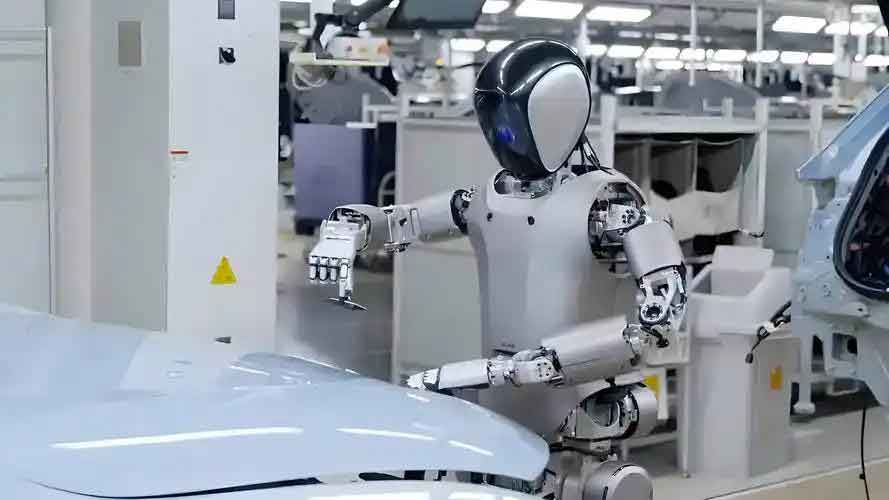
The research adopts Kansei engineering as the bridge between subjective emotional response and concrete design elements. In this framework, affinity is not treated as a vague impression but as an experiential quality that can be linked to the humanoid robot through form, material, texture, and color. The study reports that affinity design emphasizes alignment with users’ physiological and psychological factors and aims to deliver pleasant, comfortable, and relaxed emotional experiences. For the humanoid robot, these experiences are expressed through external features. The research therefore examines how users respond to specific design choices and how those choices can be translated into requirements for artificial intelligence-assisted design.
1. The humanoid robot becomes a service partner rather than a machine alone
The study places the humanoid robot in life and business service scenarios, where frequent human-robot collaboration is expected to become increasingly common. In these contexts, appearance affects both emotional response and functional expectation. A humanoid robot that appears distant or harsh may weaken trust, while a humanoid robot that communicates warmth and approachability may support acceptance. The research notes that affinity is especially important because the humanoid robot is often expected to operate near people, assist users, and participate in service interactions. The visual language of the humanoid robot therefore needs to support a relationship rather than merely signal capability.
Previous discussions of humanoid robot design have identified several relevant cues. The study cites observations that coordinated overall proportions, smooth contours, simple styling, and a friendly style can give the humanoid robot a stronger sense of affinity. From a color perspective, gentle tones can create an approachable and bright visual atmosphere and can improve the affinity of the humanoid robot. From a material perspective, soft materials can produce a sense of safety and closeness, helping the humanoid robot feel less threatening. These observations form a foundation, but the study argues that quantitative analysis of humanoid robot affinity remains limited. The research therefore moves from general design principles to a structured evaluation of appearance features.
2. Kansei engineering turns affinity into measurable humanoid robot design requirements
The research design follows a design-studies approach. It uses form analysis to extract design elements related to shape, material, texture, and color. It then uses the semantic differential method to measure the relationship between affinity perception and specific design elements. Questionnaire research and quantitative analysis are used to derive affinity features and a scoring table for different design elements. That scoring table then guides the selection and production of training samples for a stable diffusion model. The stable diffusion model is trained over multiple iterations, and the resulting models are screened for quality. The selected model can be used alone or combined with other style models to generate a matrix of humanoid robot appearance concepts. The scoring table is then used to locate high-affinity design solutions within that matrix.
The study first collected 30 pairs of image-related words associated with affinity. These pairs were grouped into three categories: social impression, temperament and style, and vitality and liveliness. Social impression describes the closeness between people and the humanoid robot. Temperament and style describes the style and character of the humanoid robot. Vitality and liveliness describes the robot’s sense of life and activity. After professional group discussion, word pairs that were semantically similar, obscure, or difficult to use in evaluating humanoid robot design elements were removed. A group of 25 design professionals then voted. The selected pairs were “indifferent-affinity,” “cold-gentle,” and “serious-lively,” corresponding to affinity, gentleness, and liveliness. The study explains that affinity directly measures the closeness the humanoid robot brings to users. Gentleness serves as an auxiliary evaluation dimension from the perspective of temperament and style, showing the degree of care and consideration conveyed by the humanoid robot. Liveliness serves as another auxiliary dimension from the perspective of vitality, presenting the freshness and vividness of the humanoid robot. Questionnaire research collected user feedback on these three dimensions, and the analysis examined differences and associations among them to provide specific guidance for improving the affinity of design elements.
3. The study abstracts humanoid robot appearance for precise questionnaire testing
To investigate how individual design elements influence affinity, the study abstracted questionnaire materials for humanoid robot appearance. For the head, the research summarized common forms used in existing humanoid robot designs: square, round, vertical racetrack, horizontal racetrack, and semicircle. For the eyes, the study identified four forms: round, square, vertical racetrack, and horizontal racetrack. For body proportion, the research referred to infant, child, juvenile, and adult proportions and drew planar forms. These forms were grouped into slim and sturdy types. For shell material, the study used plastic, cloth, metal, and transparent material, with two surface effects designed for each material. For color, the research selected three cool hues, three warm hues, and neutral colors including white, gray, and black. Saturation and brightness were adjusted for each hue. This abstraction allowed the questionnaire to test design elements with greater precision while keeping the humanoid robot concept recognizable.
The study collected 645 valid questionnaires. The analysis used statistical methods suited to the data types and research objectives. The results showed that the design elements influenced affinity in the following order from high to low: head shape, facial expression, color, material, and body proportion. This ranking is important for humanoid robot design because it suggests that the upper part of the humanoid robot, especially the head and face, carries a strong share of the affinity signal. Color and material follow, while body proportion remains relevant but comparatively lower in influence within the tested set. The study then examined relationships among the three affinity dimensions and evaluated how each design element performed.
4. Affinity, gentleness, and liveliness show strong consistency across humanoid robot features
For head shape, eye shape, body proportion, material and surface treatment, and color, the three affinity dimensions were measured as ordered categorical variables. Kendall correlation analysis was used to examine relationships among the dimensions. The study reports that head shape, eye shape, body proportion, material type, and color showed strong consistency among affinity, gentleness, and liveliness. In other words, the three dimensions tended to move together positively. The research states that this indicates the three measurement dimensions selected in the questionnaire are sufficient to describe affinity accurately. The study also reports that for material surface treatment and warm-color high-low saturation, affinity and liveliness showed a negative correlation. This means that affinity can increase as liveliness decreases in those specific comparisons.
| Design element | Affinity-gentleness | Affinity-liveliness | Gentleness-liveliness |
|---|---|---|---|
| Head shape | 0.356** | 0.303** | 0.284** |
| Eye shape | 0.318** | 0.345** | 0.368** |
| Body proportion | 0.160** | 0.113** | 0.152** |
| Plastic | 0.048** | -0.006 | -0.060** |
| Cloth | -0.016 | -0.006 | -0.020 |
| Metal | 0.029 | -0.010 | 0.028 |
| Transparent | -0.001 | 0.013 | -0.032 |
| White, gray, black | 0.294** | 0.319** | 0.301** |
| High-saturation warm color | 0.055** | 0.006 | 0.038* |
| Low-saturation warm color | -0.020 | 0.004 | -0.003 |
| High-saturation cool color | 0.047** | -0.020 | -0.007 |
| Low-saturation cool color | 0.032 | 0.006 | -0.019 |
The study notes that P values below 0.05 indicate significant correlation, while P values below 0.01 indicate very significant correlation. For material types and warm and cool tones, the three dimensions were treated as normally distributed continuous variables, and Pearson correlation analysis was used. The results again showed significant relationships among the three dimensions. The research reports a Pearson correlation of 0.501** between affinity and gentleness for the four materials, 0.148** between affinity and liveliness, and 0.143** between gentleness and liveliness. For warm-color high and low saturation, affinity and gentleness showed 0.144**, affinity and liveliness showed -0.062*, and gentleness and liveliness showed 0.007. For cool-color high and low saturation, affinity and gentleness showed 0.121**, affinity and liveliness showed 0.016, and gentleness and liveliness showed 0.035. For white versus high saturation, affinity and gentleness showed 0.280**, affinity and liveliness showed 0.158**, and gentleness and liveliness showed 0.180**. For white versus low saturation, affinity and gentleness showed 0.155**, affinity and liveliness showed 0.128**, and gentleness and liveliness showed 0.134**.
5. Head and eye forms send strong affinity signals for the humanoid robot
Head shape, eye shape, and body proportion were compared across groups using the Kruskal-Wallis H nonparametric test. Values greater than 3 were treated as positive evaluations. For head shape, the horizontal racetrack form received the strongest affinity evaluation, followed by the round form. Other forms did not show affinity. For eye shape, the vertical racetrack form received the strongest affinity evaluation, followed by the round form and the square form, while the horizontal racetrack form did not show affinity. For body proportion, affinity from high to low was infant proportion, child slim proportion, juvenile slim proportion, child sturdy proportion, juvenile sturdy proportion, and adult sturdy proportion. The study reports that slim proportions generally performed better than sturdy proportions, and that younger proportions tended to produce stronger affinity for the humanoid robot.
| Design element | Category | Affinity median (25th percentile, 75th percentile) | Gentleness median (25th percentile, 75th percentile) | Liveliness median (25th percentile, 75th percentile) |
|---|---|---|---|---|
| Head shape | A1 | 6 (5, 7) | 6 (5, 7) | 6 (5, 7) |
| Head shape | A2 | 6 (5, 6) | 6 (5, 6) | 6 (5, 6) |
| Head shape | A3 | 3 (2, 4) | 3 (2, 4) | 4 (3, 5) |
| Head shape | A4 | 6 (5, 7) | 6 (5, 7) | 6 (5, 7) |
| Head shape | A5 | 3 (2, 4) | 3 (2.5, 4.5) | 4 (3, 5) |
| Eye shape | B1 | 4 (4, 5) | 4 (3, 5) | 4 (3, 5) |
| Eye shape | B2 | 4 (4, 5) | 4 (4, 5) | 4 (4, 5) |
| Eye shape | B3 | 6 (5, 7) | 6 (5, 7) | 6 (5, 7) |
| Eye shape | B4 | 3 (2, 3) | 3 (2, 3) | 2 (2, 3) |
| Slim body | C1 | 6 (5, 6) | 5 (5, 6) | 5 (5, 6) |
| Slim body | C3 | 6 (5, 7) | 6 (5, 7) | 6 (5, 6) |
| Slim body | C4 | 6 (4, 6) | 5 (5, 6) | 5 (4, 6) |
| Sturdy body | C2 | 5 (4, 6) | 5 (4, 6) | 5 (4, 6) |
| Sturdy body | C5 | 5 (4, 6) | 6 (5, 6) | 5 (3, 5) |
| Sturdy body | C6 | 4 (3, 5) | 4 (3, 5) | 4 (3, 5) |
| Sturdy body | C7 | 4 (3, 5) | 3 (2, 4) | 4 (3, 5) |
The study interprets these results as evidence that simple, smooth, and rounded forms tend to give users a friendly and gentle visual impression. A horizontal racetrack face, vertical racetrack eyes, and a slim juvenile body proportion showed more significant positive influence on affinity for the humanoid robot. These findings do not suggest that every humanoid robot should use the same face or body. Rather, they identify a family of forms that can support affinity while leaving room for variation. The humanoid robot can retain recognizable facial structure and humanlike proportion while avoiding sharp or overly severe geometry that may weaken approachability.
6. Soft material and controlled surface texture improve humanoid robot affinity
Material and surface treatment were compared between groups using the Mann-Whitney U nonparametric test. Values greater than 3 were treated as positive evaluations. For surface material, cloth received the strongest affinity evaluation, and plush texture scored higher than woven texture. Plastic and transparent material showed comparable affinity, and matte surfaces scored higher than smooth surfaces. Metal material, although associated with higher liveliness, did not show affinity. The study reports that for different surface treatment methods, affinity and liveliness were negatively correlated. Increasing surface roughness can therefore improve affinity. For the humanoid robot, this finding suggests that a soft and textured shell may reduce the cold impression associated with hard, glossy surfaces. The humanoid robot can combine multiple affinity-friendly materials to enrich visual and tactile effects and appear more vivid and dimensional.
| Design element | Category | Affinity median (25th percentile, 75th percentile) | Gentleness median (25th percentile, 75th percentile) | Liveliness median (25th percentile, 75th percentile) |
|---|---|---|---|---|
| Plastic | D1 | 4 (3, 5) | 4 (3, 5) | 5 (4, 5) |
| Plastic | D2 | 5 (4, 5) | 5 (4, 5) | 4 (3, 5) |
| Cloth | D3 | 6 (5, 7) | 6 (5, 7) | 5 (4, 6) |
| Cloth | D4 | 6 (5, 7) | 6 (4, 6) | 5 (4, 6) |
| Metal | D5 | 2 (1, 3) | 2 (1, 3) | 4 (2, 5) |
| Metal | D6 | 2 (1, 4) | 2 (1, 4) | 4 (3, 6) |
| Transparent | D7 | 4 (3, 5) | 4 (2, 5) | 5 (4, 6) |
| Transparent | D8 | 4 (4, 5) | 4 (3, 5) | 4 (3, 5) |
The study also analyzed body height, neutral color, warm color, and cool color using Spearman correlation. For overall body height from low to high, affinity showed -0.340**, gentleness showed -0.427**, and liveliness showed -0.340**. For slim body from low to high, affinity showed -0.011, gentleness showed -0.037, and liveliness showed -0.089**. For sturdy body from low to high, affinity showed -0.379**, gentleness showed -0.541**, and liveliness showed -0.355**. For neutral color from white to black, affinity showed -0.613**, gentleness showed -0.622**, and liveliness showed -0.633**. For high-saturation warm color from right to left, affinity showed 0.102**, gentleness showed 0.068**, and liveliness showed 0.054**. For low-saturation warm color from right to left, affinity showed 0.071**, gentleness showed 0.095**, and liveliness showed 0.095**. For high-saturation cool color from left to right, affinity showed 0.220**, gentleness showed 0.228**, and liveliness showed -0.072**. For low-saturation cool color from left to right, affinity showed 0.067**, gentleness showed 0.145**, and liveliness showed -0.078**.
The study concludes that taller humanoid robot body height is associated with lower affinity. As height increases, the reduction in affinity is more significant for sturdy bodies than for slim bodies. Among neutral colors, white has the highest affinity, gray is next, and black is lowest. For warm colors, a position farther to the left is associated with greater affinity. For cool colors, a position farther to the right is associated with greater affinity. These results provide practical direction for the humanoid robot palette and proportion strategy. A humanoid robot intended for close service interaction may benefit from a lighter neutral base, a controlled warm accent, and a body height and build that do not appear overwhelming.
7. Color strategy favors lower saturation and higher brightness for the humanoid robot
The study used single-factor linear regression to compare warm and cool color evaluations. For each comparison, the first item in the row was used as the reference for the regression model. The reported coefficients show how the compared color groups relate to the three dimensions. For high versus low saturation in warm colors, affinity was 0.867, gentleness was 0.672, and liveliness was -0.208. For high versus low saturation in cool colors, affinity was 0.855, gentleness was 0.668, and liveliness was -0.012. For white versus high-saturation cool color, affinity was -1.633, gentleness was -1.647, and liveliness was -0.705. For white versus high-saturation warm color, affinity was -0.466, gentleness was -0.273, and liveliness was 0.421. For white versus low-saturation cool color, affinity was -0.778, gentleness was -0.979, and liveliness was -0.717. For white versus low-saturation warm color, affinity was 0.401, gentleness was 0.399, and liveliness was 0.213.
| Comparison group | Affinity | Gentleness | Liveliness |
|---|---|---|---|
| High versus low saturation, warm color | 0.867 | 0.672 | -0.208 |
| High versus low saturation, cool color | 0.855 | 0.668 | -0.012 |
| White versus high-saturation cool color | -1.633 | -1.647 | -0.705 |
| White versus high-saturation warm color | -0.466 | -0.273 | 0.421 |
| White versus low-saturation cool color | -0.778 | -0.979 | -0.717 |
| White versus low-saturation warm color | 0.401 | 0.399 | 0.213 |
The study reports that the affinity level of low-saturation colors is generally higher than that of high-saturation colors. The order of affinity from high to low was low-saturation warm color, white, high-saturation warm color, low-saturation cool color, and high-saturation cool color. The research concludes that higher brightness and lower saturation can make the humanoid robot more approachable. Warm colors such as beige and light orange can give users a warm and comfortable feeling. Increasing brightness and reducing saturation can also increase the affinity of cool colors. For the humanoid robot, this suggests a palette that avoids aggressive saturation and uses light, soft, and warm-neutral tones to support a welcoming presence.
8. The study produces a design feature affinity score table for the humanoid robot
To quantify the affinity level of training samples, the study created a feature affinity score table based on the design findings. The table provides a practical basis for screening and producing training samples for the humanoid robot. Each design element receives a score, allowing the research team to compare samples and guide iterative training. The table is not merely an evaluation tool. It also becomes a design requirement mechanism that connects user perception, design features, and artificial intelligence model training.
| Code | Score | Code | Score | Code | Score | Code | Score |
|---|---|---|---|---|---|---|---|
| A1 | 3 | B4 | 0 | D1 | 1 | E1 | 4 |
| A2 | 3 | C1 | 3 | D2 | 2 | E2 | 2 |
| A3 | 0 | C2 | 2 | D3 | 3 | E3 | 2 |
| A4 | 3 | C3 | 4 | D4 | 3 | E4 | 1 |
| A5 | 0 | C4 | 3 | D5 | 0 | E5 | 3 |
| B1 | 1 | C5 | 2 | D6 | 0 | E6 | 0 |
| B2 | 1 | C6 | 1 | D7 | 1 | E7 | 0 |
| B3 | 3 | C7 | 0 | D8 | 1 |
The study summarizes the design direction in three areas. In form, simple, smooth, and rounded shapes generally give users a friendly and gentle visual experience. A horizontal racetrack face, vertical racetrack eyes, and a slim juvenile body proportion have a more significant positive influence on affinity for the humanoid robot. In material, soft and textured materials can produce stronger affinity. Surface treatment that increases texture and roughness and reduces the cold impression of smooth surfaces can improve affinity. Multiple affinity-friendly materials can be combined to enrich the visual effect and make the humanoid robot more dimensional and vivid. In color, higher brightness and lower saturation can produce higher affinity. Warm colors such as beige and light orange provide warmth and comfort, while increasing brightness and reducing saturation can improve the affinity of cool colors.
9. Stable diffusion training translates humanoid robot affinity requirements into generative design
The study then develops a training method for stable diffusion models using the affinity score table. The stable diffusion model is described as an artificial intelligence image generation technology based on latent diffusion models. It has text-to-image and image-to-image functions and consists of a text encoder such as Clip, a latent diffusion model including Unet, and an autoencoder decoder such as Vae. Its principle is to repeatedly denoise an average noise image through a model function until a clear image is obtained. The study notes that stable diffusion alone, relying only on prompts, struggles to generate a humanoid robot design with strong affinity and cannot satisfy detailed and specific drawing requirements. This creates a challenge for further innovation. The research therefore uses sample-based training to guide stable diffusion toward the desired humanoid robot appearance.
The training process is based on differences in pixel RGB values. Noise of different concentrations is gradually added to samples on the source model until the image becomes an average noise image, and a new function is fitted to obtain the trained model. The main training methods include Dreambooth and Lora. Dreambooth adjusts the weights of all layers in the stable diffusion neural network and learns features and styles from sample images to meet design requirements. Lora is a method that uses a small number of images to train a model. Its principle is to insert a new calculation layer into Unet to influence image generation. Compared with Dreambooth, the Lora model is smaller and faster to train. The study uses Dreambooth to train the main model and generate different types of design solutions. It trains multiple Lora models as style models to assist in generating solutions with different characteristics, balancing model training quality and efficiency.
10. Training sample production follows the affinity score table for the humanoid robot
Training samples determine the image generation effect of the model. When selecting samples, the study ensures that samples conform to affinity features and have similar styles but different details, so that the trained model has generalization ability. To ensure training quality, the research uses modules in stable diffusion such as Controlnet, image-to-image, and inpainting, combined with Photoshop, to optimize initial materials from the whole to the details. Through multiple rounds of model training, image generation, and modification, the materials gradually meet the affinity feature requirements. The study reports an example of modification in which a humanoid robot design is refined toward a clearer affinity direction. The final annotated example includes descriptors such as affinity robot, minimalism, organic form, science fiction, humanoid robot, oval head, vertical eyes, yellow eyes, no mouth, white body, plastic material, shiny joints, teenage figure, full body, standing, and arms at sides.
After automatic annotation, the study manually annotates the samples again according to overall form, detail form, form style, material and surface treatment, and color to ensure the accuracy of affinity design feature labels. This step is important because the humanoid robot must be described consistently for the model to learn which features contribute to affinity. The annotation is not limited to object labels. It also captures the design qualities that the affinity score table identifies as relevant, including head form, eye form, body proportion, material type, surface effect, and color direction.
11. Iterative training improves the humanoid robot model across rounds
During training, the study modifies the samples in each round according to the model’s generation effect and scores each round’s training samples against the affinity score table to improve the affinity of the training results. In the first round, the training samples and results matched the head and facial features of an affinity-oriented humanoid robot but were too cartoonish and lacked realism. In the second round, more realistic samples were added, but the generated body proportion became too short. In the third round, the samples were revised to match the juvenile slim body proportion with the highest affinity score, and more different design details were added. After training, the generated results basically met the design requirements.
| Round | Head form | Eye form | Body proportion | Material type | Overall tone | Score |
|---|---|---|---|---|---|---|
| 1 | A4 | B2 | C3 | D1 | E1 | 12 |
| 2 | A4 | B3 | C1 | D2 | E5 | 14 |
| 3 | A4 | B3 | C3 | D2 | E1 | 16 |
The main training parameters include Learning Rate, Iteration, Batch Size, Epoch, Optimizer, Scheduler, DIM, and Alpha. The study reports the tested settings. Learning Rate was set to 1×10⁻⁴. Iteration was set to 10. Batch Size was set to 5. Epoch was set to 10. Optimizer was set to 8bit-Adam. Scheduler was set to Cosine. DIM was set to 128. Alpha was set to 64. These parameters are part of the reproducible training setup described by the research.
| Parameter | Value | Parameter | Value |
|---|---|---|---|
| Learning Rate | 1×10⁻⁴ | Optimizer | 8bit-Adam |
| Iteration | 10 | Scheduler | Cosine |
| Batch Size | 5 | DIM | 128 |
| Epoch | 10 | Alpha | 64 |
12. Model screening uses loss values and cross-validation imagery
When evaluating training效果, the study uses the Loss value as an important numerical indicator. After training, the model outputs each Epoch model and records the dynamic change of the Loss value. The Loss value shows a dynamic process of decreasing and then increasing. When the Loss value decreases to approximately 0.08 at the 7th to 9th Epoch, it is considered an ideal reference value. The study notes that training parameters can be adjusted and sample size increased to improve the Loss value curve and bring it closer to the ideal state.
A cross-comparison chart can generate Epoch model images under different weights to verify actual effect. The study combines the affinity score table to score and screen the cross-comparison chart. The results show that the 6th Epoch model with a weight of 0.6 to 0.8 produced the best effect. The study reports the following scores for the cross-comparison chart: at Epoch 3 with Loss 0.089, weights 0.2, 0.4, 0.6, 0.8, and 1.0 received scores of 9, 13, 13, 13, and 13; at Epoch 6 with Loss 0.075, the scores were 9, 9, 14, 14, and 13; at Epoch 9 with Loss 0.068, the scores were 9, 11, 12, 12, and 12.
| Epoch | Loss value | Weight 0.2 | Weight 0.4 | Weight 0.6 | Weight 0.8 | Weight 1.0 |
|---|---|---|---|---|---|---|
| 3 | 0.089 | 9 | 13 | 13 | 13 | 13 |
| 6 | 0.075 | 9 | 9 | 14 | 14 | 13 |
| 9 | 0.068 | 9 | 11 | 12 | 12 | 12 |
13. Style matrices help designers locate high-affinity humanoid robot concepts
The study emphasizes that affinity requires personalization and diversity. By combining the trained model with different style models, the research generates a large number of solutions with different styles and organizes them into a style matrix. The affinity score table is then used for evaluation. This allows the design team to quickly find high-affinity solutions among a large set of options. The study reports that in each style row of the matrix, the first solution received the highest affinity score. The style matrix scores are reported as follows: style 1 received 15, 12, 10, 9, and 8 across five solutions; style 2 received 15, 14, 14, 14, and 14; style 3 received 15, 14, 14, 12, and 12; style 4 received 14, 12, 12, 9, and 9.
| Style | Solution 1 | Solution 2 | Solution 3 | Solution 4 | Solution 5 |
|---|---|---|---|---|---|
| 1 | 15 | 12 | 10 | 9 | 8 |
| 2 | 15 | 14 | 14 | 14 | 14 |
| 3 | 15 | 14 | 14 | 12 | 12 |
| 4 | 14 | 12 | 12 | 9 | 9 |
The study argues that this method can significantly improve the efficiency and quality of humanoid robot appearance design. It provides a new technical path for emotional design in robotics and offers a reference for future affinity-oriented humanoid robot appearance design. The research also connects design quality to application adoption. By improving the humanoid robot’s affinity, the method may help promote the use of the humanoid robot in life and commercial service scenarios and strengthen user acceptance and willingness to use the humanoid robot.
14. The humanoid robot study offers a practical workflow but notes limitations
The research presents a complete workflow from user perception to design feature quantification and artificial intelligence model training. The workflow begins with the humanoid robot as the design object, defines affinity through three evaluation dimensions, measures user preferences for form, material, and color, produces an affinity score table, and uses that table to guide stable diffusion training. The trained model can then generate a large number of humanoid robot appearance concepts in a short time. The study reports that the approach has significant effects in improving design efficiency and optimizing design solutions. For design teams working on the humanoid robot, the value lies in combining human-centered evaluation with generative artificial intelligence rather than relying on prompts alone.
The study also acknowledges limitations. The questionnaire sample group was relatively concentrated, and the universality of the results requires validation with a larger user group. Future work can expand in several directions, including cross-cultural research, diversified style generation, and integrated research on appearance and interactive behavior. These directions could support a more universal and scalable design methodology and help the humanoid robot achieve a higher level of affinity in multiple scenarios. The research therefore does not present the affinity score table as a fixed rule for every humanoid robot. Instead, it presents a method for linking user perception, design features, and model training so that the humanoid robot can be evaluated and refined with greater precision.
15. Key takeaways for humanoid robot appearance design and artificial intelligence training
The study’s findings can be summarized in a set of practical takeaways for the humanoid robot. First, the head and face are central to affinity perception, and the humanoid robot may benefit from a horizontal racetrack face, vertical racetrack eyes, and a generally rounded and simple form language. Second, body proportion matters, and a slim juvenile proportion received stronger affinity than adult sturdy proportions in the tested set. Third, material warmth and texture are important, and the humanoid robot may benefit from cloth, plush texture, matte surfaces, and controlled roughness rather than glossy metal alone. Fourth, color should favor higher brightness and lower saturation, with white, gray, low-saturation warm colors, and selected cool colors supporting a more approachable humanoid robot. Fifth, these features can be scored and used to guide stable diffusion training, allowing the humanoid robot design process to move from manual concept development to evaluated generative exploration.
The research also shows how an affinity score table can function as a shared language across design and artificial intelligence. Designers can use the table to define requirements for the humanoid robot. Trainers can use the table to select samples and evaluate model outputs. Reviewers can use the table to compare generated humanoid robot concepts and identify high-affinity directions. This shared language is especially relevant because stable diffusion can produce many variations quickly, but speed alone does not guarantee design quality. The study demonstrates that a quantified affinity framework can guide the model toward humanoid robot designs that are not only visually diverse but also aligned with user acceptance and trust.
For the humanoid robot industry, the study suggests that appearance is not a secondary layer added after engineering. It is part of how users understand the humanoid robot’s role, safety, and social presence. A humanoid robot designed with affinity can support smoother interaction in service environments and may reduce the psychological distance between users and the machine. The research does not claim that appearance alone determines acceptance. It does show that affinity can be decomposed into design features, measured through user response, and translated into a training process for generative artificial intelligence. That connection is the central contribution of the study and the basis for its proposed method.
The humanoid robot remains a complex product that must satisfy engineering, safety, function, and emotional requirements at the same time. The study’s affinity score table is therefore best understood as a design decision aid rather than a substitute for interdisciplinary review. The humanoid robot still needs appropriate form validation, material testing, interaction design, and user evaluation. Within that broader process, the study offers a structured way to keep affinity visible and measurable. It also provides a reproducible artificial intelligence training path that can generate humanoid robot appearance concepts for further selection and refinement.
In conclusion, the study maps affinity-oriented appearance features for the humanoid robot, quantifies them through Kansei engineering and questionnaire analysis, and uses the resulting score table to train stable diffusion models. The method allows the humanoid robot to be explored through a combination of user-centered design and artificial intelligence generation. The reported results indicate that affinity can be linked to specific head, eye, body, material, and color choices. The reported training process shows that stable diffusion can be guided toward these choices through sample selection, annotation, iterative training, loss monitoring, and model screening. The style matrix then enables rapid comparison of humanoid robot concepts and supports the selection of high-affinity solutions. The research concludes that this approach can improve design efficiency and solution optimization while providing methodological guidance for future humanoid robot appearance design.