
In the realm of precision motion control, particularly within industrial robotics and aerospace systems, the harmonic drive gear stands as a pivotal component for transmitting motion and torque with high reduction ratios and compact design. My research focuses on advancing the dynamic analysis accuracy of these systems by developing a comprehensive nonlinear dynamics model. Traditional models often simplify the inherent complexities of harmonic drive gears, such as their hysteretic stiffness and dynamic friction phenomena, by treating stiffness as constant or piecewise constant and friction as static. These simplifications, while useful for initial design and control, inevitably lead to a decline in the precision of dynamic performance predictions. Therefore, I propose a novel dynamics model that integrates a memory-based hysteresis stiffness model and the LuGre dynamic friction model to capture the true nonlinear behavior of harmonic drive gears. This article details the formulation of this model, the establishment of a corresponding simulation framework, and an extensive discussion on how key parameters influence system output, aiming to provide insights for improving transmission performance and stability.
The unique structure of a harmonic drive gear, comprising a wave generator, a flexspline, and a circular spline, gives rise to distinctive mechanical behaviors. During operation, the elastic deformation of the flexspline leads to a stiffness characteristic that is not linear but exhibits hysteresis—a phenomenon where the transmitted torque depends not only on the instantaneous deflection but also on the history of loading. Similarly, the friction occurring at the meshing interfaces between the flexspline and circular spline is dynamic, displaying effects like the Stribeck curve, pre-sliding displacement, and frictional memory. Ignoring these nonlinearities results in models that fail to predict subtle yet critical dynamic responses, such as tracking errors, limit cycles, or efficiency losses under varying operational conditions. My work seeks to bridge this gap by rigorously incorporating these aspects into a unified dynamic model, validated through simulation studies.
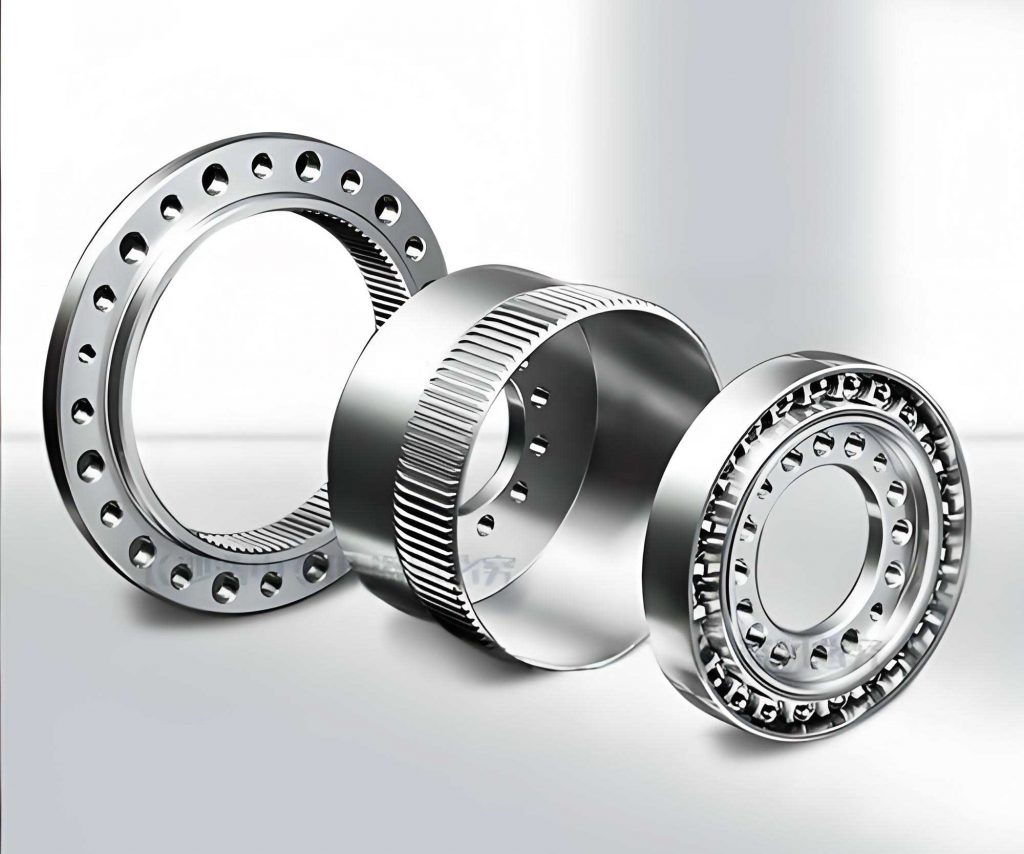
To lay the foundation, let’s consider the general dynamic representation of a system employing a harmonic drive gear. The system typically includes a servo motor, the harmonic drive gear reducer, an inertial load, and associated sensors. The wave generator is connected to the motor shaft (input), while the flexspline delivers the output to the load. The kinematics relate the input angular displacement \(\theta_j\) (motor side) and the output angular displacement \(\theta_z\) (load side) through the gear reduction ratio \(N\):
$$
\theta = \frac{\theta_j}{N} – \theta_z
$$
Here, \(\theta\) represents the effective torsional deflection across the harmonic drive gear. The dynamic equations stem from torque balances on the motor and load sides, incorporating the transmitted torque through the gear and the friction torque.
The core of my modeling effort lies in two nonlinear elements: the hysteretic stiffness and the dynamic friction. I will address each in sequence, presenting their mathematical formulation and integration into the system dynamics.
Modeling of Hysteretic Stiffness in Harmonic Drive Gears
Hysteresis, or memory-dependent behavior, is a hallmark of harmonic drive gear stiffness. Experimental torque-deflection curves show that the relationship between transmitted torque \(T\) and torsional angle \(\theta\) forms a loop, indicating that for the same torque, different deflections can occur depending on the loading history. This “stiffness hysteresis phenomenon” leads to energy loss and reduced transmission efficiency. To model this, I adopt a memory-based approach where the transmitted torque is a sum of an instantaneous nonlinear stiffness function and a memory correction term.
Let the instantaneous stiffness be described by a polynomial function \(f(\theta)\). Based on observed curves, a cubic polynomial is suitable:
$$
f(\theta) = a\theta^3 + b\theta^2 + c\theta
$$
where \(a\), \(b\), and \(c\) are coefficients determined from the harmonic drive gear’s characteristics. The memory term \(z(t)\) accounts for the dependence on past states. It is defined as an integral of past deflection rates weighted by a decaying memory kernel \(\phi(x)\):
$$
z(t) = \int_0^t \phi(x) \dot{\theta}(x) \, dx
$$
The kernel \(\phi(x)\) is chosen as an exponential decay function to represent fading memory:
$$
\phi(x) = A e^{-Bx}
$$
Here, \(A\) and \(B\) are positive constants that govern the intensity and decay rate of the memory effect. Thus, the total transmitted torque \(T(\theta, t)\) becomes:
$$
T(\theta, t) = f(\theta) + z(t) = a\theta^3 + b\theta^2 + c\theta + \int_0^t A e^{-Bx} \dot{\theta}(x) \, dx
$$
For a periodic torsional angle \(\theta(t) = C \sin(\omega t)\), the memory integral can be solved analytically. Assuming the direction of \(\dot{\theta}\) affects the sign of the hysteresis loop, the correction term for positive and negative velocity phases is:
$$
z(t) =
\begin{cases}
\frac{A C \omega}{B^2 + \omega^2} – \frac{A C (B \sin \omega t + \omega \cos \omega t) e^{-Bt}}{B^2 + \omega^2}, & \dot{\theta} > 0 \\
-\frac{A C \omega}{B^2 + \omega^2} – \frac{A C (B \sin \omega t + \omega \cos \omega t) e^{-Bt}}{B^2 + \omega^2}, & \dot{\theta} < 0
\end{cases}
$$
The instantaneous nonlinear stiffness coefficient \(K(t)\) is then derived as the derivative of torque with respect to deflection:
$$
K(t) = \frac{dT(t)}{d\theta(t)} = \frac{dT/dt}{\dot{\theta}} \quad \text{(when } \dot{\theta} \neq 0\text{)}
$$
This model captures the gradual convergence of the hysteresis loop to a steady cycle, as observed in real harmonic drive gear systems. The parameters \(a, b, c, A, B\) can be identified from experimental torque-deflection data. Table 1 summarizes typical parameters used in simulation for a harmonic drive gear.
| Parameter | Symbol | Typical Value | Unit |
|---|---|---|---|
| Cubic stiffness coefficient | \(a\) | 0.12 | N·m/rad³ |
| Quadratic stiffness coefficient | \(b\) | 0.56 | N·m/rad² |
| Linear stiffness coefficient | \(c\) | 52000 | N·m/rad |
| Memory intensity factor | \(A\) | 40000 | N·m·s/rad |
| Memory decay rate | \(B\) | 300 | 1/s |
| Deflection amplitude | \(C\) | Varies with load | rad |
| Angular frequency | \(\omega\) | \(2\pi \times 50\) | rad/s |
Modeling of Dynamic Friction in Harmonic Drive Gears
Friction in a harmonic drive gear arises predominantly from the meshing between the flexspline and circular spline teeth, along with contributions from the wave generator bearing and output shaft bearings. Static friction models like Coulomb or Stribeck models are inadequate as they neglect dynamic effects such as the pre-sliding displacement, varying break-away force, and frictional lag. For high-fidelity dynamic analysis of harmonic drive gear systems, I employ the LuGre (Lund-Grenoble) dynamic friction model, which conceptualizes the contacting surfaces as bristles that deflect like springs, giving rise to friction force.
The LuGre model is described by a differential equation for the average bristle deflection \(s(t)\) and an algebraic output equation for the friction torque \(T_f\). Adapted for rotational systems in a harmonic drive gear, the model equations are:
$$
\begin{align*}
\frac{ds}{dt} &= \omega – \frac{|\omega|}{g(\omega)} s \\
g(\omega) &= \frac{1}{\sigma_0} \left[ T_c + (T_s – T_c) e^{-(\omega/\omega_s)^2} \right] \\
T_f &= \sigma_0 s + \sigma_1 \frac{ds}{dt}
\end{align*}
$$
Here, \(\omega\) is the relative angular velocity between the meshing components. In many configurations where the circular spline is fixed, \(\omega\) corresponds to the angular velocity of the flexspline, which is related to the input and output velocities. The function \(g(\omega)\) represents the Stribeck curve, where \(T_c\) is the Coulomb friction torque, \(T_s\) is the static friction torque, and \(\omega_s\) is the Stribeck velocity. The parameters \(\sigma_0\) and \(\sigma_1\) denote the bristle stiffness and damping coefficients, respectively.
The friction torque \(T_f\) thus captures various regimes: pre-sliding micro-displacement (governed by \(\sigma_0 s\)), viscous damping-like effects (\(\sigma_1 \dot{s}\)), and the transition from static to kinetic friction via the Stribeck function. The equivalent nonlinear damping coefficient \(C_0(t)\) due to friction can be expressed as:
$$
C_0(t) = \frac{dT_f(t)}{d\omega(t)} = \frac{dT_f/dt}{\dot{\omega}} \quad \text{(when } \dot{\omega} \neq 0\text{)}
$$
Identifying the LuGre model parameters for a specific harmonic drive gear requires careful experimentation or data from manufacturer tests. Table 2 provides a set of plausible parameters for simulation purposes, reflecting typical behavior in harmonic drive gear applications.
| Parameter | Symbol | Typical Value | Unit |
|---|---|---|---|
| Bristle stiffness | \(\sigma_0\) | 1.2 × 10⁵ | N·m/rad |
| Bristle damping | \(\sigma_1\) | 0.8 | N·m·s/rad |
| Coulomb friction torque | \(T_c\) | 0.15 | N·m |
| Static friction torque | \(T_s\) | 0.25 | N·m |
| Stribeck velocity | \(\omega_s\) | 0.01 | rad/s |
Integrated Nonlinear Dynamic Model of a Harmonic Drive Gear System
With the hysteretic stiffness and dynamic friction models defined, I now integrate them into the overall dynamic equations of a harmonic drive gear transmission system. The system comprises a DC servo motor, the harmonic drive gear reducer, and an inertial load. The motor is characterized by its electrical and mechanical equations. The harmonic drive gear is represented as a torsional spring with stiffness \(K(t)\) (derived from the hysteresis model) in parallel with a damper representing the friction torque \(T_f(t)\) (from the LuGre model).
The torque balance on the motor side (wave generator) and load side (flexspline output) yields:
$$
\begin{align*}
J_j \ddot{\theta}_j + C_j \dot{\theta}_j &= T_j – T_a \\
J_z \ddot{\theta}_z + C_z \dot{\theta}_z &= T_b \\
T_b &= K(t) \left( \frac{\theta_j}{N} – \theta_z \right) \\
N T_a &= T_b + T_f = T_b + C_0(t) \frac{\dot{\theta}_j}{N}
\end{align*}
$$
Here, \(J_j\) and \(J_z\) are the motor and load moments of inertia; \(C_j\) and \(C_z\) are viscous damping coefficients on the motor and load sides (often small); \(T_j\) is the electromagnetic torque generated by the motor; \(T_a\) is the torque input to the wave generator; \(T_b\) is the torque output from the flexspline to the load; and \(N\) is the gear ratio. The friction torque \(T_f\) is expressed in terms of an equivalent damping coefficient \(C_0(t)\) acting on the motor side velocity, noting that the relative velocity for friction is related to \(\dot{\theta}_j\).
For a DC motor with armature control, the motor torque and back-EMF are given by:
$$
\begin{align*}
T_j &= K_m i \\
u &= i R + K_e \dot{\theta}_j
\end{align*}
$$
where \(K_m\) is the torque constant, \(K_e\) is the back-EMF constant, \(u\) is the armature voltage, \(i\) is the armature current, and \(R\) is the armature resistance. Combining all equations, the system dynamics can be written as a set of coupled differential equations:
$$
\begin{align*}
J_j \ddot{\theta}_j + C_j \dot{\theta}_j &= \frac{K_m}{R} \left( u – K_e \dot{\theta}_j \right) – \frac{K(t)}{N} \left( \frac{\theta_j}{N} – \theta_z \right) – \frac{C_0(t)}{N} \frac{\dot{\theta}_j}{N} \\
J_z \ddot{\theta}_z + C_z \dot{\theta}_z &= K(t) \left( \frac{\theta_j}{N} – \theta_z \right)
\end{align*}
$$
These equations form the basis for simulation. To gain initial insight, one can consider a linearized version by assuming constant average stiffness \(\bar{K}\) and constant damping \(\bar{C}_0\), leading to a transfer function from input voltage \(u(s)\) to output angle \(\theta_z(s)\). However, for accurate dynamic analysis, the full nonlinear time-varying nature of \(K(t)\) and \(C_0(t)\) must be retained.
Simulation Model Development and Parameter Analysis
I implemented the integrated nonlinear dynamic model in a MATLAB/Simulink environment to simulate the response of the harmonic drive gear system. The simulation model includes blocks for the DC motor dynamics, the hysteretic stiffness subsystem, the LuGre friction subsystem, and the mechanical load. Key system parameters, representative of a mid-range harmonic drive gear application, are listed in Table 3.
| Parameter | Symbol | Value | Unit |
|---|---|---|---|
| Armature resistance | \(R\) | 6.0 | Ω |
| Motor torque constant | \(K_m\) | 0.52 | N·m/A |
| Back-EMF constant | \(K_e\) | 0.52 | V·s/rad |
| Motor inertia | \(J_j\) | 6.8 × 10⁻⁴ | kg·m² |
| Load inertia | \(J_z\) | 2.4 × 10⁻² | kg·m² |
| Motor damping coefficient | \(C_j\) | 0.003 | N·m·s/rad |
| Load damping coefficient | \(C_z\) | 0.005 | N·m·s/rad |
| Gear ratio | \(N\) | 100 | – |
| Nominal stiffness (approx.) | \(\bar{K}\) | 7.8 × 10⁵ | N·m/rad |
| Nominal damping (approx.) | \(\bar{C}_0\) | 0.16 | N·m·s/rad |
The simulation was run with a sinusoidal input voltage \(u(t) = 24 \sin(2\pi \times 50 t)\) volts to excite dynamic behavior. I compared three model variants: (1) a linear model with constant stiffness and no friction, (2) a nonlinear model with constant stiffness and constant friction damping, and (3) the full nonlinear model with hysteretic stiffness and LuGre dynamic friction. The output of interest is the load angular displacement \(\theta_z(t)\).
For the hysteretic stiffness subsystem, I used the parameters from Table 1 and implemented the memory integral using a discrete-time approximation in Simulink. The LuGre friction block used parameters from Table 2. The simulation results clearly demonstrate the impact of nonlinearities.
First, the hysteresis stiffness model produces a steady-state torque-deflection loop as simulated. The stiffness \(K(t)\) fluctuates around the nominal value, with the hysteresis causing a phase lag between torque and deflection. This directly affects the system output: when comparing the full model to a model with equivalent constant stiffness, the load displacement amplitude is slightly reduced in the full model. This reduction, attributable to the “stiffness hysteresis phenomenon,” signifies an energy loss within the harmonic drive gear, leading to lower transmission efficiency. The magnitude of this loss depends on the amplitude and frequency of operation, as well as the hysteresis parameters \(A\) and \(B\).
Second, varying the input voltage amplitude changes the operational point. Simulations with input voltages of 12 V, 24 V, and 36 V (at 50 Hz) show that while the output displacement frequency remains locked to the input frequency, the amplitude of \(\theta_z\) increases nonlinearly with voltage. More importantly, the fluctuation range (ripple) around the steady sinusoidal output also increases with higher voltage, indicating that larger torque excitations exacerbate the nonlinear effects in the harmonic drive gear. This has implications for systems requiring precise positioning under varying loads.
Third, I conducted parameter sensitivity studies by varying the key harmonic drive gear parameters: the average transmission stiffness coefficient \(K\) and the average damping torque coefficient \(C_0\). The results are summarized in Table 4, showing the effect on steady-state output amplitude and a qualitative stability measure.
| Parameter Variation | Effect on Load Displacement Amplitude | Effect on System Stability | Remarks |
|---|---|---|---|
| Increase stiffness \(K\) | Slight increase or near constant | Improves stability (reduced oscillation) | Higher stiffness raises natural frequency, reducing sensitivity to low-frequency disturbances. |
| Decrease stiffness \(K\) | Decreases | Reduces stability (increased oscillation, longer settling time) | Softer harmonic drive gear leads to larger deflections and potential under-damped resonances. |
| Increase damping \(C_0\) | Significant decrease | Improves damping of oscillations but reduces efficiency | Higher friction dissipates more energy, lowering output for same input. |
| Decrease damping \(C_0\) | Increases | Can lead to less damped, jittery response | Lower friction improves efficiency but may cause stick-slip or limit cycles. |
The trends are clear: a higher transmission stiffness in the harmonic drive gear generally enhances system stability by increasing the torsional natural frequency and reducing compliance-induced oscillations. Conversely, a higher damping coefficient, primarily stemming from friction, reduces the output amplitude for a given input, directly translating to lower transmission efficiency. Therefore, in designing or selecting a harmonic drive gear for high-performance applications, one should seek components with high stiffness and low friction characteristics. This can be achieved through advanced materials, optimized tooth profiles, precision manufacturing, and effective lubrication strategies.
Extended Discussion on Nonlinear Dynamics Phenomena
The nonlinear dynamics of a harmonic drive gear system can exhibit complex behaviors beyond simple sinusoidal response. With the developed model, I explored scenarios such as step responses, responses to varying frequency inputs, and the influence of the Stribeck effect on start-up motion.
For a step voltage input, the system with full nonlinearities shows a settling time that is longer than predicted by a linear model. The hysteresis causes a “dead zone” effect during direction reversal, momentarily reducing the effective stiffness. The LuGre friction introduces a pre-sliding displacement before the load begins to move, and a noticeable overshoot in torque during break-away. These effects are crucial for applications requiring precise point-to-point motion, like in robotic arms.
When the input frequency is swept, the harmonic drive gear system demonstrates a nonlinear frequency response. The amplitude of \(\theta_z\) versus frequency does not follow a classic second-order resonance curve perfectly. Instead, the hysteresis and friction introduce amplitude-dependent damping and stiffness, causing the resonance peak to shift and attenuate. This behavior must be accounted for in controller design for systems involving harmonic drive gear reducers, especially when operating across a wide frequency range.
Furthermore, the interaction between hysteresis and friction can lead to minor limit cycles at very low velocities, a phenomenon often observed in precision systems. My simulations indicate that with certain parameter combinations, the output exhibits a small, persistent oscillation even when the input is constant, due to the stick-slip cycle governed by the LuGre model and the energy storage/release of the hysteresis loop. Identifying and mitigating such limit cycles is important for ultra-precision applications.
To quantify the energy loss due to hysteresis, one can compute the area enclosed by the steady-state torque-deflection loop over one cycle. For a harmonic drive gear under sinusoidal excitation, this area \(\Delta E\) represents the energy dissipated per cycle:
$$
\Delta E = \oint T \, d\theta
$$
Using the hysteresis model, this can be approximated. Similarly, the average transmission efficiency \(\eta\) over a cycle can be estimated as the ratio of output mechanical work to input mechanical work, which will be less than 100% due to hysteresis and friction losses. The efficiency is negatively correlated with both the hysteresis loop area and the average friction torque.
Implications for Design and Control of Harmonic Drive Gear Systems
The insights gained from this nonlinear dynamic modeling and simulation have direct implications for the design and control of systems incorporating harmonic drive gear reducers. For mechanical designers, the emphasis should be on maximizing the torsional stiffness of the harmonic drive gear. This involves optimizing the flexspline geometry, material selection (e.g., high-strength alloy steels), and ensuring precise tooth engagement to minimize backlash and elastic deformation. Reducing friction is equally critical; this can be addressed through surface treatments, high-quality lubricants with appropriate additives, and possibly innovative bearing arrangements for the wave generator.
For control engineers, the presence of hysteresis and dynamic friction necessitates advanced control strategies. Standard PID controllers may suffice for less demanding applications, but for high-precision tracking, model-based compensation is beneficial. The developed model can serve as a basis for feedforward compensation or for designing nonlinear observers. For instance, an inverse hysteresis model could be used to pre-distort the command signal to counteract the phase lag and amplitude reduction. Similarly, friction compensation techniques based on the LuGre model, such as observer-based feedforward, can significantly reduce tracking errors during velocity reversals and low-speed operation.
In robotics, where harmonic drive gear reducers are ubiquitous in joints, the dynamic model can improve the accuracy of torque sensing and impedance control. By accurately predicting the transmitted torque from motor current and position measurements (accounting for hysteresis and friction losses), one can achieve more precise force control without needing additional load-side torque sensors, which are often bulky and expensive.
Conclusion
In this comprehensive study, I have developed and analyzed a nonlinear dynamic model for harmonic drive gear systems that captures two essential inherent properties: hysteretic stiffness and dynamic friction. The stiffness is modeled using a memory-based hysteresis formulation that accounts for the dependence of torque transmission on loading history. The friction is represented by the LuGre dynamic model, which accurately describes pre-sliding displacement, the Stribeck effect, and frictional memory. These nonlinear elements are integrated into the coupled electromechanical equations of a DC motor-driven harmonic drive gear transmission.
Through extensive simulation in MATLAB/Simulink, I investigated the dynamic behavior under various conditions and performed parameter sensitivity analysis. The key findings are:
- The stiffness hysteresis phenomenon inherent in harmonic drive gears causes a reduction in system output amplitude compared to models assuming constant stiffness, leading to a decrease in transmission efficiency due to energy dissipation within the hysteresis loop.
- Increasing the input voltage amplitude increases the output displacement but also amplifies the output fluctuations, highlighting the excitation-dependent nature of the nonlinearities.
- The transmission stiffness coefficient of the harmonic drive gear has a stabilizing effect on the system; higher stiffness reduces oscillatory tendencies and improves response fidelity.
- The damping torque coefficient, largely arising from friction, negatively impacts transmission efficiency; higher damping dissipates more energy, resulting in lower output for the same input.
These conclusions underscore the importance of considering nonlinear effects in the design, selection, and control of harmonic drive gear systems for high-performance applications. Future work will involve experimental validation of the model on a physical harmonic drive gear test setup, refinement of parameter identification methods, and exploration of advanced control algorithms that leverage this detailed dynamic model to achieve unprecedented levels of precision and efficiency in systems utilizing harmonic drive gear technology.
The journey to accurately model and simulate the complex dynamics of harmonic drive gears is challenging but rewarding. As robotic and aerospace systems push the boundaries of performance, a deep understanding of the nonlinear behavior of critical components like the harmonic drive gear becomes indispensable. The model presented here is a step toward that understanding, providing a tool for engineers to predict, analyze, and ultimately optimize the dynamic performance of systems that rely on the unique capabilities of harmonic drive gear reducers.