
The planetary roller screw mechanism (PRSM) represents a critical high-precision transmission component, renowned for its compact size, high load capacity, and superior efficiency. Its operation, based on the conversion of rotary to linear motion via threaded meshing, makes it indispensable in advanced applications such as aerospace actuation, high-end manufacturing, and robotics. Despite its advantages, the dynamic behavior of a planetary roller screw is inherently complex and nonlinear, highly sensitive to operational conditions and internal excitations. Traditional dynamic models often treat the components as rigid bodies, neglecting essential factors like elastic deformations of the threads and the coupled dynamic effects arising from the parallel gear meshing required for synchronization. This study addresses these limitations by developing a comprehensive nonlinear dynamic model that integrates thread deformation under load and the coupled excitations from the gear pair.
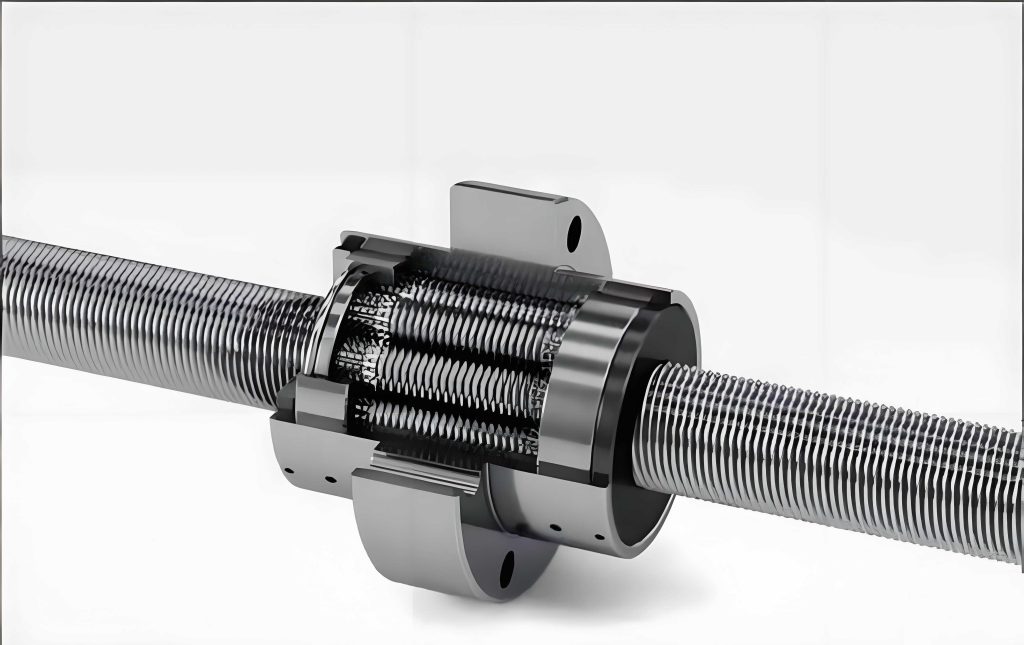
Our investigation begins by analyzing the elastic deformation of the threads within the planetary roller screw under operational loads. The deformation at the contact interfaces between the screw, rollers, and nut significantly alters the load distribution, which in turn affects the system’s stiffness and dynamic response. We consider multiple deformation modes: radial compression, bending, shear, and tilting at the thread root. The radial deformation $\delta^r$ caused by a radial force $F_r$ on a screw or roller thread is given by:
$$ \delta^i_r = \frac{(1 – \mu)F_r}{E} \frac{D_i}{p} \frac{1}{2 \tan^2 \beta_i} $$
where $i$ denotes the component (Screw, Roller, or Nut), $\mu$ is Poisson’s ratio, $E$ is the elastic modulus, $D_i$ is the major diameter, $p$ is the pitch, and $\beta_i$ is the thread flank angle. For the nut, which has a different geometry, the radial deformation formula is adjusted accordingly. The total axial deformation $\delta^i_a$ of a thread tooth, crucial for load distribution analysis, is the sum of bending ($\delta^i_{bend}$), shear ($\delta^i_{cut}$), and tilting ($\delta^i_{tilt}$) components:
$$ \delta^i_a = \delta^i_{bend} + \delta^i_{cut} + \delta^i_{tilt} $$
$$ \delta^i_{bend} = \frac{3F_a (1-\mu)^2}{4E} \left[ \frac{1 – (2 – \frac{b_i}{a_i})^2 + 2 \ln(\frac{b_i}{a_i})}{\tan^3 \beta_i} \right] – \frac{3F_a (1-\mu)^2}{4E (\frac{b_i}{a_i})^2} \frac{4}{\tan \beta_i} + \frac{6F_a (1+\mu)}{5E \tan^3 \beta_i} \ln(\frac{b_i}{a_i}) $$
The axial thread stiffness $k_{iz}$ is then derived from the force-deformation relationship $k_{iz} = F_{ai} / \delta^i_a$. These stiffness values are fundamental for constructing the dynamic load distribution model of the planetary roller screw.
A primary source of internal excitation in a planetary roller screw originates from the gear pair (ring gear and planet gear) necessary for synchronizing the rollers. We model two key excitation mechanisms: gear meshing impact and time-varying meshing stiffness. When a new tooth pair enters the meshing zone, a deviation between the theoretical and actual tooth paths can cause an impact. The maximum impact force $F_{max}$ is related to the relative impact velocity $v_m$ and the equivalent compliance $l$:
$$ F_{max} = v_m \sqrt{ \frac{b I_1 I_2}{(I_1 r^{\prime 2}_R + I_2 r^2_G) l} } $$
This impact force is modeled as a half-sine pulse over the impact duration $t_m$: $F_m(t) = F_m \sin(\omega_m t)$, where $\omega_m = \pi / t_m$. Concurrently, the time-varying meshing stiffness $k_m(t)$, resulting from the changing number of teeth in contact and the elastic deformation of the tooth geometry, acts as a parametric excitation. The combined meshing force $F_G$ transmitted to the roller is:
$$ F_G = k_m(t) \left[ y_{ring}(t) – y_G(t) \right] $$
These gear meshing excitations directly modulate the contact forces at the threaded interfaces. The dynamic contact forces on the screw-roller ($f_{SR}$) and nut-roller ($f_{NR}$) sides become time-dependent:
$$ f_{SR} = \begin{cases}
f^{max}_{SR} + 2F_m & (0 < t \leq t_s) \\
f^{max}_{SR} + 2F_G & (t_s < t \leq t_e)
\end{cases} $$
where $t_s$ is the impact duration and $t_e$ is the gear meshing period. This coupling establishes a critical link between the rotary gear dynamics and the axial threaded contact dynamics of the planetary roller screw.
The dynamic load distribution along the engaged threads is governed by deformation compatibility conditions within closed force loops. For the i-th loop between the nut and a roller, the compatibility equation is:
$$ \frac{\sum_{j=1}^{i} f_{NRj}}{k_{Na}} + \frac{f_{NRi} – f_{NRi+1}}{k_{Nz}} + \frac{f_{NRi}}{k_{NRa}} = \frac{f_{NRi+1} – f_{NRi}}{k_{Rz}} + \frac{f_{NRi+1}}{k_{NRa}} + \frac{\sum_{j=0}^{\lfloor i/2 \rfloor} (f_{NRj} – f_{SRj}) + f_{NR(\lfloor i/2 \rfloor + 1)}}{k_{Ra}} + \frac{\sum_{j=0}^{\lfloor i/2 \rfloor} (f_{NRj} – f_{SRj})}{k_{Ra}} $$
A similar equation governs the screw-roller side. Solving this system of equations yields the dynamic load distribution, which is markedly different from the static case due to the superimposed gear excitations. The following table summarizes key structural parameters used in our analysis of a representative planetary roller screw.
| Parameter | Screw | Nut | Roller |
|---|---|---|---|
| Pitch Diameter (mm) | 25 | 45 | 10 |
| Pitch, p (mm) | 2.5 | 2.5 | 2.5 |
| Number of Starts | 5 | 5 | 1 |
| Flank Angle, $\beta$ (°) | 45 | 45 | 45 |
| Gear Module (mm) | — | — | 0.5 |
Building upon the force analysis, we establish a 12-degree-of-freedom nonlinear dynamic model for the planetary roller screw system using the lumped mass method. The generalized coordinates include translational and rotational vibrations of the screw, multiple rollers, the carrier, and the nut. The equations of motion incorporate time-varying meshing stiffness, backlash in the gear pair, thread contact forces, and friction. For instance, the equation for the screw’s axial vibration $z_S$ is:
$$ m_S \frac{d^2 z_S}{dt^2} + c_{Sz} \frac{d z_S}{dt} + k_{Sz} z_S + f_{SR} + M_{Sqz} = 0 $$
where $c_{Sz}$ and $k_{Sz}$ are damping and stiffness coefficients, and $M_{Sqz}$ represents friction-related moments. The vibration $\delta_{rn}$ of a roller gear along the line of action is a key variable, expressed as:
$$ \delta_{rn} = (x_{pn} – x_r) \sin \phi_{rn} + (y_r – y_{pn}) \cos \phi_{rn} + u_r + u_n + \gamma_{rn}(t) $$
To facilitate numerical solution and general analysis, the equations are non-dimensionalized using the characteristic frequency $\omega = \sqrt{k_m (1/m_q + 1/m_{nr})}$ and the half-backlash $b_m$, with the non-dimensional time defined as $\tau = \omega t$.
We numerically solve the system’s differential equations to investigate its dynamic response under varying external excitation frequencies $\omega_e = \omega_s / \omega$, where $\omega_s$ is the screw rotational speed. The analysis reveals rich nonlinear phenomena. The bifurcation diagram for the roller gear displacement $\delta_{rn}$ shows a clear evolutionary path: the system enters a chaotic state via period-doubling bifurcation around $\omega_e \approx 0.76$, transitions to a period-2 motion near $\omega_e \approx 1.08$, and finally settles into a stable periodic motion for $\omega_e > 1.20$. The axial vibration of the screw exhibits a similar but simpler bifurcation pattern, indicating that the gear pair is the primary source of complex nonlinearity in the planetary roller screw.
Time-domain waveforms, frequency spectra, phase portraits, and Poincaré sections provide detailed insights at specific frequencies. For example, at $\omega_e = 0.96$, the gear vibration response shows a chaotic attractor: the time history is aperiodic, the frequency spectrum is broadband, the phase portrait is a complex, filled strange attractor, and the Poincaré section consists of a scattered set of points. In contrast, at $\omega_e = 1.15$, the system exhibits a period-2 limit cycle, characterized by a waveform with two distinct peaks per period, a spectrum with distinct harmonics, a closed double-loop phase trajectory, and a Poincaré section with two distinct points.
To understand the global characteristics and the coexistence of multiple attractors, we employ cell mapping methods. The global bifurcation diagram, which plots steady-state attractors for a range of initial conditions against $\omega_e$, reveals intricate multi-stability regions. For the gear pair vibration, within the frequency range $\omega_e \in (0.89, 0.96)$, period-3 (P3) and chaotic (CH) attractors coexist. In the interval $\omega_e \in (0.96, 1.09)$, an even more complex mixture of periodic and chaotic responses exists. The attractor basins, visualized via cell mapping, display highly fractal boundaries, especially for the gear subsystem, indicating a strong sensitivity to initial conditions. This implies that small disturbances in the gear meshing state can lead to qualitatively different long-term vibration behaviors in the planetary roller screw. The axial vibration of the screw also shows multi-stability, such as the coexistence of two different period-2 orbits in the range $\omega_e \in (1.18, 1.28)$, but its basin boundaries are generally less complex than those of the gear pair.
The comprehensive analysis leads to several key conclusions regarding the nonlinear dynamics of the planetary roller screw mechanism. First, the coupling between gear meshing excitations and thread contact is significant. The dynamic forces at the threaded interfaces are not static but exhibit periodic fluctuations driven by gear impacts and stiffness variations. This coupled excitation directly induces nonlinear axial vibration in the screw and the overall system. Second, under external load frequency variations, the planetary roller screw system exhibits classic nonlinear dynamic evolution, including periodic, period-doubling, and chaotic motions. A stable operational window for the screw speed $\omega_s$ is identified approximately in the non-dimensional frequency range $\omega_e \in (1.19, 1.6)$, corresponding to stable periodic motion. Third, the global analysis confirms the existence of multiple steady-state solutions (multi-stability) for both the gear and thread dynamics. The gear pair subsystem demonstrates particularly complex and fractal basin boundaries, revealing a higher sensitivity to initial conditions compared to the axial vibration mode. This underscores the importance of the gear meshing state as a dominant factor influencing the overall dynamic stability and performance of the planetary roller screw mechanism. These findings provide a foundational theoretical framework for predicting vibration, optimizing design for stability, and implementing advanced control strategies in high-precision applications of planetary roller screws.