
In modern industrial and research applications, the use of six-axis force sensors has become increasingly prevalent due to their ability to measure three orthogonal forces and three orthogonal moments simultaneously. These sensors are integral to systems such as robotic arms, testing platforms, and assembly lines, where they monitor complex spatial loads. However, many of these systems are large, immobile, or difficult to disassemble, making traditional laboratory calibration impractical. As a first-hand researcher in metrology, I have encountered numerous scenarios where on-site calibration is essential but hindered by the bulkiness of conventional calibration equipment. Traditional devices, often modeled after force standard machines, rely on weights and levers for loading, resulting in massive setups that cannot be transported easily. To address this, I have developed a compact, portable on-site calibration device for six-axis force sensors, along with a corresponding calibration methodology. This approach simplifies the process while maintaining accuracy, catering to the growing demand for field services where sensors cannot be removed for lab calibration.
The fundamental principle of a six-axis force sensor lies in its ability to decode the complex interplay between applied forces and moments through a coupling matrix. Essentially, a six-axis force sensor can be viewed as an array of force-sensing elements arranged in a specific configuration, such as the Stewart platform structure. The output signals from these elements are processed to derive the six components of force and moment. The relationship between the applied loads and the sensor outputs is described by a coupling matrix R, which accounts for the inherent crosstalk between axes. Mathematically, this is expressed as:
$$( \mathbf{F}^T )^T = \mathbf{R} \cdot \boldsymbol{\varepsilon}^T$$
where F represents the force vector, T the moment vector, R is the 6×6 coupling matrix, and ε is the vector of output signals from the sensing elements. For a Stewart structure six-axis force sensor, which consists of six elastic rods connecting upper and lower platforms, the force and moment equilibrium can be derived using screw theory. The coupling matrix R is formulated based on the geometric parameters of the sensor, such as the distribution radii of the connection points (R_A and R_B), the distance between platforms (H), and the angles between connection points (α_A and α_B). The general form of R is:
$$\mathbf{R} = \begin{bmatrix}
R_{11} & \cdots & R_{16} \\
\vdots & \ddots & \vdots \\
R_{61} & \cdots & R_{66}
\end{bmatrix}$$
Each element Rij in this matrix quantifies the influence of the j-th sensing element on the i-th force or moment component. Calibrating a six-axis force sensor involves determining these 36 parameters through controlled loading experiments. In traditional setups, this requires decoupling each axis individually, which is time-consuming and demands bulky equipment. My on-site approach simplifies this by using a series of spatial loads that simultaneously excite multiple axes, reducing the number of required tests and enabling efficient field calibration.
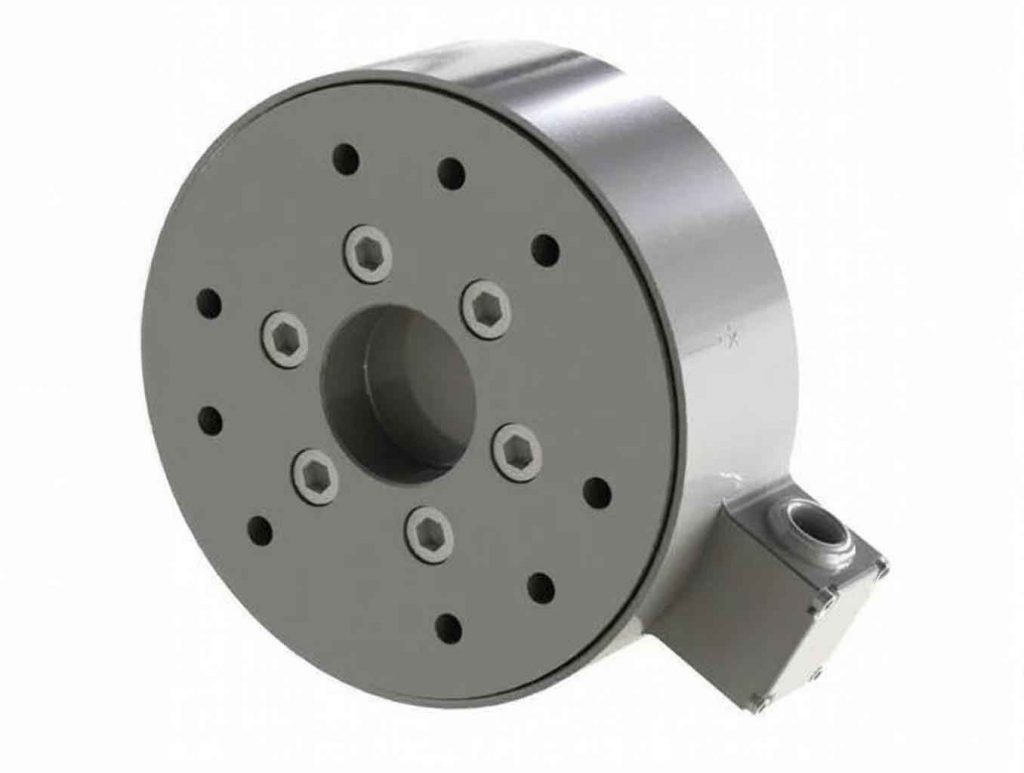
The design of my on-site calibration device for six-axis force sensors prioritizes portability and ease of use. Instead of relying on heavy weights and levers, I incorporate a 0.05% or 0.1% accuracy class standard force transducer coupled with a mechanical or hydraulic loading system. This system applies controlled forces, while a high-rigidity frame replaces the traditional testing platform. A key innovation is the use of a uniaxial coordinate frame instead of a cross-shaped one, which reduces size and weight without compromising functionality. The device includes adjustable angle blocks to orient the sensor accurately during calibration. This compact setup can be transported to field locations, such as factories or research labs, where large equipment with integrated six-axis force sensors is installed. The calibration process involves mounting the sensor onto the device, applying incremental loads, and recording the outputs. By using specific spatial load configurations, I can gather sufficient data to compute the coupling matrix efficiently, avoiding the need for complex decoupling procedures.
The calibration methodology for the six-axis force sensor using this device follows a systematic procedure. First, I determine the full-scale range of each force and moment component and select appropriate angle blocks to align the sensor. The sensor is securely mounted on the support frame to ensure rigid connections and minimize play. Loading is performed in ascending order for each primary axis, and the displayed values from the six-axis force sensor are recorded alongside the applied theoretical loads. For each component, I take measurements at 6 to 9 load points, repeating the process three times to ensure repeatability. The uniaxial coordinate frame is then repositioned to apply loads in different orientations, and the steps are repeated. This generates multiple datasets that capture the sensor’s response under varied spatial conditions. The average of these readings is used to assess the sensor’s compliance with specifications, typically within ±0.5% error limits for field applications. If recalibration is needed, the data is processed to compute the coupling matrix R, as outlined in the mathematical model.
To calibrate the six-axis force sensor, I employ the data collected from the on-site device to solve for the coupling matrix R. Expanding the matrix equation gives:
$$\begin{pmatrix}
F_x \\
F_y \\
F_z \\
T_x \\
T_y \\
T_z
\end{pmatrix} = \begin{pmatrix}
R_{11}\varepsilon_1 + R_{12}\varepsilon_2 + R_{13}\varepsilon_3 + R_{14}\varepsilon_4 + R_{15}\varepsilon_5 + R_{16}\varepsilon_6 \\
R_{21}\varepsilon_1 + R_{22}\varepsilon_2 + R_{23}\varepsilon_3 + R_{24}\varepsilon_4 + R_{25}\varepsilon_5 + R_{26}\varepsilon_6 \\
R_{31}\varepsilon_1 + R_{32}\varepsilon_2 + R_{33}\varepsilon_3 + R_{34}\varepsilon_4 + R_{35}\varepsilon_5 + R_{36}\varepsilon_6 \\
R_{41}\varepsilon_1 + R_{42}\varepsilon_2 + R_{43}\varepsilon_3 + R_{44}\varepsilon_4 + R_{45}\varepsilon_5 + R_{46}\varepsilon_6 \\
R_{51}\varepsilon_1 + R_{52}\varepsilon_2 + R_{53}\varepsilon_3 + R_{54}\varepsilon_4 + R_{55}\varepsilon_5 + R_{56}\varepsilon_6 \\
R_{61}\varepsilon_1 + R_{62}\varepsilon_2 + R_{63}\varepsilon_3 + R_{64}\varepsilon_4 + R_{65}\varepsilon_5 + R_{66}\varepsilon_6
\end{pmatrix}$$
Each row of this equation corresponds to one of the six output components, with the Rij parameters defining the linear combination of sensing element outputs. To determine all 36 parameters, I use at least six independent spatial load cases. For each load case, I apply a known force and moment combination, measure the corresponding ε vector, and record the values. By stacking these equations into a system, I can solve for R using linear algebra techniques, such as least squares regression. This method leverages the on-site device’s ability to apply controlled multi-axis loads, simplifying the calibration process compared to traditional approaches that require isolating each axis.
Uncertainty assessment is a critical part of calibrating six-axis force sensors, as it quantifies the reliability of the measurements. For force components, such as the x-axis force Fx, the mathematical model is:
$$F_x = F \cdot \cos \alpha \pm r$$
where F is the applied force from the standard transducer, α is the angle between the force direction and the sensor axis, and r is the resolution of the sensor display. The combined standard uncertainty uc(Fx) is derived from the uncertainties in F, α, and r, assuming independence:
$$u_c(F_x) = \sqrt{ \cos^2 \alpha \cdot u^2(F) + F^2 \sin^2 \alpha \cdot u^2(\alpha) + u^2(r) }$$
Similarly, for moment components like the x-axis moment Tx, the model is:
$$T_x = F \cdot L \cdot \sin \alpha \pm r$$
where L is the length of the coordinate frame. The combined standard uncertainty is:
$$u_c(T_x) = \sqrt{ L^2 \sin^2 \alpha \cdot u^2(F) + F^2 \sin^2 \alpha \cdot u^2(L) + F^2 L^2 \cos^2 \alpha \cdot u^2(\alpha) + u^2(r) }$$
The standard uncertainty components are evaluated based on various sources, such as the repeatability and stability of the standard force transducer, temperature effects, interpolation errors, hysteresis, and measurement resolution. For example, the uncertainty in the applied force u(F) includes contributions from the range difference, repeatability, long-term stability, temperature influence, interpolation, and hysteresis. These are combined as:
$$u^2(F) = \left( \frac{\Delta R}{1.64 \sqrt{3}} \right)^2 + u^2(F)_{\text{other}}$$
where u(F)other encompasses the remaining factors. The uncertainties in angle and length measurements, u(α) and u(L), are derived from the resolution of the measuring instruments, typically following a normal distribution. The expanded uncertainty U is then calculated using a coverage factor k=2, providing a 95% confidence interval. For force measurements, U = 2uc(Fx), and for moments, U = 2uc(Tx). This rigorous uncertainty analysis ensures that the on-site calibration results are traceable and reliable, even in field conditions.
To illustrate the uncertainty sources, I have compiled a table summarizing the key components and their contributions for force and moment calibrations of a six-axis force sensor. This table helps in systematically evaluating each factor during on-site assessments.
| Uncertainty Source | Symbol | Half-Width | Type | Distribution | Divisor | Standard Uncertainty |
|---|---|---|---|---|---|---|
| Force Range Difference | ΔR | ΔR | B | Uniform | 1.64√3 | ΔR / (1.64√3) |
| Force Repeatability | Rb | Rb | B | Uniform | 1.64√3 | Rb / (1.64√3) |
| Long-Term Stability | Sb | Sb | B | Uniform | 2√3 | Sb / (2√3) |
| Temperature Effect | St | St | B | Uniform | 2√3 | St / (2√3) |
| Interpolation Error | Ip | Ip | B | Uniform | √3 | Ip / √3 |
| Hysteresis | H | H | B | Triangular | √6 | H / √6 |
| Display Resolution | r | r/2 | B | Uniform | √3 | r / (2√3) |
| Angle Measurement | δα | δα | B | Normal | 3 | δα / 3 |
| Length Measurement | δL | δL | B | Normal | 3 | δL / 3 |
In practice, when calibrating a six-axis force sensor on-site, I follow a step-by-step process to minimize errors and ensure accuracy. After setting up the device in a stable environment, I perform pre-loading checks to confirm that all connections are rigid. For each force and moment component, I apply loads incrementally, recording the sensor outputs and the corresponding theoretical values. The data is then averaged across multiple runs to account for random variations. If the sensor deviations exceed acceptable limits, I proceed with recalibration by computing the coupling matrix R using the collected datasets. This involves solving the linear system formed by the expanded matrix equations, often using software tools for efficiency. The result is a calibrated six-axis force sensor that can accurately measure spatial loads in its operational environment.
The advantages of this on-site calibration method for six-axis force sensors are manifold. It eliminates the need to disassemble large systems, reducing downtime and costs. The portability of the device allows for rapid deployment in various settings, from manufacturing floors to outdoor test sites. Moreover, the use of spatial loads simplifies the calibration process, making it accessible to technicians without extensive metrology training. In my experience, this approach has proven effective for sensors with tolerances of ±0.5% or better, meeting the needs of most industrial applications. Future work could focus on automating the data collection and matrix computation further, enhancing the speed and precision of on-site calibrations for six-axis force sensors.
In conclusion, the development of this on-site calibration device and methodology represents a significant advancement in the field of force metrology. By addressing the limitations of traditional equipment, it enables efficient and accurate calibration of six-axis force sensors in their operational contexts. The integration of mathematical models, uncertainty analysis, and practical procedures ensures that the results are reliable and traceable. As the use of six-axis force sensors continues to grow in complex systems, this approach will play a crucial role in maintaining measurement integrity without the logistical challenges of lab-based calibration.