
In the quest for electromechanical actuators with higher power density, capable of delivering high forces at precise, low-speed motion, the planetary roller screw has emerged as a superior alternative to the traditional ball screw. Among its variants, the differential-type planetary roller screw, often referred to as the PWG type, presents a unique and ingenious design. My focus here is to delve deeply into the operational principles, kinematic relationships, and design parameters of this specific configuration. Unlike the standard planetary roller screw, the PWG design ingeniously combines planetary gear kinematics with screw-nut mechanics through a differential principle, resulting in an effective lead that is smaller than the lead of the primary screw. This characteristic is paramount for achieving high reduction ratios within an exceptionally compact envelope, making it ideally suited for high-load, high-speed applications in aerospace, robotics, and advanced manufacturing.
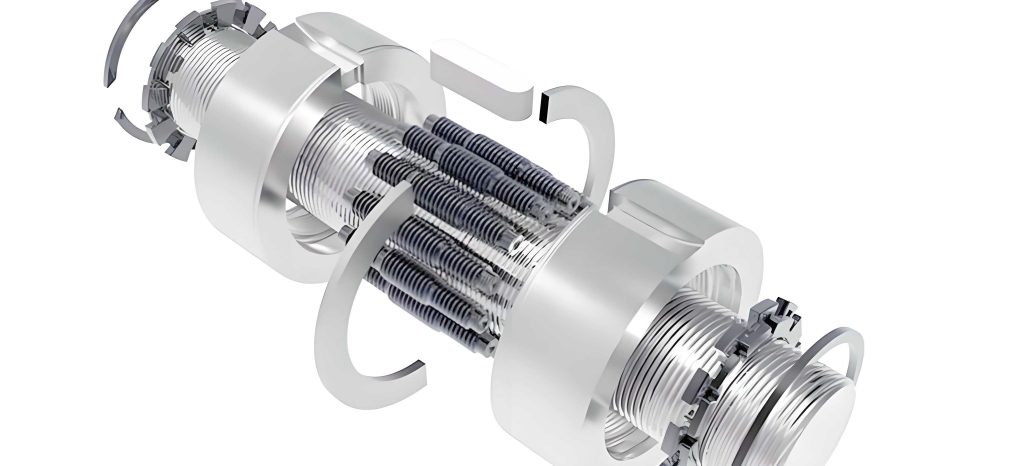
The fundamental appeal of any planetary roller screw lies in its multi-point contact and high load-carrying capacity. Load is distributed across multiple threaded rollers arranged around a central screw, dramatically increasing stiffness, fatigue life, and maximum force capability compared to a ball screw of similar size. The standard planetary roller screw operates on a principle where the rollers act as planets. They are in threaded engagement with both the central screw (sun) and an internally threaded nut (ring gear). As the screw rotates, it drives the rollers, causing them to both rotate on their own axes (spin) and revolve around the screw’s axis (orbit). A retainer or cage typically maintains the angular spacing of the rollers. The nut, constrained from rotating, is forced to translate axially. In the standard design, the lead of the nut is equal to the lead of the screw, resulting in a 1:1 relationship between screw rotation and nut translation, barring minor geometric adjustments for conformity. The kinematic model for this standard type is analogous to a 2K-H planetary gear train.
The PWG-type differential planetary roller screw deviates significantly from this standard model. Its most distinctive features are designed to overcome specific limitations and achieve a finer effective lead. The primary structural and operational differences are summarized in the table below.
| Feature | Standard Planetary Roller Screw | PWG Differential Planetary Roller Screw |
|---|---|---|
| Nut Thread Profile | Internal thread (helical) | Internal ring groove (zero helix angle) |
| Roller Thread Profile | Uniform thread along its length | Two-stage thread: large major diameter for screw engagement, small major diameter for nut engagement |
| Roller Helix Angle | Non-zero, matches nut & screw | Zero in the nut-engagement zone (ring groove) |
| Roller Axial Constraint | Often requires external synchronization (e.g., gears) to prevent skewing and jamming | Stabilized by the ring-groove nut; no external synchronization needed |
| Kinematic Principle | Direct translation, analogous to planetary gear train | Differential translation via external helical gearing |
| Effective Lead (P) | Approximately equal to screw lead (Ps) | Smaller than screw lead (P < Ps) |
The core innovation of the PWG planetary roller screw is the use of a nut with ring grooves instead of a helical thread. This means the nut has an effective lead of zero (Pn = 0). The rollers are machined with two distinct threaded sections: a section with a larger major diameter that engages with the threaded central screw, and a section with a smaller major diameter that engages with the ring grooves of the nut. Because the nut engagement is a ring groove, there is no relative axial movement possible between the roller and the nut at their contact point—it is a pure rolling contact in the axial direction. This feature inherently prevents the rollers from skewing or jamming, eliminating the need for external gear synchronization common in standard designs.
The arrangement of the rollers is critical and governed by the need to avoid axial interference. For a standard planetary roller screw with equal leads on the nut and screw, rollers can be spaced arbitrarily. For the differential type, the condition for non-interference, derived from the relative axial displacements, leads to a constraint on the maximum number of rollers (Zmax). The relationship is given by the equation for the differential lead condition:
$$ \frac{P_n}{Z} = P_s \pm kP_0 $$
Where \(P_n\) is the nut lead, \(P_s\) is the screw lead, \(P_0\) is the thread pitch, and \(k\) is an integer. Since for the PWG design \(P_n = 0\), this simplifies to:
$$ 0 = P_s \pm kP_0 $$
This implies that \(P_s = \mp kP_0\). For a single-start screw (\(P_s = P_0\)), we get \(k = \mp 1\). This constraint would severely limit the number of rollers. To overcome this and allow for a higher number of load-bearing rollers even with a single-start screw, the two-stage thread design on the rollers is employed. The axial offset between the large-diameter and small-diameter thread segments on the i-th roller, \(Z_i\), is designed to satisfy the meshing condition sequentially around the screw. For a right-handed screw with rollers arranged clockwise, this offset is calculated as:
$$ Z_i = Z_0 + (i-1)h $$
Where \(Z_0\) is the offset for the first roller and \(h\) is a constant pitch increment, effectively decoupling the roller count from the screw’s lead constraint.
Kinematic Model and Lead Calculation for the PWG Planetary Roller Screw
Establishing the kinematic model for the PWG planetary roller screw cannot rely on the simple 2K-H planetary gear train analogy because the pitch radii at the two meshing points (roller-screw and roller-nut) are not equal (\(r_s \neq r_n\)). Instead, we must use instantaneous center analysis combined with screw motion principles.
Let us define the key geometric parameters:
- \(R_s\): Geometric pitch radius of the screw thread.
- \(R_n\): Geometric pitch radius of the nut ring groove.
- \(r_s\): Pitch radius of the roller thread at the screw-roller contact point.
- \(r_n\): Pitch radius of the roller thread at the nut-roller contact point.
- \(r_c\): Orbital radius of the roller center, \(r_c = R_s + r_s\).
- \(\omega_s\): Angular velocity of the screw.
- \(\omega_c\): Angular velocity of the roller assembly (planet carrier) about the screw axis.
- \(v_c\): Tangential velocity of the roller center.
Consider the engagement between a roller and the nut. The nut has ring grooves (zero lead), so the contact point (Q) is an instantaneous center of pure rolling—there is no axial slip. The absolute velocity of point Q is zero. The velocity of the roller center \(v_c\) can be expressed relative to this instantaneous center. It is also the product of the orbital radius and the orbital angular velocity:
$$ v_c = r_c \omega_c \quad \text{where} \quad r_c = R_s + r_s $$
Now, consider the engagement between the same roller and the screw at contact point P. The velocities of the screw and the roller material at point P must be compatible. The screw thread at point P has a velocity with two components: a tangential component due to rotation and an axial component due to the helix. For a screw rotating with angular velocity \(\omega_s\), the tangential velocity component at radius \(R_s\) is \(R_s \omega_s\). The relationship between the tangential velocity (\(v_t\)) and the axial velocity (\(v_a\)) for a screw with lead \(P_s\) is:
$$ v_a = \frac{P_s}{2\pi} \omega_s $$
The velocity vector of the screw at the meshing point P must match that of the roller. Using the geometry of the system and the fact that the roller’s motion is defined by its orbital velocity \(\omega_c\) and its spin (which is dictated by the pure rolling condition at Q), we can derive the relationship between \(\omega_s\) and \(\omega_c\). The detailed vector analysis leads to the conclusion that the orbital velocity is proportional to the screw’s rotational velocity, scaled by the ratio of the pitch radii:
$$ \omega_c = \frac{r_s}{r_s + r_n} \omega_s $$
The direction of \(\omega_c\) is the same as \(\omega_s\) for a right-handed screw. The axial translation velocity of the nut (\(v\)), which is the output, is determined solely by the orbital motion of the rollers, as the rollers have no axial movement relative to the nut. This velocity is the product of the orbital speed and the effective lead of the mechanism:
$$ v = P \omega_c / (2\pi) $$
Simultaneously, from the perspective of the screw’s rotation, the axial velocity of the nut can also be expressed using the screw’s lead \(P_s\) and the relative motion between the screw rotation and the roller carrier rotation. The kinematic closure equation, considering the differential action, is:
$$ v = \frac{P_s}{2\pi} (\omega_s – \omega_c) $$
Substituting the expression for \(\omega_c\) into this equation and solving for the effective lead \(P\) (where \(v = P \omega_s / (2\pi)\)) yields the fundamental formula for the PWG planetary roller screw lead:
$$ P = P_s \left(1 – \frac{r_s}{r_s + r_n}\right) $$
This can be rewritten in a more insightful form:
$$ P = P_s \left(\frac{r_n}{r_s + r_n}\right) $$
Furthermore, since \(r_c = R_s + r_s\), and acknowledging the geometric relationship at the nut \(R_n = r_c + r_n = R_s + r_s + r_n\), we can also express the lead as:
$$ P = P_s \left(\frac{R_n – (R_s + r_s)}{R_n}\right) \quad \text{or} \quad P = P_s \left(\frac{r_n}{R_n – R_s}\right) $$
The critical takeaway from this derivation is that the effective lead \(P\) of the PWG differential planetary roller screw is always less than the lead of the screw \(P_s\), because the term \(r_n/(r_s + r_n)\) is always less than 1. The reduction ratio is directly and precisely controlled by the ratio of the roller’s pitch diameters at the two engagement zones. This is the essence of the “differential” action: the output motion is the difference between the screw’s input motion and the motion “absorbed” by the orbital movement of the rollers, which is governed by the radius ratio.
Design Parameter Analysis and Numerical Example
The derived lead formula reveals the key design parameters for a PWG planetary roller screw. By carefully selecting \(r_s\) and \(r_n\), a designer can tailor the effective lead without changing the primary screw’s lead or pitch, which may be standardized. The following table summarizes the influence of key parameters.
| Parameter | Effect on Effective Lead (P) | Design Consideration |
|---|---|---|
| Screw Lead (Ps) | Directly proportional. Doubling Ps doubles P. | Larger Ps allows higher nut speed for a given input RPM but reduces force resolution. |
| Roller Pitch Radius at Screw (rs) | Inversely related. Increasing rs decreases P. | Affects load capacity and contact stress at the screw-roller interface. Larger rs typically allows more threads in contact. |
| Roller Pitch Radius at Nut (rn) | Directly proportional. Increasing rn increases P. | Affects load capacity at the nut-roller interface. A smaller rn relative to rs is key for achieving a very small P. |
| Ratio (rn/rs) | Critical. As rn/rs → 0, P → 0. As rn/rs → ∞, P → Ps. | The primary means of setting the reduction ratio. Manufacturing precision is crucial to maintain the designed ratio and avoid lead error. |
Let’s apply the model to a concrete example. Consider a PWG planetary roller screw with the following parameters, typical for a high-precision application:
| Parameter | Symbol | Value |
|---|---|---|
| Screw Lead | \(P_s\) | 3.0 mm |
| Roller Major Diameter (Screw end) | \(d_s = 2r_s\) | 9.384 mm |
| Roller Major Diameter (Nut end) | \(d_n = 2r_n\) | 7.684 mm |
| Screw Pitch Diameter | \(2R_s\) | 19.23 mm |
First, calculate the pitch radii: \(r_s = 9.384 / 2 = 4.692 \text{ mm}\), \(r_n = 7.684 / 2 = 3.842 \text{ mm}\).
Now, compute the effective lead \(P\) using the fundamental formula:
$$ P = P_s \left(\frac{r_n}{r_s + r_n}\right) = 3.0 \times \left(\frac{3.842}{4.692 + 3.842}\right) $$
$$ P = 3.0 \times \left(\frac{3.842}{8.534}\right) \approx 3.0 \times 0.4502 $$
$$ P \approx 1.351 \text{ mm} $$
This result demonstrates the powerful reduction capability of the differential planetary roller screw. The screw has a 3.0 mm lead, but the assembly provides an effective lead of approximately 1.351 mm. This translates to a 55% reduction in linear travel per screw revolution, directly increasing the output force resolution and the system’s positional accuracy for a given rotary encoder resolution on the input shaft.
Experimental verification is crucial. Testing such a mechanism on a precision motion analyzer (e.g., a laser interferometer or a high-grade encoder-based lead checker) would involve measuring the axial displacement of the nut over a large number of screw revolutions. The cumulative lead error plot would show minor fluctuations due to manufacturing imperfections, friction variations, and potential micro-slip. However, the average measured lead over a long travel should closely match the calculated value of 1.351 mm. Discrepancies of less than 1% are achievable with proper preload and precision manufacturing, validating the kinematic model’s accuracy. The preload is essential in a PWG design to maintain firm frictional contact at the screw-roller interface and prevent gross slip, which would make the lead unpredictable and variable.
Advantages, Challenges, and Application Context
The PWG differential planetary roller screw offers compelling advantages, but also presents distinct design and application challenges.
Advantages:
- High Reduction Ratio in a Compact Space: The ability to achieve a sub-screw lead provides a built-in speed reduction and force multiplication without additional external gearheads, leading to a very high power density.
- High Stiffness and Load Capacity: It inherits the multi-contact advantage of standard planetary roller screws, supporting very high axial, radial, and moment loads.
- Elimination of Synchronization Gears: The ring-groove nut inherently stabilizes the rollers, removing a potential source of backlash, wear, and complexity.
- High-Speed Capability: The design is generally suitable for higher rotational speeds than ball screws due to lower centrifugal effects on the rolling elements.
Challenges and Considerations:
- Preload and Friction Sensitivity: The transmission of motion relies on frictional drive at the screw-roller interface. Insufficient preload can lead to slip and loss of positional accuracy. Optimal preload design is critical.
- Manufacturing Complexity: Producing the two-stage rollers and the precise ring-groove nut requires advanced, high-precision machining and threading processes, impacting cost.
- Heat Generation: Under high loads and speeds, the sliding friction component (especially under preload) can generate significant heat, requiring careful thermal management.
- Lead Error Sources: Deviations in the manufactured pitch diameters \(r_s\) and \(r_n\) will directly proportionally affect the actual lead. Tight tolerances are mandatory.
In conclusion, the PWG-type differential planetary roller screw represents a sophisticated evolution of screw-based linear actuation. By mastering its operational principle—centered on the differential equation \(P = P_s \frac{r_n}{r_s + r_n}\)—engineers can design ultra-compact, high-force, and high-precision actuation systems. Its place is firmly in demanding fields like aerospace flight control surface actuation, robotic joint drives requiring high dynamic performance, and industrial presses where space is constrained but power requirements are extreme. Future developments will likely focus on advanced materials, coatings to manage friction and wear, and integrated sensorization for real-time monitoring of preload and health status, pushing the performance boundaries of this remarkable planetary roller screw variant even further.