
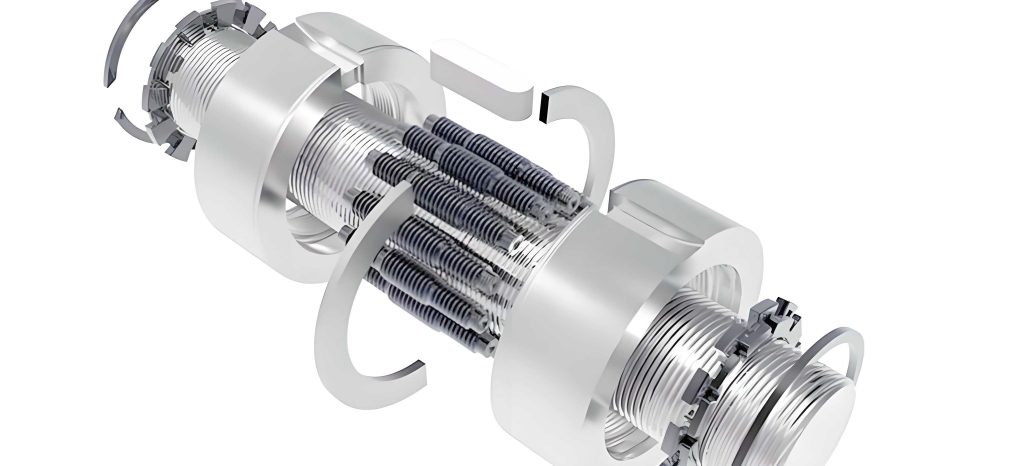
The planetary roller screw is a precision mechanical actuator that converts rotary motion into linear motion. Compared to the more common ball screw, it offers superior load capacity, higher efficiency, and longer service life, making it a critical component in demanding applications such as CNC machine tools, industrial robotics, and aerospace systems. The internal structure of a planetary roller screw assembly is complex, comprising a threaded screw, multiple threaded rollers, a nut with internal threads, an internal gear ring, and a retainer or cage. High reliability and precision are paramount, and the selection of modification coefficients (also known as addendum modification coefficients or profile shift coefficients) for the mating gears—specifically the internal gear ring on the nut and the spur gears on the ends of the rollers—is a fundamental design challenge. Suboptimal choice of these coefficients can lead to premature failure, reduced accuracy, or unreliable performance. This article details a systematic methodology for optimizing these modification coefficients to enhance the overall performance and durability of the planetary roller screw mechanism.
The fundamental working principle can be analogized to a planetary gear system combined with a screw thread interface. The central screw acts as the sun gear, the multiple rollers act as planets, and the internal gear ring acts as the ring gear. When the screw rotates and the nut is prevented from rotating, the rollers are compelled to perform a planetary motion. This motion, through the helical engagement between the roller threads and the screw/nut threads, is translated into linear displacement of the nut. The spur gears on the roller ends mesh with the internal gear ring, ensuring synchronized motion among all rollers and preventing kinematic interference. This gear train also shares the load under high-speed and heavy-duty conditions, relieving stress on the threaded interfaces.
The optimization of modification coefficients is guided by the need to prevent specific failure modes inherent to gear teeth under load. For the planetary roller screw, the primary considerations are:
- Contact Strength (Pitting Resistance): To maximize resistance to surface fatigue (pitting), the contact stress at the meshing teeth must be minimized. This is achieved by increasing the radius of relative curvature at the contact point, which generally calls for a larger sum of the modification coefficients for the mating pair.
- Bending Strength (Tooth Breakage Resistance): To prevent tooth bending fatigue failure, the bending stresses in both the internal gear and roller pinion teeth should be balanced and minimized. This involves optimizing the tooth shape, which imposes certain limits on the permissible range of modification coefficients.
- Surface Durability (Scuffing and Wear Resistance): To improve resistance to adhesive wear (scuffing) and abrasive wear, the specific sliding velocities between tooth profiles should be as equal as possible at the points of engagement and recess. This condition also constrains the choice of modification coefficients.
Based on these principles, a multi-objective optimization problem is formulated. The design variables are the modification coefficient for the internal gear ring, $x_1$, and for the roller pinion, $x_2$. The individual objective functions are derived as follows:
1. Objective for Maximum Contact Strength:
Maximize the sum of modification coefficients. From the equation for the operating pressure angle $\alpha’$ of a gear pair with profile shift, we have:
$$
\text{max } f_1(x_1, x_2) = x_1 + x_2 = \frac{z_1 + z_2}{2 \tan \alpha} (\text{inv } \alpha’ – \text{inv } \alpha)
$$
where $z_1$ and $z_2$ are the number of teeth on the internal gear and pinion, $\alpha$ is the standard pressure angle (typically 20°), and $\text{inv } \alpha = \tan \alpha – \alpha$.
2. Objective for Balanced Bending Strength:
Minimize the difference in calculated bending stresses.
$$
\text{min } f_2(x_1, x_2) = | \sigma_{F1} – \sigma_{F2} |
$$
The bending stress $\sigma_F$ for a gear is calculated using the Lewis formula extended with modern correction factors:
$$
\sigma_F = \frac{F_t}{b m} K_A K_V K_{F\beta} K_{F\alpha} Y_{Fa} Y_{Sa} Y_{\epsilon}
$$
where $F_t$ is the tangential load, $b$ is the face width, $m$ is the module, $K$ factors account for application, dynamic load, face load distribution, and transverse load distribution, and $Y_{Fa}$ (form factor), $Y_{Sa}$ (stress correction factor), and $Y_{\epsilon}$ (contact ratio factor) are dependent on the virtual number of teeth and the modification coefficient.
3. Objective for Equalized Specific Sliding:
Minimize the difference in sliding coefficients $\eta$ at the approach and recess points.
$$
\text{min } f_3(x_1, x_2) = | \eta_1 – \eta_2 |
$$
The sliding coefficient $\eta$ at a point on the tooth profile is defined as the ratio of the sliding velocity to the rolling velocity.
These three objectives are combined into a single scalar objective function using a weighted sum approach. To manage the different scales of the objectives, they are first normalized. A practical normalization function is:
$$
f_{r_i}(x) = \frac{f_i(x) – p_i}{q_i – p_i} – \sin\left(2\pi \frac{f_i(x) – p_i}{q_i – p_i}\right)
$$
where $p_i$ and $q_i$ are the estimated lower and upper bounds for the $i$-th objective function over the feasible design space. Weighting factors $w_i$ are determined based on the allowable tolerance $\Delta f_i = (q_i – p_i)/2$ for each objective, such that $w_i = 1/(\Delta f_i)^2$. This penalizes objectives with smaller tolerances more heavily. The final aggregate objective function to be minimized is:
$$
\text{min } F(x_1) = -w_1 f_{r1}(x_1) + w_2 f_{r2}(x_1) + w_3 f_{r3}(x_1)
$$
Note that $x_2$ is not an independent variable once $x_1$ and the center distance are chosen, due to the fixed center distance constraint in the planetary roller screw assembly. Therefore, $x_2$ is expressed as a function of $x_1$.
The optimization is subject to a set of geometric and performance constraints essential for the proper functioning of the planetary roller screw gears:
| Constraint | Mathematical Expression | Purpose |
|---|---|---|
| 1. Tip Circle > Base Circle | $g_1(x_1) = x_1 – \frac{z_1}{2}(\cos\alpha – 1) + h_{a}^* \ge 0$ $g_2(x_1) = x_2(x_1) – \frac{z_2}{2}(\cos\alpha – 1) – h_{a}^* \ge 0$ |
Ensures usable tooth profile exists above the base circle. |
| 2. Minimum Contact Ratio | $g_3(x_1) = \frac{1}{2\pi}[z_1(\tan\alpha_{a1} – \tan\alpha’) – z_2(\tan\alpha_{a2} – \tan\alpha’)] \ge \varepsilon_{\min}$ (e.g., 1.2) | Guarantees smooth, continuous power transmission. |
| 3. Profile Non-Interference | $g_4(x_1) = z_1(\delta_1 + \text{inv}\alpha_{a1}) – z_2(\delta_2 + \text{inv}\alpha_{a2}) + (z_2 – z_1)\text{inv}\alpha’ \ge \Delta_{\min}$ | Prevents the tip of one gear from digging into the fillet of the other. |
| 4. Tip Clearance (Radial Gap) | $g_5(x_1) = R_{a2} – R_{a1} + a’ – c^* m \ge 0$ $g_6(x_1) = R_{a2} – R_{f1} – a’ – c^* m \ge 0$ |
Ensures adequate radial space between non-mating surfaces to prevent rubbing and allow for lubrication. |
Where $h_a^*$ is the addendum coefficient, $\alpha_{a}$ is the pressure angle at the tip circle, $R_a$ and $R_f$ are tip and root radii, $a’$ is the operating center distance, $c^*$ is the clearance coefficient (e.g., 0.25), and $m$ is the module.
The resulting constrained nonlinear optimization problem is solved using the Complex Method, a direct search algorithm suitable for problems with inequality constraints. The steps are as follows:
- Initialize the basic parameters: $m, z_1, z_2, h_a^*, a’, \alpha$.
- Generate an initial “complex” of $k$ feasible points (vertices) in the design space ($k > n+1$, where $n=1$ is the number of variables). Random points are generated and checked against constraints $g_u(x_1) \le 0$ until $k$ feasible points are found.
- Evaluate the objective function $F(x_1)$ at all vertices. Identify the worst vertex $x_1^h$ with the highest (least optimal) $F$ value.
- Calculate the centroid $x_1^c$ of all vertices except the worst one.
- Generate a reflected point: $x_1^r = x_1^c + \beta (x_1^c – x_1^h)$, where the reflection coefficient $\beta > 1$ (typically 1.3).
- If $x_1^r$ is infeasible, move it halfway towards the centroid until it becomes feasible.
- If $F(x_1^r) < F(x_1^h)$, replace $x_1^h$ with $x_1^r$. Otherwise, contract the reflection point towards the centroid.
- Repeat steps 3-7 until the vertices converge, i.e., the standard deviation of the objective function values at all vertices falls below a specified tolerance.
Application Example
To demonstrate the method, the gear parameters from a commercial planetary roller screw are optimized. The base parameters are listed below:
| Parameter | Symbol | Value |
|---|---|---|
| Screw Pitch Diameter | $d_s$ | 15 mm |
| Lead | $P_h$ | 2 mm |
| Number of Screw Starts | $N_s$ | 5 |
| Internal Gear Teeth | $z_1$ | 100 |
| Roller Pinion Teeth | $z_2$ | 20 |
| Module | $m$ | 0.25 mm |
| Original Modification Coeff. (Int. Gear) | $x_{1,orig}$ | 0.28 |
Applying the optimization model and the Complex Method algorithm, the feasible bounds for the objectives were found to be: $2.68 \le f_1 \le 5.38$, $0 \le f_2 \le 33.2$ MPa, $0 \le f_3 \le 3.08$. The corresponding weighting factors were calculated as $w_1 = 0.35$, $w_2 = 0.01$, $w_3 = 0.81$. The optimization process yielded the following results:
| Optimized Parameter | Symbol | Value |
|---|---|---|
| Internal Gear Modification Coefficient | $x_1$ | 0.21 |
| Roller Pinion Modification Coefficient | $x_2$ | -0.16 |
| Sum of Modification Coefficients | $x_1 + x_2$ | 0.05 |
The optimized values satisfy all geometric constraints (contact ratio > 1.2, no interference, sufficient clearances) while minimizing the composite objective function $F(x_1)$. The shift from the original design ($x_1=0.28$, implying $x_2$ likely different) to the optimized pair ($x_1=0.21, x_2=-0.16$) represents a re-balancing of the design priorities—slightly reducing the sum of coefficients (impacting contact stress) to achieve a much better balance in sliding coefficients and bending stresses, as reflected by the high weight $w_3$.
Discussion and Extended Considerations
The proposed methodology provides a structured, automated approach to a critical design decision in planetary roller screw engineering. Key insights from this analysis include:
- Weighting Factor Sensitivity: The dominance of $w_3$ in this example highlights that for this specific planetary roller screw geometry and assumed operating conditions, wear and scuffing resistance might be the limiting factor rather than pure bending strength. The weights should be calibrated based on empirical failure data or specific application priorities (e.g., infinite life vs. high load capacity).
- Constraint Activity: In many designs, the minimum contact ratio or tip clearance constraints are “active,” meaning the optimal solution lies on the boundary of these constraints. This underscores their importance in defining the feasible design space.
- Algorithm Choice: The Complex Method is robust for low-dimensional problems with nonlinear constraints. For higher-dimensional optimizations (e.g., if thread parameters were also included), more advanced algorithms like Sequential Quadratic Programming (SQP) might be more efficient.
- Integration with System Model: A more comprehensive model could integrate this gear optimization with the load distribution analysis across the multiple rollers in the planetary roller screw and the thread contact mechanics, allowing for a true system-level optimization where gear and thread parameters are co-optimized.
In conclusion, the optimal selection of modification coefficients for the internal gear and roller pinions in a planetary roller screw is a non-trivial task that significantly impacts mechanism life and reliability. By formulating clear objectives based on failure mode analysis and establishing rigorous geometric constraints, a mathematical optimization model can be constructed. Solving this model using a direct search method like the Complex Method yields a quantitatively justified set of coefficients. This approach moves the design process from one based on experience and iteration to a systematic, performance-driven procedure, ultimately enhancing the load capacity, efficiency, and longevity of the planetary roller screw assembly in high-performance applications.