
Harmonic drive gear systems are pivotal in precision engineering, offering advantages such as high torque density, compact size, and minimal backlash. These systems are extensively utilized in robotics, aerospace, and navigation mechanisms due to their ability to achieve high reduction ratios with smooth operation. The flexspline, a core component of the harmonic drive gear, undergoes cyclic elastic deformation under the action of a wave generator, which induces both assembly and transmission stresses. In super-short cup-shaped flexsplines, characterized by a low length-to-diameter ratio, stress concentrations at the cup bottom become critically high, often exceeding the stress levels in the tooth ring specified by design standards. This elevation in stress poses a significant risk of fatigue failure, thereby limiting the reliability and load-carrying capacity of the harmonic drive gear. To address this challenge, structural optimization of the flexspline, particularly the cup bottom, is essential. This study proposes a novel design approach employing a variable thickness bottom, aiming to minimize the maximum equivalent stress under both assembly and transmission conditions. Through parametric finite element modeling, sensitivity analysis, and optimization techniques, we identify key geometric parameters influencing stress and develop an optimized profile that enhances the performance of super-short harmonic drive gear systems.
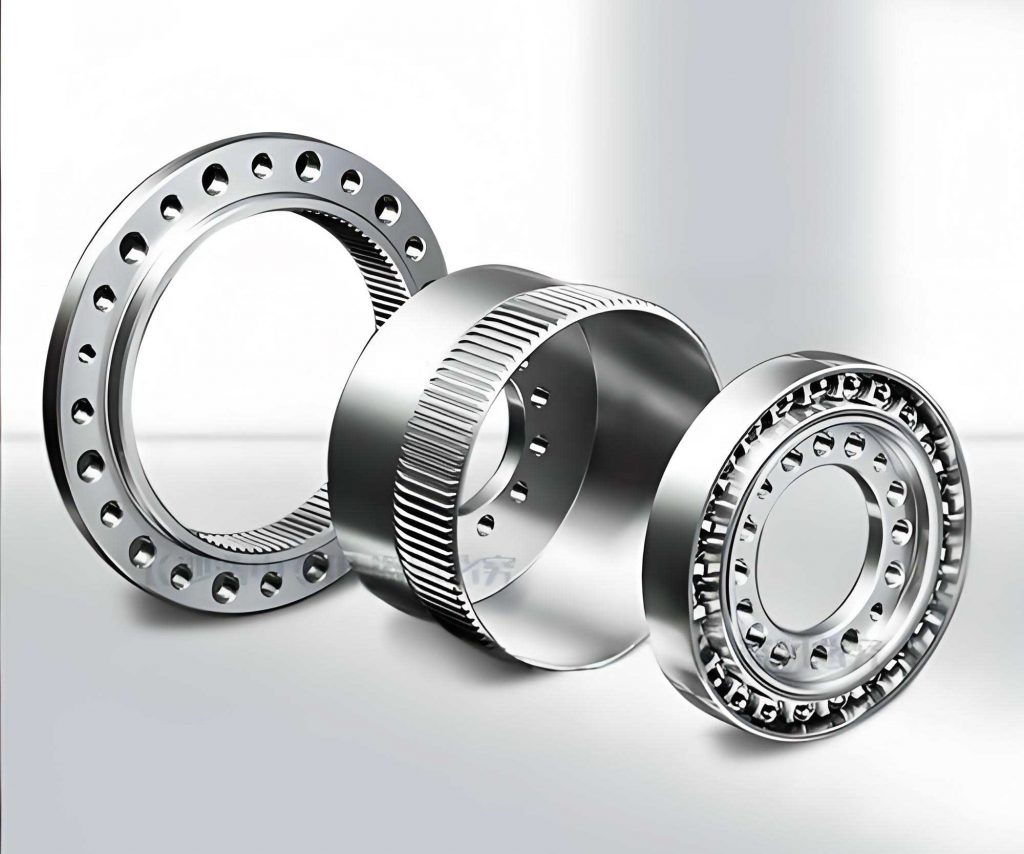
The harmonic drive gear operates on the principle of elastic kinematics, where a wave generator deforms a flexible cup-shaped component (the flexspline) to mesh with a rigid circular spline. This interaction enables torque transmission with high precision. However, the flexspline is subjected to repetitive stress cycles, making it the most vulnerable element. In super-short configurations, the reduced axial length amplifies stress at the cup bottom due to limited deformation absorption capacity. Traditional design guidelines, such as those in national standards, focus primarily on tooth ring stress but overlook the cup bottom stress, which becomes dominant in short designs. Consequently, there is a pressing need to develop advanced optimization methodologies tailored for these compact harmonic drive gear assemblies. This research contributes by integrating finite element analysis (FEA) with shape optimization algorithms, specifically targeting the variable thickness bottom to achieve stress reduction. The methodology encompasses the establishment of a parametric model, simulation of stress states, sensitivity evaluation of geometric parameters, and application of optimization routines like the complex method and ANSYS-built-in tools.
To analyze the stress behavior, a parametric finite element model of the cup-shaped flexspline is developed using solid elements. The model represents one-quarter of the flexspline, exploiting symmetry to reduce computational cost. The material properties are defined for 30CrMnSiA alloy steel, with an elastic modulus $$E = 207 \text{ GPa}$$ and Poisson’s ratio $$\mu = 0.3$$. The geometric parameters, including inner radius, wall thickness, and fillet radii, are parameterized to facilitate variation studies. Key dimensions for a reference harmonic drive gear, based on the HD CSG-25 series with a reduction ratio of 100, are summarized in Table 1. Note that the tooth ring is omitted in this study to isolate the cup bottom stress analysis; its effect is accounted for by an equivalent thickness derived from stiffness considerations.
| Symbol | Parameter | Value (mm) |
|---|---|---|
| \(r_i\) | Inner radius of the cup | 30.660 |
| \(t_1\) | Wall thickness of the cup | 0.480 |
| \(b_1\) | Width of the tooth ring | 8.061 |
| \(b_2\) | Axial length of the cup wall | 9.778 |
| \(l\) | Total length of the cup | 24.528 |
| \(l_1\) | Diaphragm width | 10.140 |
| \(r_1\) | Fillet radius near cup wall | 1.000 |
| \(r_2\) | Fillet radius near diaphragm | 0.500 |
| \(r_3\) | Inner radius of the flange | 10.000 |
For the assembly stress analysis, the deformation induced by a standard elliptical wave generator is simulated. The radial displacement of the mid-plane of the tooth ring is imposed as a boundary condition. The radial coordinate \(\rho\) at an angle \(\phi\) from the major axis is given by the ellipse equation:
$$
\rho = \frac{ab}{\sqrt{a^2 \sin^2 \phi + b^2 \cos^2 \phi}}
$$
where \(a\) and \(b\) are the semi-major and semi-minor axes, respectively, defined as \(a = r_0 + W_0\) and \(b = \frac{12r_0 – 7a + 4\sqrt{a(3r_0 – 2a)}}{9}\), with \(r_0\) being the initial mid-plane radius and \(W_0\) the maximum radial deformation. The radial displacement \(W\) is then \(W = \rho – r_0\). Symmetry boundary conditions are applied on the longitudinal planes, and the flange nodes are fixed to represent mounting conditions. This setup allows calculation of the equivalent von Mises stress distribution, particularly focusing on the cup bottom region.
In the transmission state, the flexspline experiences meshing forces due to torque load. Based on Ivanov’s empirical formulas, the distribution of circumferential force per unit width \(q_\theta\) and radial force \(q_\rho = q_\theta \tan(\alpha)\) (where \(\alpha\) is the pressure angle) is applied to the mid-plane nodes of the tooth ring. The peak force \(q_{\theta max}\) is determined from the maximum instantaneous torque \(M = 369 \text{ N·m}\) for the reference harmonic drive gear. The force distribution over the engagement zone, bounded by angles \(\phi_2\) and \(\phi_3\) relative to the peak force axis \(\phi_1 = -15^\circ\), is expressed as:
$$
q_\theta = q_{\theta max} \cos^2\left( \frac{\pi(\phi – \phi_1)}{2\phi_2} \right) \quad \text{for} \quad \phi_1 \leq \phi \leq \phi_1 + \phi_2
$$
and
$$
q_\theta = q_{\theta max} \cos^2\left( \frac{\pi(\phi – \phi_1)}{2\phi_3} \right) \quad \text{for} \quad \phi_1 – \phi_3 \leq \phi \leq \phi_1
$$
with \(\phi_2 = 37.5^\circ\) and \(\phi_3 = 7.5^\circ\). The peak force is computed by integrating over the engagement area:
$$
q_{\theta max} = \frac{\pi M}{2 \phi_2 d_g b_1}
$$
where \(d_g\) is the pitch diameter. This loading condition, combined with symmetric constraints, yields the transmission stress state.
Sensitivity analysis is conducted to assess the influence of key geometric parameters on the maximum equivalent stress in the cup bottom. The parameters studied include the length-to-diameter ratio \(l/d_0\) (where \(d_0 = 2r_0\)), fillet radii \(r_1\) and \(r_2\), and diaphragm width \(l_1\). For each parameter, the stress under both assembly and transmission conditions is evaluated while keeping other dimensions constant. The results are summarized in Table 2, highlighting the trends and percentage changes.
| Parameter | Range | Assembly Stress Trend | Transmission Stress Trend | Key Observation |
|---|---|---|---|---|
| Length-to-diameter ratio \(l/d_0\) | 0.1 to 0.6 | Exponential increase as ratio decreases | Similar exponential increase | Stress exceeds tooth ring stress for \(l/d_0 < 0.44\) |
| Fillet radius \(r_1\) (normalized by \(r_i\)) | 0.033 to 0.160 | Linear increase (176.3 to 229.9 MPa, +30.4%) | Minor increase (623.3 to 638.5 MPa) | Smaller \(r_1\) reduces stress significantly in assembly |
| Fillet radius \(r_2\) (normalized by \(r_i\)) | 0.013 to 0.140 | Monotonic increase (176.1 to 278.8 MPa, +58.3%) | Decrease (623.3 to 458.3 MPa, -26.5%) | Opposite effects on assembly vs. transmission stress |
| Diaphragm width \(l_1\) (normalized by \(l\)) | 0.140 to 0.385 | Monotonic decrease (888.4 to 174.4 MPa) | Sharp then gradual decrease | Larger \(l_1\) greatly reduces both stresses |
The sensitivity analysis reveals that for super-short harmonic drive gear flexsplines, the cup bottom stress is highly sensitive to geometric parameters. Reducing the length-to-diameter ratio drastically increases stress, confirming the criticality of cup bottom design in compact configurations. Notably, decreasing the fillet radius near the cup wall (\(r_1\)) and increasing the diaphragm width (\(l_1\)) effectively lower both assembly and transmission stresses. However, the fillet radius near the diaphragm (\(r_2\)) has a contrasting effect: increasing it raises assembly stress but lowers transmission stress. This dichotomy necessitates a balanced design approach, motivating the development of a variable thickness bottom to achieve optimal stress distribution.
To further reduce stress, a variable thickness bottom is proposed, modeled using a cubic spline function. The thickness profile along the cup bottom is defined by three control points: Point A at the junction with the cup wall, Point C at the mid-point, and Point E at the flange junction. Their coordinates are \((r_i + t_1, th_1)\), \(((r_b + r_i + t_1)/2, th_2)\), and \((r_b, th_3)\), respectively, where \(r_b\) is the outer radius of the flange, and \(th_1\), \(th_2\), \(th_3\) are the thickness variables. The spline curve ensures smooth transitions and is expressed in piecewise form. For the segment between A and C:
$$
z = a_1 y^3 + b_1 y^2 + c_1 y + d_1
$$
and for the segment between C and E:
$$
z = a_2 y^3 + b_2 y^2 + c_2 y + d_2
$$
where \(y\) is the radial coordinate and \(z\) is the thickness. The coefficients are determined by continuity conditions at C (value, first derivative, and second derivative) and natural boundary conditions at A and E (second derivatives set to zero). This yields a system of eight equations solved for the coefficients. The curve is then intersected with the fillet circles at points B and D to form the complete profile.
The optimization problem aims to minimize the maximum equivalent stress in the cup bottom, denoted as \(EQV\_BOTMAX\), by adjusting the thickness variables. The objective function is:
$$
\min f(\mathbf{x}) = \min f(th_1, th_2, th_3) = \min(EQV\_BOTMAX)
$$
subject to constraints on the thickness variables to avoid interference with the inner wall:
$$
t_1 \leq th_1 \leq b_1, \quad t_1 \leq th_2 \leq b_1, \quad t_1 \leq th_3 \leq b_1 – t_1
$$
where \(t_1\) is the nominal wall thickness and \(b_1\) is the tooth ring width. This formulation allows shape optimization of the cup bottom for both assembly and transmission states separately.
The complex method, a direct search optimization algorithm, is implemented via APDL programming to solve the problem. Starting from an initial simplex of design points, the algorithm iteratively reflects, expands, or contracts the simplex to converge to the optimum. For the assembly stress optimization, after 262 iterations, the optimal thickness values are \(th_1 = 1.213 \text{ mm}\), \(th_2 = 0.480 \text{ mm}\), and \(th_3 = 0.774 \text{ mm}\), achieving a maximum stress of 151.8 MPa, a 15.9% reduction from the initial uniform thickness design (180.6 MPa). For the transmission stress optimization, 88 iterations yield \(th_1 = 2.709 \text{ mm}\), \(th_2 = 0.806 \text{ mm}\), and \(th_3 = 1.535 \text{ mm}\), with a maximum stress of 349.9 MPa, a 43.9% reduction from the initial 623.3 MPa. The optimization processes are illustrated in Figure 1, showing stress convergence over iterations.
To validate the results, ANSYS’s built-in zero-order (subproblem approximation) and first-order (gradient-based) optimization methods are applied to the assembly stress case. The zero-order method approximates the objective function with a response surface, while the first-order method uses derivative information. The outcomes, compared in Table 3, demonstrate close agreement with the complex method, confirming the robustness of the optimized design for harmonic drive gear applications.
| Optimization Method | \(th_1\) (mm) | \(th_2\) (mm) | \(th_3\) (mm) | Maximum Assembly Stress (MPa) |
|---|---|---|---|---|
| Complex Method | 1.213 | 0.480 | 0.774 | 151.8 |
| Zero-Order Method (ANSYS) | 0.508 | 0.489 | 0.940 | 156.6 |
| First-Order Method (ANSYS) | 1.528 | 0.480 | 0.694 | 152.3 |
The optimized variable thickness profiles exhibit distinct characteristics: for assembly stress reduction, the thickness is increased near the cup wall fillet (\(th_1\)) and the flange (\(th_3\)), while the mid-region (\(th_2\)) remains close to nominal. For transmission stress reduction, all thickness values are substantially higher, with a pronounced thickening at the cup wall fillet. This indicates that stress mitigation strategies differ between states; assembly stress benefits from localized thickening at transition zones, whereas transmission stress requires overall reinforcement. The stress distributions in the optimized flexsplines show that the maximum assembly stress occurs at the mid-diaphragm along the major axis, while the maximum transmission stress is concentrated at the inner wall near the diaphragm fillet. These insights guide the design of robust harmonic drive gear components.
The implications of this study are significant for advancing harmonic drive gear technology, especially in compact applications like robotic joints. Traditional design codes often underestimate cup bottom stress in super-short flexsplines, leading to potential overstress and failure. By adopting a variable thickness bottom, designers can achieve stress reductions of up to 44%, enhancing fatigue life and load capacity. Moreover, the sensitivity analysis highlights that geometric parameters such as fillet radii and diaphragm width are critical levers for stress control. In practical harmonic drive gear manufacturing, these findings can inform machining and forging processes to produce optimized profiles without compromising functionality. Future work could extend this approach to dynamic loading conditions, thermal effects, or multi-objective optimization considering weight and cost. Additionally, experimental validation through strain gauge measurements or fatigue testing would further solidify the reliability of the proposed designs.
In conclusion, this research addresses the critical issue of stress concentration in super-short harmonic drive gear flexsplines by developing a variable thickness bottom optimization framework. Through finite element modeling, sensitivity analysis, and shape optimization using the complex method, substantial reductions in both assembly and transmission stresses are achieved. The key findings include: (1) cup bottom stress surpasses tooth ring stress in short designs, necessitating focused design efforts; (2) geometric parameters like fillet radii and diaphragm width have profound and sometimes contrasting effects on stress states; and (3) a variable thickness profile, parameterized via cubic splines, enables tailored stress minimization. The optimization results are validated with standard ANSYS tools, ensuring practicality. This work contributes to the design of more reliable and efficient harmonic drive gear systems, paving the way for enhanced performance in precision engineering applications. As the demand for compact and high-torque harmonic drive gear assemblies grows, such optimization strategies will become increasingly vital in achieving optimal mechanical integrity and longevity.