
In the field of precision mechanical transmission, the planetary roller screw has emerged as a critical component due to its superior performance characteristics, including low friction, high efficiency, long service life, and substantial load-bearing capacity. My research focuses on the structural parameter optimization of the planetary roller screw to enhance its design efficiency and operational reliability. This article delves into the transmission principles, parameter determination, and optimization methodologies, employing advanced algorithms to streamline the design process. Throughout this discussion, the term ‘planetary roller screw’ will be frequently emphasized to underscore its centrality in this analysis.
The planetary roller screw is widely utilized in applications such as precision instruments, CNC machine tools, industrial robotics, medical devices, aerospace, and metallurgy. Its versatility stems from various configurations, which can be classified based on axial movement, installation methods, length combinations, and precision capabilities. To provide a visual reference, consider the following illustration of a planetary roller screw assembly:
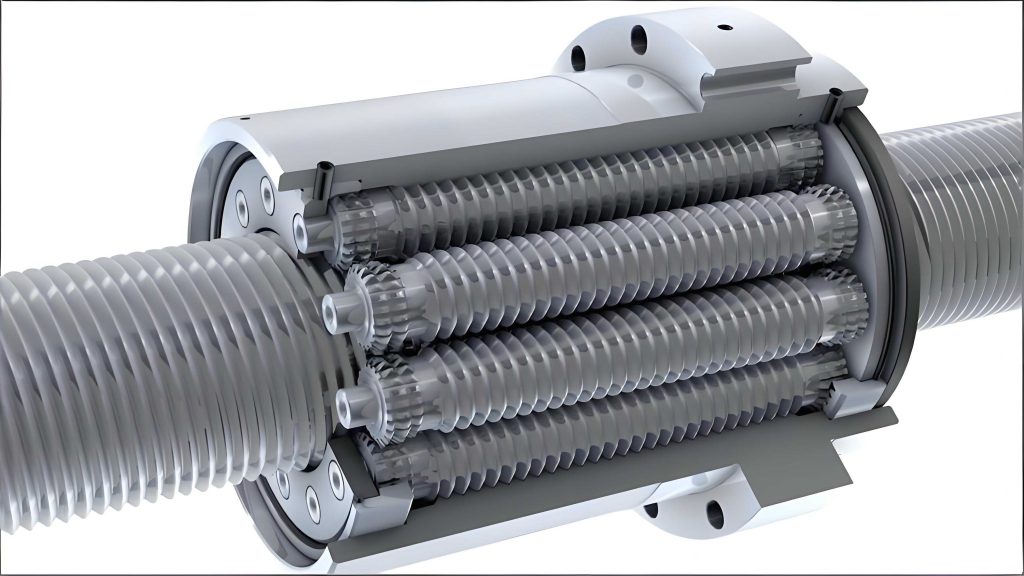
Understanding the transmission principle is fundamental to optimizing the planetary roller screw. The system comprises a screw (acting as the sun gear), rollers (serving as planetary gears), and a nut (functioning as the ring gear). When the screw rotates and the nut is circumferentially fixed, the rollers undergo planetary-like motion, converting rotary motion into linear reciprocation via helical transmission. The gears at both ends of the rollers ensure synchronous engagement, pure rolling at the pitch circle, and prevention of interference due to individual roller slippage. This kinematic relationship can be expressed mathematically. For instance, to approximate no sliding between the nut and screw, the diameter ratio must satisfy:
$$ \frac{d_s}{d_r} = n – 2 $$
where \( d_s \) is the screw diameter, \( d_r \) is the roller diameter, and \( n \) is the number of screw starts. Additionally, based on motion principles, the relationship between nut and roller diameters is:
$$ \frac{d_n}{d_r} = \frac{z_n}{z_r} $$
Here, \( d_n \) is the nut diameter, \( z_n \) is the number of teeth on the nut gear, and \( z_r \) is the number of teeth on the roller gear. These equations form the basis for initial parameter sizing in planetary roller screw design.
Determining the structural parameters of the planetary roller screw involves calculating basic dimensions for the screw, rollers, and nut, followed by deriving parameters for the planetary gears at the ends. The gear pair, often integrated by milling teeth directly onto the roller threads, is crucial for maintaining alignment and load distribution. However, these parameters are constrained by multiple factors, necessitating optimization to balance performance metrics such as volume, strength, and meshing quality. In this analysis, I treat key variables as design parameters and apply multi-objective optimization techniques.
The optimization process begins with defining design variables. For the planetary roller screw, I select the module \( m \), number of teeth on the roller gear \( z_r \), total number of rollers \( C \), profile shift coefficient for the roller gear \( x_1 \), and gear width \( B \). These are represented as a vector:
$$ \mathbf{X} = [m, z_r, C, x_1, B]^T = [x_1, x_2, x_3, x_4, x_5]^T $$
Next, I establish multiple objective functions. The first objective is to minimize the overall volume of the gear system, which reduces material costs and enhances compactness. The volume includes the sun gear (screw) and planetary gears (rollers), given by:
$$ f_1(\mathbf{X}) = V_s + C V_r = \frac{\pi B}{4} (d_s^2 + C d_r^2) $$
Since the roller gear is milled on the roller thread, its outer diameter relates to the nominal roller diameter. Incorporating revision coefficients \( L \) and \( S \), the function becomes:
$$ f_1(\mathbf{X}) = \frac{1}{4} \pi x_5 \left[ (n-2)^2 + x_3 \right] \left[ \frac{x_1 (x_2 + 2h_a^* + x_4) – S}{L} \right]^2 $$
where \( h_a^* \) is the addendum coefficient. The second objective is to maximize the contact ratio \( \varepsilon \), which improves load capacity and transmission smoothness. For an internal meshing gear pair with height correction, the contact ratio is:
$$ \varepsilon = \frac{1}{2\pi} \left[ z_r (\tan \alpha_{a1} – \tan \alpha_1′) \pm z_n (\tan \alpha_{a2} – \tan \alpha_2′) \right] $$
Here, \( \alpha_{a1} \) and \( \alpha_{a2} \) are pressure angles at the addendum circles, and \( \alpha_1′ \) and \( \alpha_2′ \) are operating pressure angles. After substitutions, this simplifies to:
$$ f_2(\mathbf{X}) = \frac{x_2}{2\pi} \tan \left( \arccos \frac{x_1 x_2 \cos \alpha}{d_{ra}} \right) – \frac{x_2}{2\pi} \tan \alpha_1′ – \frac{x_2}{2\pi n} \tan \left( \arccos \frac{x_1 x_2 \cos \alpha}{d_{na}} \right) + \frac{x_2}{2\pi n} \tan \alpha_2′ $$
with \( d_{ra} = m z_r + 2m(h_a^* + x_1) \) and \( d_{na} = n m z_r – 2m \left( h_a^* + \Delta h_a^* – x_2 \right) \), where \( \Delta h_a^* \) is an increment to avoid interference. To handle these conflicting objectives, I use the multiplication-division method to unify them into a single function. Since volume is a cost-type (to be minimized) and contact ratio is a benefit-type (to be maximized), the combined objective is:
$$ f(\mathbf{X}) = \frac{f_1(\mathbf{X})}{f_2(\mathbf{X})} $$
The optimization is subject to numerous constraints derived from structural and strength requirements. These constraints ensure practical feasibility and performance reliability. Below is a summary table of key constraints for the planetary roller screw:
| Constraint Type | Mathematical Expression | Description |
|---|---|---|
| Module positivity | \( h_1(\mathbf{X}) = -x_1 \leq 0 \) | Module must be positive and standard. |
| No undercutting | \( h_2(\mathbf{X}) = h_a^* – x_2 \sin^2 \alpha / 2 – x_4 \leq 0 \) | Prevent gear tooth root undercutting. |
| No tooth pointing | \( 0.4 – d_{ra} \left[ \text{inv}(\arccos \frac{x_1 x_2 \cos \alpha}{d_{ra}}) – \text{inv} \alpha – \left( \frac{\pi}{2x_2} + \frac{2x_4}{x_2 \tan \alpha} \right) \right] \leq 0 \) and similar for \( d_{na} \) | Avoid excessive tooth tip thinning. |
| Geometric meshing | \( h_5(\mathbf{X}) = x_{\Sigma} = x_2 – x_1 = \frac{(n-1)x_2 (\text{inv} \alpha’ – \text{inv} \alpha)}{2 \tan \alpha} \) | Ensure no-backlash meshing conditions. |
| No interference | \( \tan \alpha – \frac{4(h_a^* – x_4)}{x_2 \sin 2\alpha} – \tan \alpha’ + n \tan(\arccos \frac{x_1 x_2 \cos \alpha}{d_{na}}) – n \tan \alpha’ \leq 0 \) and counterpart | Prevent gear tooth interference during engagement. |
| Contact strength | \( K_A K_\beta \sqrt{\frac{2 K T_n}{x_2^2 x_5 x_1^2 (n-2)(n-1)}} – [\sigma]_N \leq 0 \) and similar for bending | Meet gear tooth contact and bending strength limits. |
| Width limits | \( x_5 – 0.35 x_1 x_2 (1 + n) \leq 0 \) and \( 0.2 x_1 x_2 (1 + n) – x_5 \leq 0 \) | Constrain gear width for stability. |
| Adjacent condition | \( [x_1 x_2 + 2x_1(h_a^* + x_4)] – (n+1) x_1 x_2 \sin \frac{\pi}{x_3} \leq 0 \) | Ensure clearance between adjacent rollers. |
| Pressure angle range | \( \alpha’ – 25^\circ \leq 0 \) and \( 17^\circ – \alpha’ \leq 0 \) | Limit operating pressure angle for performance. |
To solve this constrained multi-objective optimization problem, I employ the simulated annealing algorithm, which is effective for discrete variable optimization. The design variables—such as module, tooth count, and roller number—are inherently discrete due to manufacturing considerations. The algorithm explores the solution space by generating new states based on discrete variable representations. For general discrete variables, a state is generated as:
$$ x = X[\text{Int}((n-1) \cdot \text{Rnd}() + 1)] $$
where \( \text{Rnd}() \) yields a random value in [0,1]. For pseudo-discrete variables within interval [a, b] with increment k, the expression is:
$$ x = \text{Int}\left\{ \frac{1}{k} [(b-a) \cdot \text{Rnd}() + a] \right\} \cdot \frac{1}{k} $$
This approach allows the simulated annealing algorithm to efficiently find global optima while respecting discrete nature, making it ideal for optimizing planetary roller screw parameters. The algorithm iteratively evaluates the unified objective function \( f(\mathbf{X}) \) under the constraints, using Metropolis criteria to accept or reject states, ultimately converging to an optimal solution.
To demonstrate the applicability of this optimization framework, I present a case study. Consider a planetary roller screw with the following basic parameters:
| Parameter | Value |
|---|---|
| Nominal screw diameter | 20 mm |
| Pitch | 1.2 mm |
| Nut outer diameter | 42 mm |
| Number of screw starts | 5 |
Using the optimization method described, I obtain improved parameters for the planetary gears integrated with the rollers and the internal nut gear. The results are summarized below:
| Parameter | Initial Value | Optimized Value |
|---|---|---|
| Number of teeth \( z_r \) | 12 | 13 |
| Number of rollers \( C \) | 8 | 9 |
| Gear width \( B \) (mm) | 5 | 4.5 |
| Module \( m \) (mm) | 0.5 | 0.5 |
| Profile shift coefficient \( x_1 \) | 0.28 | 0.25 |
| Parameter | Initial Value | Optimized Value |
|---|---|---|
| Number of teeth \( z_n \) | 60 | 65 |
| Number of rollers \( C \) | 8 | 9 |
| Gear width \( B \) (mm) | 5 | 5 |
| Module \( m \) (mm) | 0.5 | 0.5 |
| Profile shift coefficient \( x_2 \) | 0.28 | 0.25 |
The optimization leads to increased tooth counts and roller numbers, which enhance the contact ratio and overall stiffness of the planetary roller screw. This improvement contributes to smoother operation and higher load capacity, validating the effectiveness of the approach. Furthermore, the reduction in gear width for the roller gear aligns with volume minimization goals, demonstrating a balanced optimization outcome.
In conclusion, this analysis provides a comprehensive methodology for optimizing the structural parameters of planetary roller screws. By integrating transmission principles, multi-objective function formulation, and the simulated annealing algorithm, I achieve significant design improvements. The optimization reduces volume and increases contact ratio, thereby lowering costs and shortening design cycles while ensuring high performance. The planetary roller screw, as a pivotal component in advanced mechanical systems, benefits greatly from such systematic optimization efforts. Future work could explore dynamic modeling or material selection to further enhance planetary roller screw designs. Overall, this research underscores the importance of parameter optimization in developing efficient and reliable planetary roller screw systems for diverse industrial applications.