
In the field of precision robotics and high-torque transmission systems, the rotary vector reducer plays a critical role due to its exceptional fatigue strength, stiffness, longevity, and stable backlash accuracy. As a key component, the cycloidal gear within the rotary vector reducer enables compact design, wide transmission ratios, high efficiency, reliability, and low noise. However, to meet practical operational demands, such as compensating for manufacturing errors, ensuring proper lubrication, and achieving minimal backlash, the standard tooth profile of the cycloidal gear must undergo modification. This article explores the optimization of modification methods and parametric design for cycloidal gears in rotary vector reducers, focusing on determining the best modification approach, solving for optimal modification values, and facilitating computer-aided design and manufacturing.
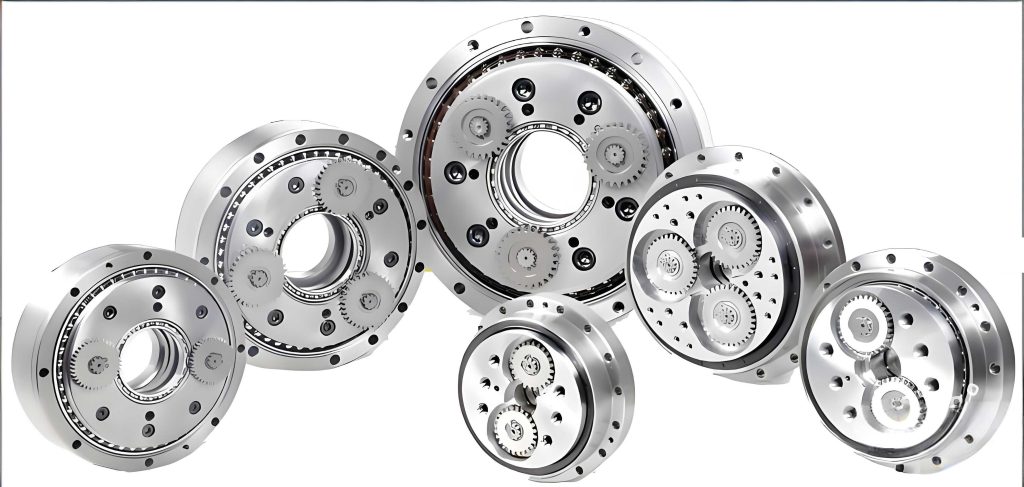
The performance of a rotary vector reducer heavily depends on the cycloidal gear’s tooth profile, which interacts with pin gears to transmit motion. In practical applications, modifications are essential to introduce reasonable radial clearance Δj and lateral clearance Δc, allowing for assembly tolerances, thermal expansion, and lubrication. Common modification methods include profile shift modification, equidistant modification, and rotational angle modification. Rotational angle modification alone is impractical as it leads to zero-clearance contact at the tooth root and tip, causing interference. Therefore, a combined approach is necessary. After evaluating various methods, the optimal modification for cycloidal gears in rotary vector reducers is determined to be a combination of negative profile shift and positive equidistant modification. This method approximates conjugate tooth profiles in the working region, ensures proper clearances, and minimizes comprehensive backlash, thereby enhancing the durability and precision of rotary vector reducers.
To formalize the modification, we define key parameters: pin gear center circle radius r_p, pin gear outer radius r_{rp}, eccentricity a, number of pin teeth z_p, number of cycloidal gear teeth z_c, profile shift modification amount Δr_p (negative for negative shift), and equidistant modification amount Δr_{rp} (positive for positive equidistant). The standard cycloidal gear tooth profile coordinates are derived from the trochoidal equation, but after modification, the coordinates for the combined negative shift and positive equidistant modification are given by:
$$x’_c = \left( r_p + \Delta r_p – (r_{rp} + \Delta r_{rp}) S_r^{-1/2} \right) \cos\left[(1 – i_H) \phi\right] – \frac{a}{r_p + \Delta r_p} \left( r_p + \Delta r_p – z_p (r_{rp} + \Delta r_{rp}) S_r^{-1/2} \right) \cos(i_H \phi)$$
$$y’_c = \left( r_p + \Delta r_p – (r_{rp} + \Delta r_{rp}) S_r^{-1/2} \right) \sin\left[(1 – i_H) \phi\right] + \frac{a}{r_p + \Delta r_p} \left( r_p + \Delta r_p – z_p (r_{rp} + \Delta r_{rp}) S_r^{-1/2} \right) \sin(i_H \phi)$$
where $S_r^{-1/2} = (1 + K’_1^2 – 2K’_1 \cos\phi)^{-1/2}$, $K’_1 = a z_p / (r_p + \Delta r_p)$ is the modified shortening coefficient, $i_H = z_p / z_c$ is the transmission ratio, and $\phi$ is the angle parameter ranging typically from 25° to 100° for the working portion. The radial clearance is constrained as $\Delta r_p + \Delta r_{rp} = \Delta j > 0$.
The goal is to find optimal modification values $\Delta r^*_p$ and $\Delta r^*_{rp}$ that minimize the deviation from an ideal conjugate profile, represented by a rotational angle modification with amount $\delta_c$. The rotational angle modification coordinates are:
$$x_c = (r_p – r_{rp} S^{-1/2}) \cos\left[(1 – i_H) \phi – \delta\right] – \frac{a}{r_p} (r_p – z_p r_{rp} S^{-1/2}) \cos(i_H \phi + \delta)$$
$$y_c = (r_p – r_{rp} S^{-1/2}) \sin\left[(1 – i_H) \phi – \delta\right] + \frac{a}{r_p} (r_p – z_p r_{rp} S^{-1/2}) \sin(i_H \phi + \delta)$$
where $S^{-1/2} = (1 + K_1^2 – 2K_1 \cos\phi)^{-1/2}$ and $K_1 = a z_p / r_p$. For a given lateral clearance Δc, the rotational angle modification amount δc is determined to match the desired tooth profile.
We establish an optimization model with the objective function:
$$f(\Delta r_{rp}, \Delta r_p) = \frac{1}{m} \sum_{i=1}^{m} | x’_{c_i} – x_{c_i} |$$
where m is the number of points evenly distributed in the working region of φ. The optimization problem is to minimize f subject to constraints: $\Delta r_{rp} > 0$, $\Delta r_p < 0$, and $\Delta r_p + \Delta r_{rp} = \Delta j$. This ensures that the modified tooth profile closely aligns with the conjugate profile while maintaining required clearances in rotary vector reducers.
To solve this optimization, various methods were analyzed, including gradient-based techniques and penalty methods. Traditional MATLAB optimization tools, such as fmincon, are sensitive to initial values and may not yield reliable results. Therefore, a two-point extrapolation mixed penalty function method is employed. This method combines the advantages of interior and exterior penalty functions, allowing arbitrary starting points and faster convergence to approximate optima. The algorithm iteratively adjusts penalty factors to guide the solution toward the constrained optimum. The process involves:
- Defining the penalty function P(x, r) = f(x) + r * (sum of constraint violations).
- Starting with an initial penalty factor r0 and reduction coefficient c.
- Solving unconstrained subproblems to update x.
- Extrapolating using two points to accelerate convergence.
- Repeating until constraints are satisfied and f is minimized.
This approach efficiently handles the nonlinear constraints and objective function, making it suitable for optimizing cycloidal gear modifications in rotary vector reducers.
To validate the modification method, a drawing program was developed using VC++ 6.0. This program allows interactive input of cycloidal gear parameters and modification values, generating graphical comparisons between standard, modified, and rotationally modified tooth profiles. The visual output confirms that the negative shift and positive equidistant combination produces a tooth profile that closely matches the conjugate profile in the working region, with appropriate clearances at the root and tip. This tool enhances the design process for rotary vector reducers by enabling rapid verification and adjustment.
Consider a practical example of a single-stage rotary vector reducer with parameters: r_p = 52.5 mm, r_{rp} = 2.25 mm, z_p = 40, z_c = 39, a = 1 mm, and required clearances Δj = 0.2 mm and Δc = 0.1 mm. Using the optimization model and the two-point extrapolation mixed penalty function method, the optimal modification values are computed as Δr_p = -0.368 mm and Δr_{rp} = 0.569 mm. The VC++ program plots the tooth profiles, showing that the modified profile aligns well with the rotational angle modification profile in the working region (φ from 25° to 100°), while maintaining radial and lateral clearances. This demonstrates the effectiveness of the chosen modification method for rotary vector reducers.
| Modification Method | Advantages | Disadvantages | Suitability for Rotary Vector Reducers |
|---|---|---|---|
| Profile Shift Only | Simple to implement | Large initial backlash, poor conjugate approximation | Low |
| Equidistant Only | Better conjugate approximation than shift | May not meet clearance requirements | Moderate |
| Rotational Angle Only | Perfect conjugate profile | No clearances, complex grinding process | Not practical |
| Positive Shift + Positive Equidistant | Good conjugate approximation | Increased lateral clearance, larger backlash | Moderate |
| Negative Shift + Positive Equidistant | Excellent conjugate approximation, minimal backlash, proper clearances | Requires optimization for values | High (Optimal) |
Beyond modification, parametric design of cycloidal gears is crucial for manufacturing efficiency and accuracy. Using Pro/ENGINEER 4.0 (Pro/E 4.0), a parametric model of the cycloidal gear is created. The process involves setting parameters (e.g., r_p, r_{rp}, a, z_p, z_c, Δr_p, Δr_{rp}), defining the tooth profile curve via equations, extruding to form a single tooth, and patterning to complete the gear. The parametric approach allows quick updates to design changes, reducing development time for rotary vector reducers. The tooth profile curve in Pro/E is defined by the modified coordinate equations, enabling automatic regeneration when parameters are adjusted.
For high-precision machining, such as with CNC机床, the distribution of points along the cycloidal gear tooth profile must account for varying curvature to minimize interpolation errors. The curvature κ(φ) of the modified tooth profile is derived as:
$$\kappa(\phi) = \frac{r_p S_r^{1/2}}{K’_1 (z_p + 1) \cos\phi – (1 – z_p K’_1)} + r_{rp}$$
where $S_r^{1/2} = (1 + K’_1^2 – 2K’_1 \cos\phi)^{1/2}$. The arc length differential is $ds = \sqrt{(x’_c)^2 + (y’_c)^2} d\phi$. To distribute points proportionally to curvature, the number of points n over an interval [0, φ] is given by:
$$n = C \int_0^{\phi} \kappa(\phi) \sqrt{(x’_c)^2 + (y’_c)^2} d\phi$$
where C is a coefficient determined by the total number of points N on a single tooth:
$$C = \frac{N}{\int_0^{2\pi} \kappa(\phi) \sqrt{(x’_c)^2 + (y’_c)^2} d\phi}$$
This ensures denser point distribution in high-curvature regions (e.g., near the tooth tip and root) and sparser distribution in flatter regions, improving machining accuracy for rotary vector reducers.
A program in VC++ 6.0 is developed to compute coordinates of points distributed according to this curvature-based formula. For the example rotary vector reducer, with N = 100 points per tooth, the program calculates coordinates and plots the tooth profile, showing non-uniform point density that adapts to curvature changes. This provides a theoretical foundation for CNC toolpath generation, enhancing the manufacturing precision of cycloidal gears in rotary vector reducers.
| Parameter | Symbol | Value | Unit |
|---|---|---|---|
| Pin Gear Center Circle Radius | r_p | 52.5 | mm |
| Pin Gear Outer Radius | r_{rp} | 2.25 | mm |
| Number of Pin Teeth | z_p | 40 | – |
| Number of Cycloidal Gear Teeth | z_c | 39 | – |
| Eccentricity | a | 1.0 | mm |
| Profile Shift Modification | Δr_p | -0.368 | mm |
| Equidistant Modification | Δr_{rp} | 0.569 | mm |
| Radial Clearance | Δj | 0.2 | mm |
| Lateral Clearance | Δc | 0.1 | mm |
| Shortening Coefficient (Standard) | K_1 | 0.7619 | – |
| Modified Shortening Coefficient | K’_1 | 0.7678 | – |
The integration of optimization, parametric design, and curvature-based point distribution significantly advances the development of rotary vector reducers. The negative shift and positive equidistant modification method, optimized via the two-point extrapolation mixed penalty function, ensures that cycloidal gears exhibit near-conjugate tooth profiles, minimal backlash, and adequate clearances. This enhances the performance, reliability, and lifespan of rotary vector reducers in applications such as industrial robots, aerospace actuators, and precision machinery.
Parametric modeling in Pro/E 4.0 streamlines the design process, allowing rapid prototyping and modification. The curvature-based coordinate calculation facilitates high-precision CNC machining, reducing errors and improving surface finish. Future work may involve dynamic simulation of the modified cycloidal gears within rotary vector reducers to assess load distribution and fatigue life, further optimizing the design for extreme conditions.
In conclusion, this comprehensive approach to cycloidal gear modification and parametric design underscores the importance of tailored engineering solutions for rotary vector reducers. By leveraging mathematical optimization, software validation, and advanced CAD techniques, manufacturers can produce rotary vector reducers that meet stringent requirements for accuracy, durability, and efficiency, solidifying their role in modern automation and robotics.