
The pursuit of creating machines that can replicate the versatility and finesse of the human hand has been a long-standing goal in robotics. A dexterous robotic hand is pivotal for enabling robots to perform complex, unstructured tasks beyond repetitive industrial manipulation, such as intricate assembly, tool use, and delicate object handling. Traditional designs often feature a fixed, rigid palm, relying solely on the articulation of multiple fingers with numerous degrees of freedom to achieve dexterity. This approach, while successful to a degree, inherently limits the workspace and adaptability of the hand. A paradigm shift is introduced by the concept of a metamorphic palm—a palm capable of changing its configuration through internal mechanism adjustments. This paper explores the optimization of such a dexterous robotic hand featuring a metamorphic palm, using biomechanical principles derived from human hand anatomy to guide its design and enhance its anthropomorphic capabilities.
The human hand’s remarkable functionality is not solely due to its fingers; the palmar arches play a crucial role. Anatomically, the palm is structured by two transverse and five longitudinal arches, forming a dynamic cavity that adapts to the shape and size of grasped objects. This adaptability is key to stable and power-efficient grasps. A specific metric from biomechanics, the kinematic transverse metacarpal arch, quantifies this palmar shape modulation during movement. It is defined by three planes: the thenar, midpalmar, and hypothenar planes, intersecting at the relatively fixed carpometacarpal junction. The arch value $\sigma$ is the sum of the angles between these consecutive planes:
$$
\sigma = \sigma_1 + \sigma_2 = \arccos\left(\frac{\mathbf{n}_1}{\|\mathbf{n}_1\|} \cdot \frac{\mathbf{n}_2}{\|\mathbf{n}_2\|}\right) + \arccos\left(\frac{\mathbf{n}_2}{\|\mathbf{n}_2\|} \cdot \frac{\mathbf{n}_3}{\|\mathbf{n}_3\|}\right)
$$
where $\mathbf{n}_1$, $\mathbf{n}_2$, and $\mathbf{n}_3$ are the normal vectors of the thenar, midpalmar, and hypothenar planes, respectively. Studies indicate that during human grasping, this arch value typically varies within the range of $100^\circ$ to $120^\circ$. This metric provides a direct, quantitative link between human palmar motion and the desired behavior of an anthropomorphic dexterous robotic hand.
The subject of this optimization is a metamorphic dexterous robotic hand whose palm is constructed as a spherical five-bar linkage. When one link is fixed, it becomes a spherical four-bar mechanism, allowing the palm’s contour to change actively. Four fingers are mounted on three adjacent links of this palm mechanism. The thumb is attached via a revolute joint on one link, while the index finger is mounted on the next, and the middle and little fingers are fixed on the third link (the fixed link in the initial analysis). A spherical model of the three links carrying the fingers is established for parameter optimization. The key design parameters for this sub-assembly are the link lengths (represented by central angles $\alpha_i$), the finger mounting angles $\delta_i$, and the orientation of the thumb’s base joint $\xi$.
The position of the metacarpophalangeal (MCP) joint $\mathbf{q}_i$ for each finger in the base coordinate system is derived through coordinate transformations. For the thumb ($i=1$), with its additional revolute joint angle $\theta$, the position is:
$$
\mathbf{q}_1 = ^0\mathbf{R}_j\,^j\mathbf{p}_1 + ^0\mathbf{R}_j\,^j\mathbf{R}_p\,^p\mathbf{d}_{10}, \quad ^p\mathbf{d}_{10} = [d_{10}\cos\theta, -d_{10}\sin\theta, 0]^T
$$
For the other fingers ($i=2,3,4$), the connection is fixed:
$$
\mathbf{q}_i = ^0\mathbf{R}_j\,^j\mathbf{p}_i + ^0\mathbf{R}_j\,^j\mathbf{R}_p\,^p\mathbf{d}_{i0}, \quad ^p\mathbf{d}_{i0} = [d_{i0}, 0, 0]^T
$$
where $^0\mathbf{R}_j$ is the rotation matrix of the palm link $j$, $^j\mathbf{p}_i = [r\sin\delta_i, 0, r\cos\delta_i]^T$ is the mount point on the spherical palm of radius $r$, and $^p\mathbf{d}_{i0}$ is the finger’s proximal link vector.
The plane normal vectors for the kinematic arch calculation are then $\mathbf{n}_i = \mathbf{q}_i \times \mathbf{q}_{i+1}$ for $i=1,2,3$. The core optimization objective is to maximize the number of robot hand configurations where the calculated palmar arch $\sigma(\mathbf{X})$ falls within the human-like range, where $\mathbf{X}$ is the vector of design parameters. This is formalized as maximizing the cardinality of the set $A$:
$$
\max f(\mathbf{X}) = n(A), \quad \text{where} \quad A = \{ \sigma(\mathbf{X}) \mid 100^\circ \le \sigma(\mathbf{X}) \le 120^\circ \}
$$
Crucially, these configurations must also correspond to viable grasps. A necessary condition for a stable three-finger pinch grasp (using thumb, index, and middle fingers) is that the operational plane normals of these fingers are coplanar. This is expressed as the equality constraint:
$$
\mathbf{m}_1 \cdot (\mathbf{m}_2 \times \mathbf{m}_3) = 0
$$
Additional practical constraints are applied, such as ensuring the index finger mounting angle is less than its link’s length ($\delta_2 < \alpha_3$), maintaining a reasonable distance between fingers, and defining bounds for all parameters: $\mathbf{X} \in (\underline{\mathbf{X}}, \overline{\mathbf{X}})$. A penalty function method transforms this constrained problem into an unconstrained one, which is then solved using a genetic algorithm. The optimized parameters for the finger-carrying spherical triple linkage are found to be:
$$
\alpha_3 = 45.50^\circ,\quad \delta_1 = 56.70^\circ,\quad \delta_2 = 34.38^\circ,\quad \delta_3 = 11.93^\circ,\quad \xi = 86.93^\circ.
$$
This optimization yielded 64 target grasp postures $(\phi_3, \phi_4, \theta)$ that satisfy both the arch value and grasp constraint.
The next stage involves the dimensional synthesis of the full spherical five-bar metamorphic palm. Its purpose is to generate the specific joint inputs ($\phi_3, \phi_4$) required to achieve the 64 target postures identified in the first stage. The palm is designed to operate in several distinct modes, each corresponding to a different effective spherical four-bar linkage (by locking different joints). The goal is to find palm link lengths (central angles $\alpha_0, \alpha_1, \alpha_2, \alpha_4$) and a set of output link angles $\mu_k$ such that the trajectory of the output point can be fitted onto a series of concentric spherical circles defined by $\mu_k$. Using an adaptive synthesis method for spherical mechanisms, the optimization model minimizes the root-mean-square fitting error $f(\mathbf{Y})=\sqrt{\sum \varepsilon_i^2 / n}$ for design variables $\mathbf{Y}=(\alpha_2, \alpha_4, \mu_1, \mu_2, \mu_3)^T$, subject to a total length constraint. The synthesis results provide the parameters for three effective four-bar modes and, subsequently, the lengths of the two remaining driving links in the five-bar chain. The final, fully optimized parameters for the metamorphic dexterous robotic hand are summarized in the table below.
| Component | Parameter | Symbol | Optimized Value |
|---|---|---|---|
| Metamorphic Palm | Link 0 Central Angle | $\alpha_0$ | $111.28^\circ$ |
| Link 1 Central Angle | $\alpha_1$ | $75.11^\circ$ | |
| Link 2 Central Angle | $\alpha_2$ | $60.97^\circ$ | |
| Link 3 Central Angle | $\alpha_3$ | $45.50^\circ$ | |
| Link 4 Central Angle | $\alpha_4$ | $67.15^\circ$ | |
| Finger Mounting | Thumb Mount Angle | $\delta_1$ | $56.70^\circ$ |
| Index Finger Mount Angle | $\delta_2$ | $34.38^\circ$ | |
| Middle Finger Mount Angle | $\delta_3$ | $11.93^\circ$ | |
| Little Finger Mount Angle | $\delta_4$ | $50.00^\circ$ |
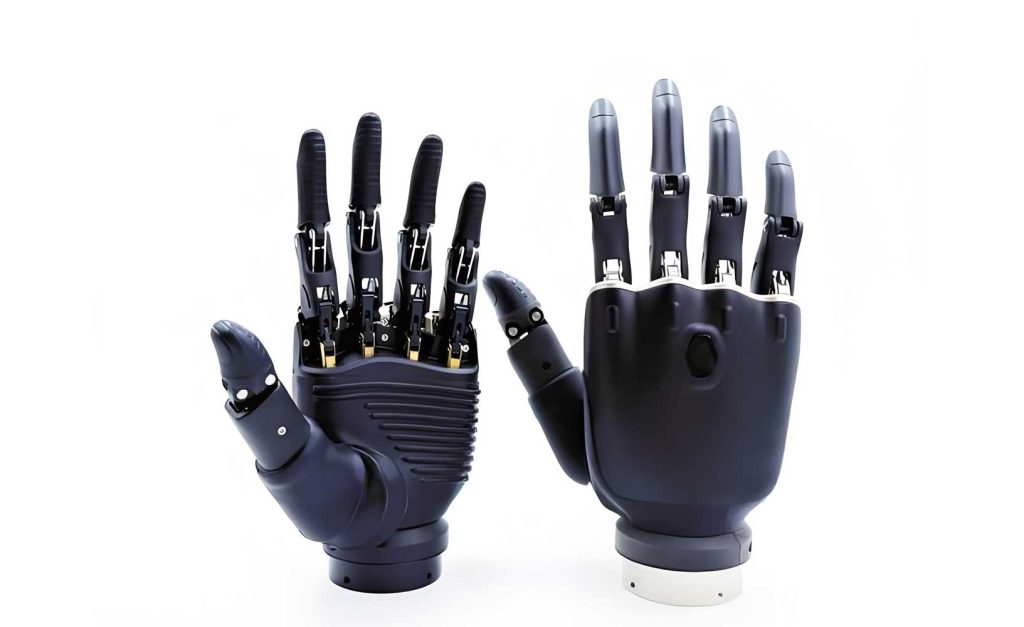
The final step is the verification of the optimization results. The dimensional synthesis of the palm inevitably introduces trajectory fitting errors. These errors propagate to the finger positions, potentially causing the final achieved palmar arch value to deviate from the target range or violating the grasp coplanarity condition. After filtering out postures with significant synthesis errors, the optimized dexterous robotic hand is capable of achieving 38 distinct grasp postures that are both kinematically feasible and anthropomorphic, i.e., their palmar arch values lie within $100^\circ$-$120^\circ$. A subset of these validated postures, defined by the palm joint angles $\phi_3, \phi_4$ and the thumb base angle $\theta$, is listed below. The analysis confirms that for these postures, the arch value deviation and grasp condition error remain within acceptable tolerances, validating the effectiveness of the two-stage optimization process.
| Posture # | $\phi_3$ (°) | $\phi_4$ (°) | $\theta$ (°) | Posture # | $\phi_3$ (°) | $\phi_4$ (°) | $\theta$ (°) |
|---|---|---|---|---|---|---|---|
| 1 | 60 | 10 | 40.66 | 20 | 50 | 50 | 37.02 |
| 2 | 70 | 10 | 43.22 | 21 | 20 | 60 | 18.34 |
| 3 | 80 | 10 | 44.83 | 22 | 30 | 60 | 25.94 |
| 4 | 90 | 10 | 45.53 | 23 | 40 | 60 | 32.15 |
| 5 | 30 | 20 | 25.94 | 24 | 50 | 60 | 37.02 |
| 6 | 40 | 20 | 32.15 | 25 | 20 | 70 | 18.34 |
| 7 | 50 | 20 | 37.02 | 26 | 30 | 70 | 25.94 |
| 8 | 60 | 20 | 40.66 | 27 | 40 | 70 | 32.15 |
| 9 | 70 | 20 | 43.22 | 28 | 50 | 70 | 37.02 |
| 10 | 30 | 30 | 25.94 | 29 | 10 | 80 | 9.53 |
| 11 | 40 | 30 | 32.15 | 30 | 20 | 80 | 18.34 |
| 12 | 50 | 30 | 37.02 | 31 | 30 | 80 | 25.94 |
| 13 | 60 | 30 | 40.66 | 32 | 40 | 80 | 32.15 |
| 14 | 30 | 40 | 25.94 | 33 | 50 | 80 | 37.02 |
| 15 | 40 | 40 | 32.15 | 34 | 10 | 90 | 9.53 |
| 16 | 50 | 40 | 37.02 | 35 | 20 | 90 | 18.34 |
| 17 | 20 | 50 | 18.34 | 36 | 30 | 90 | 25.94 |
| 18 | 30 | 50 | 25.94 | 37 | 40 | 90 | 32.15 |
| 19 | 40 | 50 | 32.15 | 38 | 50 | 90 | 37.02 |
In conclusion, this work presents a comprehensive methodology for the optimization of a metamorphic dexterous robotic hand. The key innovation lies in the application of the human kinematic transverse metacarpal arch as a direct, quantitative performance metric and optimization target. By establishing this bio-inspired link, the design process ensures that the robotic hand’s palmar motion mimics the fundamental shape adaptation of the human palm during grasp. The two-stage optimization—first of the finger-carrying linkage parameters to maximize anthropomorphic postures, and second of the metamorphic palm dimensions to realize those postures—successfully yields a hand capable of numerous human-like grasps. The verified results demonstrate that the optimized dexterous robotic hand, with its actively reconfigurable palm, achieves a significant level of anthropomorphism, moving beyond fixed-palm designs. This approach highlights the importance of holistic hand design, where the palm is not a static base but an active contributor to dexterity, paving the way for more versatile and capable robotic manipulators for advanced applications in manufacturing, healthcare, and service robotics.