
The pursuit of higher power density and energy efficiency in compact robotic joints, particularly for legged robots operating in demanding environments, has intensified the focus on precision gear reducers. Among these, the cycloidal drive stands out due to its inherent advantages of high reduction ratio, compactness, and excellent load-bearing capacity. While significant research has been dedicated to analyzing the load distribution and stress state of cycloidal drives, accurate modeling of transmission efficiency—a critical performance metric for energy-conscious applications—remains a complex challenge. Traditional models often simplify contact mechanics or overlook significant loss contributors, leading to inaccurate predictions. This study aims to establish a comprehensive, high-fidelity model for calculating the transmission efficiency of a cycloidal pinwheel reducer, explicitly incorporating the influence of friction forces from the outset. Furthermore, it systematically analyzes the impact of both operational conditions and key design parameters on efficiency. Finally, a multi-objective optimization framework is employed to identify parameter sets that simultaneously maximize efficiency and minimize the overall volume of the drive.
Mathematical Modeling of Contact Forces in Cycloidal Drives
Accurate force analysis is the cornerstone of any efficiency model. Contrary to many studies that introduce friction only during efficiency calculation, this model integrates friction forces directly into the static equilibrium equations. This approach ensures a more realistic distribution of loads among the contacting teeth. The analysis begins with the multi-tooth contact mechanics of the cycloidal drive. Considering elastic deformation of the teeth and bending of the pin, the load distribution is non-uniform. The total deflection in the direction of the common normal at a meshing point \(i\) for a small rotation \(\beta\) of the cycloid wheel is given by:
$$ \delta_i = l_{ci} \beta $$
where \(l_{ci}\) is the distance from the cycloid wheel center \(O_c\) to the foot of the common normal. When manufacturing tolerances and intentional profile modifications (to ensure lubrication and assembly) create initial backlash \(\Delta \phi_i\), the force on the \(i\)-th contacting tooth pair can be expressed as:
$$ F_i = F_{\text{max}} \frac{\delta_i – \Delta \phi_i}{\delta_{\text{max}}} $$
Here, \(F_{\text{max}}\) is the force on the most heavily loaded tooth, and \(\delta_{\text{max}}\) is the total deformation (contact + bending) at that point. The force equilibrium equations for the cycloid wheel, considering all meshing pin teeth and output pins, along with their respective friction forces, are established. The friction forces are modeled with coefficients for rolling (\(\mu_1, \mu_3, \mu_r\)) and sliding (\(\mu_2, \mu_4\)) at different interfaces: cycloid wheel/pin sleeve, pin sleeve/pin, output pin sleeve/output pin, and the crank bearing.
The moment equilibrium for a single cycloid wheel under a load torque \(M_c\) leads to an expression for \(F_{\text{max}}\):
$$ F_{\text{max}} = \frac{M_c}{ \sum_{i=m}^{n} \left[ l_{ci} – (\mu_1 + \mu_2) l_{cfi} \right] \left( \frac{l_{ci}}{r_c} – \frac{\Delta \phi_i}{\delta_{\text{max}}} \right) } $$
The total deformation \(\delta_{\text{max}}\) is itself a function of \(F_{\text{max}}\), calculated using Hertzian contact theory for the contact deformation \(W_{\text{max}}\) and beam theory for the pin bending deformation \(f_{\text{max}}\):
$$ \delta_{\text{max}} = W_{\text{max}} + f_{\text{max}} = C_1 F_{\text{max}}[C_3 + \ln(C_2 F_{\text{max}})] + C_4 F_{\text{max}} $$
where \(C_1, C_2, C_3, C_4\) are constants derived from material properties, geometry, and the profile curvature at the contact point. An iterative numerical scheme is used to solve for \(F_{\text{max}}\) and subsequently all individual tooth forces \(F_i\).
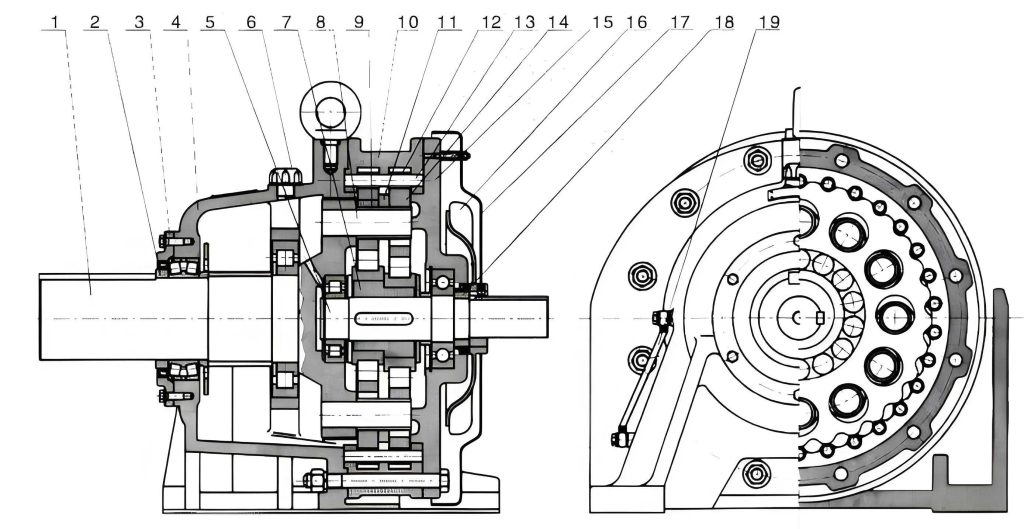
Comprehensive Power Loss and Efficiency Model
The overall transmission efficiency \(\eta\) is calculated using the power loss method:
$$ \eta = \frac{P_{\text{out}}}{P_{\text{in}}} = \frac{P_{\text{in}} – P_{\text{loss}}}{P_{\text{in}}} $$
The total power loss \(P_{\text{loss}}\) is the sum of five major components:
$$ P_{\text{loss}} = P_1 + P_2 + P_3 + P_4 + P_5 $$
The following table summarizes these components and their governing equations:
| Loss Component | Description | Key Formulae |
|---|---|---|
| 1. Meshing Loss (\(P_1\)) | Loss from rolling (\(P_{1g}\)) and sliding (\(P_{1h}\)) friction at the cycloid-pin tooth interface. | $$ P_{1g} = N \mu_1 \sum_{i} F_i r_i \omega_c $$ $$ P_{1h} = N \mu_2 \sum_{i} F_i v’_i $$ $$ v’_i = \omega_c r_i \frac{r_{rp}}{r_{rt}} $$ |
| 2. Output Mechanism Loss (\(P_2\)) | Loss from rolling (\(P_{2g}\)) and sliding (\(P_{2h}\)) friction at the cycloid hole-output pin interface. | $$ P_{2g} = \mu_3 \sum_{j} Q_j R_w \omega_{cwt} $$ $$ P_{2h} = \mu_4 \sum_{j} Q_j v_{wj} $$ |
| 3. Bearing Loss (\(P_3\)) | Friction loss in all supporting bearings, including the crank bearing. | $$ P_3 = 10^{-3} \left[ N_1(M_0 + M_1) + N_2(M’_0 + M’_1) \right] |\omega_{zc}| $$ Based on Palmgren’s empirical formulas. |
| 4. Seal Loss (\(P_4\)) | Power dissipated by the shaft seals. | $$ P_4 = \frac{\pi d_0^2 F_0 n_y}{1910} $$ |
| 5. Lubrication Churning Loss (\(P_5\)) | Drag loss due to the lubricant on gear faces (\(P_{dp}\)) and sides (\(P_{df}\)). | $$ P_{dp} = 4 c_n \pi B u_v r_{c0}^2 (\omega_b – \omega_c)^2 $$ $$ P_{df} = c_m \pi \rho u_k^{0.5} r_{c0}^4 (\omega_b – \omega_c)^{2.5} $$ |
This model provides a more holistic view of efficiency compared to previous studies that often neglected \(P_4\) and \(P_5\), which become significant at higher operating speeds.
Influence of Operational and Design Parameters on Efficiency
Using the established model, a systematic analysis was conducted to understand how various factors influence the overall transmission efficiency of the cycloidal drive.
Operational Parameters:
Analysis shows a clear trade-off. The transmission efficiency decreases monotonically with increasing input speed due to the rise in velocity-dependent losses (bearing, churning, seal). Conversely, efficiency increases with applied load torque, as the fixed losses (like seal friction) become a smaller fraction of the transmitted power. However, this increase exhibits a diminishing return.
Design Parameters:
The influence of eight key design parameters was investigated within their mechanically feasible ranges (governed by strength, tooth undercutting, and assembly constraints). The following table categorizes their impact based on the magnitude of change in efficiency they induce:
| Impact Level | Design Parameter | Trend on Efficiency (η) | Primary Reason |
|---|---|---|---|
| High Impact (>3% change) |
Pin Pin Radius (\(r_{rp}\)) | Decreases as radius increases | Larger bending stiffness reduces number of contacting teeth, increasing load per tooth and meshing loss. |
| Pin Distribution Radius (\(R_p\)) | Decreases as radius increases | Increases the moment arm for meshing forces, raising the required force for a given torque and thus friction losses. | |
| Eccentricity (\(e\)) | Increases as eccentricity increases | Improves force distribution across more teeth, reducing load per tooth and meshing friction. | |
| Pin Sleeve Radius (\(r_{rt}\)) | Increases as radius increases | Reduces sliding velocity at the pin sleeve/pin interface, decreasing the corresponding sliding friction loss (\(P_{1h}\)). | |
| Moderate/Low Impact (<3% change) |
Number of Pins (\(Z_p\)) | Slightly increases with more pins | Improves load sharing, but effect is limited within typical design ranges before other constraints intervene. |
| Output Pin Distribution Radius (\(R_w\)) | Slightly increases as radius increases | Reduces the force required at the output mechanism for a given output torque, lowering \(P_2\). | |
| Output Pin Radius (\(r_{wp}\)) | Slightly decreases as radius increases | Increases the sliding velocity at the output pin interface, raising \(P_{2h}\). | |
| Cycloid Wheel Width (\(B\)) | Slightly increases as width increases | Reduces contact pressure for a given load, slightly lowering meshing deformation and loss. |
Multi-Objective Parameter Optimization
To leverage the insights from the parametric study, a multi-objective optimization problem is formulated. The goal is to find a set of design parameters that maximize efficiency while minimizing the overall volume of the cycloidal drive.
Design Variables: Seven key parameters were selected as variables: eccentricity (\(e\)), pin distribution radius (\(R_p\)), pin sleeve radius (\(r_{rt}\)), pin pin radius (\(r_{rp}\)), cycloid width (\(B\)), output pin distribution radius (\(R_w\)), and output pin radius (\(r_{wp}\)). The number of pins (\(Z_p\)) was fixed to maintain a specific reduction ratio.
Constraints: The variables are subject to nonlinear inequality constraints \(c_1(x) \) to \(c_9(x)\) ensuring mechanical integrity:
$$
\begin{aligned}
&0.42 \leq k_1 = \frac{e Z_p}{R_p} \leq 0.80 \quad \text{(Shortening coefficient)}\\
&1.5 \leq \frac{R_p}{r_{rt} \sin(\pi/Z_p)} \leq 2.0 \quad \text{(Pin diameter coefficient)}\\
&r_{rp} < |a_{\text{min}}| R_p \quad \text{(Avoid undercutting and pointed teeth)}\\
&0.1R_p \leq B \leq 0.2R_p\\
&r_{rp} \leq r_{rt} – 1 \quad \text{(Geometric feasibility)}
\end{aligned}
$$
Objective Functions: The two competing objectives are formalized as minimization problems:
$$
\begin{aligned}
&g_1(\mathbf{x}) = 1 – \eta = \frac{P_{\text{loss}}(\mathbf{x})}{P_{\text{in}}} \quad \text{(Minimize loss)}\\
&g_2(\mathbf{x}) = \frac{V(\mathbf{x})}{V_0} \quad \text{(Minimize volume ratio)}
\end{aligned}
$$
where \(V(\mathbf{x}) = \pi (R_p + r_{rt} + H_1)^2 (2B + H_2)\) approximates the reducer housing volume.
Optimization Results: The Non-dominated Sorting Genetic Algorithm II (NSGA-II) was employed to solve this problem. The algorithm produced a Pareto frontier, a set of optimal solutions representing the best possible trade-offs between efficiency and volume. From this frontier, a balanced solution was selected. The table below compares the original and an optimized design parameter set:
| Parameter | Original Design | Optimized Design |
|---|---|---|
| Eccentricity, \(e\) (mm) | 1.4 | 2.0 |
| Pin Distribution Radius, \(R_p\) (mm) | 30 | 30 |
| Pin Sleeve Radius, \(r_{rt}\) (mm) | 5.0 | 5.6 |
| Pin Pin Radius, \(r_{rp}\) (mm) | 3 | 2 |
| Cycloid Width, \(B\) (mm) | 4.5 | 4.0 |
| Output Pin Distribution Radius, \(R_w\) (mm) | 17 | 19 |
| Output Pin Radius, \(r_{wp}\) (mm) | 2.6 | 1.9 |
| Calculated Efficiency, \(\eta\) (%) | 82.75 | 87.90 |
| Relative Volume, \(V/V_0\) (%) | 100.0 | 95.6 |
The optimization successfully identified a parameter combination that increases transmission efficiency by 5.15% while simultaneously reducing the overall volume by 4.4%. This demonstrates a significant improvement in the torque density of the cycloidal drive.
Conclusion
This study has developed a comprehensive and high-fidelity model for analyzing and optimizing the transmission efficiency of a cycloidal pinwheel reducer. By integrating friction forces directly into the load distribution model and accounting for all major power loss sources—meshing, output mechanism, bearing, seal, and lubrication losses—the model provides a more accurate prediction of efficiency compared to simplified approaches. The parametric sensitivity analysis revealed that operational speed and load, along with design parameters like pin pin radius, pin distribution radius, eccentricity, and pin sleeve radius, have the most pronounced effect on efficiency. Leveraging these insights, a multi-objective optimization framework successfully generated a Pareto-optimal set of designs, from which a solution achieving a 5.15% increase in efficiency and a 4.4% reduction in volume was extracted. This work provides a valuable theoretical foundation and a practical methodology for designing next-generation high-efficiency, compact cycloidal drives for advanced robotic and mechatronic systems. Future work could integrate dynamic effects and thermal analysis to further enhance the model’s predictive capability under transient operating conditions.