
As a fundamental component in precision robotics, aerospace, and high-end automation, the performance of harmonic drive gears is paramount. Their unique operating principle, relying on the controlled elastic deformation of a flexible spline, offers advantages like high reduction ratios, compactness, and near-zero backlash. Among the various tooth profiles developed for harmonic drive gears, the double-circular-arc profile has demonstrated superior characteristics in terms of load distribution and contact stress management compared to traditional involute profiles. A key phenomenon associated with this profile is the “dual-conjugate” engagement, where both the convex and concave arcs of the flexspline tooth theoretically contact the rigid gear simultaneously over a specific interval of meshing. Maximizing this dual-conjugate interval is crucial for enhancing the load-carrying capacity and transmission stiffness of the harmonic drive gear. However, designing the tooth profile parameters to achieve this optimal condition presents a complex, multi-variable optimization challenge with non-explicit objectives. This article details a methodology developed to address this challenge using a Genetic Algorithm (GA), providing a robust and efficient framework for the optimization of double-circular-arc harmonic drive gears.
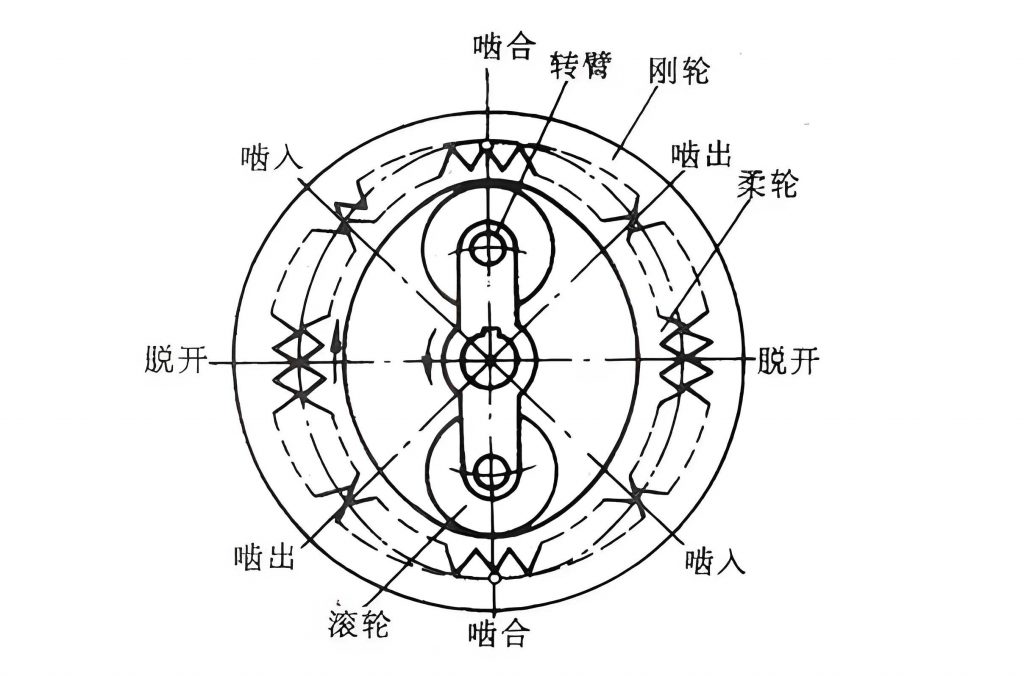
The core of a harmonic drive gear consists of three elements: a rigid circular spline, a flexible spline (flexspline), and a wave generator. The wave generator, typically elliptical, deforms the flexspline, causing its teeth to engage with those of the rigid spline at two diametrically opposite regions. The tooth profile of the flexspline directly dictates the quality of this engagement. The double-circular-arc profile for the flexspline, as considered here, is constructed from three segments: a convex circular arc near the tooth tip, a concave circular arc near the tooth root, and a common tangent line connecting them. The complete geometry is defined by a set of interrelated parameters.
| Symbol | Meaning | Symbol | Meaning |
|---|---|---|---|
| \( h_a \) | Addendum | \( h_{l2} \) | Vertical height from tangent to root |
| \( h_f \) | Dedendum | \( \gamma \) | Inclination angle of the common tangent |
| \( \rho_a \) | Radius of convex arc | \( X_a \) | Displacement of convex arc center |
| \( \rho_f \) | Radius of concave arc | \( l_a \) | Offset of convex arc center |
| \( h_l \) | Total vertical length of tangent (\(h_{l1}+h_{l2}\)) | \( X_f \) | Displacement of concave arc center |
| \( h_{l1} \) | Vertical height from tangent to tip | \( l_f \) | Offset of concave arc center |
To establish the mathematical model, a coordinate system \( X_1O_1Y_1 \) is fixed to the flexspline tooth, with the \( Y_1 \)-axis along the tooth’s symmetrical centerline. Using the arc length \( s \) from the tooth tip \( A \) as a parameter, the equations for the right-side tooth profile segments are derived. The convex arc segment \( AB \) is given by:
$$ \begin{cases}
x_1(s) = \rho_a \cos(\alpha_a – s/\rho_a) + x_{Oa} \\
y_1(s) = \rho_a \sin(\alpha_a – s/\rho_a) + y_{Oa}
\end{cases} \quad \text{for } s \in (0, l_1) $$
where \( \alpha_a = \arcsin((h_a + X_a)/\rho_a) \), \( x_{Oa} = -l_a \), \( y_{Oa} = t/2 + h_f – X_a \), and \( l_1 = \rho_a (\alpha_a – \gamma) \). The common tangent segment \( BC \) is expressed as:
$$ \begin{cases}
x_2(s) = \rho_a \cos \gamma + x_{Oa} + (s – l_1)\sin \gamma \\
y_2(s) = \rho_a \sin \gamma + y_{Oa} – (s – l_1)\cos \gamma
\end{cases} \quad \text{for } s \in (l_1, l_2) $$
where \( l_2 = l_1 + h_l / \cos \gamma \). Finally, the concave arc segment \( CD \) is defined by:
$$ \begin{cases}
x_3(s) = x_{Of} – \rho_f \cos(\gamma + (s – l_2)/\rho_f) \\
y_3(s) = y_{Of} – \rho_f \sin(\gamma + (s – l_2)/\rho_f)
\end{cases} \quad \text{for } s \in (l_2, l_3) $$
where \( x_{Of} = \pi m/2 + l_f \), \( y_{Of} = h_f + t/2 + X_f \), and \( l_3 = l_2 + \rho_f (\arcsin((X_f + h_f)/\rho_f) – \gamma) \).
The conjugate tooth profile of the rigid gear, which meshes perfectly with the defined flexspline profile, is determined using the envelope theory. The kinematic model considers the relative motion between the flexspline and the rigid gear when the wave generator rotates. The fundamental conjugate condition is represented by a system of equations that transform the flexspline profile coordinates \( (x_1, y_1) \) into the rigid gear coordinate system \( (x_2, y_2) \) while satisfying the meshing equation:
$$ \begin{cases}
\begin{bmatrix} x_2(s, \varphi) \\ y_2(s, \varphi) \\ 1 \end{bmatrix} =
\begin{bmatrix}
\cos\psi & \sin\psi & \rho \sin\beta \\
-\sin\psi & \cos\psi & \rho \cos\beta \\
0 & 0 & 1
\end{bmatrix}
\begin{bmatrix} x_1(s) \\ y_1(s) \\ 1 \end{bmatrix} \\[12pt]
\displaystyle \frac{\partial x_2}{\partial \varphi} \frac{\partial y_2}{\partial s} – \frac{\partial y_2}{\partial \varphi} \frac{\partial x_2}{\partial s} = 0 \\[8pt]
\psi = \mu + \beta = \mu + \frac{(z_2 – z_1)\varphi}{z_2} + \frac{\nu}{r_m}
\end{cases} $$
Here, \( \varphi \) is the wave generator rotation angle, \( \rho \) is the polar radius of the deformed flexspline neutral curve, \( \beta \) is the rotation of the flexspline’s deformed end, \( \psi \) is the total rotation angle of the tooth coordinate system, and \( \mu, \nu \) represent the normal deflection and tangential displacement of the tooth, respectively. Solving this system analytically for the double-circular-arc profile is exceedingly difficult; therefore, a numerical solution is pursued. By discretizing the parameter \( s \) and solving for corresponding \( \varphi \) values that satisfy the meshing equation, a set of discrete conjugate points \( (x_2, y_2) \) for the rigid gear is obtained.
Analysis of the meshing reveals a distinctive characteristic of the double-circular-arc harmonic drive gear. For a given set of initial parameters, the conjugate points typically form two distinct conjugate regions during a full engagement cycle. One region corresponds primarily to the conjugate profile generated by the flexspline’s convex arc, and another corresponds to that generated by the concave arc. The primary design goal is to adjust the flexspline’s geometric parameters so that a significant portion of the conjugate profile from the convex arc (Conjugate Profile 2) overlaps or aligns closely with a portion of the conjugate profile from the concave arc (Conjugate Profile 5). This overlap creates the extended “dual-conjugate” zone, where both arcs share the load. The objective function for optimization must therefore quantify the degree of alignment between these two discrete conjugate profile segments.
Since the conjugate profiles are discrete point sets, a direct analytical comparison is not feasible. The proposed method first performs polynomial curve fitting on both discrete profile segments to obtain continuous representations, \( P_1(x) \) and \( P_2(x) \). The difference function \( F(x) = P_1(x) – P_2(x) \) is evaluated at \( n \) discrete points \( x_i \) within their common domain. The objective function \( T \), to be minimized, is defined as the L2-norm of this difference vector:
$$ T = \lVert \mathbf{F_1} \rVert = \sqrt{ \sum_{i=1}^{n} \left[ P_1(x_i) – P_2(x_i) \right]^2 } $$
Minimizing \( T \) forces Conjugate Profiles 2 and 5 to coincide, thereby maximizing the dual-conjugate interval. The design variables chosen for optimization are the independent parameters that define the flexspline tooth shape: the convex arc radius \( \rho_a \), the concave arc radius \( \rho_f \), the common tangent inclination angle \( \gamma \), the vertical heights \( h_{l1} \) and \( h_{l2} \), and the chordal tooth thickness ratio \( K \). The optimization is subject to practical geometric constraints:
$$ \begin{align*}
m &\leq \rho_a \leq 1.8m \\
m &\leq \rho_f \leq 1.8m \\
4^\circ &\leq \gamma \leq 16^\circ \\
0 &\leq h_{l1} \leq 0.08 \\
0 &\leq h_{l2} \leq 0.08 \\
1.1 &\leq K \leq 1.3
\end{align*} $$
To solve this complex, non-linear, and computationally intensive optimization problem, a Genetic Algorithm is employed. GAs are population-based, stochastic search algorithms inspired by natural selection. They operate on a set (population) of potential solutions (chromosomes), each encoding the design variables. The algorithm iteratively improves the population through processes of selection, crossover, and mutation, guided by the fitness value (inverse of the objective function \( T \)). The significant advantage of using a GA for this harmonic drive gear optimization is its ability to handle non-differentiable objectives, avoid local minima, and efficiently search a large, multi-dimensional parameter space without requiring gradient information. The optimization process is implemented by integrating the numerical conjugate solving routine and the objective function calculation within the GA’s fitness evaluation step.
To demonstrate the efficacy of the proposed GA-based optimization method for the harmonic drive gear, a case study is conducted. A harmonic drive with a transmission ratio of 100, module \( m = 0.5 \), flexspline tooth count \( z_1 = 200 \), and rigid gear tooth count \( z_2 = 202 \) is analyzed. Fixed parameters include addendum \( h_a = 0.4 \) mm, dedendum \( h_f = 0.55 \) mm, and wall thickness \( t = 0.85 \) mm. The GA parameters are set with a population size of 100, crossover probability of 0.8, mutation probability of 0.1, and a termination criterion of 100 generations or a fitness tolerance of 0.01.
The optimization converges to an optimal set of design parameters that minimize the objective function \( T \). The results are summarized in the table below:
| Design Variable | Optimized Value | Design Variable | Optimized Value |
|---|---|---|---|
| Convex Arc Radius \( \rho_a \) | 0.71 mm | Tangent Height to Tip \( h_{l1} \) | 0.01 mm |
| Concave Arc Radius \( \rho_f \) | 0.80 mm | Tangent Height to Root \( h_{l2} \) | 0.07 mm |
| Tangent Inclination Angle \( \gamma \) | 10.44° | Tooth Thickness Ratio \( K \) | 1.18 |
For this optimal configuration, the calculated objective function value is \( T = 5.4 \times 10^{-3} \) mm. The average absolute deviation between the two fitted conjugate profiles, \( T_{ave} = \frac{1}{n}\sum |P_1(x_i) – P_2(x_i)| \), is on the order of \( 10^{-4} \) mm. This minimal deviation indicates that the conjugate profiles from the convex and concave arcs are virtually coincident over a significant range, successfully creating a large dual-conjugate zone for the harmonic drive gear. Compared to traditional grid-search or sequential optimization methods, the GA approach proved significantly more efficient. It optimized six parameters simultaneously within broad bounds, avoiding the combinatorial explosion of a full factorial search and the risk of local minima inherent in gradient-based methods applied to this problem.
Understanding the sensitivity of the objective function to each optimized parameter is crucial for practical manufacturing of the harmonic drive gear. Tolerances must be assigned based on how significantly a parameter’s variation degrades the optimal dual-conjugate condition. A single-parameter sensitivity analysis is performed by varying one parameter around its optimal value while holding all others constant and observing the change in \( T \).
The analysis reveals distinct sensitivity patterns:
High Sensitivity Parameters: The objective function \( T \) is highly sensitive to the common tangent inclination angle \( \gamma \) and the vertical heights \( h_{l1} \) and \( h_{l2} \). Even deviations as small as ±0.01° for \( \gamma \) or ±0.0002 mm for \( h_{l1} \) and \( h_{l2} \) can cause a noticeable increase in \( T \). This implies that these parameters require tight manufacturing control to preserve the optimized meshing performance of the harmonic drive gear.
Low Sensitivity Parameters: In contrast, \( T \) exhibits relatively low sensitivity to the convex arc radius \( \rho_a \), the concave arc radius \( \rho_f \), and the tooth thickness ratio \( K \). These parameters can tolerate larger deviations (e.g., ±0.01 mm for the arc radii) with a less dramatic impact on the objective function.
This sensitivity analysis provides a strategic guideline for the production of the double-circular-arc harmonic drive gear. To control manufacturing costs while ensuring high performance, tighter tolerances should be imposed on the high-sensitivity parameters (\( \gamma, h_{l1}, h_{l2} \)), while more lenient tolerances can be applied to the low-sensitivity parameters (\( \rho_a, \rho_f, K \)). This balanced approach effectively manages the trade-off between precision and cost.
| Parameter | Sensitivity | Suggested Range (for T<0.01 mm) |
|---|---|---|
| \( \gamma \) | Very High | 10.44° ± 0.01° |
| \( h_{l1} \) | Very High | 0.0100 mm ± 0.0002 mm |
| \( h_{l2} \) | Very High | 0.0700 mm ± 0.0002 mm |
| \( \rho_a \) | Low | 0.71 mm ± 0.01 mm |
| \( \rho_f \) | Low | 0.80 mm ± 0.01 mm |
| \( K \) | Low | 1.18 – 1.20 |
In conclusion, this work presents a comprehensive and effective methodology for the optimization of double-circular-arc harmonic drive gears. By formulating the goal of maximizing the dual-conjugate interval as a minimization problem of the deviation between two conjugate profiles and employing a Genetic Algorithm as the solver, the method overcomes key limitations of previous approaches. It enables the simultaneous optimization of a larger set of design parameters within a flexible and efficient computational framework. The subsequent single-parameter sensitivity analysis offers valuable, practical insights for manufacturing tolerance allocation, directly linking optimal design to producibility. This integrated approach—from parametric modeling and conjugate theory to GA-based optimization and sensitivity study—provides a powerful tool for enhancing the load capacity and transmission performance of harmonic drive gears, contributing to the advancement of high-precision motion systems.