
In my investigation into precision mechanical transmissions, the strain wave gear, commonly known as a harmonic drive, represents a cornerstone technology. Its advantages are profound: exceptional positional accuracy, high torque density within a compact and lightweight package, near-zero backlash, and the capability to achieve high single-stage reduction ratios. These attributes have cemented its role in demanding applications ranging from aerospace robotics and satellite antenna positioning to sophisticated medical and optical instruments. However, the very principle that enables these benefits—transmission through controlled elastic deformation of a flexible spline—introduces significant design complexities. A primary challenge is the occurrence of gear tooth interference during meshing, which generates heat, increases wear, and ultimately compromises the transmission’s longevity and smooth operation. This interference is particularly acute in cup-type designs, where the flexible cup’s rim can tilt relative to the wave generator’s principal axis, leading to non-uniform engagement along the tooth face. Traditional analytical methods struggle to accurately model this highly nonlinear, contact-driven deformation. Therefore, in this work, I propose and demonstrate a comprehensive design methodology centered on Finite Element Analysis (FEA). My objective is to simulate the elastic assembly process, analyze the resulting meshing state of the deformed teeth, and use these simulation insights to iteratively redesign the rigid circular spline—specifically by introducing a conical profile—to achieve a near-zero interference condition.
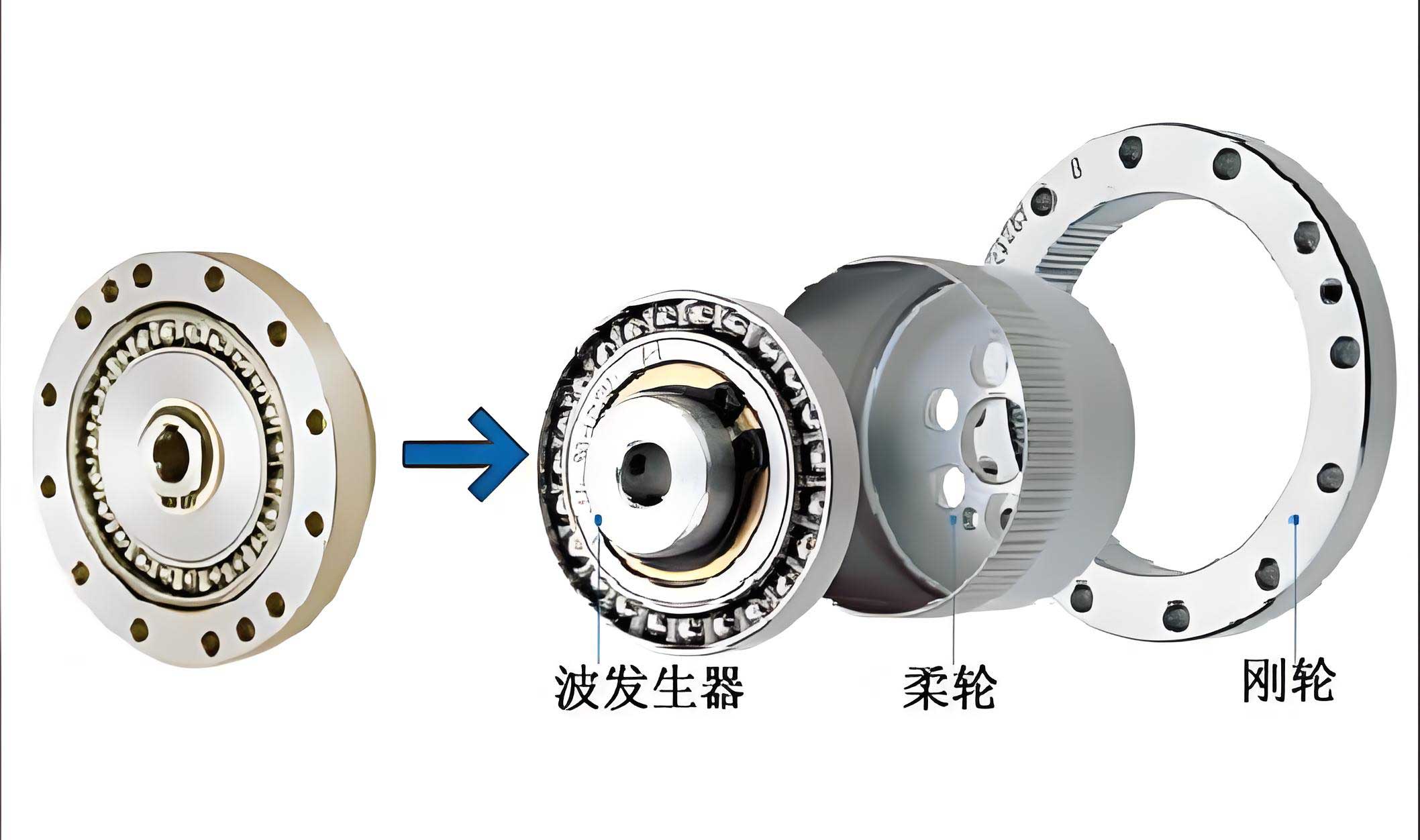
The foundation of any reliable FEA is an accurate geometric model. I constructed a three-dimensional solid model of a cup-type strain wave gear assembly. The flexible spline was modeled as a cylindrical cup with external teeth. The critical parameters for the tooth geometry of the flexible spline are summarized in the table below. A key feature is the positive profile shift (x = 1.8) applied to the flexible spline teeth, a standard practice in strain wave gear design to optimize the contact pattern and adjust the positioning of the working depth.
| Parameter | Symbol | Value |
|---|---|---|
| Module | m | 0.5 mm |
| Number of Teeth | z_f | 120 |
| Pressure Angle | α | 20° |
| Addendum Coefficient | h_a* | 0.5 |
| Dedendum/Clearance Coefficient | c* | 0.25 |
| Profile Shift Coefficient | x | 1.8 |
The corresponding rigid circular spline was modeled with 122 teeth (two teeth more than the flexspline, defining the fundamental wave reduction ratio) and a standard, non-shifted involute profile. The wave generator was simplified for the purpose of this static assembly analysis. Instead of modeling the complex interaction of the elliptical cam and the thin-walled flexible ball bearing separately, I combined them into a single, rigid elliptical plug. The dimensions of this plug are critical: the major axis (a) is set to the nominal bore diameter of the undeformed flexible spline plus the required radial deflection, while the minor axis (b) is slightly smaller. This represents the “unstressed” generator shape that will be forced into the flexible spline. The radial deflection, $w_0$, is a fundamental parameter calculated as:
$$ w_0 = a – r_{nominal} $$
where $r_{nominal}$ is the nominal radius of the flexible spline’s inner bore before deformation.
The core of my analysis involves a nonlinear static Finite Element simulation of the assembly process. This is a complex, large-deformation contact problem. I discretized the flexible spline model using higher-order SOLID186 elements, with a refined mesh in the tooth region to capture stress concentrations and accurate deformation geometry. The material was defined as a linear elastic alloy steel with an Elastic Modulus $E = 197$ GPa and a Poisson’s ratio $ν = 0.3$.
| Category | Setting / Property | Value / Description |
|---|---|---|
| Material | Elastic Modulus (E) | 197 GPa |
| Poisson’s Ratio (ν) | 0.3 | |
| FEA Model | Element Type | SOLID186 (3D 20-Node Solid) |
| Contact Type | Surface-to-Surface (Flexspline inner bore = Contact, Wave Generator = Target) | |
| Friction Coefficient (μ) | 0.1 | |
| Solution | Analysis Type | Static Structural, Large Deflection ON |
| Boundary Condition | Fixed constraint on the bottom flange of the flexspline cup. | |
| Solver | Sparse Direct Solver |
A surface-to-surface contact pair was established between the inner cylindrical surface of the flexible spline (contact surface) and the outer surface of the rigid elliptical wave generator (target surface). A friction coefficient of 0.1 was applied to model tangential interaction. The base of the flexible spline cup was fully constrained, simulating its attachment to a housing. The solver was configured to handle large deformations and the nonlinearities arising from changing contact status. The solution process essentially simulated the “press-fitting” of the wave generator into the flexible spline, generating the prestressed, elliptical deformation state that defines the operating shape of the strain wave gear.
Upon solving the model, I extracted the full-field displacement results. The primary interest lies in the deformed geometry of the flexible spline’s external teeth. By superimposing the original, undeformed rigid spline tooth profile onto contour plots of the deformed flexspline, I could visually and quantitatively assess the meshing condition. The simulation for the conventional cylindrical rigid spline revealed significant interference. This interference is not uniform; it is most severe at the open end (rim) of the cup due to the aforementioned tilting or “coning” effect. The flexible spline does not deform as a perfect elliptical cylinder; its rim rotates outward slightly, altering the lead angle of the teeth. The rigid cylindrical spline, designed to mate with a perfect theoretical ellipse, thus clashes with the actual deformed shape. An approximate measure of the interference depth, $d_{int}$, along the tooth flank normal direction can be extracted from the model for the worst-case teeth, which was found to be on the order of 0.05 mm in the initial design. This level of interference is unacceptable for efficient operation.
The key insight from the FEA was the quantification of this rim displacement. By querying the nodal solution at critical points on the tooth profile at the open end of the cup along the major axis, I obtained precise displacement components. Let ($u_x$, $u_y$, $u_z$) represent the displacements in the radial (towards major axis), circumferential, and axial directions, respectively, for a node on the tooth’s working surface at the rim. The critical finding was that $u_y$ (the radial outward displacement) was substantially larger than at the root of the cup. This gradient in radial deformation along the tooth face width is the root cause of the interference with a cylindrical rigid spline.
This led to the central redesign proposition: if the deformation of the flexible spline has a conical component, then the conjugate rigid spline should also be conical to match it. Instead of a cylindrical internal gear, I designed the rigid circular spline as a conical gear, or more precisely, a “tapered” internal gear. The design principle is straightforward: the reference pitch diameter of the rigid spline is made larger at the open-end side (where the flexspline expands more) and follows the standard size at the closed-end side. The conical angle is derived directly from the FEA results. If the axial length of the gear face is $L$, and the difference in radial displacement between the rim and the base is $Δu_y$, then the effective half-cone angle $γ$ for the rigid spline can be approximated by:
$$ \tan(γ) \approx \frac{Δu_y}{L} $$
In my specific case, the data indicated that to align with the deformed flexspline, the addendum and dedendum circles of the rigid spline at the open end needed to be radially offset by approximately the value of $u_y$ at the rim relative to their nominal position at the base.
For clarity in subsequent simulation and to isolate the effect of the rim engagement, I modeled a “slice” of this conical rigid spline—specifically, the cross-sectional tooth profile that would engage with the rim of the deformed flexible spline. This profile is essentially that of a standard gear with a slightly larger pitch diameter. I then imported this new rigid spline profile into the post-processing environment of the solved FEA model, superimposing it onto the same deformed flexspline state.
| Design | Rigid Spline Profile | Maximum Interference Depth ($d_{int}$) | Meshing Quality Observation |
|---|---|---|---|
| Initial Design | Cylindrical | ~0.05 mm | Severe interference on the tooth flanks, especially near the cup rim. High wear potential. |
| Optimized Design | Conical / Tapered | ~0.00 mm (Near Zero) | No visible flank interference. Clear, uniform backlash is maintained along the entire tooth profile. |
The result was a dramatic improvement. The interference observed with the cylindrical rigid spline was virtually eliminated. The conical rigid spline profile closely followed the natural deformed contour of the flexible spline teeth, resulting in a clean meshing condition with uniform clearance. This validates the hypothesis that compensating for the flexible spline’s deformation gradient through a conjugate rigid spline taper is a highly effective strategy. It is important to note that achieving absolute zero interference is not the practical goal; a controlled amount of backlash is necessary for lubrication and thermal expansion. The power of this FEA-driven method is that it allows for the precise adjustment of the conical profile and the nominal center distance to engineer a specific, minimal, and uniform backlash across all engaging teeth. This optimization effectively increases the number of teeth in simultaneous, load-bearing contact and distributes the load more evenly, directly enhancing the strain wave gear’s torque capacity and fatigue life.
The mathematical formulation for the deformed neutral curve of the flexible spline can be approximated, for design purposes, as a combination of an ellipse and a linear taper. If we define a coordinate system with the Z-axis along the cup’s axis (Z=0 at the base, Z=L at the rim) and θ as the angular coordinate, the radial displacement $w(θ, z)$ of the neutral surface can be modeled as:
$$ w(θ, z) = w_0 \cdot f(z) \cdot \cos(2θ) $$
where $w_0$ is the nominal radial deflection at the major axis, $\cos(2θ)$ describes the two-lobed elliptical wave, and $f(z)$ is a taper function. A simple linear taper is given by:
$$ f(z) = 1 + k \cdot \frac{z}{L} $$
where $k$ is a taper coefficient derived from FEA or experimental measurement ($k > 0$ for rim expansion). The rigid spline’s pitch radius, $R_{rigid}(z)$, should then be designed as:
$$ R_{rigid}(z) = R_{nominal} + w_0 \cdot f(z) + δ $$
where $R_{nominal}$ is the nominal pitch radius of the undeformed flexible spline, and $δ$ is a small constant introduced to provide the desired operational backlash after deformation.
In conclusion, my work establishes a robust, simulation-driven framework for the design and optimization of strain wave gears. By leveraging nonlinear Finite Element Analysis to simulate the critical assembly and pre-stress state, I moved beyond idealized geometric assumptions to capture the true elastic behavior of the flexible spline. The visualization of the tooth meshing state under load provided direct, actionable insight into the problem of interference. The proposed solution—designing the rigid circular spline with a conical profile tailored to the FEA-predicted deformation gradient—proved highly effective in eliminating harmful interference. This methodology offers several key advantages: it replaces approximate analytical models with accurate numerical simulation, enables visualization of the complex meshing interface, and allows for targeted, performance-driven design iterations. For engineers, this approach provides a powerful tool to develop higher-performance, more reliable, and longer-lasting strain wave gear transmissions, pushing the boundaries of this essential technology in precision motion control.