
In this study, we explore the impact of different leg configurations on the performance of a quadruped robot, specifically focusing on stability and energy consumption during trotting gait. Quadruped robots, often referred to as robot dogs, have garnered significant attention due to their superior stability, flexibility, and adaptability to complex environments. The leg configuration plays a crucial role in determining the kinematic and dynamic behavior of these systems. Common leg configurations include full-knee, full-elbow, external knee-elbow, and internal knee-elbow types, each with distinct advantages and disadvantages. For instance, full-knee configurations are known for their running and climbing capabilities, while full-elbow types excel in downhill stability. However, a comprehensive analysis of these configurations under uniform conditions is essential to identify the most efficient design for practical applications.
Our approach involves establishing a kinematic model for the quadruped robot, planning its posture and foot trajectory during motion, and deriving the joint driving functions through inverse kinematics. We employ co-simulation using SolidWorks and MATLAB/Simulink to evaluate the centroid offset in the motion space and joint energy consumption, thereby assessing stability and energy efficiency. By importing simplified models of the four leg configurations into MATLAB, we conduct comparative simulations to determine the optimal configuration. The results indicate that the full-elbow configuration offers the highest stability and lowest energy consumption among the four types. This analysis provides valuable insights for selecting appropriate leg configurations in quadruped robot design, enhancing performance in real-world scenarios.
The trotting gait is a dynamic walking pattern where the robot alternates between swing and stance phases for its legs. In a quadruped robot, this gait involves diagonal leg pairs moving in synchrony, with one pair in the swing phase (lifting and placing) and the other in the stance phase (supporting the body). This pattern allows for higher speeds and better adaptability compared to slower gaits like crawling. For our robot dog, we define the legs as left-front (fl), right-front (fr), left-back (bl), and right-back (br). During trotting, fl and br form one diagonal pair, while fr and bl form the other. This coordination ensures continuous motion, with each leg transitioning smoothly between phases to maintain balance and propulsion.
Foot trajectory planning is critical for achieving stable and efficient locomotion in a quadruped robot. The trajectory defines the path followed by the foot during the swing phase, encompassing lifting, swinging, and landing. Key requirements include staying within joint motion limits, ensuring smooth transitions to minimize impacts, maintaining continuous and smooth curves, and enabling gentle ground contact to prevent slipping. For the swing phase, we impose constraints on the horizontal (x) and vertical (z) directions, as summarized in Table 1. These constraints ensure that the foot starts and ends with zero velocity and acceleration, reducing shocks during touchdown and liftoff.
| Direction | Position (mm) | Velocity (mm/s) | Acceleration (mm/s²) |
|---|---|---|---|
| Horizontal (x) | x(t=0) = 0 | ẋ(t=0) = 0 | ẍ(t=0) = 0 |
| x(t=Tm) = S | |||
| ẋ(t=Tm) = 0 | ẍ(t=Tm) = 0 | ||
| Vertical (z) | z(t=0) = 0 | ż(t=0) = 0 | z̈(t=0) = 0 |
| z(t=Tm/2) = H | |||
| z(t=Tm) = 0 | |||
| ż(t=Tm/2) = 0 | z̈(t=Tm/2) = 0 | ||
| ż(t=Tm) = 0 | z̈(t=Tm) = 0 |
We compare two common trajectory types: composite cycloid and polynomial. The composite cycloid trajectory is derived from the path of a point on a circle rolling along a line, defined by the parametric equations. After optimization to meet the constraints, the trajectory equations for the swing phase are:
$$ x = S \left( \frac{t}{T_m} – \frac{1}{2\pi} \sin\left( \frac{2\pi t}{T_m} \right) \right) \quad (0 \leq t < T_m) $$
$$ z = \begin{cases}
\frac{2H}{T_m} t – \frac{T_m}{4\pi} \sin\left( \frac{4\pi t}{T_m} \right) & \text{for } 0 \leq t < \frac{T_m}{2} \\
\frac{2H}{T_m} \left( T_m + \frac{T_m}{4\pi} \sin\left( \frac{4\pi t}{T_m} \right) – t \right) & \text{for } \frac{T_m}{2} \leq t < T_m
\end{cases} $$
For the polynomial trajectory, we use a fifth-degree polynomial for the x-direction and an eighth-degree polynomial for the z-direction to satisfy the constraints. The equations are:
$$ x = A t^5 + B t^4 + C t^3 + D t^2 + E t + F $$
$$ z = a t^8 + b t^7 + c t^6 + d t^5 + e t^4 + f t^3 + g t^2 + h t + i $$
Substituting the constraints, we obtain:
$$ x = \frac{6S}{T_m^5} t^5 – \frac{15S}{T_m^4} t^4 + \frac{10S}{T_m^3} t^3 $$
$$ z = \frac{768H}{T_m^8} t^8 + \frac{3072H}{T_m^7} t^7 – \frac{4868H}{T_m^6} t^6 + \frac{3840H}{T_m^5} t^5 – \frac{1536H}{T_m^4} t^4 + \frac{256H}{T_m^3} t^3 $$
Comparing the two trajectories with parameters H = 30 mm, S = 60 mm, and T_m = 1 s, we analyze displacement, velocity, and acceleration curves. The composite cycloid shows smoother displacement variations and lower peak velocity and acceleration in the z-direction, making it more suitable for our quadruped robot. This choice minimizes jerks and enhances stability during the swing phase, which is crucial for the robot dog’s performance in uneven terrains.
To model the kinematics of the quadruped robot, we use the Denavit-Hartenberg (D-H) method. For a single leg, such as the left-front leg, we define coordinate frames: (x_b, y_b, z_b) for the body centroid, (x_1, y_1, z_1) for the shoulder joint, (x_2, y_2, z_2) for the hip joint, (x_3, y_3, z_3) for the knee joint, and (x_4, y_4, z_4) for the foot tip. The link lengths are l_1, l_2, l_3, and the joint angles are θ_1, θ_2, θ_3. The transformation matrix from the foot tip to the base frame is derived as:
$$ ^0_4T = ^0_1T \cdot ^1_2T \cdot ^2_3T \cdot ^3_4T = \begin{bmatrix}
-s_{23} & -c_{23} & 0 & -l_2 s_2 – l_3 s_{23} \\
s_1 c_{23} & -s_1 s_{23} & c_1 & l_1 c_1 + l_2 s_1 c_2 + l_3 s_1 c_{23} \\
-c_1 c_{23} & c_1 s_{23} & s_1 & l_1 s_1 – l_2 c_1 c_2 – l_3 c_1 c_{23} \\
0 & 0 & 0 & 1
\end{bmatrix} $$
where s_1 = sin θ_1, c_1 = cos θ_1, s_23 = sin(θ_2 + θ_3), c_23 = cos(θ_2 + θ_3). The rotation matrix and foot tip coordinates relative to the base frame are:
$$ ^0_4R = \begin{bmatrix}
-\sin(θ_2 + θ_3) & -\cos(θ_2 + θ_3) & 0 \\
\sin θ_1 \cos(θ_2 + θ_3) & -\sin θ_1 \sin(θ_2 + θ_3) & \cos θ_1 \\
-\cos θ_1 \cos(θ_2 + θ_3) & \cos θ_1 \sin(θ_2 + θ_3) & \sin θ_1
\end{bmatrix} $$
$$ P_x = -l_2 \sin θ_2 – l_3 \sin(θ_2 + θ_3) $$
$$ P_y = l_1 \cos θ_1 + l_2 \sin θ_1 \cos θ_2 + l_3 \sin θ_1 \cos(θ_2 + θ_3) $$
$$ P_z = l_1 \sin θ_1 – l_2 \cos θ_1 \cos θ_2 – l_3 \cos θ_1 \cos(θ_2 + θ_3) $$
For inverse kinematics, we solve for the joint angles given the foot tip coordinates. From the equations, we derive:
$$ P_x^2 + P_y^2 + P_z^2 = l_1^2 + l_2^2 + l_3^2 + 2 l_2 l_3 \cos θ_3 $$
Thus, θ_3 is:
$$ θ_3 = \arccos \left( \frac{P_x^2 + P_y^2 + P_z^2 – l_1^2 – l_2^2 – l_3^2}{2 l_2 l_3} \right) $$
Similarly, θ_1 and θ_2 are obtained as:
$$ θ_1 = -\arcsin \left( \frac{l_1}{\sqrt{P_z^2 + P_y^2}} \right) + \arctan \left( \frac{P_y}{-P_z} \right) $$
$$ θ_2 = \arcsin \left( \frac{-P_x}{\sqrt{(l_2 + l_3 \cos θ_3)^2 + (l_3 \sin θ_3)^2}} \right) + \arctan \left( \frac{l_3 \sin θ_3}{l_2 + l_3 \cos θ_3} \right) $$
These equations provide unique solutions for the joint angles, enabling precise control of the quadruped robot’s legs. The joint angle profiles for knee and elbow configurations are smooth, ensuring stable motion. However, the leg posture affects the space available for obstacle clearance. For example, in knee configurations, the lower leg may intrude into the swing trajectory during the stance phase, potentially causing collisions. Similarly, in elbow configurations, the lower leg could hit obstacles during the swing phase. Therefore, elevating the body height is necessary to mitigate these issues in a robot dog navigating complex environments.
We also plan the body posture using inverse kinematics. The body’s pose relative to the world frame is represented by a transformation matrix B:
$$ B = \begin{bmatrix} R & P \\ 0 & 1 \end{bmatrix} $$
where R is the rotation matrix and P is the position vector. The vector from the body centroid to the shoulder joint is transformed as:
$$ \vec{O_b O_{fl0}} = R \cdot \vec{O_b O’_{fl0}} $$
with \vec{O_b O’_{fl0}} = (l, d, 0) being a constant based on the robot’s structure. The foot tip vector relative to the shoulder is:
$$ \vec{O_{fl0} O_4} = \vec{O O_4} – \vec{O O_b} – \vec{O_b O_{fl0}} $$
This allows us to compute the joint control functions for all legs, ensuring coordinated movement of the quadruped robot.
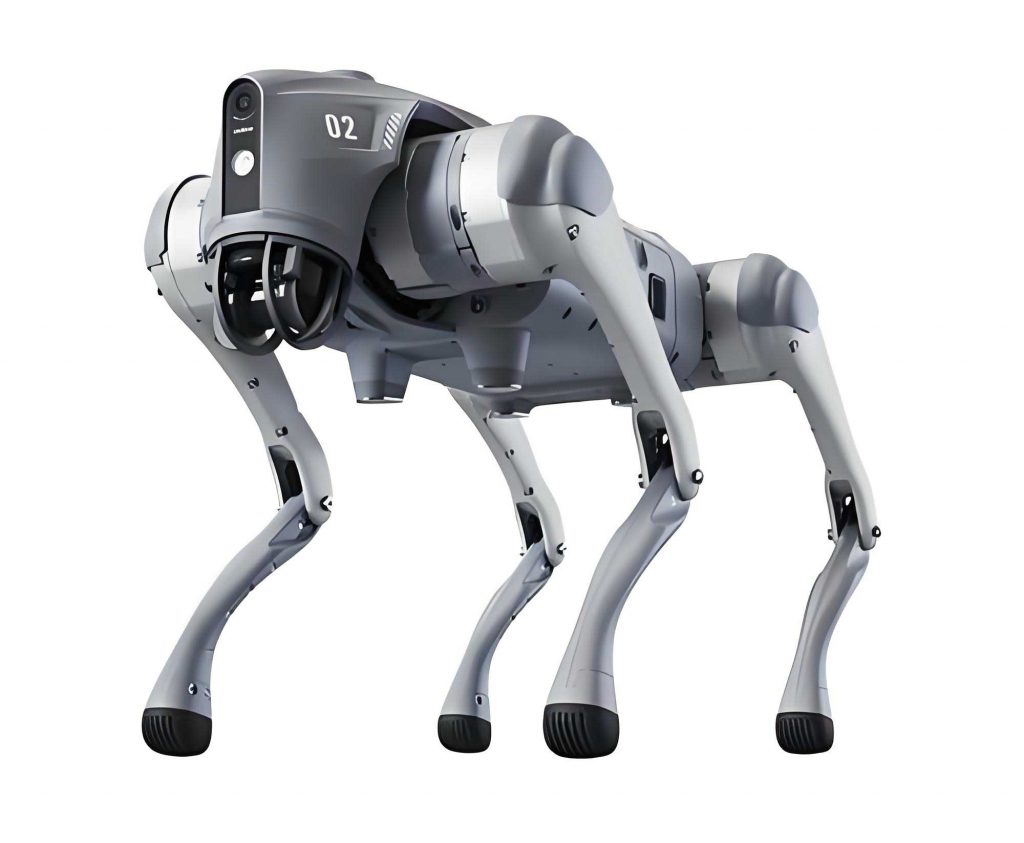
For simulation, we model the four leg configurations in SolidWorks and import them into MATLAB/Simulink. The parameters used are listed in Table 2. We analyze stability by examining the centroid offset in 3D space and energy consumption by calculating the work done by the joints over time.
| Parameter | Value |
|---|---|
| Body Length (2L) (mm) | 310 |
| Body Width (2w) (mm) | 150 |
| Stride Length (S) (mm) | 40 |
| Stride Height (H) (mm) | 20 |
| Side Swing Length (l_1) (mm) | 30 |
| Thigh Length (l_2) (mm) | 100 |
| Shank Length (l_3) (mm) | 100 |
| Motion Period (s) | 0.5 |
Stability analysis focuses on the displacement of the robot’s centroid in the x, y, and z directions during trotting. The initial state is a standing posture, and we simulate for 10 seconds. The results show that:
- In the forward direction (x), the full-elbow, full-knee, internal knee-elbow, and external knee-elbow configurations achieve displacements of 2324.2 mm, 2334.1 mm, 2390.0 mm, and 2412.1 mm, respectively. The external knee-elbow covers the most distance, but differences are minimal.
- In the lateral direction (y), the maximum offsets are 52.1 mm, 449.8 mm, 379.6 mm, and 142.7 mm for the same configurations. The full-elbow exhibits the least lateral drift, indicating superior stability.
- In the vertical direction (z), the full-elbow configuration shows the smallest fluctuations, further confirming its stability advantage.
These findings suggest that the full-elbow leg configuration provides the most stable motion for a quadruped robot, minimizing unwanted shifts and enhancing control.
Energy consumption is evaluated by calculating the work done by the hip and knee joints, as the shoulder joint contributes minimally to forward motion. The work formula is:
$$ W = \int_0^T M \omega \, dt $$
where M is the joint torque and ω is the angular velocity. Using MATLAB/Simulink, we simulate the work over 10 seconds for the left-front and left-back legs, assuming symmetrical behavior. The total work values are:
- Full-elbow: 21.54 J
- Full-knee: 28.99 J
- Internal knee-elbow: 27.20 J
- External knee-elbow: 25.96 J
The full-elbow configuration consumes the least energy, with both front and rear legs showing lower work compared to others. This highlights its efficiency, which is crucial for extending the operational time of a robot dog in field applications.
In conclusion, our comprehensive analysis of leg configurations for a quadruped robot in trotting gait demonstrates that the full-elbow type offers the best combination of stability and energy efficiency. This configuration minimizes centroid offsets in all directions and reduces joint work, making it ideal for applications requiring prolonged operation and robust performance. Future work could explore dynamic adaptations and real-world testing to further validate these findings. This study underscores the importance of leg configuration selection in optimizing the performance of quadruped robots, advancing their capabilities in various environments.