
In recent years, the development of legged robots, particularly quadruped robots or robot dogs, has garnered significant attention due to their superior stability, flexibility, and adaptability in complex environments. As a researcher in robotics, I have focused on analyzing the impact of leg configurations on the performance of quadruped robots, as the choice of leg type plays a decisive role in kinematics and dynamics. Common leg configurations include the full knee type, full elbow type, external knee-elbow type, and internal knee-elbow type, each with distinct advantages and disadvantages. For instance, the full knee type is often associated with running and climbing capabilities, while the full elbow type excels in downhill stability. In this article, I will delve into a comprehensive performance analysis of these leg configurations, emphasizing stability and energy consumption during trotting gait, using kinematic modeling, trajectory planning, and simulation results. The goal is to provide insights for selecting optimal leg configurations in robot dog design, leveraging mathematical formulations and empirical data to support conclusions.
To begin, understanding the trotting gait of a quadruped robot is essential. The trotting gait involves a periodic motion where legs are divided into swing and support phases, with diagonal legs moving in synchrony. For example, the left front and right hind legs form one pair, while the right front and left hind legs form another. During motion, one pair is in the swing phase (lifting and landing), while the other remains in the support phase (maintaining ground contact). This gait offers higher speed and environmental adaptability compared to crawling or walking gaits, making it ideal for dynamic environments. The trajectory planning for the foot during the swing phase is critical, as it must ensure smooth motion, avoid impacts, and maintain continuity. We consider two common trajectory types: the composite cycloid trajectory and the polynomial trajectory. After comparative analysis, the composite cycloid trajectory proves superior due to smoother displacement, velocity, and acceleration profiles, reducing joint stress and enhancing stability for the robot dog.
In terms of kinematic modeling, we employ the Denavit-Hartenberg (D-H) method to establish a framework for the quadruped robot. For a single leg, such as the left front leg, we define coordinate systems from the body center to the foot end, with joint angles and lengths parameterized. The forward kinematics derive the transformation matrix from the foot coordinate system to the base coordinate system, expressed as:
$$^0_4T = ^0_1T \cdot ^1_2T \cdot ^2_3T \cdot ^3_4T = \begin{bmatrix}
– s_{23} & – c_{23} & 0 & – l_2 s_2 – l_3 s_{23} \\
s_1 c_{23} & – s_1 s_{23} & c_1 & l_1 c_1 + l_2 s_1 c_2 + l_3 s_1 c_{23} \\
– c_1 c_{23} & c_1 s_{23} & s_1 & l_1 s_1 – l_2 c_1 c_2 – l_3 c_1 c_{23} \\
0 & 0 & 0 & 1
\end{bmatrix}$$
where $s_1 = \sin \theta_1$, $c_1 = \cos \theta_1$, $s_{23} = \sin(\theta_2 + \theta_3)$, and $c_{23} = \cos(\theta_2 + \theta_3)$. The foot position relative to the base coordinate system is given by:
$$P_x = – l_2 \sin \theta_2 – l_3 \sin(\theta_2 + \theta_3)$$
$$P_y = l_1 \cos \theta_1 + l_2 \sin \theta_1 \cos \theta_2 + l_3 \sin \theta_1 \cos(\theta_2 + \theta_3)$$
$$P_z = l_1 \sin \theta_1 – l_2 \cos \theta_1 \cos \theta_2 – l_3 \cos \theta_1 \cos(\theta_2 + \theta_3)$$
For inverse kinematics, we solve for the joint angles $\theta_1$, $\theta_2$, and $\theta_3$ based on the foot coordinates, leading to unique solutions:
$$\theta_3 = \arccos \left( \frac{P_x^2 + P_y^2 + P_z^2 – l_1^2 – l_2^2 – l_3^2}{2 l_2 l_3} \right)$$
$$\theta_1 = – \arcsin \left( \frac{l_1}{\sqrt{P_z^2 + P_y^2}} \right) + \arctan \left( \frac{P_y}{-P_z} \right)$$
$$\theta_2 = \arcsin \left( \frac{-P_x}{\sqrt{(l_2 + l_3 \cos \theta_3)^2 + (l_3 \sin \theta_3)^2}} \right) + \arctan \left( \frac{l_3 \sin \theta_3}{l_2 + l_3 \cos \theta_3} \right)$$
These equations enable precise control of the robot dog’s leg movements during trotting. Additionally, the body pose relative to the world coordinate system is modeled using transformation matrices, accounting for the robot’s orientation and position during motion. This comprehensive kinematic approach ensures accurate trajectory tracking and stability for the quadruped robot.
Moving to trajectory planning, the foot trajectory during the swing phase must satisfy constraints on position, velocity, and acceleration to minimize impacts and ensure smooth operation. For the composite cycloid trajectory, the parametric equations are derived as:
$$x = S \left( \frac{t}{T_m} – \frac{1}{2\pi} \sin \left( \frac{2\pi t}{T_m} \right) \right) \quad \text{for } 0 \leq t < T_m$$
$$z = \begin{cases}
\frac{2H}{T_m} \left( t – \frac{T_m}{4\pi} \sin \left( \frac{4\pi t}{T_m} \right) \right) & \text{for } 0 \leq t < \frac{T_m}{2} \\
\frac{2H}{T_m} \left( T_m + \frac{T_m}{4\pi} \sin \left( \frac{4\pi t}{T_m} \right) – t \right) & \text{for } \frac{T_m}{2} \leq t < T_m
\end{cases}$$
where $S$ is the step length, $H$ is the step height, and $T_m$ is the swing phase period. For the polynomial trajectory, a fifth-order polynomial for the x-direction and an eighth-order polynomial for the z-direction are used, but the composite cycloid is preferred due to its lower peak velocities and accelerations, reducing energy consumption and improving stability for the quadruped robot. The comparison of these trajectories highlights the importance of smooth motion in enhancing the performance of a robot dog in various terrains.
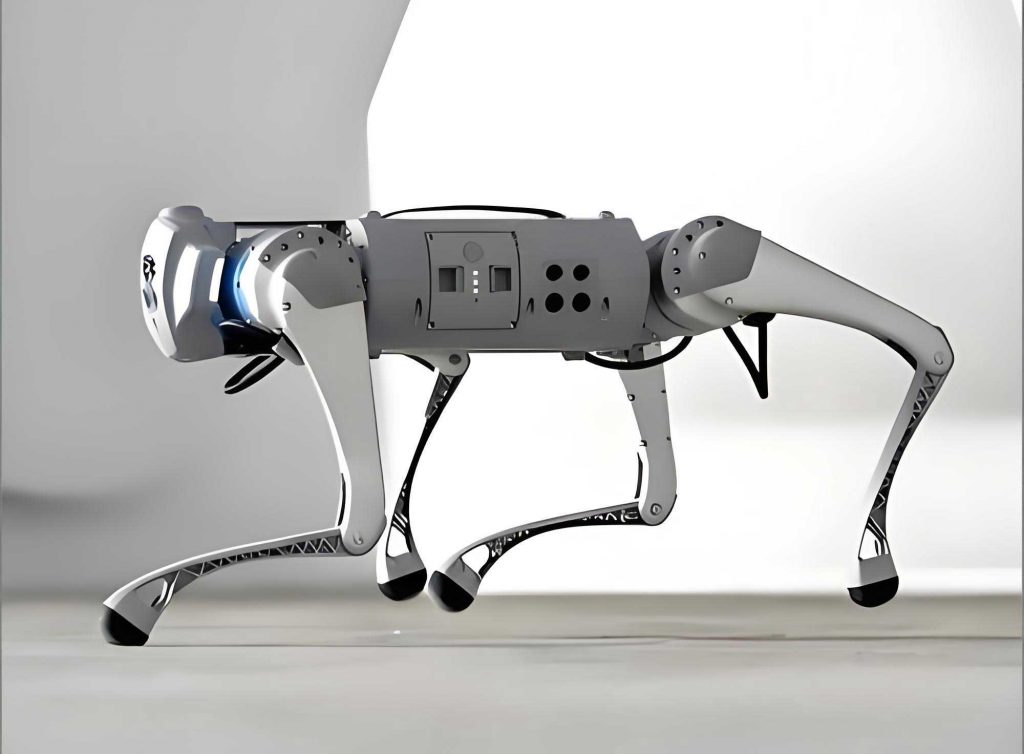
For simulation, we developed models of the four leg configurations in SolidWorks and imported them into MATLAB/Simulink for analysis. The simulation parameters are summarized in the table below, which includes key dimensions and motion settings for the quadruped robot.
| Parameter | Value |
|---|---|
| Body Length (2L) / mm | 310 |
| Body Width (2w) / mm | 150 |
| Step Length (S) / mm | 40 |
| Step Height (H) / mm | 20 |
| Lateral Swing Length (l1) / mm | 30 |
| Thigh Length (l2) / mm | 100 |
| Shank Length (l3) / mm | 100 |
| Motion Period / s | 0.5 |
Stability analysis focuses on the displacement of the robot’s center of mass in three-dimensional space during trotting. The results indicate that the full elbow type configuration exhibits the least deviation in lateral and vertical directions, ensuring smoother motion. For instance, after 10 seconds of simulation, the lateral displacement for the full elbow type is only 52.1 mm, compared to 449.8 mm for the full knee type, 379.6 mm for the internal knee-elbow type, and 142.7 mm for the external knee-elbow type. Vertically, the full elbow type shows minimal fluctuations, contributing to enhanced stability for the robot dog. This makes the full elbow configuration ideal for applications requiring precise control and reduced oscillations in the quadruped robot.
Energy consumption is another critical factor, as it directly affects the operational time of the robot dog. We calculate the work done by the hip and knee joints using the formula:
$$W = \int_0^T M \omega \, dt$$
where $M$ is the joint torque and $\omega$ is the joint angular velocity. The simulation results for the total work over 10 seconds are presented in the table below, highlighting the energy efficiency of different leg configurations.
| Leg Configuration | Front Leg Work (J) | Hind Leg Work (J) | Total Work (J) |
|---|---|---|---|
| Full Elbow Type | 10.25 | 11.29 | 21.54 |
| Full Knee Type | 15.34 | 13.65 | 28.99 |
| Internal Knee-Elbow Type | 12.89 | 14.31 | 27.20 |
| External Knee-Elbow Type | 12.01 | 13.95 | 25.96 |
As shown, the full elbow type consumes the least energy, with a total of 21.54 J, while the full knee type requires the most at 28.99 J. This lower energy demand in the full elbow configuration translates to longer battery life and improved sustainability for the quadruped robot, making it a preferable choice for extended missions. The reduced work in both front and hind legs underscores the efficiency of this leg type in minimizing joint efforts during trotting.
In discussion, the superiority of the full elbow leg configuration in both stability and energy consumption can be attributed to its kinematic structure, which allows for more natural motion patterns and reduced inertial effects. Compared to other configurations, the full elbow type minimizes lateral sway and vertical oscillations, leading to a smoother gait. This is particularly important for a robot dog navigating uneven terrains, where stability is paramount. Moreover, the energy savings align with the need for efficient power management in autonomous quadruped robots. While other configurations like the external knee-elbow type offer larger workspace, they fall short in overall performance metrics. Thus, for general-purpose applications, the full elbow type emerges as the optimal choice, balancing speed, adaptability, and resource utilization.
To further illustrate the joint behavior, the angular profiles for knee and elbow types during trotting are smooth and continuous, ensuring minimal jerks and impacts. The inverse kinematics solutions provide accurate joint angles, facilitating real-time control for the quadruped robot. Additionally, the trajectory planning ensures that the foot lands softly, avoiding slippage and enhancing grip. These factors collectively contribute to the robust performance of the robot dog in dynamic environments. Future work could explore adaptive trajectory planning for different terrains or integrate machine learning for optimized gait transitions.
In conclusion, through detailed kinematic modeling, trajectory planning, and simulation analysis, we have evaluated the performance of four leg configurations in a quadruped robot. The full elbow type stands out as the most stable and energy-efficient configuration, making it highly suitable for practical implementations of robot dogs. This analysis provides a foundation for designers to select leg configurations based on specific requirements, emphasizing the importance of holistic performance metrics in the development of advanced quadruped robots. As robotics continues to evolve, such insights will drive innovations in legged locomotion, enhancing the capabilities of these machines in real-world scenarios.