
In the field of force and position control, the six-axis force sensor plays a critical role by measuring three orthogonal forces and three moments in a spatial coordinate system. These sensors are widely applied in areas such as aerospace robotics and rocket thrust testing, where precise force feedback is essential. The core challenges in developing a six-axis force sensor lie in structural design and the selection of force-sensitive elements. Piezoelectric six-axis force sensors are particularly notable for their high stability, static rigidity, and ability to operate reliably in harsh environments. In this article, we explore the fundamental aspects of piezoelectric six-axis force sensors, including their structure, mechanical modeling, decoupling principles, and calibration experiments, with a focus on optimizing performance through symmetrical arrangements like square configurations.
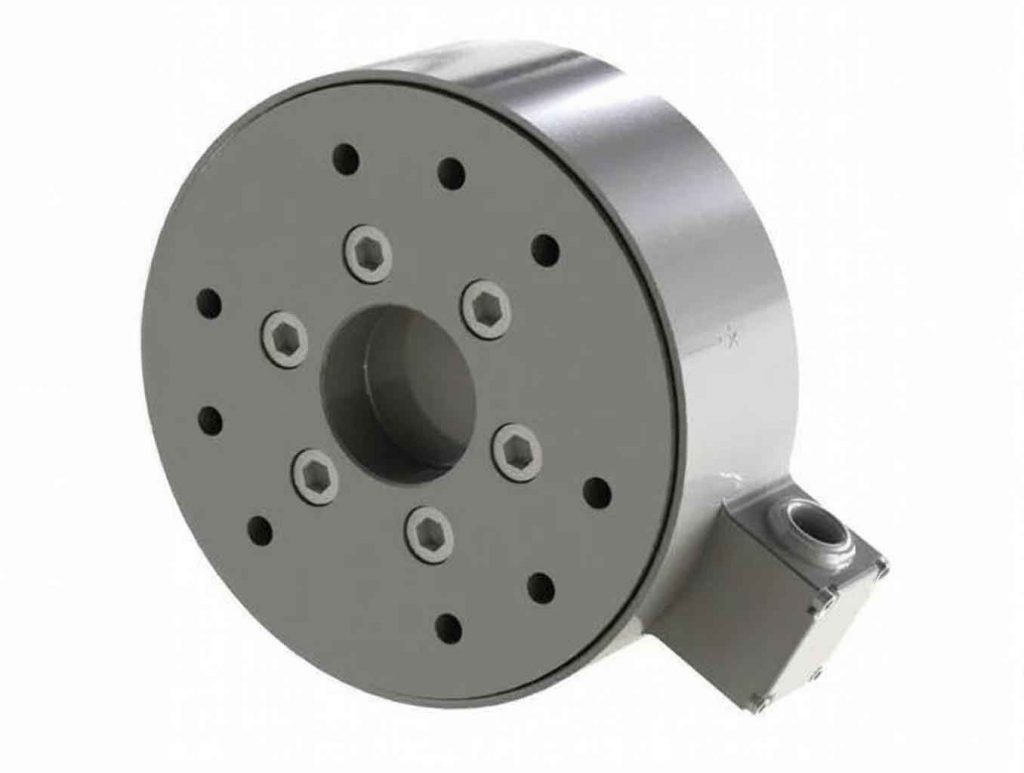
The structure of a piezoelectric six-axis force sensor relies on quartz crystal groups to detect multidimensional forces. Typically, four quartz crystal groups are employed, divided into three subsets: one xy quartz group and two yx quartz groups. The normal force component, Fz, is measured by the xy group, while the tangential forces, Fx and Fy, are detected by the yx groups. The sensitivity axes of the two yx groups form a 90-degree angle, and all groups exhibit consistent polarity in output. This arrangement ensures that the sensor can capture complex force interactions effectively. The layout of quartz groups is crucial for minimizing interference between force components, which directly impacts measurement accuracy. Six-axis force sensors can be categorized into direct-output and indirect-output types based on their structural coupling. Direct-output sensors compute forces directly from the sensing elements, whereas indirect-output sensors, like the piezoelectric six-axis force sensor, involve coupling between force and moment components, requiring decoupling algorithms to derive the six-dimensional output. The piezoelectric effect, including shear and longitudinal effects, is harnessed to measure forces, with signals coupled across directions. A common design features a symmetrical circular structure with four support points, offering high stiffness and simple manufacturing. The spatial arrangement of quartz groups can be either rhombus (diamond) or square, with symmetry being key to reducing cross-talk.
To model the mechanical behavior of the six-axis force sensor, we assume the sensor body acts as a rigid structure, while the quartz groups are elastic elements with uniform stiffness and sensitivity. When an external force F is applied, it decomposes into six components: Fx, Fy, Fz, Mx, My, and Mz. The force distribution follows principles such as lever balance and uniform allocation, depending on the direction relative to the quartz groups. For instance, a force perpendicular to the quartz group plane (e.g., Fz) is distributed based on lever balance, while forces parallel to the group alignments are evenly shared. The transformation of external forces and moments to the quartz groups can be expressed mathematically. Let the forces on the quartz groups be denoted as F_{z1}, F_{z2}, F_{z3}, F_{z4} for the normal components and similar for shear directions. The relationship between the external forces and the quartz group forces is given by the following linear equations.
For a rhombus arrangement, the equations are:
$$ \begin{aligned} F_x &= k_1 (F_{z1} – F_{z3}) \\ F_y &= k_2 (F_{z2} – F_{z4}) \\ F_z &= k_3 (F_{z1} + F_{z2} + F_{z3} + F_{z4}) \\ M_x &= k_4 a (F_{z2} – F_{z4}) \\ M_y &= k_5 a (F_{z1} – F_{z3}) \\ M_z &= k_6 b (F_{z1} + F_{z3} – F_{z2} – F_{z4}) \end{aligned} $$
where a and b represent distances from the origin to the element axes, and k_i are constants related to sensitivity. In contrast, the square arrangement yields:
$$ \begin{aligned} F_x &= k_1′ (F_{z1} – F_{z2} + F_{z3} – F_{z4}) \\ F_y &= k_2′ (F_{z1} + F_{z2} – F_{z3} – F_{z4}) \\ F_z &= k_3′ (F_{z1} + F_{z2} + F_{z3} + F_{z4}) \\ M_x &= k_4′ a (F_{z1} + F_{z2} – F_{z3} – F_{z4}) \\ M_y &= k_5′ a (F_{z1} – F_{z2} – F_{z3} + F_{z4}) \\ M_z &= k_6′ b (F_{z1} – F_{z2} + F_{z3} – F_{z4}) \end{aligned} $$
These models highlight that while the rhombus configuration simplifies calculations by omitting some quartz group information, it amplifies errors in moment measurements. For example, Mx in the rhombus case depends only on Fz2 and Fz4, so inaccuracies in these values lead to significant deviations. The square arrangement, by incorporating more data points, reduces such errors and enhances reliability for the six-axis force sensor.
Coupling in multidimensional force sensors arises from structural and error-related factors, with the latter being a primary concern. Error coupling means that each force component affects the output signals of others, compromising accuracy. Decoupling algorithms are essential to isolate these effects. Using a function-based approach, we model the coupling with linear regression. For instance, when force Fx is applied, the output voltage Ux is influenced by other components, leading to:
$$ U_x = a_{xx} F_x + a_{xy} F_y + a_{xz} F_z + a_{xmx} M_x + a_{xmy} M_y + a_{xmz} M_z + b_x $$
where a_{ij} are coupling coefficients and b_x is a constant. Similarly, for other outputs, we have:
$$ \begin{aligned} U_y &= a_{yx} F_x + a_{yy} F_y + a_{yz} F_z + a_{ymx} M_x + a_{ymy} M_y + a_{ymz} M_z + b_y \\ U_z &= a_{zx} F_x + a_{zy} F_y + a_{zz} F_z + a_{zmx} M_x + a_{zmy} M_y + a_{zmz} M_z + b_z \\ U_{mx} &= a_{mxx} F_x + a_{mxy} F_y + a_{mxz} F_z + a_{mxmx} M_x + a_{mxmy} M_y + a_{mxmz} M_z + b_{mx} \\ U_{my} &= a_{myx} F_x + a_{myy} F_y + a_{myz} F_z + a_{mymx} M_x + a_{mymy} M_y + a_{mymz} M_z + b_{my} \\ U_{mz} &= a_{mzx} F_x + a_{mzy} F_y + a_{mzz} F_z + a_{mzmx} M_x + a_{mzmy} M_y + a_{mzmz} M_z + b_{mz} \end{aligned} $$
This can be expressed in matrix form as U = A F + b, where U is the output vector, F is the force-moment vector, A is the coupling matrix, and b is the bias vector. Decoupling involves inverting this relationship to solve for F, often using least-squares methods to minimize errors. For a six-axis force sensor, this process is iterative, requiring calibration data to refine the coefficients.
Calibration experiments for piezoelectric six-axis force sensors typically involve static tests with incremental loading and unloading in all six directions. The goal is to quantify interference, which should ideally be below 5% for reliable operation. In our tests, we compared rhombus and square arrangements, applying forces and moments while recording outputs. The results are summarized in the table below, which shows the maximum interference errors observed during calibration.
| Configuration | Applied Force/Moment | Interference Error | Remarks |
|---|---|---|---|
| Rhombus | Fx, Fy | Up to 10% on Mx, My | High cross-talk due to simplified equations |
| Rhombus | Mx, My | Up to 10% on Fx, Fy | Significant deviation in moment calculations |
| Square | Fx, Fy, Fz, Mx, My, Mz | Less than 5% | Consistent with standards, low interference |
| Both | Fz, Mz | Less than 1% | Minimal cross-talk with symmetrical layout |
As evident, the square configuration outperforms the rhombus by maintaining errors within acceptable limits, ensuring accurate force and moment measurements. This makes the square arrangement preferable for applications requiring high precision in a six-axis force sensor.
In summary, we have detailed the design and analysis of a piezoelectric six-axis force sensor, emphasizing the importance of quartz group layout. Through mechanical modeling and decoupling algorithms, we demonstrated that square arrangements reduce interference compared to rhombus setups. The piezoelectric six-axis force sensor, with its simplicity and accuracy, is well-suited for axial force measurements in demanding environments. Future work could explore advanced materials or real-time decoupling techniques to further enhance performance.
The development of a reliable six-axis force sensor hinges on continuous refinement of structural symmetry and calibration methods. By leveraging mathematical models and empirical data, we can achieve robust sensors that meet the rigorous demands of modern engineering applications. This analysis underscores the value of systematic approaches in optimizing six-axis force sensor designs for improved functionality and reliability.