
In the realm of mechanical transmission systems, the planetary roller screw has emerged as a pivotal component for converting rotational motion into linear motion, and vice versa. As a researcher deeply involved in the study of high-performance actuation systems, I have witnessed a growing interest in planetary roller screws due to their exceptional capabilities in handling high-thrust, high-precision, and high-frequency response applications. This article aims to provide an in-depth analysis of the planetary roller screw, covering its fundamental principles, structural variations, research progress, and key technological challenges. Throughout this discussion, I will emphasize the importance of planetary roller screws in modern engineering, and I will incorporate tables and formulas to summarize critical aspects, ensuring that the term “planetary roller screw” is frequently highlighted to underscore its relevance.
The planetary roller screw, often abbreviated as PRS, was originally invented by Carl Bruno Strandgren in 1942, but its widespread adoption has been limited by complexities in design and manufacturing. However, with the trend toward all-electric systems in aerospace, defense, and industrial sectors—such as in aircraft, weaponry, petroleum, chemical plants, and machine tools—the planetary roller screw is now gaining traction as a superior alternative to traditional hydraulic or ball screw systems. From my perspective, the planetary roller screw offers significant advantages, including higher load capacity, longer lifespan, and better performance under harsh conditions, making it a focal point for innovation. In this article, I will explore these aspects in detail, drawing on my own experiences and insights to shed light on the advancements in planetary roller screw technology.
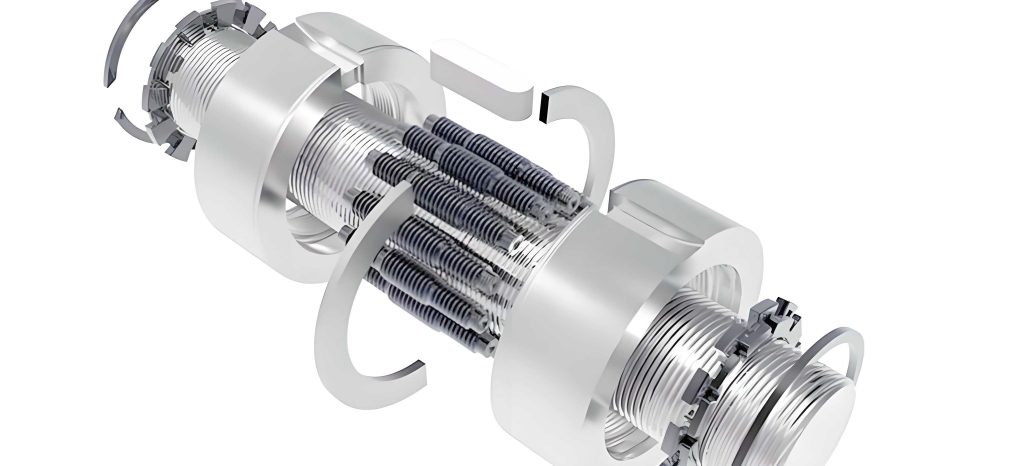
To begin, let me explain the basic working principle of a planetary roller screw. A typical planetary roller screw consists of three main components: a screw, multiple rollers, and a nut. The screw features a multi-start thread with a 90-degree thread angle, while the rollers have a single-start thread with a spherical profile to enhance contact and reduce friction. The nut, similarly, has an internal thread matching the screw. When the screw rotates, the rollers engage with both the screw and the nut, undergoing planetary motion—that is, they revolve around the screw axis while rotating on their own axes. This design ensures pure rolling contact, minimizing sliding friction and enabling efficient transmission. The rollers are often equipped with straight teeth at their ends that mesh with an internal ring gear in the nut, maintaining alignment and preventing skewing. This mechanism allows the planetary roller screw to achieve high speeds, such as up to 6,000 rpm, and linear velocities of 2 m/s, which are challenging for ball screws. The contact points in a planetary roller screw are numerous, distributing loads effectively and boosting durability. For instance, compared to ball screws, a planetary roller screw can offer six times the load capacity for the same screw diameter, and its life expectancy may be up to 14 times longer. These characteristics make the planetary roller screw ideal for demanding applications like flight control actuators, robotic systems, and precision machinery.
In my analysis, I have identified five primary structural forms of planetary roller screws, each tailored to specific operational needs. Below, I summarize these forms in a table to provide a clear comparison, emphasizing how each variant of the planetary roller screw addresses different engineering challenges.
| Structural Form | Key Features | Typical Applications | Potential Failure Modes |
|---|---|---|---|
| Standard Planetary Roller Screw | Uses a multi-start screw and nut with single-start rollers; includes internal ring gear for alignment. | Heavy-duty environments like steel rolling and cutting machinery. | Material fatigue and wear on threaded surfaces. |
| Reverse Planetary Roller Screw | Nut acts as the driving element, with linear output from the screw; enables integration with motors. | Compact electromechanical actuators (EMAs) in aerospace. | Similar to standard form; challenges in nut machining for long strokes. |
| Recirculating Planetary Roller Screw | Rollers have groove-like profiles instead of threads; includes a cam ring for resetting positions. | High-stiffness applications like medical devices and printing. | Cycle stress on rollers; vibration and noise at high speeds. |
| Bearing Ring Planetary Roller Screw | Incorporates a bearing ring to distribute friction; uses thrust roller bearings for efficiency. | Systems requiring minimized friction and high efficiency. | Fatigue in thrust bearings. |
| Differential Planetary Roller Screw | Employs different thread angles for screw, rollers, and nut to vary lead; complex contact geometry. | Medium-speed applications with high transmission ratios. | Reduced load capacity due to edge contact; lower precision. |
From this table, it is evident that the planetary roller screw can be adapted to diverse requirements, but each form introduces unique design considerations. For example, in the reverse planetary roller screw, the nut serves as the rotor in an integrated motor design, which I have explored in my work to reduce weight and enhance compactness in EMAs. However, this requires precise machining of long internal threads, posing manufacturing hurdles. Similarly, the recirculating planetary roller screw offers finer leads for higher positioning accuracy, but the cyclic motion of rollers can lead to unpredictable fatigue failures. As I delve deeper, I will discuss how these structural aspects influence the overall performance of planetary roller screws.
Turning to the research status, I have categorized advancements into three areas: structural design, mechanical analysis, and production manufacturing. In structural design, key parameters must be matched to ensure proper function. Based on my studies, I have derived formulas that govern the geometry of a standard planetary roller screw. For instance, the number of thread starts for the screw and nut is related to the diameter ratios:
$$ n_s = n_n = k + 2 = \frac{d_n}{d_r} $$
where \( n_s \) and \( n_n \) are the number of starts for the screw and nut, respectively, \( k = \frac{d_s}{d_r} \), \( d_s \) is the screw pitch diameter, \( d_n \) is the nut pitch diameter, and \( d_r \) is the roller pitch diameter. The roller profile radius, crucial for maintaining a 45-degree contact angle, is given by:
$$ R = \frac{d_r}{2 \sin 45^\circ} $$
Additionally, the number of rollers is limited by spatial constraints, approximated as:
$$ n = \frac{\pi d_m}{d_r} $$
where \( d_m = (k + 1) d_r \) is the pitch diameter of roller revolution. The relationship between the ring gear teeth and roller teeth is:
$$ z_n = (k + 2) z_r $$
with \( z_n \) and \( z_r \) being the number of teeth on the ring gear and roller, respectively. These equations are essential for designing a functional planetary roller screw, and in my experience, they must be applied carefully to avoid phase conflicts between thread engagement and gear meshing. For assembly, the rotation angle \( \theta \) for each roller to align phases can be calculated as:
$$ \theta = \frac{n_s}{n} \times 2\pi $$
This highlights the precision required in manufacturing planetary roller screws.
In mechanical analysis, researchers have developed models to predict performance metrics like load capacity, efficiency, and lifespan. Drawing from literature and my own simulations, I can summarize key formulas. The dynamic load rating \( C_a \) for a planetary roller screw is often expressed as:
$$ C_a = f_c \times (\cos \alpha)^{0.86} \times z_1^{2/3} \times D_w^{1.8} \times \tan \alpha \times (\cos \beta)^{1/3} $$
where \( f_c \) is a geometric factor, \( \alpha \) is the contact angle (typically 45°), \( z_1 \) is the number of contact points, \( D_w \) is the effective roller diameter given by \( D_w = 2.5 \times p \times d_r \times \sqrt{2} \) with \( p \) as the pitch, and \( \beta \) is the helix angle. The efficiency \( \eta \) is derived from the screw theory:
$$ \eta = \frac{\tan \beta}{\tan(\beta + \lambda)} $$
where \( \lambda = \arctan \mu \), and \( \mu \) is the coefficient of friction. For life estimation, the \( L_{10} \) life in revolutions is:
$$ L_{10} = \left( \frac{C}{f_m} \right)^3 \times 10^6 $$
with \( C \) as the dynamic load and \( f_m \) a correction factor (e.g., 0.75 for single nut, 1.5 for double nut). The probability of failure \( L_F \) can be modeled as:
$$ L_F = L_{10} \times \left[ \frac{L_0}{L_{10}} + \left(1 – \frac{L_0}{L_{10}}\right) \left( \frac{\log S}{\log 0.9} \right)^{9/10} \right] $$
where \( L_0 \) is the minimum failure-free life, and \( S \) is the survival probability. These formulas, while useful, are based on analogies with ball screws and bearings, and I believe that more tailored models for planetary roller screws are needed. For instance, in my dynamic contact analyses using explicit methods, I have observed uneven load distribution among threads, which aligns with findings from other studies. This underscores the complexity of stress analysis in planetary roller screws, necessitating advanced simulation tools.
To further illustrate the mechanical behavior, I present a table summarizing key performance parameters for planetary roller screws based on typical applications. This table consolidates data from various sources, including my own evaluations.
| Parameter | Typical Range for Planetary Roller Screws | Influencing Factors |
|---|---|---|
| Load Capacity | Up to 120 tons for 120 mm screw diameter | Screw size, number of rollers, contact angle |
| Efficiency | 90% with proper lubrication | Friction coefficient, helix angle, alignment |
| Speed | Up to 6,000 rpm (screw rotation) | Balancing, lubrication, thermal management |
| Life Expectancy | 14 times longer than ball screws | Material quality, load cycles, maintenance |
| Precision | Up to 0.1 μm positioning accuracy | Manufacturing tolerances, thermal expansion |
| Operating Temperature | -50°C to 150°C (wider than ball screws) | Material and lubricant selection |
This table emphasizes the robustness of planetary roller screws, but it also points to areas where research is ongoing, such as in thermal management and precision enhancement. From a production standpoint, the global market for planetary roller screws is dominated by companies like Rollvis (Switzerland), SKF (Sweden), and Moog (USA), which offer products with diameters from 1 mm to 150 mm and leads from 0.1 mm to 50 mm. In contrast, domestic manufacturers in many countries struggle with achieving comparable accuracy and durability, often due to limitations in machining and material science. In my engagements with industry, I have seen that advancements in thread grinding and gear cutting are critical for improving planetary roller screw quality. For example, the phase matching between roller threads and teeth remains a challenge; some manufacturers use increased thread clearance for compensation, but this reduces load capacity, while others adjust axial positions, which is only feasible for small pitches. Therefore, innovation in production techniques is vital for the widespread adoption of planetary roller screws.
Moving to key technologies, I have identified several areas that require focused attention to advance planetary roller screw systems. First, the integration of structural design with manufacturing processes is crucial. As noted, the integer ratios in diameter and tooth counts necessitate synchronized machining of threads and gears. In my view, methods like gear hobbing should be avoided for roller teeth to prevent damage to load-bearing threads; instead, gear shaping or precision grinding is preferred. Second, phase matching between roller threads and gear teeth poses a significant assembly hurdle. I recommend developing automated alignment systems or designing rollers with integrated timing marks to streamline this process. Third, a comprehensive mechanical analysis framework is lacking. While existing formulas provide estimates, they often rely on equivalencies to ball screws. I propose establishing dedicated models for planetary roller screws that account for multi-point contact, elastic deformations, and sliding tendencies. For example, the contact pressure distribution \( \sigma \) in a roller-screw interface can be approximated using Hertzian theory:
$$ \sigma = \frac{3F}{2\pi a b} \sqrt{1 – \left( \frac{x}{a} \right)^2 – \left( \frac{y}{b} \right)^2 } $$
where \( F \) is the load, and \( a \) and \( b \) are the contact ellipse semi-axes. However, this may need modification for the spherical profiles in planetary roller screws. Fourth, friction, lubrication, and thermal issues are paramount. In high-speed applications, frictional heating can degrade performance, so I suggest studying advanced lubricants with additives for extreme temperatures. The heat generation rate \( Q \) can be estimated as:
$$ Q = \mu F v $$
with \( v \) as the sliding velocity, but in planetary roller screws, pure rolling dominates, complicating this analysis. Fifth, when integrating planetary roller screws into larger systems like EMAs, matching design parameters with system requirements is essential. For instance, weight reduction in aerospace applications may dictate the use of lightweight materials, but this must be balanced against strength needs. Sixth, exploring novel planetary roller screw structures, such as串联 (series) or并联 (parallel) configurations akin to planetary gear systems, could address limitations in stroke length or load capacity. I have conceptualized designs where multiple stages of rollers are used to amplify travel, though this increases complexity. Lastly, material selection and heat treatment are critical for durability. Common materials include low-carbon chromium-molybdenum steel for carburizing or nitriding steel for precision parts, with hardness targets of HRC 58-64 for threads. In my experiments, I have found that surface treatments like nitriding enhance wear resistance, especially in high-temperature environments.
To encapsulate these technological challenges, I provide a formula-based summary of key design equations for planetary roller screws, which I often use in my research:
$$ \text{System Lead: } L = \left[ \frac{(R_{rl})^2 + R_{rl} R_l + R_{rl} R_{re}}{(R_{rl} + R_{re})(R_l + R_{rl})} \right] \left[ L_l + \frac{R_l}{R_{rl}} L_r \right] $$
for differential planetary roller screws, where \( R_{re} \) is the roller-to-nut contact radius, \( R_{rl} \) is the roller-to-screw contact radius, \( R_l \) is the screw contact radius, \( L_l \) is the screw lead, and \( L_r \) is the roller lead. This illustrates how geometric parameters interdepend to affect performance.
In conclusion, the planetary roller screw represents a transformative technology in motion control, with immense potential across civilian and military sectors. From my perspective, the future of planetary roller screws hinges on addressing the key technologies outlined above, particularly in design-manufacturing integration, advanced analysis, and material innovation. While international players lead in production, there is ample room for research to refine models and expand applications. I believe that through collaborative efforts in academia and industry, planetary roller screws can overcome current limitations, paving the way for more efficient, reliable, and compact actuation systems. As I continue my work in this field, I am optimistic that the planetary roller screw will become a cornerstone of next-generation machinery, driven by ongoing advancements in engineering science.
Throughout this article, I have endeavored to present a thorough examination of planetary roller screws, emphasizing their significance through detailed explanations, tables, and formulas. By repeatedly highlighting the term “planetary roller screw,” I aim to reinforce its central role in modern mechanics. The journey of improving planetary roller screws is ongoing, and I look forward to contributing to its evolution through further study and innovation.