
High-fidelity dynamic modeling of actuator systems is paramount for precise control and aeroelastic stability analysis, particularly in aerospace applications. The planetary roller screw mechanism, a high-precision transmission device utilizing threaded meshing for motion conversion, is a critical component in such systems due to its ability to withstand high speeds, heavy loads, and high-frequency operation. The core challenge in achieving rapid and accurate control of an actuator system lies in developing a high-precision dynamic model for its planetary roller screw. The presence of numerous non-standard threaded contacts within the planetary roller screw structure complicates dynamic modeling. This study establishes a dynamic model that incorporates thread meshing stiffness based on Hertzian contact theory. To verify the model’s accuracy, a dedicated test rig for investigating the dynamic characteristics of a planetary roller screw was constructed.
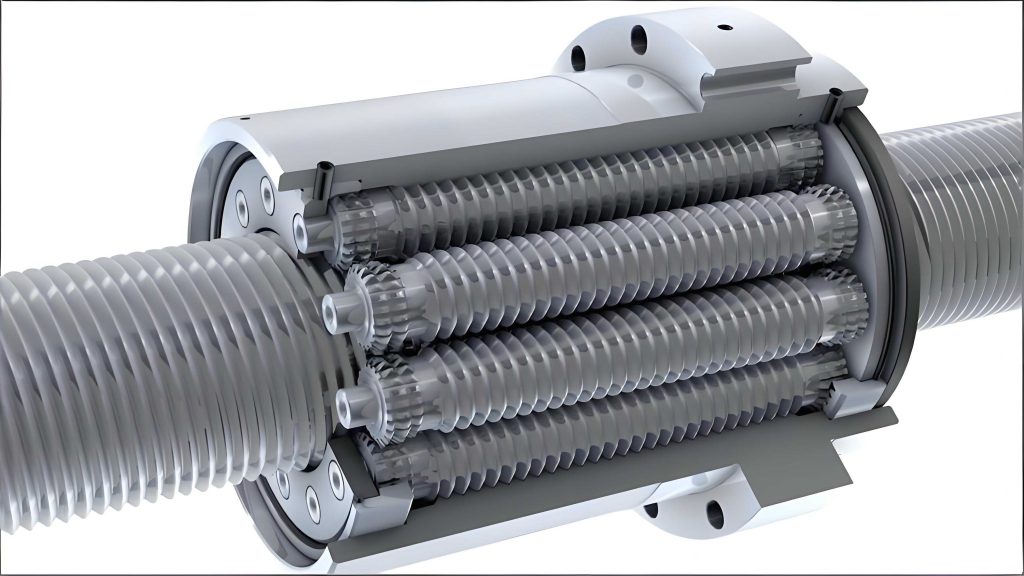
The planetary roller screw assembly primarily consists of a screw, multiple rollers, a nut, an internal gear ring (or ring gear), and a carrier or planet cage. Its operation is based on planetary gear principles. During operation, the screw is driven to rotate by a motor. This rotation causes contact between the screw threads and the roller threads. Consequently, each roller rotates about its own axis, revolves around the screw axis (planet motion), and translates axially along the screw. The nut, engaged with the rollers, is driven to perform a linear motion along the screw’s axial direction. When under load, the rollers positioned beneath the screw provide the primary support. The overall stiffness of a planetary roller screw comprises body stiffness, thread stiffness (both primarily axial), and contact stiffness (normal to the contact surfaces). The multitude of threaded contacts necessitates a simplified yet accurate dynamic representation.
1. Dynamic Modeling of the Planetary Roller Screw
Accurate modeling of the contact interactions is fundamental to capturing the dynamic behavior of the planetary roller screw. The stiffness at each thread contact interface significantly influences the system’s overall support stiffness and, consequently, its natural frequencies. For two contacting curved surfaces, such as the threads of the screw and a roller, the deformation according to Hertzian contact theory can be expressed. The contact stiffness between a roller and the screw is derived from this deformation.
The comprehensive contact stiffness for a single roller thread involves two contacts in series: the roller-screw interface and the roller-nut interface. For a roller with multiple engaged threads, the stiffness contributions from each thread are combined. The total axial support stiffness of the planetary roller screw mechanism is then the parallel sum of the equivalent stiffness from each roller, projected onto the axial (vertical) direction. Consider a planetary roller screw with N rollers. The axial component of force and deflection for a roller at an angular position θi relative to the vertical load direction must be considered. The equivalent axial stiffness contribution from the i-th roller, Ka,i, is given by:
$$ K_{a,i} = K_{H,i} \cdot \cos^2(\theta_i) $$
where KH,i is the combined thread contact stiffness for that roller (considering all its engaged threads in series and parallel as needed). The total axial support stiffness Kaxial,total is:
$$ K_{axial,total} = \sum_{i=1}^{N} K_{a,i} = \sum_{i=1}^{N} \left( K_{H,i} \cdot \cos^2(\theta_i) \right) $$
For a symmetrical configuration with rollers evenly spaced and assuming identical roller stiffness KH, the summation simplifies. The deformation δ under an axial force F for any roller is δ = F / KH. The axial deflection component for a roller at angle θi is δa,i = δ ⋅ cos(θi). The force required to cause this axial deflection component is Fa,i = KH ⋅ δ / cos(θi) = F / cos(θi). However, the correct approach is to equate the virtual work: the axial force times the axial displacement equals the sum of roller forces times their axial displacement components. This leads to the stiffness contribution formula KH ⋅ cos2(θi) as stated above.
The thread contact stiffness KH itself is a function of the contact geometry and material properties. According to Hertz theory for general curved surface contact, the deformation δH is:
$$ \delta_H = \left( \frac{9P^2}{16{E^*}^2 R_{Ei}} \right)^{\frac{1}{3}} \cos\beta \mathcal{F}_2 $$
where P is the contact force, E* is the equivalent elastic modulus, REi is the equivalent radius of curvature at the contact, β is the thread contact angle, and ℱ2 is a displacement correction factor. The equivalent modulus is:
$$ \frac{1}{E^*} = \frac{1-\nu_1^2}{E_1} + \frac{1-\nu_2^2}{E_2} $$
where E1, E2 and ν1, ν2 are the elastic moduli and Poisson’s ratios of the two contacting materials (e.g., screw and roller). The equivalent radius REi and the geometrical parameters A and B are determined by the principal curvatures of the contacting threads.
The contact stiffness for a single thread pair is non-linear, as Kcontact = dP/dδH ∝ P1/3. For dynamic analysis around an operating preload P0, a linearized stiffness can be used: Kcontact,linear ≈ (3/2) Kcontact(P0). The combined stiffness for one roller’s thread engagements is a series-parallel combination. If a roller engages with n threads on the screw and n threads on the nut, and assuming stiffness KHS for each screw-roller contact and KHN for each nut-roller contact, the total stiffness for that roller KH can be approximated (for identical contacts) as:
$$ K_{H} = n \cdot \left( \frac{K_{HS} \cdot K_{HN}}{K_{HS} + K_{HN}} \right) $$
The parameters of the specific planetary roller screw model analyzed in this study are summarized in the following table:
| Parameter | Value |
|---|---|
| Screw Radius | 10.5 mm |
| Screw Length | 256 mm |
| Screw Number of Thread Starts | 5 |
| Screw Helix Angle | 1.74° |
| Nut Radius | 17.5 mm |
| Nut Length | 65 mm |
| Nut Number of Thread Starts | 5 |
| Nut Helix Angle | 1.04° |
| Roller Radius | 3.5 mm |
| Roller Length | 30 mm |
| Number of Rollers | 11 |
| Threads per Roller | 75 |
| Roller Number of Thread Starts | 1 |
| Roller Helix Angle | 1.04° |
| Thread Contact Angle (β) | 45° |
To create a computationally efficient dynamic model, the planetary roller screw is simplified as a continuous beam (representing the screw) supported by discrete spring-damper-mass elements representing the effect of the rollers. The screw is discretized using the finite element method. Each roller contact location is modeled with a linear spring whose stiffness is the equivalent axial support stiffness Ka,i calculated for that position, and an attached mass representing the effective mass of the roller and its associated nut segment. The dynamic equation of the system is:
$$ [\mathbf{M}] \{\ddot{u}\} + [\mathbf{C}] \{\dot{u}\} + [\mathbf{K}] \{u\} = \{Q\} $$
where [M], [C], and [K] are the global mass, damping, and stiffness matrices, {u} is the displacement vector containing translational and rotational degrees of freedom at each node, and {Q} is the excitation force vector. For free vibration analysis, damping and external forces are neglected:
$$ [\mathbf{M}] \{\ddot{u}\} + [\mathbf{K}] \{u\} = 0 $$
Assuming harmonic motion {u} = {Φ}ejωt, the eigenvalue problem is obtained:
$$ \left( [\mathbf{K}] – \omega^2 [\mathbf{M}] \right) \{\Phi\} = 0 $$
The solutions ωi and {Φ}i are the natural frequencies and corresponding mode shapes of the planetary roller screw system.
2. Parameter Influence on Stiffness and Natural Frequencies
The thread contact angle β and the roller radius are two critical design parameters that profoundly affect the meshing stiffness and, therefore, the dynamic characteristics of the planetary roller screw. The axial support stiffness increases with both parameters. The relationship between total axial support stiffness Kaxial,total and the contact angle β for different roller radii shows a non-linear increasing trend, with the rate of increase accelerating at higher angles. This is because a larger contact angle increases the normal contact stiffness component projected into the axial direction. Similarly, increasing the roller radius also increases the axial support stiffness, primarily by increasing the contact area and modifying the thread profile geometry, though the rate of increase diminishes as the radius grows larger.
The natural frequencies of the planetary roller screw system are directly influenced by these stiffness changes, as well as by associated mass changes. The first two natural frequencies are of particular interest for avoiding resonance in operational bandwidths. Simulation results for the model with the base parameters show a first-order natural frequency of 182 Hz and a second-order natural frequency of 781 Hz. The first mode shape primarily involves a rocking motion of the screw about a central support point, with significant combined axial and radial displacement. The second mode shape is characterized by a predominantly axial translation of the screw.
The influence of the roller radius on these natural frequencies is non-monotonic. While stiffness generally increases with radius, the mass and rotational inertia of the roller, as well as the effective added mass in the model, also increase. There exists an optimal roller radius that maximizes the first and second natural frequencies; for the studied configuration, this optimum occurs near a radius of 3.5 mm. Beyond this point, the added mass effect begins to outweigh the stiffness benefit, causing the natural frequencies to decrease. This highlights the importance of integrated design optimization for the planetary roller screw.
In contrast, the effect of increasing the thread contact angle is more straightforward. As the contact angle increases, the system’s stiffness rises without a proportional increase in mass (the geometry of the screw and nut threads change, but their core masses remain largely constant). Consequently, both the first and second natural frequencies increase steadily with the contact angle, and the rate of this increase itself rises at higher angles. This makes the contact angle a very effective parameter for boosting the dynamic rigidity and fundamental natural frequencies of a planetary roller screw mechanism.
3. Experimental Validation of Dynamic Characteristics
To validate the accuracy of the proposed dynamic model, a dedicated experimental test rig was designed and constructed. The primary goal was to measure the first few natural frequencies of the planetary roller screw assembly under conditions simulating a fixed nut and free-ended screw, corresponding to a common actuator configuration.
The test rig comprised several key components. The planetary roller screw specimen was mounted in a sturdy steel base. A screw locking device prevented any rotation of the screw. A large-diameter thrust bolt was used to axially fix the screw at one end, simulating a boundary condition. A preload mechanism applied a static axial load to the screw through a bearing assembly to establish consistent contact conditions in the threads. Dynamic excitation was provided by an electromagnetic shaker, connected to the free end of the screw via a stinger and a dynamic force sensor. The resulting axial vibration response of the screw was measured using a non-contact eddy current displacement sensor positioned near the excitation point. A data acquisition system recorded the force and displacement signals for frequency response analysis.
| Component | Parameter | Value / Specification |
|---|---|---|
| Sensors | Dynamic Force Sensor | Range: 0-5 kN, Sensitivity: 4 pC/N |
| Eddy Displacement Sensor | Range: 0-1 mm, Sensitivity: 0.0625 mm/V | |
| Test Fixture | Screw Base Dimensions | 400 mm (L) x 240 mm (W) x 300 mm (H) |
| Screw Locking Device | 400 mm (L) x 90 mm (W) x 300 mm (H) |
The experimental procedure involved a sine-sweep test. The shaker applied a constant-amplitude sinusoidal force over a specified frequency range (e.g., 0-1000 Hz). The frequency response function (FRF), specifically the displacement/force compliance, was computed from the measured time-domain signals. The natural frequencies were identified as the peaks in the FRF magnitude plot.
The experimental results clearly identified the first two resonant peaks. The first natural frequency was measured at 195 Hz, and the second natural frequency was measured at 747 Hz. Comparing these to the simulation results of 182 Hz and 781 Hz yields relative errors of approximately 6.7% and 4.3%, respectively. This close agreement validates the accuracy of the developed dynamic model for the planetary roller screw. The minor discrepancies can be attributed to several practical factors not fully captured in the model, such as slight misalignments, damping in the contacts and supports, uncertainties in material properties, and the simplified linear representation of the contact stiffness around the preload point. Nonetheless, the model successfully predicts the key dynamic characteristics.
4. Conclusions
This study presented a comprehensive approach to modeling, analyzing, and experimentally validating the dynamic characteristics of a planetary roller screw mechanism. A high-fidelity dynamic model was developed by incorporating thread meshing stiffness derived from Hertzian contact theory into a discretized beam framework. The model effectively accounts for the complex series-parallel stiffness network formed by the multiple thread engagements between the screw, rollers, and nut.
The parameter study revealed significant insights. The thread contact angle and the roller radius are dominant design parameters influencing the system’s axial support stiffness. Increasing the contact angle monotonically increases both the stiffness and the first two natural frequencies of the planetary roller screw. The effect of the roller radius is more nuanced due to the competing effects of increased stiffness and increased mass; an optimal radius exists that maximizes the fundamental natural frequencies.
Experimental validation confirmed the model’s predictive capability. The measured first and second natural frequencies showed excellent agreement with the simulated values, with errors less than 7%. This confirms that the proposed modeling methodology provides a rapid and accurate means for dynamic analysis, which is crucial for control system design and flutter analysis in aerospace servo-actuation systems.
For designers, the key takeaways are that increasing the thread contact angle is a highly effective way to raise the natural frequencies and dynamic stiffness of a planetary roller screw. Furthermore, careful selection of the roller radius, considering both stiffness and inertia effects, can help push the system’s resonant frequencies beyond the intended operational bandwidth, thereby preventing harmful vibrations and ensuring stable, high-performance operation of the actuation system.