
The pursuit of high-performance motion control in applications such as precision CNC machine tools, robotics, and aerospace actuators has driven the development of advanced mechanical transmission systems. Among these, the planetary roller screw mechanism (PRSM) stands out for its exceptional load capacity, high stiffness, and compact design. To eliminate backlash and achieve bidirectional precision positioning, preloading is essential. This study focuses on a specific preloaded configuration: the double-nut planetary roller screw mechanism with pins. This mechanism utilizes the relative angular displacement between two nuts to generate a controlled preload, which is then maintained by locking this displacement with shear pins, creating a robust, zero-backlash assembly.
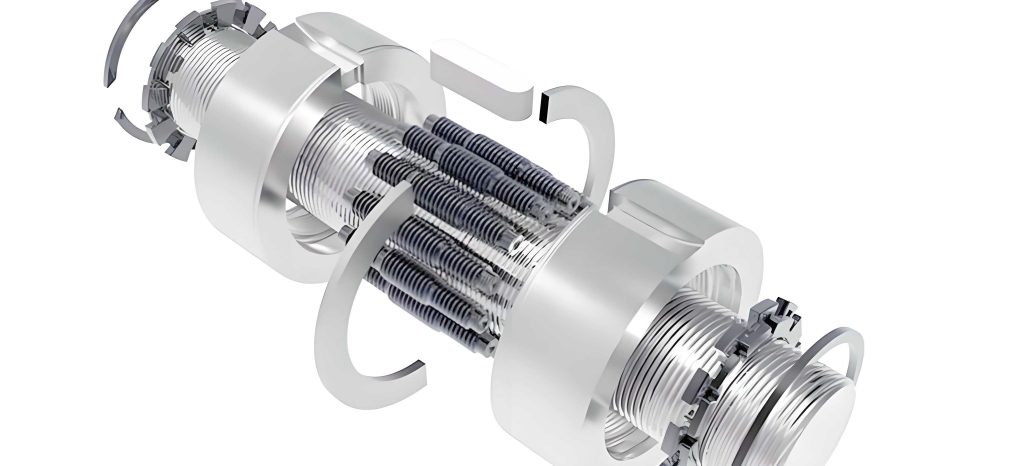
In this paper, a comprehensive static model is developed to elucidate the preload mechanism and analyze the load distribution within this double-nut planetary roller screw assembly. The model accounts for the unique loading states of the dual nuts, their corresponding sets of rollers, and the screw thread engagements under both preload-only and externally loaded conditions. A detailed methodology for calculating forces and elastic deformations is presented, providing a foundational tool for the design and analysis of such systems.
Structural Configuration and Preload Principle
The double-nut planetary roller screw mechanism comprises two independent nut sub-assemblies (Nut #1 and Nut #2) mounted on a common screw. Each sub-assembly includes its own set of planetary rollers, a cage, and a ring gear. The two nuts are in direct contact at their interface. The key to the preload function is a set of shear pins that connect Nut #1 and Nut #2, preventing relative rotation once a preload is established.
The preload is generated as follows: With Nut #2 held fixed and the screw’s rotation constrained, Nut #1 is rotated. Since all threads are right-handed, this rotation causes Nut #1 to translate axially towards Nut #2. Initially, with zero preload ($F_{pre}^0 = 0$), the relative angle $\varphi$ between the nuts is defined as $0^\circ$. Continuing to rotate Nut #1 increases $\varphi$, which axially compresses the screw segment between the two nuts, thereby generating the initial preload force $F_{pre}^0$. Once the desired preload is achieved, the shear pins are installed to permanently lock the relative angle $\varphi$, thus maintaining the preload. The axial elastic displacements of Nut #1 and Nut #2 under preload are denoted as $u_{N1}^0$ and $u_{N2}^0$, respectively.
When an external axial load $F_N$ is applied to Nut #2, the initial equilibrium is disturbed. The preload forces on the nuts change to $F_{pre}^1$ and $F_{pre}^2$, and their elastic displacements become $u_{N1}$ and $u_{N2}$. The force balance and displacement compatibility conditions govern this new state.
Development of the Static Mechanics Model
A spring-based discrete model, analogous to a finite element approach, is constructed to analyze the system. The screw, nuts, and rollers are discretized into axial spring elements representing their bulk stiffness. The thread contacts between the rollers and the nuts, and between the rollers and the screw, are modeled as nonlinear spring elements whose stiffness depends on the contact force itself, following Hertzian contact theory.
The contact stiffness for a nut-roller thread pair is given by:
$$k_{NRm,k} = \frac{F_{NRm,k}}{\delta_{NRm,k}} = \left( \frac{16 F_{NRm,k} E_{NRm}^2 R_{NRm}}{9 \cos\lambda_{NRm} \cos\beta_{NRm}} \right)^{1/3}$$
where $F_{NRm,k}$ and $\delta_{NRm,k}$ are the axial component of contact force and deformation for the $k$-th thread on roller set $m$ ($m=1,2$), $E_{NRm}$ is the equivalent modulus, $R_{NRm}$ is the equivalent radius of curvature, $\lambda_{NRm}$ is the lead angle, and $\beta_{NRm}$ is the thread flank angle. A similar equation defines the screw-roller contact stiffness $k_{SRm,k}$.
The model’s total deformation vector $\boldsymbol{\delta}$ is related to the nodal displacement vector $\mathbf{u}$ through a transformation matrix $\mathbf{A}$:
$$ \boldsymbol{\delta} = \mathbf{A} \mathbf{u} $$
Accounting for boundary conditions (fixed screw end), a reduced system is solved. The equilibrium equation for the unconstrained nodes is:
$$ \mathbf{F}’ = (\mathbf{A}’)^T \mathbf{F}_e = (\mathbf{A}’)^T \mathbf{K} \mathbf{A}’ \mathbf{u}’ $$
where $\mathbf{F}’$ is the applied load vector at nodes (containing preload and external forces), $\mathbf{K}$ is the global stiffness matrix assembling all element stiffnesses, $\mathbf{A}’$ is the reduced transformation matrix, and $\mathbf{u}’$ is the unconstrained nodal displacement vector. The contact forces on individual threads are extracted from the element force vector $\mathbf{F}_e$.
Solution Methodology
The analysis is performed in two sequential stages, as outlined below.
Stage 1: Preload-Only Condition. An iterative algorithm is employed. Starting with an assumed uniform load distribution ($F_{NRm,k} = F_{SRm,k} = F_{pre}^0 / n_T$), the stiffness matrix $\mathbf{K}$ is assembled, and the system equilibrium equation is solved for displacements and updated contact forces. This process iterates until convergence. The final total elastic deflection $\delta = u_{N2}^0 – u_{N1}^0$ is used to find the required nut rotation $\varphi$ and the resulting pin shear force $F_{pin}$:
$$ \varphi = \frac{2\pi}{L_S} \delta, \quad F_{pin} = \frac{F_{pre}^0 L_S}{2\pi r_{pin}} $$
where $L_S$ is the screw lead and $r_{pin}$ is the pin circle radius.
Stage 2: Application of External Load. With the preload deflection $\delta$ known from Stage 1, the application of an external load $F_N$ on Nut #2 introduces a change $\Delta F$ in the nut preloads:
$$ F_{pre}^1 = F_{pre}^0 + \Delta F, \quad F_{pre}^2 = F_{pre}^0 + \Delta F – F_N $$
The displacement compatibility condition must still hold: $u_{N2} – u_{N1} = \delta$. The unknowns $\Delta F$, $\mathbf{u}’$, and all contact forces $F_{NRm,k}$, $F_{SRm,k}$ are found by solving the coupled nonlinear system formed by the equilibrium equations, the stiffness definitions, and the compatibility condition.
Model Validation via Finite Element Analysis
To validate the analytical static model, a 3D nonlinear finite element model of a one-sixth sector (60° segment) of the mechanism was built in ABAQUS. The model included all contact pairs between nuts, rollers, and the screw. Material was set as GCr15 bearing steel. The boundary conditions fixed the screw at one end and applied symmetry constraints. A small interference at the nut-nut interface simulated the preload. Contact was defined as frictionless surface-to-surface interaction.
| Parameter | Screw | Roller | Nut |
|---|---|---|---|
| Pitch Diameter $d_i$ (mm) | 19.5 | 6.5 | 32.5 |
| Flank Angle $\beta_i$ (°) | 45 | 45 | 45 |
| Number of Starts $n$ | 5 | 1 | 5 |
| Pitch $P$ (mm) | 2 | 2 | 2 |
| Rollers per Nut $n_{roller}$ | — | 6 | — |
| Threads per Roller $n_T$ | — | 15 | — |
For an initial preload $F_{pre}^0 = 2380.1 N$, the load distribution on the threads calculated by the proposed model and the FEA showed excellent agreement, with a maximum error below 4%. When an external load was applied, the predicted preload force on Nut #1 ($F_{pre}^1$) from the analytical model matched the FEA results with an error less than 2% across a load range. This validates the accuracy and feasibility of the developed static model for the double-nut planetary roller screw.
Analysis of the Preload Mechanism and Load Distribution
Using the validated model, the behavior of the double-nut planetary roller screw mechanism is investigated.
Preload-Only Condition
The relationship between initial preload ($F_{pre}^0$), required nut rotation ($\varphi$), and pin shear force ($F_{pin}$) is foundational. Due to the nonlinear increase in contact stiffness with force, $\varphi$ increases with $F_{pre}^0$ at a decreasing rate. Crucially, a relatively small angular displacement generates a significant axial preload. The pin force is linearly proportional to the preload but is substantially smaller in magnitude.
$$ F_{pin} \propto F_{pre}^0, \quad \text{and} \quad F_{pin} \ll F_{pre}^0 $$
| $F_{pre}^0$ (N) | $\varphi$ (°) | $F_{pin}$ (N) |
|---|---|---|
| 1000 | ~0.21 | ~6.6 |
| 2000 | ~0.37 | ~13.3 |
| 3000 | ~0.51 | ~19.9 |
| 4000 | ~0.63 | ~26.5 |
Under pure preload, the load distribution is symmetric for Nut #1/Roller Set #1 and Nut #2/Roller Set #2. The load on individual threads is not uniform. For Nut #1, threads near the nut-nut interface (right end of the roller) carry higher loads, while for Nut #2, threads near the interface (left end of its roller) carry higher loads. The maximum thread load consistently occurs on the screw-roller interface, not the nut-roller interface.
Behavior Under External Load
Applying an external force $F_N$ to Nut #2 (opposing the preload direction) fundamentally alters the internal force state. The initial preload $F_{pre}^0$ is redistributed. A key finding is that the external load required to completely unload Nut #2 ($F_{pre}^2 = 0$) is significantly larger than the initial preload. For example, with $F_{pre}^0 = 3000 N$, this occurs at $F_N \approx 8572 N$. This high “preload yield” capacity is a direct benefit of the nonlinear stiffness in the double-nut planetary roller screw system.
The forces evolve as follows with increasing $F_N$:
$$ F_{pre}^1 = F_{pre}^0 + \Delta F \quad \text{(increases)}$$
$$ F_{pre}^2 = F_{pre}^0 + \Delta F – F_N \quad \text{(decreases)}$$
$$ F_{pin} = \frac{(F_{pre}^0 + \Delta F) L_S}{2\pi r_{pin}} \quad \text{(increases slightly)}$$
Notably, the shear pin force remains an order of magnitude smaller than the applied external load, validating the pin’s role as a rotation lock rather than a primary load-bearing element.
The load distribution shifts dramatically. The load on Roller Set #1 (associated with Nut #1) increases, while the load on Roller Set #2 decreases. For Nut #1/Roller Set #1, the highest-loaded thread on the nut side remains at the far-right end (away from the interface). On the screw side for Roller Set #1, the distribution pattern changes from a “low-to-high” gradient (under low $F_N$) to a “high-to-low” gradient (when $F_N > F_{pre}^0$), with the maximum load shifting to the far-left end of the engagement zone. This redistribution is critical for assessing fatigue life and contact stress.
Conclusions
This study establishes a comprehensive static model for analyzing the preload mechanism and load distribution in a double-nut planetary roller screw assembly with shear pins. The model successfully integrates the nonlinear stiffness of threaded contacts with the force and displacement compatibility conditions of the dual-nut system. Validation against finite element analysis confirms its accuracy.
The key insights into the preload mechanism of this planetary roller screw configuration are:
- A small relative rotation between the nuts generates a substantial initial preload force. The required locking shear force in the pins is relatively low compared to the preload.
- The system exhibits a high preload retention capability. The external load required to eliminate preload on one nut is much greater than the initial preload value, a consequence of nonlinear contact stiffness.
- Under external load, a dynamic redistribution of preload and thread contact forces occurs. Load is shed from the nut opposing the external force and picked up by the other nut, with significant shifts in the locations of maximum thread load.
This model and the derived understanding provide a vital theoretical foundation for the design, performance prediction, and optimization of preloaded double-nut planetary roller screw mechanisms in high-precision, bidirectional drive applications.