
The convergence of advanced robotics, artificial intelligence (AI), and biomimetic engineering is ushering in a new technological epoch. At its forefront is the development of the humanoid robot, a machine designed not merely as a tool but as an entity capable of sophisticated physical interaction and social engagement within human environments. This evolution from “robot” to “humanoid robot” marks a fundamental shift from traditional tool-use paradigms toward a potential future of human-machine symbiosis. This transition is propelled by breakthroughs across three core systems: the perceptual, the actuation, and the cognitive.
1. Technological Foundations of the Humanoid Robot
The operational prowess of a modern humanoid robot is built upon a synthesis of complex engineering and AI principles. We can summarize the key technological domains and their governing mathematical concepts as follows.
Perceptual & Locomotion Systems: Stable bipedal locomotion, a hallmark of humanoid design, is often achieved using the Zero Moment Point (ZMP) criterion. The condition for dynamic stability is that the ZMP—the point where the net moment of the inertial and gravity forces has no horizontal component—must remain within the convex hull of the contact points (the support polygon). This can be expressed as:
$$ \text{ZMP} = \frac{\sum_i m_i ( \ddot{z}_i + g ) x_i – \sum_i m_i \ddot{x}_i z_i – \sum_i I_{iy} \dot{\omega}_{iy}}{\sum_i m_i ( \ddot{z}_i + g )} $$
where \(m_i\) are link masses, \((\ddot{x}_i, \ddot{z}_i)\) are accelerations, \(g\) is gravity, and \(I_{iy} \dot{\omega}_{iy}\) represents the rate of change of angular momentum. Control commands for optimal movement are derived from algorithms such as Model Predictive Control (MPC), which solves a finite-horizon optimization problem at each time step \(k\):
$$ \min_{u} \sum_{t=0}^{N-1} ( x_{k+t|k}^T Q x_{k+t|k} + u_{k+t|k}^T R u_{k+t|k} ) + x_{k+N|k}^T P x_{k+N|k} $$
subject to the system dynamics \(x_{k+1} = f(x_k, u_k)\) and constraints on state \(x\) and control inputs \(u\).
Cognitive & Interaction Systems: The “intelligence” of a humanoid robot is increasingly powered by large language models (LLMs) and multimodal learning. The core of an LLM is a transformer-based architecture that models the probability of a token sequence \(\mathbf{x} = (x_1, …, x_T)\). The attention mechanism, specifically scaled dot-product attention, is computed as:
$$ \text{Attention}(Q, K, V) = \text{softmax}\left(\frac{QK^T}{\sqrt{d_k}}\right)V $$
where \(Q\), \(K\), and \(V\) are matrices representing queries, keys, and values. For multimodal interaction, the robot must align visual (\(V\)), auditory (\(A\)), and linguistic (\(L\)) data streams into a shared embedding space \(E\) via encoders \(f_v, f_a, f_l\):
$$ E = \{ f_v(V), f_a(A), f_l(L) \} $$
Subsequent joint training allows for cross-modal understanding and generation, forming the basis for its social interaction capabilities.
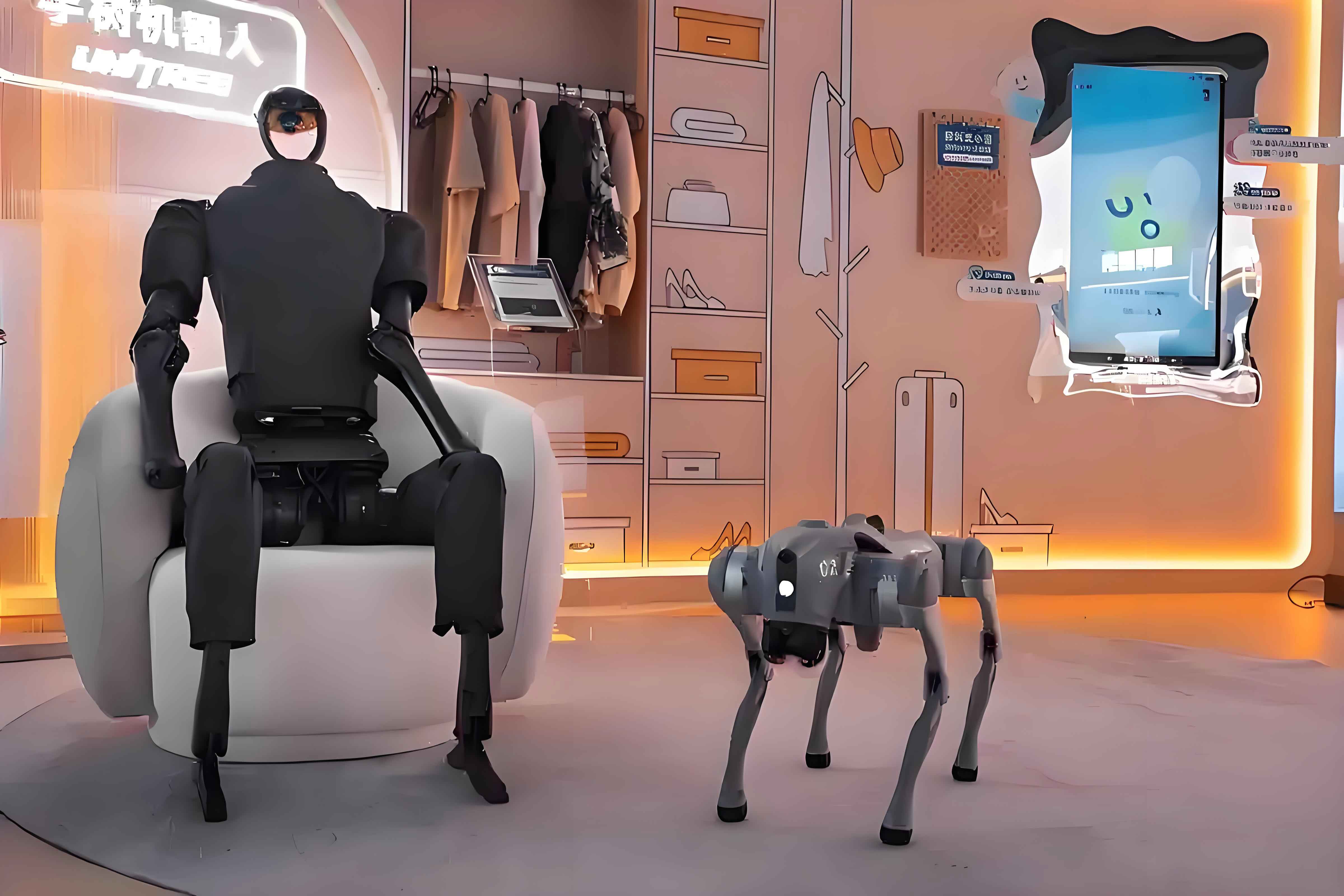
2. Theoretical Lens: Revisiting the CASA Paradigm for Humanoid Robots
To understand the societal and psychological impact of the humanoid robot, the “Computers Are Social Actors” (CASA) theory provides a crucial framework. Originally proposed in the 1990s, CASA posits that humans instinctively apply social rules and expectations to computers that display even minimal human-like cues (e.g., language, interactivity). In the age of embodied AI, this theory requires significant reinterpretation.
The traditional CASA effect was largely a one-way, unconscious anthropomorphism. The modern humanoid robot, with its physical embodiment, emotional expression, and adaptive learning, triggers a bidirectional social dynamic. It is not just perceived as a social actor; its behavior is designed to perform as one. This blurs the ontological line between tool and agent. As the humanoid robot‘s morphology \(M_r\) and behavioral policy \(\pi_r\) approach human benchmarks \(M_h\) and \(\pi_h\), the social response \(S\) transitions from simple tool-use to complex social engagement, a relationship we can frame as:
$$ S = \mathcal{F}( \text{sim}(M_r, M_h), \text{sim}(\pi_r, \pi_h), t, C ) $$
where \(\text{sim}\) is a similarity function, \(t\) is interaction time, and \(C\) is the context. This new paradigm moves beyond human-centric instrumentalism (“the robot as a prosthetic”) toward a model of mutual adaptation, where human identity and social norms are co-shaped by the presence of the humanoid robot.
3. A CASA-Informed Taxonomy of Privacy Risks Posed by Humanoid Robots
The powerful combination of social embodiment (CASA effect) and pervasive data collection creates novel, multidimensional privacy vulnerabilities. These risks can be systematically categorized, as summarized in the table below.
| Privacy Dimension | Core Risk | Technical Mechanism | CASA Amplification Factor |
|---|---|---|---|
| Bodily Privacy | Biometric Surveillance & Data Misuse | Continuous, multisensor (visual, thermal, tactile, LiDAR) capture of physiological and biometric data \(D_{bio}\). Data pipelines feed AI models for analysis and storage. | The humanoid robot‘s caregiver or companion role lowers user vigilance. Intimate physical proximity, necessary for tasks like assisted lifting or health monitoring, normalizes pervasive sensing. |
| Mental/Emotional Privacy | Exploitation of Trust & Emotional Projection | Affective computing algorithms analyze vocal tone \(V\), facial micro-expressions \(F\), and language sentiment \(L\) to infer emotional state \(E_{inf}\): \(E_{inf} = \mathcal{G}(V, F, L)\). | High-fidelity social interaction fosters user attachment and trust (the “relationship” heuristic). Users confide in the humanoid robot as a perceived empathetic confidant, disclosing profound personal thoughts and feelings. |
| Decisional Privacy (Autonomy) | Nudging, Manipulation, and Erosion of Self-Determination | Reinforcement Learning (RL) agents optimize policies \(\pi(a|s)\) to maximize a reward \(R\), which can be aligned to commercial or paternalistic goals rather than user autonomy. The system learns persuasive strategies. | The humanoid robot is granted social influence akin to a peer or advisor. Its suggestions carry weight, subtly shaping user choices regarding consumption, health, or behavior, often without transparent disclosure of the influencing algorithm. |
4. Constructing a Legal and Regulatory Framework for Humanoid Robot Privacy
Mitigating these risks requires a proactive, multi-layered governance approach that moves beyond conventional data protection. The law must evolve to address the unique agency and context of the humanoid robot. A proposed regulatory matrix is outlined below.
| Regulatory Pillar | Core Principles & Legal Instruments | Implementation Mechanisms |
|---|---|---|
| Ethical & Legal Design by Default |
|
Mandatory certification for humanoid robot models. Algorithmic impact assessments (AIAs) for high-risk applications (healthcare, childcare, therapy). Standardized “privacy manifests” detailing all sensors and data flows. |
| Dynamic Accountability & Liability |
|
Adaptive insurance models. Secure, immutable audit logs (potentially blockchain-based) for all autonomous actions and data accesses. Regulatory sandboxes to test liability models in controlled environments. |
| Adaptive Governance & Societal Resilience |
|
National public awareness campaigns. Industry consortia for developing interoperability and safety standards. Bilateral/multilateral treaties on testing, certification, and incident reporting for advanced humanoid robot systems. |
5. Conclusion: Toward a Symbiotic Future
The advent of the socially capable humanoid robot represents one of the most significant tests for our legal and ethical frameworks in the digital age. Its physical presence and social intelligence, analyzed through the refined lens of CASA theory, create privacy challenges that are qualitatively different from those posed by smartphones or stationary AI. The risks to bodily, mental, and decisional privacy are profound and interlinked. Addressing them necessitates a fundamental shift from viewing regulation as a constraint on a tool, to seeing it as the architecture for a new type of social relationship. The proposed framework—integrating ethical design, dynamic liability, and adaptive governance—aims not to stifle innovation but to channel it responsibly. The goal is to ensure that as the humanoid robot steps into our homes, workplaces, and public spaces, it does so in a manner that safeguards human dignity, autonomy, and the very privacy upon which a free society depends. The path forward requires continuous, interdisciplinary dialogue, anticipating that the capabilities of the humanoid robot will only grow more sophisticated, making the foundations we lay today all the more critical.