
The evolution of protected cultivation has been remarkable, with vast expanses of land now dedicated to greenhouse production. This intensive form of agriculture plays a crucial role in ensuring food security and economic stability. However, a persistent bottleneck lies in the harvesting phase, which remains heavily reliant on manual labor, consuming 40% to 50% of the total workforce required for crop production. The rising cost and scarcity of labor have intensified the need for automation. Within this context, robotic harvesters have emerged as a promising solution. The end effector is the critical interface between the robot and the crop, directly responsible for the delicate tasks of locating, grasping, and detaching the fruit. Its performance fundamentally determines the robot’s efficiency, success rate, and, most importantly, its ability to handle produce without damage. This article synthesizes the research and development of end effectors for harvesting key greenhouse crops, analyzing their functional principles, structural designs, and the ongoing challenges that shape future directions.
The core functionality of a harvesting end effector can be decomposed into three sequential modules: Perception and Final Targeting, Grasping and Stabilization, and Fruit Stem Separation. Each module presents unique engineering challenges within the unstructured and cluttered environment of a greenhouse.
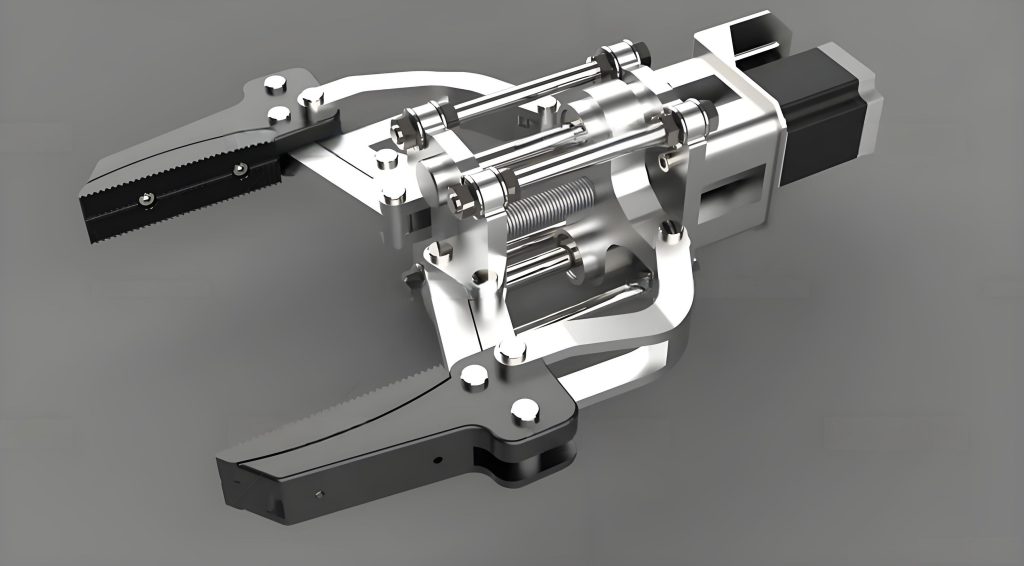
1. Core Functional Modules of a Harvesting End Effector
1.1 Perception and Final Targeting
While the primary robotic vision system guides the manipulator to the approximate fruit location, the end effector often requires its own localized sensing for precise final positioning. This is essential for accurate stem cutting or grasping, especially when the fruit is occluded by leaves or stems from the main camera’s perspective. Common sensors integrated into the end effector include miniature RGB or depth cameras, laser rangefinders, tactile sensors, and proximity switches. These sensors provide real-time feedback for micro-adjustments, ensuring the cutting blade or gripper is correctly aligned with the fruit peduncle (stem). The positional error $\Delta P$ between the tool center point (TCP) of the end effector and the target stem location must be minimized:
$$ \Delta P = \sqrt{(x_t – x_s)^2 + (y_t – y_s)^2 + (z_t – z_s)^2} $$
where $(x_t, y_t, z_t)$ are the coordinates of the TCP and $(x_s, y_s, z_s)$ are the coordinates of the target stem point. An end effector with integrated vision reduces $\Delta P$ to within a few millimeters, which is critical for successful operation.
1.2 Grasping and Stabilization
The grasping mechanism must secure the fruit or its stem firmly enough for separation but gently enough to prevent bruising, cutting, or other damage. The contact pressure $P_c$ is a key metric:
$$ P_c = \frac{F_g}{A_c} $$
where $F_g$ is the gripping force and $A_c$ is the total contact area between the gripper and the fruit. To minimize damage ($P_c < P_{damage}$), strategies aim to maximize $A_c$ using compliant materials or adaptive surfaces. Grasping strategies are broadly categorized as follows:
| Grasping Target | Method | Principle | Advantages | Disadvantages | Typical Crops |
|---|---|---|---|---|---|
| Fruit | Vacuum Suction | Negative pressure via a suction cup or tube creates adhesion. | Fast, low damage, simple control. | Limited holding force; requires relatively smooth, flat surface; fails on highly curved or uneven fruit. | Tomato, Strawberry, Bell Pepper |
| Fruit | Mechanical Gripping (Rigid) | Jaws or fingers close around the fruit body. | High holding force, reliable. | High risk of mechanical damage due to concentrated stress. | Less common for delicate fruit; used for stems. |
| Fruit | Mechanical Gripping (Flexible/Compliant) | Fingers made of soft materials (silicone, rubber) or using adaptive structures (Fin-Ray, tendon-driven) conform to fruit shape. | Larger $A_c$, lower $P_c$, reduced damage, adaptable to size/shape variations. | More complex design and control; may have less absolute gripping force. | Cucumber, Bell Pepper, Tomato |
| Stem | Mechanical Gripping | Jaws clamp the peduncle close to the fruit or plant node. | Avoids fruit contact entirely, eliminating fruit surface damage. | Requires extremely precise targeting; risk of damaging the plant vine. | Cucumber, Strawberry |
1.3 Fruit Stem Separation
Detaching the fruit cleanly from the plant is the final action. The separation force $F_s$ must be applied effectively. Common methods include:
| Separation Method | Principle | Implementation | Advantages | Disadvantages |
|---|---|---|---|---|
| Mechanical Cutting | Shearing the stem with a blade or scissor mechanism. | Motor-driven straight blade, rotary blade, or scissor cutter. | Fast, universally applicable, clean cut. | Requires precise blade-stem alignment; risk of cutting leaves or vines; requires sharp maintenance. |
| Thermal Cutting | Localized heating to sever the stem via burning/melting. | Heated wire or focused laser beam. | Non-contact; can sterilize the cut surface, potentially extending shelf-life. | Slower (requires dwell time); energy-intensive; safety concerns with lasers; may cause tissue damage near cut. |
| Biomimetic Detachment | Mimicking human action: twisting, bending, or pulling to break the stem at the abscission layer. | Rotary motion of the gripper or a combined twist-and-pull action. | Low energy; can be very effective for fruits with a natural abscission layer. | Requires complex, multi-DOF motion sequence; not universal; may exert undesirable forces on the plant. |
The choice of separation method often depends on the biomechanical properties of the fruit stem. The cutting force $F_{cut}$ for a simple blade can be modeled based on stem cross-sectional area $A_{stem}$ and the plant tissue’s shear strength $\tau$: $F_{cut} \approx A_{stem} \cdot \tau$.
2. Crop-Specific End Effector Designs and Analysis
2.1 Cucumber Harvesting End Effectors
Cucumbers present a challenge due to their elongated shape, sensitive skin, and dense foliage. Early and influential work on cucumber harvesting robots featured an end effector combining a suction cup for fruit stabilization, a gripper to clamp the stem, and a heated blade for cutting. This design emphasized a clean, potentially sterilized cut. Performance was hampered primarily by inaccuracies in final stem positioning. Subsequent designs focused on improving gentleness and precision. One approach employed compliant rubber fingers for grasping the fruit body, significantly reducing the risk of skin damage, paired with a simple cutting blade. A secondary, close-up vision camera on the end effector was used for final stem location, improving cutting accuracy. Another innovative direction explored non-contact laser cutting, where the stem is severed by a focused high-energy beam. The laser power $P_{laser}$ required is a function of the energy needed to vaporize the stem material:
$$ E_{required} = m \cdot [C_p \Delta T + L_v] $$
$$ P_{laser} \cdot t_{dwell} \approx E_{required} $$
where $m$ is the mass of stem material to be removed, $C_p$ is specific heat, $\Delta T$ is the temperature rise to vaporization, $L_v$ is the latent heat of vaporization, and $t_{dwell}$ is the laser exposure time. While eliminating contact and spatial constraints, this method is slower due to the necessary $t_{dwell}$.
2.2 Strawberry Harvesting End Effectors
Strawberries, often grown in elevated troughs or tabletops, are a primary target for automation due to their high value and labor-intensive harvest. Early Japanese designs utilized a suction tube to draw the berry into the end effector, followed by a twisting or cutting action to sever the stem. This evolved into systems using a vacuum cup for primary fruit acquisition, complemented by a clamping and cutting gripper. Research highlighted that failure was often caused not by the end effector itself, but by the primary vision system missing the fruit or by the manipulator displacing the target during approach. To address the stringent single-berry positioning requirements, a clever integrated cutting-gripping mechanism was developed. This design features a blade on one finger and a matching slot on the other. When closed to cut the stem, the blade enters the slot, trapping and holding the berry securely in a single action. To dramatically improve throughput, a multi-berry harvesting end effector was conceived. This design uses a comb-like structure with guiding slots and a closing mechanism to simultaneously harvest several berries in a single linear motion, trading individual precision for batch efficiency. The potential time saving is significant: if harvesting $n$ berries takes time $T_{single}(n) \approx n \cdot t_{approach} + n \cdot t_{pick}$, a batch harvester might achieve $T_{batch}(n) \approx t_{approach} + t_{pick}$.
2.3 Sweet Pepper (Bell Pepper) Harvesting End Effectors
Sweet peppers grow in complex, occluded clusters, making them one of the most difficult crops for robotic harvesting. Research has produced contrasting end effector philosophies. A scissor-type cutter, while mechanically simple, proved too bulky to navigate dense foliage effectively. Two distinct designs from European research provide a valuable comparison: The “Fin Ray” end effector utilizes two adaptive, compliant grippers based on the Fin Ray® structure (which bends inwards under pressure, conforming to object shape) to gently envelop the fruit. A separate cutting mechanism then severs the stem. The “Lip-type” end effector uses a suction cup to pull the pepper forward, followed by two enclosing “lips” that slice the stem from both sides as they close. Performance evaluations revealed a critical trade-off: the Fin Ray design achieved a higher fruit acquisition success rate (93% vs 61% in prepared environments) due to its gentle, conforming grasp. However, the Lip-type design had a higher successful cutting rate once the fruit was acquired (76% vs 29%). This underscores that a successful end effector must optimize the entire sequence, not just one sub-function.
2.4 Tomato Harvesting End Effectors
Tomato harvesting robots often employ a combination of suction and gripping, reflecting the fruit’s relatively robust but still damage-prone nature. Early designs used a suction cup to pull the tomato away from the cluster, followed by mechanical fingers to grasp it and twist off the stem. Later iterations improved the suction mechanism with multi-bellows designs for better adhesion on curved surfaces and used materials like ABS to constrain finger motion for more controlled gripping. A notable design shift is a rotary plucking gripper, which aims to replicate a swift human picking motion. Perhaps the most biomimetic approach is a system employing a suction cup for initial attachment, followed by an inflatable bladder inside a rotating sleeve to grip and twist the fruit. This combination aims for a natural abscission layer separation. The torque $\tau_{twist}$ required for separation can be related to the fruit’s weight $m g$ and the effective radius $r$ of the grip, considering the stem’s torsional strength: $\tau_{twist} \propto m g r$.
2.5 End Effectors for Other Crops
The principles developed for major crops are being adapted to others. For kiwifruit, which has a relatively strong stem, a successful end effector uses a simple two-finger gripper to clasp the fruit and then rotates the entire wrist to twist and break the stem, simulating manual harvest. For eggplant, designs often return to the fundamental integrated grip-and-cut mechanism, sometimes augmented with additional ultrasonic sensors on the end effector for better final targeting in low-light or occluded conditions.
3. Critical Challenges and Limitations
Despite decades of research, greenhouse harvesting robots and their end effectors remain predominantly in the experimental phase. Three interconnected barriers impede widespread commercialization:
1. Poor Adaptability to Complex, Unstructured Environments: Most end effectors require a significant degree of crop preparation (e.g., simplified pruning, training, or leaf removal) or operate reliably only under highly controlled laboratory conditions. The real greenhouse environment, with its variable lighting, overlapping leaves, dangling stems, and densely packed fruit, presents extreme challenges for both perception and precise physical interaction. An end effector must be part of a system that can robustly handle this variability.
2. Low Operational Efficiency and Success Rate: Harvest cycle times for single fruit often range from 20 to over 60 seconds, with success rates frequently below 85% in real-world tests. This performance is currently inferior to that of a skilled human worker. The efficiency bottleneck lies not only in the end effector‘s action sequence but also in the time consumed by the manipulator’s movement and the processing time for sensor data. Failed attempts due to misdetection, misalignment, or environmental interference further reduce effective throughput.
3. High System Cost: The integration of advanced sensors (cameras, lasers), specialized actuators, and custom-manufactured compliant mechanisms results in a high unit cost for the robotic system and its end effector. This economic barrier is prohibitive for most growers, especially when the robot’s performance and reliability do not yet guarantee a clear return on investment compared to seasonal labor.
4. Future Research Directions and Conclusions
The path forward for greenhouse harvesting robot end effectors requires advancements on two fronts: technological innovation and agricultural adaptation.
Technological Advancements for the End Effector:
- Enhanced Perception: Integrating multi-modal sensing (e.g., combining RGB-D, thermal, and tactile feedback) directly into the end effector for robust target identification and slip/force detection in all lighting and occlusion conditions.
- Intelligent, Adaptive Grasping: Further development of soft robotics, variable stiffness actuators, and machine learning-based grip control to handle a wide variety of shapes, sizes, and ripeness levels with guaranteed low damage.
- Fast and Reliable Separation: Research into hybrid methods (e.g., micro-vibration assisted cutting) or optimized biomimetic actions that are both swift and gentle on the plant.
- System-Level Co-design: Optimizing the end effector not in isolation but as an integral part of the manipulator, vision system, and path planning algorithm to minimize total cycle time and maximize reliability.
Agricultural Adaptation:
Parallel efforts in plant science and cultivation are equally critical. The future may see the development of greenhouse crops and training systems specifically designed for robotic harvesting (“robot-ready” cultivars). This could involve breeding for more uniform fruit placement, stronger stems that resist accidental damage, or more obvious visual features. Modifying plant architecture through pruning and training to present fruit in accessible, uncluttered “pick zones” would drastically simplify the task for both the robot’s vision and its end effector.
In conclusion, the end effector is the decisive component in translating robotic potential into practical greenhouse harvesting. While significant progress has been made, moving from promising prototypes to robust, cost-effective commercial solutions requires sustained, interdisciplinary collaboration between robotics engineers, computer scientists, and agricultural biologists. The goal is to create end effectors and integrated robotic systems that are not just capable of picking fruit, but can do so with the speed, reliability, and care necessary to compete in modern agriculture.