
In recent years, the development of intelligent robots has become increasingly important for applications such as earthquake rescue, resource exploration, and missions in hazardous environments. Among various robotic platforms, legged robots, particularly quadruped bionic robots, offer superior adaptability to unstructured terrains compared to wheeled or tracked systems due to their discrete foot placement and ability to navigate discontinuous paths. This design focuses on a wireless-controlled quadruped bionic robot utilizing an STM32 microcontroller, which achieves stable locomotion through dynamic modeling and gait planning. The integration of Lagrangian dynamics establishes mathematical relationships between joint angles and leg movements, enabling precise motion control. Furthermore, gait analysis based on kinematic characteristics ensures coordinated and stable walking. Experimental results demonstrate that this bionic robot can perform various actions, including stable walking, turning, twisting, arm lifting, swimming, and push-ups, all via wireless control. This research highlights the potential of quadruped bionic robots for real-world applications, emphasizing the role of advanced control strategies in enhancing robotic autonomy and functionality.
The overall design of the quadruped bionic robot incorporates mechanical, control, and sensor components. The mechanical structure is built from lightweight aluminum alloy to reduce weight while maintaining rigidity, crucial for dynamic movements. The control system centers on an STM32F103RBT6 microcontroller, chosen for its high-speed processing and precision, coupled with a 24-channel servo control board to manage eight LDX-218 digital servos that actuate the robot’s legs. Wireless communication is facilitated by a Bluetooth module, allowing remote operation via a PS2手柄 (handheld controller). Power is supplied by a high-capacity lithium battery, providing up to 150 minutes of operation. This modular approach ensures flexibility and scalability in the bionic robot’s design, enabling future enhancements such as additional sensors or adaptive algorithms.
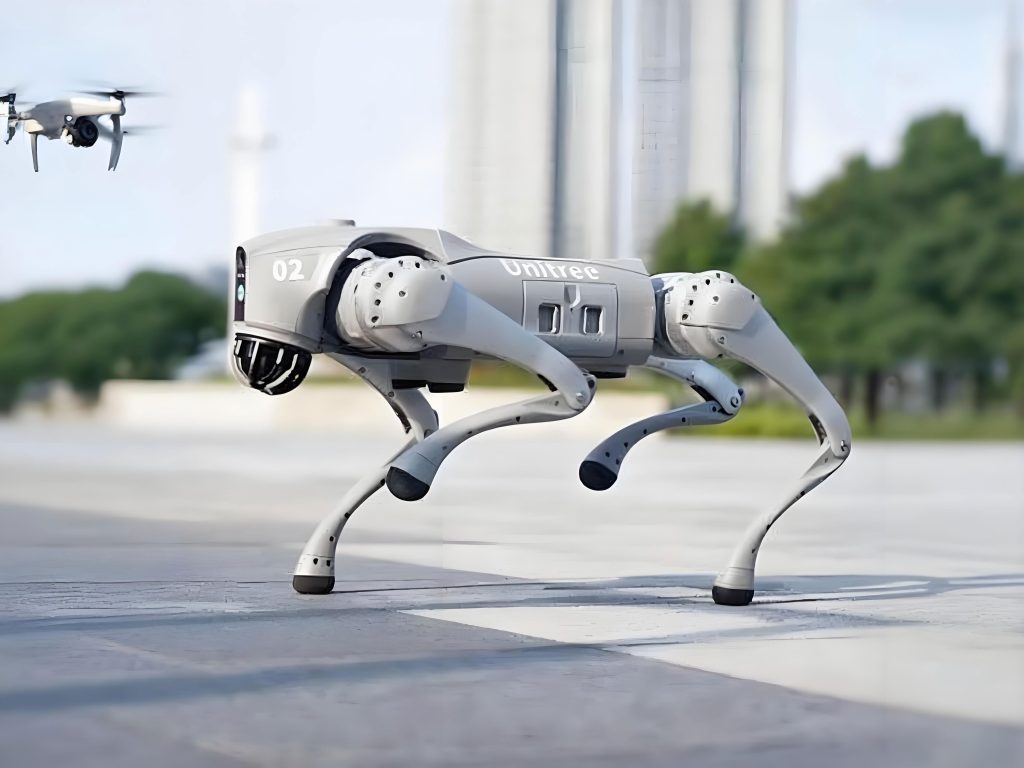
To achieve stable walking, dynamic modeling of the bionic robot’s leg structure is essential. Each leg is modeled as a two-link rigid body system with two rotational degrees of freedom, resulting in an 8-degree-of-freedom system for the entire robot. Using Lagrangian dynamics, the relationship between joint torques and leg motion is derived. In a Cartesian coordinate system, where the x-direction represents forward motion, y is lateral, and z is vertical, the leg parameters include link masses \(m_1\) and \(m_2\), lengths \(L_1\) and \(L_2\), moments of inertia \(I_1\) and \(I_2\), and angular displacements \(\theta_1\) and \(\theta_2\). The kinetic energy \(E_k\) and potential energy \(E_p\) are expressed as:
$$E_k = \sum_{i=1}^{2} \frac{1}{2} m_i v_i^2 + \sum_{i=1}^{2} \frac{1}{2} I_i \omega_i^2 = \sum_{i=1}^{2} \frac{1}{2} m_i L_i^2 \dot{\theta}_i^2 + \sum_{i=1}^{2} \frac{1}{2} I_i \dot{\theta}_i^2,$$
$$E_p = -\sum_{i=1}^{2} m_i g z_i,$$
where \(v_i\) and \(\omega_i\) are linear and angular velocities, and \(g\) is gravitational acceleration. The Lagrangian function \(L = E_k – E_p\) leads to the joint torque \(T\) via the Euler-Lagrange equation:
$$T = \frac{d}{dt} \left( \frac{\partial L}{\partial \dot{\theta}_i} \right) – \frac{\partial L}{\partial \theta_i} \in \mathbb{R}^{2 \times 1}.$$
This model allows for calculating the required torques based on leg motion, forming the foundation for control algorithms in the bionic robot. The dynamics account for nonlinearities and coupling effects, which are critical for precise movement in unstructured environments.
Gait planning is a key aspect of ensuring stable locomotion for the bionic robot. Quadruped robots typically employ gaits such as walk, trot, pace, and bound, each characterized by different phase relationships between support and swing phases. For this bionic robot, the trot gait is selected due to its balance of speed and stability. In the trot gait, diagonal legs move synchronously, with a phase difference of 0.5 between support and swing phases, and a duty factor \(\beta = 0.5\). This gait minimizes energy consumption while maintaining a high stability margin, making it ideal for adaptive walking. The gait is defined by a periodic coordination of joint trajectories, which are planned using the dynamic model to avoid slippage and ensure smooth transitions. Table 1 summarizes the characteristics of common quadruped gaits, emphasizing the advantages of the trot for this bionic robot design.
| Gait Type | Phase Difference | Duty Factor (\(\beta\)) | Stability | Speed |
|---|---|---|---|---|
| Walk | 0.25 | > 0.5 | High | Low |
| Trot | 0.5 | 0.5 | Medium | Medium |
| Pace | 0.5 | 0.5 | Low | High |
| Bound | 0.5 | < 0.5 | Low | High |
The control module design for the bionic robot leverages the STM32 microcontroller to execute gait plans and manage servo movements. Upon activation, the PS2手柄 sends wireless commands via Bluetooth to the STM32, which decodes the signals and coordinates the servo control board. The LDX-218 servos receive PWM signals with pulse widths ranging from 0.5 to 2.5 ms, corresponding to angular positions from 0° to 180°. This linear relationship ensures precise control over leg movements. The control algorithm integrates feedback from the servos to adjust trajectories in real-time, enhancing the bionic robot’s adaptability. The overall control flow can be represented as a state machine, where each action group—such as walking or turning—is pre-programmed into the microcontroller. This setup allows the bionic robot to perform complex sequences without external intervention, showcasing its autonomy.
Hardware components of the bionic robot include the mechanical frame, servos, and communication modules. The frame is constructed from 1–2 mm thick aluminum alloy, optimized for lightweight yet robust performance. The LDX-218 digital servos provide a torque of 17 kg·cm at 7.4 V, with a response time of 0.16 s per 60° rotation, ensuring rapid and accurate movements. Key parameters of the servos are listed in Table 2, highlighting their suitability for dynamic bionic robot applications. The Bluetooth module operates within a 10-meter range, using frequency hopping to mitigate interference and ensure reliable data transmission. This hardware synergy enables the bionic robot to withstand mechanical stresses while maintaining efficient wireless control.
| Parameter | Value |
|---|---|
| Dimensions (mm) | 40 × 20 × 40.5 |
| Weight (g) | 60 |
| Accuracy | 0.3° |
| Rotation Angle | 180° |
| Voltage | 7.4 V |
| Torque | 17 kg·cm |
Experimental results demonstrate the bionic robot’s capabilities across various motion patterns. In walking tests, the robot achieved stable forward and backward locomotion at approximately 5 cm/s using the trot gait. Turning experiments showed that the bionic robot can perform in-place rotations, essential for navigating tight spaces. Complex actions, such as arm lifting, swimming, and push-ups, were successfully executed via wireless commands. For instance, the arm lifting action allows the bionic robot to manipulate objects, while the swimming motion mimics aquatic locomotion, expanding its applicability to amphibious environments. These tests validate the effectiveness of the dynamic modeling and gait planning, with the bionic robot maintaining balance and coordination throughout. Table 3 summarizes the performance metrics of key actions, underscoring the versatility of this bionic robot platform.
| Action | Speed (cm/s) | Stability | Applications |
|---|---|---|---|
| Walking | 5 | High | Terrain traversal |
| Turning | N/A (in-place) | Medium | Obstacle avoidance |
| Arm Lifting | N/A | High | Object manipulation |
| Swimming | 3 | Medium | Aquatic missions |
| Push-ups | N/A | High | Stability training |
Despite these successes, several areas for improvement in the bionic robot design are noted. First, energy efficiency remains a challenge due to frequent accelerations and decelerations in leg movements, leading to heat generation and reduced battery life. Implementing elastic leg mechanisms or lighter materials could mitigate this issue. Second, the two-link leg structure, while simple, limits adaptability to highly irregular terrain; adding more degrees of freedom or optimizing foot design could enhance traction and stability. Third, the current system lacks advanced sensors for environmental perception, which is crucial for autonomous operation in complex scenarios. Future iterations of the bionic robot could integrate LiDAR, cameras, or inertial measurement units to enable real-time adaptation. Lastly, while laboratory tests are promising, field experiments in unstructured environments are necessary to validate the bionic robot’s robustness under real-world conditions.
In conclusion, this research presents a comprehensive design and experimental study of a quadruped bionic robot based on an STM32 microcontroller. Through Lagrangian dynamic modeling, the relationship between joint actuation and leg motion was formalized, enabling precise control. Gait planning, particularly the adoption of the trot gait, ensured stable and coordinated locomotion. The hardware integration of lightweight materials, high-torque servos, and wireless communication facilitated a range of actions, from basic walking to complex maneuvers. Experiments confirmed the bionic robot’s ability to perform reliably under wireless control, highlighting its potential for applications in disaster response, exploration, and hazardous environment operations. Future work will focus on enhancing energy efficiency, terrain adaptability, and sensor-based autonomy, further advancing the capabilities of quadruped bionic robots. The iterative development of such bionic systems underscores their growing importance in robotics, with this study contributing to the foundational knowledge required for next-generation intelligent machines.
The mathematical framework for the bionic robot can be extended to include more complex dynamics, such as ground reaction forces and compliance effects. For example, the equation of motion for a single leg can be generalized as:
$$M(\theta) \ddot{\theta} + C(\theta, \dot{\theta}) \dot{\theta} + G(\theta) = T,$$
where \(M\) is the mass matrix, \(C\) represents Coriolis and centrifugal terms, and \(G\) is the gravitational vector. This formulation allows for simulation and optimization of the bionic robot’s movements in software before hardware implementation. Additionally, the control strategy can incorporate PID (Proportional-Integral-Derivative) controllers for each joint, with gains tuned based on the dynamic model. The error function for joint \(i\) is defined as:
$$e_i(t) = \theta_{i, \text{desired}}(t) – \theta_{i, \text{actual}}(t),$$
and the control input \(u_i(t)\) is given by:
$$u_i(t) = K_p e_i(t) + K_i \int_0^t e_i(\tau) d\tau + K_d \frac{de_i(t)}{dt},$$
where \(K_p\), \(K_i\), and \(K_d\) are tuning parameters. This approach enhances the bionic robot’s accuracy in following planned trajectories, especially when external disturbances are present.
Furthermore, the gait optimization for the bionic robot can be formulated as a minimization problem. For instance, to maximize stability during walking, the cost function \(J\) might include terms for energy consumption and stability margin:
$$J = \int_0^T \left( \alpha \sum_{i=1}^8 T_i^2 + \beta (1 – S(t))^2 \right) dt,$$
where \(T\) is the gait period, \(T_i\) are joint torques, \(S(t)\) is the instantaneous stability margin (e.g., based on the center of pressure), and \(\alpha\) and \(\beta\) are weighting factors. Solving this using numerical methods can yield optimized gait parameters for the bionic robot, improving performance across different terrains. Such advanced techniques highlight the interdisciplinary nature of bionic robot development, merging mechanics, control theory, and computer science.
In terms of hardware advancements, future versions of the bionic robot could employ hybrid actuation systems, combining electric servos with pneumatic or hydraulic elements for greater force output. The use of composite materials, such as carbon fiber, could further reduce weight while increasing durability. Additionally, integrating machine learning algorithms would allow the bionic robot to learn from experience, adapting its gaits to unknown environments autonomously. For example, reinforcement learning could be applied to optimize walking strategies based on sensory feedback, making the bionic robot more resilient and intelligent. These innovations align with broader trends in robotics, where bionic designs inspired by nature lead to more efficient and capable systems.
The societal impact of quadruped bionic robots is significant, as they can perform tasks that are dangerous or inaccessible to humans. In search-and-rescue operations, a bionic robot could navigate rubble to locate survivors, while in agriculture, it might traverse uneven fields for monitoring crops. The wireless control capability extends its utility to remote or confined spaces, such as nuclear facilities or underwater pipelines. As technology progresses, the cost-effectiveness of such bionic robots is likely to improve, enabling widespread adoption. This study contributes to that trajectory by demonstrating a practical and controllable platform, paving the way for more sophisticated bionic robot applications in diverse industries.
To summarize, the design and experimentation of this STM32-based quadruped bionic robot underscore the importance of integrating dynamic modeling, gait planning, and robust control. The successful implementation of various motion patterns via wireless commands validates the approach, while identified areas for improvement guide future research. By continuing to refine these systems, we can unlock the full potential of bionic robots for enhancing human safety and productivity, ultimately creating machines that seamlessly interact with complex environments. The journey toward fully autonomous bionic robots is ongoing, and this work represents a meaningful step forward in that endeavor.