
In recent years, the increasing frequency of natural disasters has elevated the risks faced by rescue personnel, prompting a shift towards robotic solutions for hazardous missions. To address this, we have developed a versatile quadruped robot dog designed to navigate complex terrains and perform exploration tasks in disaster scenarios. This robot dog aims to replace human responders in dangerous environments, ensuring safety while enabling efficient data collection and辅助救援. Our design focuses on high stability, adaptability, and integration of advanced sensors, making it a robust tool for search and rescue operations. This article details the mechanical design, gait analysis, and sensor technologies of the robot dog, emphasizing its potential in real-world applications.
The core of our robot dog lies in its mechanical structure, which features an 8-degree-of-freedom (DOF) configuration with an elbow-knee leg design arranged in an X-pattern. This configuration enhances stability and allows for agile movement across various surfaces. We utilized SolidWorks for 3D modeling to create a detailed virtual prototype, ensuring precise component alignment and weight distribution. The materials were selected for strength and lightness: the main body frame is constructed from aluminum alloy, while the leg bones are made of carbon fiber tubes. For instance, the thigh bone has an outer diameter of 20 mm, and the calf bone has an outer diameter of 15 mm. A rubber sleeve covers the calf bone to increase ground friction, improving traction during locomotion. High-torque servo motors are employed at the hip and knee joints, enabling powerful and controlled movements. To validate the design, we imported the model into ADAMS for dynamic simulation, where constraints, driving functions, friction forces, and contact parameters were defined. The simulation environment included a workspace platform and gravity effects, allowing us to analyze the robot dog’s behavior under realistic conditions.
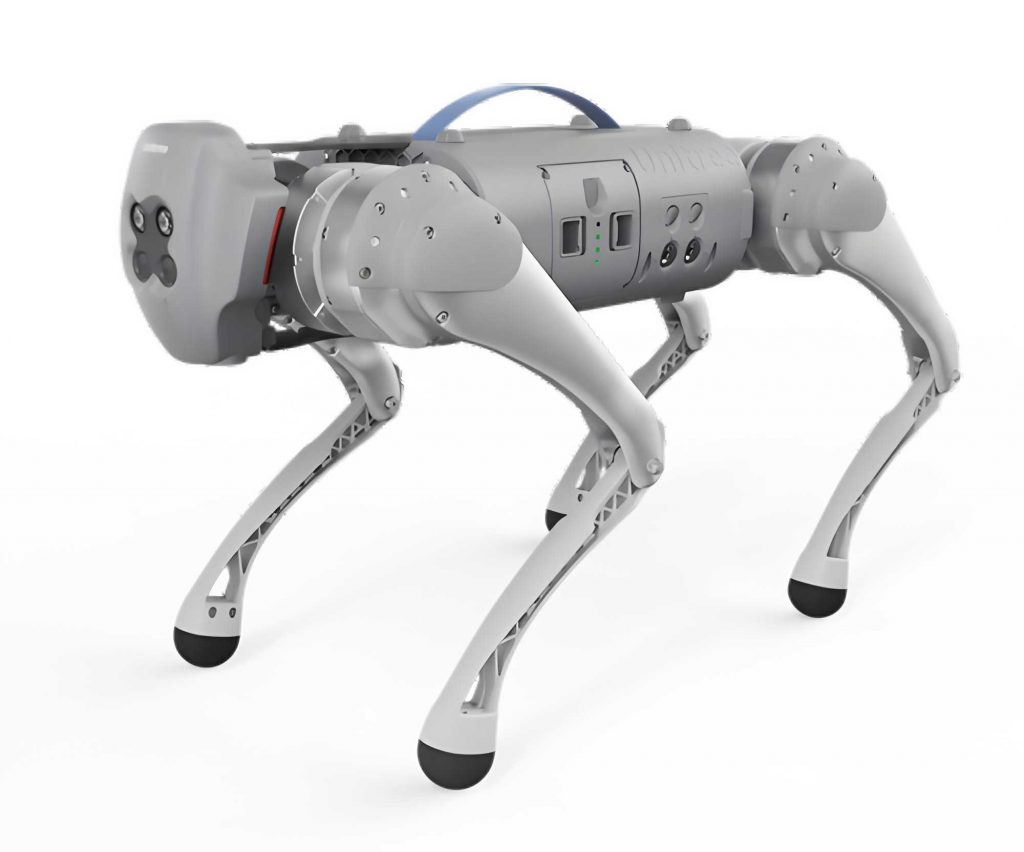
In ADAMS, we established a virtual model of the quadruped robot dog to simulate its walking gait. The driving functions for the joints were based on sinusoidal and half-wave functions, optimized for the elbow-knee leg design. For the hip joints, the rotation angles are given by:
$$ \theta_{\text{hip, LF}} = 9.42 \times \frac{2\pi}{360} \sin\left(\frac{2\pi t}{0.8} + \frac{\pi}{2}\right) $$
$$ \theta_{\text{hip, LR}} = 9.42 \times \frac{2\pi}{360} \sin\left(\frac{2\pi t}{0.8} – \frac{\pi}{2}\right) $$
For the knee joints, we used a combination of sinusoidal and absolute functions to achieve the desired motion:
$$ \theta_{\text{knee, LF}} = -\frac{5.23 \times 2\pi / 360}{2} \sin\left(\frac{2\pi t}{0.8}\right) – \left| \frac{5.23 \times 2\pi / 360}{2} \sin\left(\frac{2\pi t}{0.8}\right) \right| $$
$$ \theta_{\text{knee, LR}} = -\frac{5.23 \times 2\pi / 360}{2} \sin\left(\frac{2\pi t}{0.8} + \pi\right) – \left| \frac{5.23 \times 2\pi / 360}{2} \sin\left(\frac{2\pi t}{0.8} + \pi\right) \right| $$
These functions ensure smooth joint movements, minimizing jerks and enhancing stability. The simulation results demonstrated that the robot dog’s center of mass remained largely stable during forward motion, with only minor lateral deviations during initiation. The trajectories of the hip and knee joints were also平稳, confirming the effectiveness of the driving functions. This stability is crucial for the robot dog to operate reliably in uneven terrains. Table 1 summarizes the key parameters of the joint驱动 functions used in the simulation.
| Joint | Function Type | Amplitude (degrees) | Period (s) | Phase Shift |
|---|---|---|---|---|
| Hip (Left Front) | Sinusoidal | 9.42 | 0.8 | +π/2 |
| Hip (Left Rear) | Sinusoidal | 9.42 | 0.8 | -π/2 |
| Knee (Left Front) | Half-wave | 5.23 | 0.8 | 0 |
| Knee (Left Rear) | Half-wave | 5.23 | 0.8 | π |
Gait analysis is fundamental to the locomotion of the quadruped robot dog. We adopted a diagonal gait, which is a static gait known for its efficiency and stability. In this gait, legs on diagonals move synchronously: first, the left front and right rear legs step forward, followed by the right front and left rear legs. This sequence minimizes重心 adjustments and maximizes static stability margin. The stability margin is defined as the minimum distance from the projection of the robot dog’s center of mass onto the ground plane to the edges of the support polygon formed by the three grounded legs. Mathematically, if the projection point is M and the support triangle has vertices A, B, and C, the stability margin S is:
$$ S = \min(d(M, AB), d(M, BC), d(M, CA)) $$
where \( d(M, AB) \) is the perpendicular distance from M to line AB. We optimized the步态顺序 to achieve the highest stability margin. Through simulation, we determined that starting with the left front leg, followed by the right rear, right front, and left rear, yields the best longitudinal and lateral stability. The分解动作 of the robot dog during walking can be described in five phases: (a) initial standing posture, (b) lifting left front leg, (c) lifting right rear leg, (d) lifting left rear leg, and (e) lifting right front leg. This cyclic process ensures continuous forward motion while maintaining balance. Table 2 compares different gait types for the robot dog, highlighting the advantages of the diagonal gait.
| Gait Type | Stability | Speed | Energy Efficiency | Suitability for Rough Terrain |
|---|---|---|---|---|
| Diagonal Gait | High | Moderate | High | Excellent |
| Trot Gait | Moderate | High | Moderate | Good |
| Pace Gait | Low | High | Low | Poor |
| Walk Gait | Very High | Low | Very High | Excellent |
To enhance the adaptability of the robot dog, we incorporated a six-degree-of-freedom robotic arm and a tracked tank底盘, allowing it to switch between legged and tracked locomotion modes. This hybrid design enables the robot dog to traverse diverse terrains, such as rocky surfaces, debris, or muddy areas, where单一 locomotion may fail. The robotic arm can be used for manipulation tasks, such as moving obstacles or retrieving samples, further extending the capabilities of the robot dog in disaster scenarios.
Sensor integration is a critical aspect of the robot dog, enabling environmental analysis and生命体 detection. We equipped the robot dog with a multi-sensor matrix, including gas detectors, sound recognition modules, image采集 systems, and real-time positioning units. The gas detection module identifies toxic gases common in disaster sites, such as carbon monoxide or methane, protecting救援 personnel from exposure. Table 3 lists the gas sensors used in the robot dog, along with their detection ranges and响应 times.
| Sensor Type | Target Gas | Detection Range (ppm) | Response Time (s) | Accuracy |
|---|---|---|---|---|
| MQ-7 | Carbon Monoxide | 10-10000 | <30 | ±5% |
| MQ-4 | Methane | 300-10000 | <20 | ±10% |
| MQ-135 | Ammonia, Sulfide | 10-1000 | <40 | ±15% |
| DHT-22 | Temperature/Humidity | N/A | <2 | ±0.5°C |
For生命体识别, we combined traditional image recognition with thermal imaging技术. The robot dog uses a camera module for visible-light imaging and an MLX90640 sensor for thermal imaging. Thermal imaging is particularly effective in low-visibility conditions, such as smoke-filled or dark environments, as it detects infrared radiation emitted by objects. To process thermal images, we applied the Canny edge detection algorithm, which involves several steps: Gaussian filtering to reduce noise, gradient calculation using Sobel operators, non-maximum suppression, and hysteresis thresholding. Mathematically, the Gaussian filter is applied as:
$$ G(x,y) = \frac{1}{2\pi\sigma^2} e^{-\frac{x^2 + y^2}{2\sigma^2}} $$
where \( \sigma \) is the standard deviation. The gradient magnitude \( M \) and direction \( \theta \) are computed as:
$$ M = \sqrt{G_x^2 + G_y^2}, \quad \theta = \arctan\left(\frac{G_y}{G_x}\right) $$
Here, \( G_x \) and \( G_y \) are the gradients in the x and y directions, respectively. The Canny algorithm then identifies edges by tracking local maxima in the gradient direction, producing清晰 contours of objects, including potential survivors. This dual imaging approach allows the robot dog to perform robust生命体搜索 under varying conditions. Additionally, sound recognition modules enable the detection of human voices or distress signals, further enhancing搜救 accuracy.
Communication and localization are vital for the robot dog to relay information back to a command center. We integrated北斗 positioning modules for real-time location tracking, even in GPS-denied environments.图传 modules transmit video feeds from the cameras, while远程通信 modules ensure stable data transfer over long distances. This setup forms an intelligent搜救物联网 platform, where the robot dog acts as a mobile node collecting and sending critical data. The data fusion from multiple sensors enables comprehensive environmental analysis, such as mapping gas distributions or identifying safe paths, facilitating科学准确的救援 decisions.
The control system of the robot dog is based on a stability margin optimization principle. We implemented a对角步态 controller that adjusts joint angles in real-time to maintain balance. The controller uses feedback from inertial measurement units (IMUs) and force sensors on the feet to compute the stability margin and modify the gait parameters accordingly. The objective function for optimization can be expressed as:
$$ \max S(\theta_1, \theta_2, \dots, \theta_8) $$
subject to joint limits and dynamics constraints, where \( \theta_i \) are the joint angles. This adaptive control allows the robot dog to navigate slopes, stairs, or uneven surfaces without tipping over. Simulation studies in ADAMS confirmed that the robot dog can maintain a stability margin of at least 50 mm during normal walking, which is sufficient for most disaster terrains.
In terms of power management, the robot dog is equipped with high-capacity lithium-polymer batteries, providing up to 4 hours of continuous operation. The power consumption of each component is optimized through efficient motor drivers and low-power sensor circuits. Table 4 summarizes the power specifications of key subsystems in the robot dog.
| Subsystem | Voltage (V) | Current (A) | Power (W) | Operating Time (h) |
|---|---|---|---|---|
| Servo Motors (8x) | 12 | 2.5 | 30 | 3.5 |
| Main Controller | 5 | 1.0 | 5 | 4.0 |
| Sensor Array | 3.3 | 0.5 | 1.65 | 4.0 |
| Communication Modules | 5 | 0.8 | 4 | 3.8 |
| Total (Average) | 12 | 3.2 | 38.4 | 4.0 |
Future enhancements for the robot dog include integrating artificial intelligence algorithms for autonomous navigation and decision-making. Machine learning models can be trained to recognize specific disaster scenarios, such as collapsed buildings or fire zones, enabling the robot dog to adapt its behavior accordingly. Additionally, swarm robotics approaches could allow multiple robot dogs to collaborate, covering larger areas and performing coordinated tasks. The modular design of the robot dog facilitates easy upgrades, such as adding new sensors or improving computational hardware.
In conclusion, our quadruped robot dog represents a significant advancement in rescue robotics, combining mechanical robustness with intelligent sensing. The elbow-knee leg design, validated through ADAMS simulations, ensures stable locomotion across diverse environments. The diagonal gait optimization maximizes stability, while the hybrid locomotion system enhances terrain adaptability. Gas detection and image recognition technologies enable comprehensive environmental monitoring and生命体搜索. With real-time communication and positioning, this robot dog can serve as a reliable tool for disaster exploration, reducing risks to human responders. We believe that continued development of such robot dogs will play a crucial role in future救援 operations, saving lives and improving efficiency.
The development of this robot dog involved extensive testing and iteration. We conducted field trials in simulated disaster scenarios, such as rubble piles and smoke chambers, to evaluate performance. The robot dog successfully navigated obstacles, detected simulated gas leaks, and identified human dummies using thermal imaging. These tests confirmed the practicality of the design and highlighted areas for improvement, such as increasing battery life or enhancing waterproofing for use in flooded areas. The positive outcomes reinforce the potential of the robot dog as a versatile platform for各种救援 missions.
From a technical perspective, the kinematics of the robot dog can be described using Denavit-Hartenberg parameters. For each leg, the forward kinematics equations relate joint angles to foot position. For instance, for a leg with two rotational joints (hip and knee), the position \( (x, y, z) \) of the foot relative to the body is given by:
$$ x = L_1 \cos(\theta_1) + L_2 \cos(\theta_1 + \theta_2) $$
$$ y = L_1 \sin(\theta_1) + L_2 \sin(\theta_1 + \theta_2) $$
$$ z = 0 \text{ (for planar motion)} $$
where \( L_1 \) and \( L_2 \) are the lengths of the thigh and calf bones, and \( \theta_1 \) and \( \theta_2 \) are the hip and knee angles, respectively. Inverse kinematics are used to compute joint angles for desired foot trajectories, essential for步态 planning. These calculations are performed in real-time by the onboard microcontroller, ensuring precise control of the robot dog’s movements.
Moreover, the sensor fusion algorithm combines data from gas sensors, cameras, and IMUs to create a cohesive environmental model. A Bayesian framework is employed to estimate the probability of hazards or survivors. For example, the probability of toxic gas presence \( P(G|D) \) given sensor data \( D \) is:
$$ P(G|D) = \frac{P(D|G) P(G)}{P(D)} $$
where \( P(G) \) is the prior probability based on historical data, and \( P(D|G) \) is the likelihood from sensor readings. This probabilistic approach allows the robot dog to make informed decisions, such as avoiding contaminated areas or prioritizing search zones.
The robot dog’s software architecture is based on ROS (Robot Operating System), enabling modular development and easy integration of new functionalities. Nodes for locomotion control, sensor processing, and communication run concurrently, communicating via topics and services. This framework supports scalability, allowing future additions like SLAM (Simultaneous Localization and Mapping) for autonomous exploration. The use of ROS also facilitates collaboration with other robotic systems, potentially enabling the robot dog to work alongside drones or ground vehicles in large-scale救援 operations.
In summary, this quadruped robot dog embodies a holistic approach to rescue robotics, addressing mechanical design, gait control, sensor integration, and智能决策. Its ability to operate in多种环境 makes it a valuable asset for disaster response teams. As technology advances, we anticipate further refinements, such as lighter materials, more efficient actuators, and advanced AI, which will enhance the capabilities of robot dogs in saving lives. The journey from concept to prototype has demonstrated the feasibility of such systems, paving the way for wider adoption in emergency scenarios.