
As a researcher in robotics, I have dedicated significant effort to understanding and advancing the field of legged locomotion, particularly for quadruped robots, often colloquially termed robot dogs. These machines represent a pinnacle of bio-inspired engineering, capable of navigating complex, unstructured environments with a level of agility and stability that surpasses wheeled or tracked platforms. The core challenge lies in replicating the elegant efficiency and robustness observed in nature’s quadrupeds. This article synthesizes my perspective on the key technologies underpinning the motion and stability control of a quadruped robot, drawing from extensive analysis of mechanism design, kinematics and dynamics, gait planning, actuation, and advanced control strategies. I will systematically explore each module and, crucially, delineate the logical interconnections that form a cohesive control architecture for these sophisticated robot dogs.
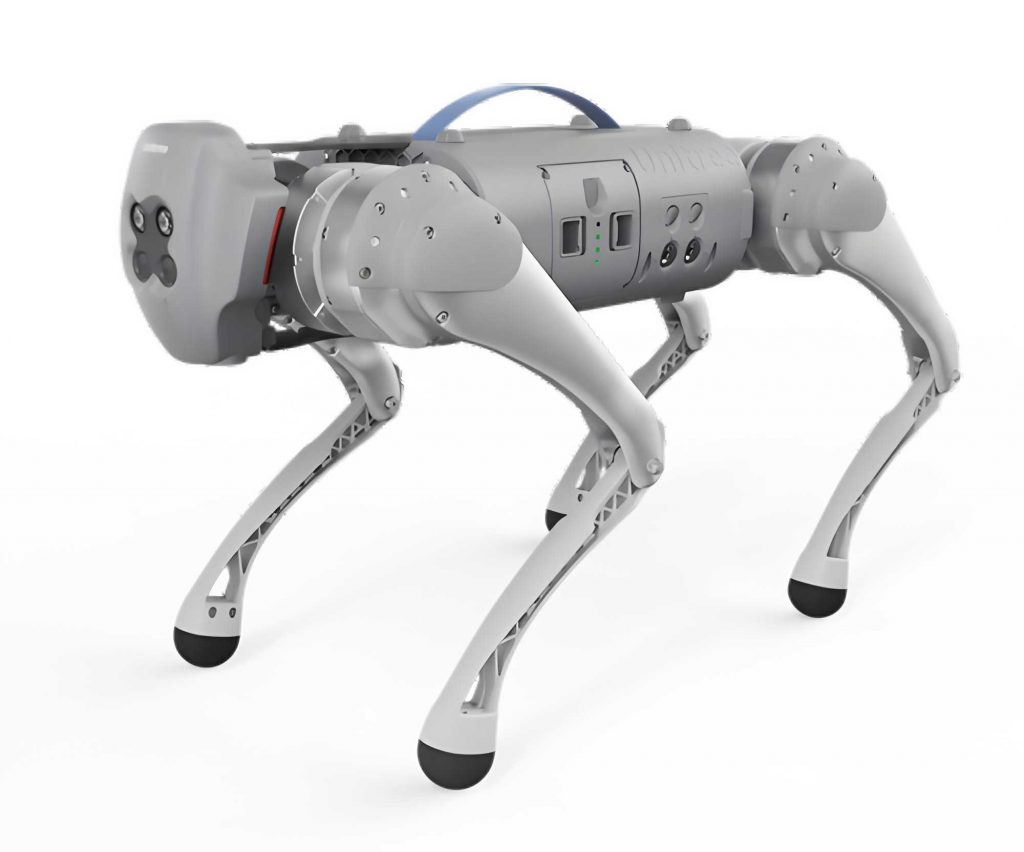
The pursuit of high-performance quadruped robot locomotion is driven by multiple, often competing, objectives: maximizing speed and agility, minimizing energy consumption, and ensuring unwavering stability across diverse terrains and dynamic maneuvers. A robot dog must not only walk steadily on flat ground but also trot, gallop, jump, and recover from external disturbances. My analysis begins with the foundational element: the physical embodiment of the quadruped robot. The mechanical design of a quadruped robot dictates its inherent capabilities and limitations. I have observed that most modern robot dogs employ serial leg configurations, typically with three degrees of freedom per leg—two at the hip for forward/backward and lateral motion, and one at the knee. This topology strikes a balance between workspace, control complexity, and mechanical simplicity. The specific arrangement, whether all-knee, all-elbow, or a mixed configuration like knee-front-elbow-rear, influences traits such as maximum speed, climbing ability, and passive stability. For instance, an all-knee configuration is often favored for high-speed locomotion in a quadruped robot, while a mixed layout can offer a larger support polygon. Beyond topology, the mechanical design focuses on minimizing leg inertia through lightweight materials and strategic placement of actuators, often relocating the knee motor to the hip segment via linkages. Furthermore, the integration of passive compliance, such as springs in the ankle or foot, is a critical bio-inspired strategy to absorb impact shocks and improve energy efficiency, much like tendons in biological systems. The design of the torso is another key consideration; while a rigid body is simpler, incorporating passive or active spinal joints can significantly enhance the stride length and dynamic performance of a robot dog, enabling more complex behaviors like bounding or galloping.
Once the physical structure of a quadruped robot is defined, the next step is to model its motion. Kinematic analysis provides the geometric relationship between joint angles and the position of the foot (end-effector) in space. For a quadruped robot, each leg can be treated as a serial manipulator fixed to the body. I frequently utilize the Denavit-Hartenberg (D-H) convention to establish coordinate frames for each link and compute the homogeneous transformation matrix. For a simple 3-DOF leg, the transformation from the hip to the foot is given by the product of individual link transformations: $$ T = A_1(\theta_1) A_2(\theta_2) A_3(\theta_3) $$ where $A_i(\theta_i)$ is the D-H matrix for joint $i$. The forward kinematics allow me to compute the foot position $[p_x, p_y, p_z]^T$ given the joint angles $\theta_1, \theta_2, \theta_3$. Conversely, inverse kinematics is used to determine the joint angles required to achieve a desired foot position, which is essential for trajectory tracking. This often has multiple solutions, and I select the one that respects joint limits and avoids singularities. The relationship between joint velocities and foot velocity is described by the Jacobian matrix $J$: $$ \dot{p} = J(\theta) \dot{\theta} $$ This Jacobian is also fundamental for static force analysis. According to the principle of virtual work, the joint torques $\tau$ required to generate a force $F$ at the foot are: $$ \tau = J^T F $$ This equation is pivotal for understanding how ground reaction forces map to actuator torques in a quadruped robot.
While kinematics deals with motion geometry, dynamics explains the motion resulting from forces and torques. For a robot dog, dynamic modeling is complex due to its multi-body, hybrid nature (switching between swing and stance phases). I primarily employ two methods: the Newton-Euler formulation and the Lagrangian formulation. The Newton-Euler approach is a force-balance method applied recursively to each link. For a single rigid body link, the equations are: $$ f = m \dot{v}_c $$ $$ \tau = {}_c I \dot{\omega} + \omega \times ({}_c I \omega) $$ where $f$ and $\tau$ are the force and torque acting on the link, $m$ is its mass, $\dot{v}_c$ is the acceleration of its center of mass, ${}_c I$ is its inertia tensor, and $\omega$ and $\dot{\omega}$ are its angular velocity and acceleration. The Lagrangian method, based on energy, is often more systematic for complex systems. The Lagrangian $L$ is defined as the difference between kinetic energy $K$ and potential energy $P$. The dynamics are then given by: $$ \tau = \frac{d}{dt} \left( \frac{\partial L}{\partial \dot{q}} \right) – \frac{\partial L}{\partial q} $$ where $q$ are the generalized coordinates (joint angles). For an $n$-DOF quadruped robot, this expands to the standard form: $$ M(q)\ddot{q} + C(q, \dot{q})\dot{q} + G(q) = \tau $$ Here, $M(q)$ is the mass matrix, $C(q, \dot{q})$ is the Coriolis and centripetal matrix, and $G(q)$ is the gravity vector. This model is crucial for simulation and model-based control strategies. However, for real-time control, simplified models like the Single Rigid Body (SRB) model are often used, where the leg masses are neglected, and the entire quadruped robot is treated as a single body with mass $m$ and inertia $I$, acted upon by the resultant of all ground reaction forces.
The locomotion of a quadruped robot is characterized by its gait—the coordinated, rhythmic pattern of leg movements. I have studied various gaits and their suitability for different speeds and terrains. The choice of gait for a robot dog is paramount for stability and efficiency. Static gaits, like crawl and walk, always maintain at least three feet on the ground, ensuring stability based on static equilibrium. Dynamic gaits, like trot and gallop, involve periods with only two or even zero feet on the ground, relying on dynamic balance principles. The following table summarizes the key parameters of common quadruped robot gaits, defined by the load factor $\beta$ (fraction of cycle a leg is on the ground) and phase differences $\phi_i$ between legs.
| Gait Type | Load Factor (β) | Phase Difference (ϕi) for Legs (LF, LR, RF, RR) | Stability Class |
|---|---|---|---|
| Crawl | β > 0.75 | 0, 3/4, 1/2, 1/4 | Static |
| Walk | β = 0.75 | 0, 3/4, 1/2, 1/4 | Static |
| Trot | β = 0.5 | 0, 1/2, 1/2, 0 | Dynamic |
| Pace | β = 0.5 | 0, 0, 1/2, 1/2 | Dynamic |
| Bound | β = 0.5 | 0, 1/2, 0, 1/2 | Dynamic |
| Gallop | β < 0.5 | 0, ≈1/2, ≈0, ≈1/2 | Dynamic |
Gait planning is intrinsically linked to foot trajectory planning. For a swinging leg, the foot must follow a smooth path from lift-off to touch-down, ensuring sufficient ground clearance and minimizing impact. I often use polynomial functions to define these trajectories. For example, a swing leg trajectory in the vertical direction $z(t)$ can be defined by a cubic polynomial: $$ z(t) = a_0 + a_1 t + a_2 t^2 + a_3 t^3 $$ The coefficients $a_i$ are solved using boundary conditions, such as initial and final position, velocity, and acceleration. For a trotting quadruped robot, the foot trajectory during the stance phase is also critical for propelling the body forward. A common approach is to use a virtual foot point that moves relative to the body, generating the desired body velocity. Another bio-inspired method for gait generation is the use of Central Pattern Generators (CPGs), which are systems of coupled oscillators that produce rhythmic signals for joint control without requiring explicit trajectory planning. CPGs can exhibit limit cycle behavior, providing inherent robustness to perturbations for a robot dog.
The actuators are the muscles of the quadruped robot. The performance of a robot dog is heavily dependent on the torque, speed, bandwidth, and power density of its joint actuators. Electric motors are the most common choice, often paired with high-ratio gearboxes to achieve the high torques required for dynamic locomotion. However, gearing introduces friction and backlash. To address this, and to incorporate compliance, I have worked with Series Elastic Actuators (SEAs), where a spring is placed in series with the motor. This allows for more accurate force control and shock absorption. The force output of an SEA can be modeled as: $$ \tau = k (\theta_m – \theta_j) $$ where $k$ is the spring stiffness, $\theta_m$ is the motor angle, and $\theta_j$ is the joint angle. For more advanced biomimicry, Variable Stiffness Actuators (VSAs) can dynamically adjust the spring stiffness $k$, enabling the quadruped robot to adapt its impedance to different terrains and tasks, much like an animal modulating its muscle tension. The control law for a typical joint actuator in a quadruped robot often combines position, velocity, and torque feedback: $$ \tau_{cmd} = \tau_{ff} + K_p (\theta_d – \theta) + K_d (\dot{\theta}_d – \dot{\theta}) $$ where $\tau_{ff}$ is a feedforward torque, $\theta_d$ and $\dot{\theta}_d$ are desired position and velocity, and $K_p$, $K_d$ are gains. This hybrid control allows for precise tracking while managing interactions with the environment.
The ultimate challenge is integrating all these components into a robust stability control system. For a quadruped robot, simple position control is insufficient; force control is essential to handle unexpected contact forces and maintain balance. I frequently employ impedance control, which regulates the dynamic relationship between position error and contact force. The desired behavior is often specified as: $$ F = K_p (x_d – x) + K_d (\dot{x}_d – \dot{x}) $$ where $F$ is the output force, $x_d$ is the desired position, and $K_p$ and $K_d$ are the virtual stiffness and damping parameters. This creates a virtual spring-damper system between the robot dog and its environment. For higher-level balance, the concept of the Zero Moment Point (ZMP) is used for static and slow dynamic gaits. The ZMP is the point on the ground where the net moment of inertial and gravity forces is zero. For stability, the ZMP must lie within the support polygon defined by the contact points. For more dynamic motions, the Spring-Loaded Inverted Pendulum (SLIP) model is a powerful template. It models the whole quadruped robot as a point mass atop a massless springy leg, capturing the essential dynamics of running and hopping. The equation for the vertical motion in a SLIP model during stance is: $$ m \ddot{z} = k (l_0 – l) – mg $$ where $m$ is the mass, $k$ is the spring constant, $l_0$ is the rest length, and $l$ is the current length of the leg.
Modern high-performance control for a quadruped robot heavily relies on optimization-based methods, particularly Model Predictive Control (MPC). In my work, I use MPC to solve the problem of optimal foot force distribution in real-time. The state of the quadruped robot is often simplified to the body’s position $P$, orientation $\phi$, linear velocity $\dot{P}$, and angular velocity $\omega$. The continuous-time dynamics of this single rigid body model, under the influence of gravity $g$ and multiple contact forces $f_i$, is: $$ \frac{d}{dt} \begin{bmatrix} P \\ \phi \\ \dot{P} \\ \omega \end{bmatrix} = \begin{bmatrix} \dot{P} \\ R(\phi) \omega \\ \frac{1}{m} \sum f_i + g \\ I^{-1} ( \sum r_i \times f_i – \omega \times (I \omega) ) \end{bmatrix} $$ where $R(\phi)$ is the rotation matrix, $I$ is the body inertia, and $r_i$ is the position of contact $i$ relative to the center of mass. This continuous model is discretized with a time step $\Delta t$: $$ x_{k+1} = A_d x_k + B_d u_k $$ where $x_k$ is the state vector and $u_k = [f_1^T, …, f_n^T]^T$ is the vector of contact forces. The MPC controller then solves a finite-horizon optimal control problem at each time step: $$ \min_{u} \sum_{k=0}^{N-1} \left( \| x_{k+1} – x_{ref} \|_Q^2 + \| u_k \|_R^2 \right) $$ subject to the dynamics constraint $x_{k+1} = A_d x_k + B_d u_k$ and contact constraints, such as the friction cone condition $|f_{t,i}| \leq \mu f_{n,i}$ for each force $f_i$, ensuring the foot of the quadruped robot does not slip. The output of the MPC is the optimal sequence of ground reaction forces, which are then converted to joint torques using the force-Jacobian transpose: $\tau = J^T f$. This is typically combined with a Whole-Body Controller (WBC) that manages multiple tasks with a hierarchy. For example, the highest priority is given to maintaining contact constraints, followed by tracking the body trajectory, and finally tracking the swing leg trajectories. The WBC solves a series of quadratic programs to compute the optimal joint torques and accelerations that satisfy these prioritized tasks.
The logical flow between these technological modules in a quadruped robot control architecture is systematic. It begins with a high-level planner that sets the desired velocity and gait based on the environment. This information is used by the gait generator and the swing leg trajectory planner. The state estimator fuses data from Inertial Measurement Units (IMU), joint encoders, and sometimes foot force sensors to provide a best estimate of the body’s position, velocity, orientation, and angular velocity. This estimated state and the high-level motion command are fed into the MPC controller. The MPC solves for the optimal ground reaction forces for the stance legs. These forces, along with the swing leg trajectories, are passed to the Whole-Body Controller. The WBC computes the desired joint torques, which are finally sent to the low-level joint actuators. The actuators, with their local PID and impedance control loops, execute these commands, driving the physical quadruped robot. Sensor feedback from the robot closes the loop, allowing the state estimator and controllers to adapt in real-time. This integrated architecture enables a robot dog to perform dynamic and stable locomotion across challenging terrains.
Looking forward, the evolution of quadruped robot technology presents several exciting research avenues. I believe the next generation of robot dogs will feature even more advanced biomimetic mechanisms, with multi-articulated spines and adaptive foot morphology to enhance agility and terrain negotiation. The development of artificial muscles with higher power density and faster response than current electric actuators could be a game-changer, allowing quadruped robots to match the explosive power and efficiency of biological systems. In terms of intelligence, I foresee a shift towards more embodied AI, where control is not just a reactive process but a predictive and adaptive one. Deep reinforcement learning is already showing promise in teaching complex locomotion skills directly from trial and error, and this will likely be integrated with model-based methods like MPC for improved sample efficiency and safety. Furthermore, the ability for a quadruped robot to autonomously perceive its environment in 3D, reason about traversability, and plan complex paths over long horizons will be crucial for real-world deployment in search and rescue or exploration missions. Finally, the concept of modularity and self-reconfiguration could lead to versatile robot dogs that can adapt their structure for different tasks or environments, truly embodying the ultimate goal of a general-purpose legged machine.