
In the field of precision transmission systems, harmonic drive gears are widely recognized for their compact size, high reduction ratios, strong load-bearing capacity, and superior transmission accuracy. These attributes make harmonic drive gears indispensable in applications such as aerospace, robotics, and other areas requiring precise motion control. A critical aspect of ensuring optimal performance in harmonic drive gears is the control of backlash, which directly influences transmission error, hysteresis, and meshing quality. Insufficient backlash can lead to interference between tooth profiles, while excessive backlash may increase transmission errors and reduce positioning accuracy. Therefore, developing effective design methods to achieve uniformly distributed spatial backlash is essential for enhancing the reliability and efficiency of harmonic drive gears.
This study focuses on the radial modification design of the flexspline tooth profile in harmonic drive gears, specifically using a triple arc tooth profile. The goal is to improve the meshing state between the spatial tooth profile of the flexspline, machined via radial tool modification, and the planar tooth profile of the circular spline. By establishing a design method for radial modification, we aim to achieve uniform backlash distribution across multiple axial cross-sections of the flexspline, thereby optimizing the meshing characteristics and ensuring better load distribution. The harmonic drive gear is a key component in many high-precision systems, and its performance hinges on precise tooth profile design.
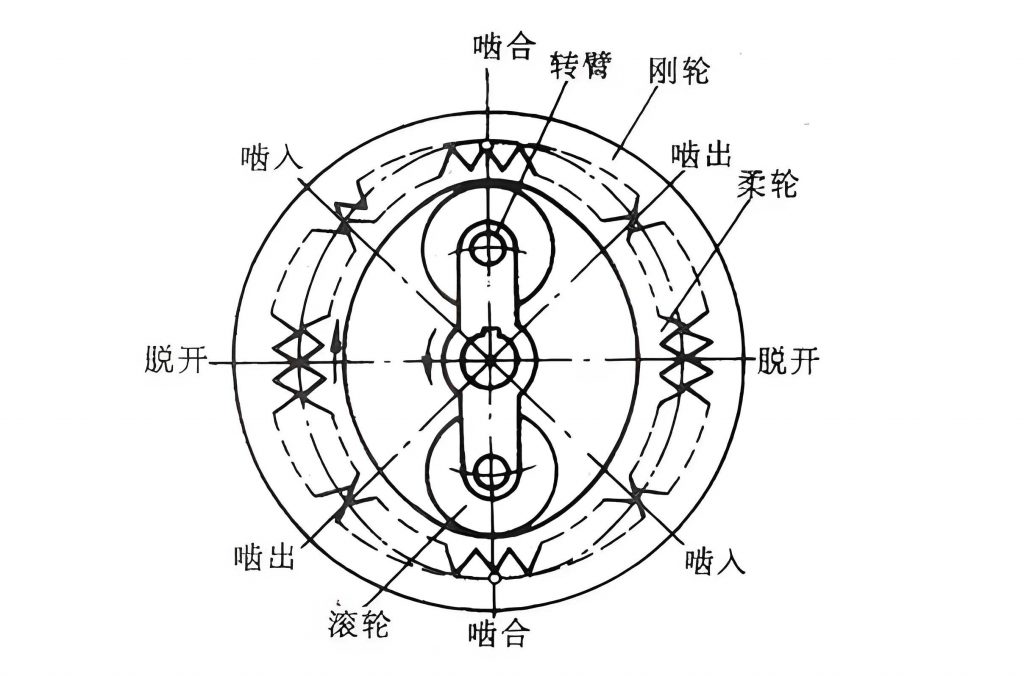
The foundation of this work lies in the precise algorithm for flexspline assembly deformation under an elliptical wave generator. This algorithm determines the radial and circumferential positions of flexspline teeth, which are crucial for calculating backlash between mating tooth profiles. The backlash algorithm for circular arc tooth profiles is employed to evaluate the meshing gaps, considering the shortest distance between profiles and its conversion to circumferential backlash. By assuming a straight-line generator along the axial direction, we can analyze tooth positioning and backlash in various cross-sections, revealing the spatial backlash distribution due to tapered deformation in cup-shaped flexsplines. This approach allows us to identify interference issues in unmodified designs and iteratively design radial modifications to eliminate them.
The harmonic drive gear operates on the principle of elastic deformation: the flexspline, typically a thin-walled cup, deforms under an elliptical wave generator, creating a variable gear mesh with the rigid circular spline. This results in a high reduction ratio through minor tooth difference. However, the tapered deformation along the flexspline’s axis leads to non-uniform radial displacements, causing varying meshing conditions in different axial sections. Without modification, the conjugate tooth profile designed for a specific cross-section may exhibit ideal backlash only in that section, while other sections suffer from severe interference or excessive gaps. Thus, spatial tooth profile design becomes necessary to ensure consistent performance across the entire tooth width.
In this article, we present a comprehensive methodology for radial modification design based on backlash optimization. We begin by detailing the meshing motion relationships and backlash calculations for harmonic drive gears. Next, we define the triple arc tooth profiles for both flexspline and circular spline, and discuss the multi-section positioning strategy using the straight-line assumption. Subsequently, we analyze the backlash distributions in unmodified and modified cases, supported by meshing trajectory simulations. Finally, we discuss the implications of our findings and conclude with recommendations for practical applications. Throughout the discussion, we emphasize the importance of the harmonic drive gear in advanced mechanical systems.
Meshing Motion and Backlash Calculation in Harmonic Drive Gears
The meshing process in a harmonic drive gear involves the relative motion between the flexspline and circular spline teeth as the wave generator rotates. To understand this, we establish coordinate systems for each component. Let the wave generator be fixed in the coordinate system {O-XWYW}, where O is the rotation center and the XW-axis aligns with the long axis of the elliptical wave generator. The flexspline tooth is associated with the coordinate system {Of-XfYf}, with Of on the neutral surface of the flexspline and the Xf-axis coinciding with the tooth symmetry line. The circular spline tooth coordinate system is {O-XCYC}, where the XC-axis aligns with the tooth space symmetry line.
The deformation of the flexspline’s neutral circle under the wave generator is described by the radial displacement function. For an elliptical wave generator, the deformed neutral curve can be expressed as:
$$ \rho(\phi_1) = \frac{ab}{\sqrt{a^2 \sin^2 \phi_1 + b^2 \cos^2 \phi_1}}, \quad 0 \leq \phi_1 \leq \frac{\pi}{2} $$
where \( a = r_m + w_0 \) is the semi-major axis, \( b \) is the semi-minor axis determined by the condition of no elongation of the neutral line, \( r_m \) is the radius of the undeformed neutral circle, \( w_0 \) is the maximum radial displacement at the design cross-section, and \( \phi_1 \) is the angular position on the deformed neutral curve. The relationship between the angular positions before and after deformation is given by:
$$ \phi = \frac{1}{r_m} \int_0^{\phi_1} \sqrt{\rho^2 + \left( \frac{d\rho}{d\phi_1} \right)^2} \, d\phi_1 $$
Here, \( \phi \) is the angular position on the undeformed neutral circle. The angular position of the circular spline tooth space symmetry line relative to the wave generator long axis is:
$$ \phi_W = \frac{z_1}{z_2} \phi $$
where \( z_1 \) and \( z_2 \) are the number of teeth on the flexspline and circular spline, respectively. The angle between the radial vector to point Of and the circular spline symmetry line is:
$$ \theta = \phi_1 – \phi_W = \phi_1 – \frac{z_1}{z_2} \phi $$
The deviation angle of the flexspline normal line, which affects the tooth orientation, is:
$$ \theta_{uz} = -\arctan \left( \frac{d\rho/d\phi_1}{\rho} \right) $$
Thus, the angle between the flexspline tooth symmetry line and the circular spline tooth space symmetry line is:
$$ \Phi = \theta_{uz} + \theta $$
The coordinates of point Of in the circular spline coordinate system are:
$$
\begin{cases}
x_{2O1} = \rho \sin \theta \\
y_{2O1} = \rho \cos \theta
\end{cases}
$$
These equations define the trajectory of the flexspline tooth relative to the circular spline, serving as the basis for tooth profile design and backlash analysis in harmonic drive gears.
Backlash in harmonic drive gears is defined as the minimum circumferential gap between potentially contacting tooth surfaces. For circular arc tooth profiles, the calculation involves determining the shortest distance between two profiles and converting it to circumferential backlash. Consider two arc profiles: let \( d_{\text{min}} \) be the shortest distance between them, and let \( \alpha_1 \) be the inclination angle of the line segment representing this shortest distance. If \( \alpha_2 \) is the angle between the radial vector to a point on the flexspline profile and the x-axis, the circumferential backlash \( j_{\text{min}} \) is given by:
$$ j_{\text{min}} = \frac{d_{\text{min}}}{\cos(\alpha_1 + \alpha_2)} $$
where \( \alpha_1 = \arctan(k_{d_{\text{min}}}) \) with \( k_{d_{\text{min}}} \) being the slope of the shortest distance line, and \( \alpha_2 = \arctan(x_{A1}/y_{A1}) \) for a point \( A_1 \) on the flexspline profile. This formula applies to various cases, such as between two convex arcs, a line segment and a convex arc, or two concave arcs, which are common in triple arc profiles. Accurate backlash calculation is vital for assessing the meshing state and ensuring optimal performance in harmonic drive gears.
Tooth Profile Definition and Multi-Section Positioning
The triple arc tooth profile offers flexibility and superior meshing characteristics compared to double arc profiles, making it suitable for high-performance harmonic drive gears. The flexspline tooth profile is constructed using three arcs: an upper arc, a middle arc, and a lower arc. Key parameters include the radii of these arcs, radial heights relative to the pitch circle, and the tooth thickness. The geometric definition ensures smooth transitions between arcs, facilitating continuous conjugation.
For the flexspline, let the pitch circle radius be \( r_m \), and the tooth thickness on the pitch circle be \( s \). The middle arc has a radius \( \rho_{af} \) and is tangent to the pitch circle at an angle \( \alpha \). The upper arc radius is \( \rho_a \), and the lower arc radius is \( \rho_f \). The addendum and dedendum heights are \( h_a \) and \( h_f \), respectively. The middle arc extends radially above and below the pitch circle by \( h_{la} \) and \( h_{lf} \). These parameters are determined through geometric constraints to form a continuous profile. An example set of parameters for a flexspline with 100 teeth and module 0.506603 mm is summarized in Table 1.
| Parameter | Symbol | Value (mm) |
|---|---|---|
| Addendum height | \( h_a \) | 0.2837 |
| Dedendum height | \( h_f \) | 0.3192 |
| Middle arc top height | \( h_{la} \) | 0.2330 |
| Middle arc bottom height | \( h_{lf} \) | 0 |
| Middle arc radius | \( \rho_{af} \) | 1.3678 |
| Upper arc radius | \( \rho_a \) | 0.1317 |
| Lower arc radius | \( \rho_f \) | 2.4317 |
| Tooth thickness on pitch circle | \( s \) | 0.5659 |
The circular spline tooth profile is designed as the conjugate of the flexspline profile at the design cross-section. It also consists of three arcs: an upper arc with radius \( \rho_{a2} \), a middle arc with radius \( \rho_{af2} \), and a lower arc with radius \( \rho_{f2} \). The centers of the middle and lower arcs are positioned based on conjugation conditions. Key parameters include the addendum circle radius \( r_{a2} \), dedendum circle radius \( r_{f2} \), and the central angle \( \theta_{BK} \) subtended by the middle arc. For a circular spline with 102 teeth, example parameters are given in Table 2.
| Parameter | Symbol | Value (mm) |
|---|---|---|
| Addendum circle radius | \( r_{a2} \) | 25.2694 |
| Dedendum circle radius | \( r_{f2} \) | 26.0766 |
| Upper arc radius | \( \rho_{a2} \) | 0.61233 |
| Lower arc radius | \( \rho_{f2} \) | 0.7979 |
| Middle arc center x-coordinate | \( x_B \) | -1.42843 |
| Middle arc center y-coordinate | \( y_B \) | 25.0201 |
| Lower arc center x-coordinate | \( x_K \) | 1.06597 |
| Lower arc center y-coordinate | \( y_K \) | 25.96174 |
In cup-shaped flexsplines, tapered deformation occurs along the axial direction due to the wave generator insertion. Using the straight-line generator assumption, the radial position at an axial distance \( z \) from the cup bottom can be expressed as:
$$ \rho(\phi, z) = \left( \rho(\phi) – r_m \right) \frac{z}{z_0} + r_m, \quad 0 < z < l $$
where \( z_0 \) is the axial distance from the cup bottom to the design cross-section, \( l \) is the total length of the cylindrical part, and \( \rho(\phi) \) is the radial displacement function at the design section. This equation implies that each axial cross-section has a different neutral curve, leading to varying meshing conditions. To analyze spatial backlash distribution, we define multiple cross-sections along the flexspline axis. For instance, with a cup length of 26 mm and tooth ring width of 8.5 mm, sections can be defined at axial positions such as the front (near the cup mouth), middle (design section), and back (near the cup bottom). Specifically, let the front section be at \( z = 25.3 \) mm, the middle section at \( z = 20.435 \) mm, and the back section at \( z = 16.8 \) mm. Intermediate sections can be equally spaced between these points.
The backlash in each cross-section is computed by positioning the flexspline tooth profile based on the local deformed neutral curve and calculating the gap relative to the planar circular spline profile. This reveals how backlash varies axially, highlighting potential interference or excessive gaps in unmodified designs. For the harmonic drive gear to function optimally, it is crucial to minimize these variations through radial modification.
Backlash Distribution Without Radial Modification
Initially, the conjugate circular spline tooth profile is designed for the middle cross-section (4th section) using conventional conjugation theory. When backlash is computed for unmodified flexspline profiles across multiple sections, significant non-uniformity is observed. In the design section, backlash is small and uniform over a wide engagement range, typically less than 1.2 μm for engagement angles between 5° and 50°. This indicates ideal meshing conditions in that section. However, in other sections, particularly the front and back sections, severe interference occurs, meaning negative backlash where tooth profiles overlap.
For example, in the frontmost section (1st section), interference peaks at approximately -81 μm near an engagement angle of 2°. In the backmost section (7th section), interference reaches about -98 μm near 75°. The intermediate sections show gradually decreasing interference from front to back, with a convergence point near 22° where backlash approaches zero. This pattern stems from the tapered deformation: front sections experience greater radial expansion, causing the flexspline teeth to protrude into the circular spline, while back sections have reduced expansion, leading to different interference patterns. Such interference can cause increased wear, noise, and reduced efficiency in harmonic drive gears, underscoring the need for radial modification.
Meshing trajectory simulations visually confirm these issues. In the design section, the flexspline tooth tip engages smoothly with the circular spline root arc over a broad range, showing minimal and uniform gaps. In contrast, front sections exhibit large overlaps between the flexspline tip and circular spline profile, while back sections show interference during the engagement phase. These simulations highlight the limitations of single-section conjugate design for cup-shaped flexsplines, motivating the development of spatial tooth profiles via radial tool modification.
Radial Modification Design for Uniform Spatial Backlash
To address the non-uniform backlash distribution, we propose a radial modification method where the cutting tool is adjusted inward at different axial positions. This creates a linearly varying tooth thickness along the flexspline axis, effectively designing a spatial tooth profile. The modification alters the flexspline’s neutral line radius axially, compensating for tapered deformation. Let \( r_p(z) \) be the neutral line radius at axial position \( z \), and \( \delta_p(z) \) be the radial change in tooth thickness due to modification. The relationship is:
$$ r_p(z) = r_m – \frac{\delta_p(z)}{2} $$
By choosing appropriate \( \delta_p(z) \) values, we can tailor the flexspline tooth profile to achieve near-zero backlash in all cross-sections. The goal is to iteratively determine modification amounts that eliminate interference while maintaining small backlash across the engagement range. Based on the interference patterns observed, we set radial inward modifications at the front and back sections, with linear tapering toward the middle section.
Through iterative design, an optimal modification scheme is derived. For instance, relative to the middle section at \( z = 20.435 \) mm, the radial downward displacements for front sections (1st, 2nd, 3rd) might be 81.82 μm, 54.55 μm, and 27.27 μm, respectively. For back sections (5th, 6th, 7th), displacements could be 16.81 μm, 33.62 μm, and 50.40 μm. These values are determined by solving an optimization problem that minimizes the maximum absolute backlash across all sections and engagement angles. The objective function can be formulated as:
$$ \min_{\delta_p(z)} \max_{i, \phi} |j_i(\phi, \delta_p(z))| $$
where \( j_i(\phi, \delta_p(z)) \) is the backlash at section \( i \) and engagement angle \( \phi \), given the modification function \( \delta_p(z) \). Constraints ensure that backlash is non-negative (no interference) and close to zero. The iterative process involves computing backlash distributions for trial modifications, adjusting values based on results, and converging to an optimal set.
After applying the optimal radial modification, backlash distributions improve significantly. In all cross-sections, backlash becomes nearly zero at specific engagement points and remains small throughout the range. For example, the 1st section achieves zero backlash at 2°, the 4th section at 11° and 45°, and the 7th section at 51°. The maximum backlash across sections is reduced to under 1.2 μm, indicating uniform spatial distribution. This ensures that the harmonic drive gear operates with line meshing from front to back, enhancing load distribution and transmission accuracy.
| Cross-Section | Axial Position z (mm) | Radial Downward Displacement (μm) | Neutral Line Radius \( r_p(z) \) (mm) |
|---|---|---|---|
| 1st (Front) | 25.3 | 81.82 | 24.7328 |
| 2nd | 23.5 | 54.55 | 24.7463 |
| 3rd | 21.7 | 27.27 | 24.7598 |
| 4th (Middle) | 20.435 | 0 | 24.7737 |
| 5th | 19.1 | 16.81 | 24.7653 |
| 6th | 17.8 | 33.62 | 24.7569 |
| 7th (Back) | 16.8 | 50.40 | 24.7485 |
Meshing trajectory simulations for modified profiles confirm the improvements. In front sections, inward modification eliminates interference, allowing the flexspline tooth tip to engage properly with the circular spline root arc. In back sections, modification prevents tip interference during engagement, resulting in smooth meshing with near-zero gaps. The simulations show that radial modification enables line contact along the tooth width, which is desirable for distributing loads and reducing stress concentrations in harmonic drive gears.
Discussion and Conclusions
The design of tooth profiles for cup-shaped or hat-shaped flexsplines in harmonic drive gears must account for spatial deformation effects. Tapered deformation leads to varying neutral curves along the axis, so conjugate design based on a single cross-section is insufficient. Radial tool modification offers a practical solution by creating axially varying tooth profiles that compensate for these differences. Our study demonstrates that through iterative optimization of modification amounts, uniform spatial backlash can be achieved, enhancing meshing performance across all cross-sections.
The triple arc tooth profile provides flexibility for such modifications due to its parametric nature. By adjusting the radial positions of tool paths, we can effectively control tooth thickness and profile geometry. The proposed method involves calculating backlash distributions using precise deformation algorithms and arc geometry, then iteratively refining modification values until backlash is minimized uniformly. This approach ensures that the harmonic drive gear operates with minimal transmission error and improved load capacity.
Key insights from this work include:
- Spatial Considerations in Harmonic Drive Gear Design: For flexsplines with tapered deformation, tooth profile design should consider multiple axial sections. Single-section conjugate design may lead to interference in other sections, compromising performance.
- Effectiveness of Radial Modification: Inward tool modification at front and back sections can eliminate interference and achieve near-zero backlash. Linear tapering of modification amounts is a simple yet effective strategy for many applications.
- Optimization through Backlash Analysis: Iterative design based on backlash calculations allows for fine-tuning modification parameters. The goal is to minimize the maximum backlash across sections, ensuring uniform meshing.
- Simulation Validation: Meshing trajectory simulations are valuable for visualizing tooth engagement and verifying design outcomes. They complement analytical calculations and provide confidence in the proposed modifications.
In conclusion, the radial modification method presented here offers a systematic approach to improving spatial backlash uniformity in harmonic drive gears with triple arc tooth profiles. By integrating precise deformation modeling, backlash algorithms, and iterative optimization, we can design flexspline tooth profiles that ensure optimal meshing across the entire tooth width. This contributes to the development of more reliable and efficient harmonic drive gears for high-precision applications. Future work could explore nonlinear modification schemes, dynamic load analysis, and experimental validation to further refine the design process.
The harmonic drive gear remains a critical component in advanced mechanical systems, and continuous improvements in tooth profile design are essential for meeting evolving performance demands. Through methods like radial modification, we can enhance backlash control, reduce wear, and extend the service life of these transmissions, supporting innovations in robotics, aerospace, and beyond.