
In the evolving landscape of library services, the shift toward smart services emphasizes intelligent perception, decision-making, and execution through technological integration. However, traditional library service scenarios often lack embodiment, failing to dynamically interact with users and environments. From my perspective as a researcher in this field, I believe that embodied AI technology—particularly embodied AI robots—holds transformative potential for addressing these gaps. This study aims to diagnose the disembodiment issues in traditional library settings, propose enabling mechanisms driven by embodied AI robots, outline reconstruction logic, and explore ecological evolution paths. By leveraging tables and formulas for clarity, I will delve into how embodied intelligence can reshape library spaces into adaptive, immersive, and user-centric ecosystems.
Traditional library service scenarios suffer from significant disembodiment, which I categorize into three core problems. First, spatial disembodiment arises from static environmental perception. Libraries often function as passive containers for resources, ignoring the dynamic interplay between user behavior and space. For instance, user movement trajectories and dwell times are rarely used to optimize layouts. Second, service disembedding stems from unilateral decision-making. Systems rely on historical data like borrowing records, overlooking context-driven needs emerging from users’ physical presence. This creates a disconnect where services are preset rather than responsive. Third, experiential suspension occurs due to fragmented human-computer interaction. Devices like AR navigation or chatbots operate in isolation, forcing users to adapt to machine logic through discrete actions, leading to disjointed experiences. To summarize these issues, I present the following table contrasting traditional and envisioned smart scenarios:
| Aspect | Traditional Library Scenario | Smart Service Scenario with Embodied AI Robots |
|---|---|---|
| Spatial Perception | Static, resource-centered design | Dynamic, user-adaptive via multi-modal sensing |
| Service Decision | Unilateral, based on historical data | Contextualized, inferred from real-time behavior |
| User Experience | Fragmented, requiring manual interface switching | Coherent, with immersive bodily interaction |
These limitations highlight the need for embodied AI robots to infuse libraries with adaptive intelligence, transforming them into living environments that perceive, reason, and act in harmony with human presence.
The enabling mechanism for library smart service scenarios revolves around three pillars empowered by embodied AI robots. First, multi-modal embedding for environmental perception involves deploying sensors—such as cameras, microphones, and IoT devices—to capture spatial and user data. An embodied AI robot integrates these inputs through fusion algorithms, creating a real-time digital twin of the library. For example, a robot can use vision to detect crowd density and audio to identify noise levels, adjusting lighting or acoustics accordingly. This can be modeled as a perceptual fusion formula: $$ P(t) = \alpha \cdot V(t) + \beta \cdot A(t) + \gamma \cdot E(t) $$ where \( P(t) \) is the integrated perception at time \( t \), \( V(t) \) denotes visual data, \( A(t) \) represents auditory data, \( E(t) \) signifies environmental sensor data, and \( \alpha, \beta, \gamma \) are weights optimized for context. Second, contextualized reasoning for behavioral decision-making employs machine learning and knowledge graphs to predict user needs. An embodied AI robot analyzes historical patterns and current context—like a user lingering near a shelf—to recommend resources or trigger services. The decision model can be expressed as: $$ D = \arg\max_{a \in A} \sum_{c \in C} P(c|H) \cdot U(a,c) $$ where \( D \) is the optimal decision, \( A \) is the set of possible actions, \( C \) is contextual factors, \( H \) is user history, and \( U \) denotes utility. Third, adaptive collaboration for service execution ensures seamless coordination among robots, systems, and librarians. Through natural language and gesture interfaces, an embodied AI robot dynamically adjusts service flows, such as guiding a user to a study room while notifying staff of special requests. This adaptive synergy is captured by: $$ S_{output} = f(I, F, \Theta) $$ with \( S_{output} \) as service output, \( I \) for user input, \( F \) for system feedback, and \( \Theta \) as adaptive parameters tuned via reinforcement learning. These mechanisms collectively enable libraries to transition from static hubs to interactive smart spaces.
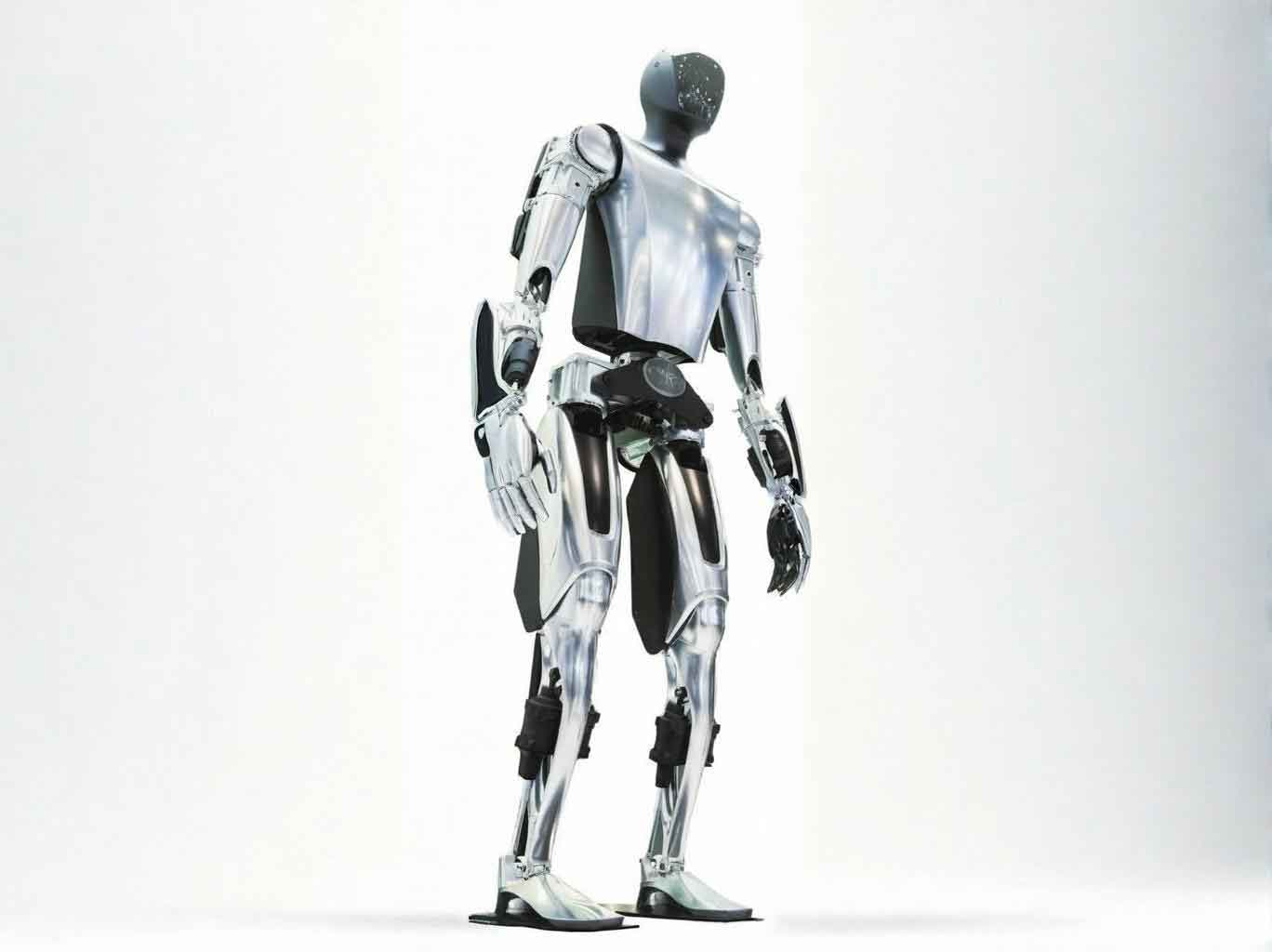
The reconstruction logic for library smart service scenarios, as I propose, involves a layered approach centered on embodied AI robots. Initially, building a perceptually permeable intelligent environment substrate requires redesigning spaces with flexible elements like movable furniture and deploying sensor networks. An embodied AI robot acts as a mobile node in this substrate, enhancing coverage and data collection. For instance, robots equipped with LiDAR can map spatial usage, feeding data into a central platform for analysis. The system integration can be summarized in this table:
| Layer | Components | Role of Embodied AI Robot |
|---|---|---|
| Spatial Planning | Adaptable layouts, smart lighting | Dynamic reconfiguration based on real-time scans |
| Technology Deployment | Cameras, WiFi, IoT sensors | Mobile sensing hub complementing fixed sensors |
| System Integration | Data management platforms, control centers | Providing edge computing for low-latency responses |
Next, designing bodily involved service trigger nodes leverages embodied AI robots for natural interaction. Users can engage with robots through gestures, postures, or facial expressions—for example, waving to summon assistance or pointing to query a book. The trigger mechanism blends explicit and implicit cues, with robots inferring needs from behavior. Feedback is multi-modal, combining visual displays on robot screens, haptic vibrations, or auditory cues. Mathematically, a trigger event \( T \) can be defined as: $$ T = \begin{cases} 1 & \text{if } \sum_{i} w_i \cdot B_i(t) > \tau \\ 0 & \text{otherwise} \end{cases} $$ where \( B_i(t) \) denotes bodily signals (e.g., gesture intensity), \( w_i \) are weights learned from interaction data, and \( \tau \) is a threshold. Finally, crafting an immersive and coherent user experience闭环 involves strategies like scenario-based narratives and personalized pathways. An embodied AI robot can guide users through a curated journey, such as a historical exploration using mixed reality, while maintaining continuity across interactions. The experience quality \( Q \) can be modeled as: $$ Q = \int_{0}^{T} \lambda(t) \cdot C(t) \, dt $$ where \( \lambda(t) \) is immersion level over time \( T \), and \( C(t) \) represents coherence in service delivery. This logic ensures that libraries evolve from disjointed service points to holistic, embodied environments.
The ecological collaborative evolution path for library smart service scenarios necessitates systemic integration of embodied AI robots. I envision four key trajectories. First, a human-robot symbiotic service delivery model redefines roles: librarians handle emotional support and ethical oversight, while embodied AI robots manage routine tasks like inventory checks or navigation. Their collaboration is governed by protocols ensuring seamless handoffs. For instance, a robot might detect a complex query and escalate it to a human librarian, with interaction data shared via cloud platforms. This synergy can be quantified using a cooperation efficiency metric: $$ \eta = \frac{S_{joint}}{S_{robot} + S_{human}} $$ where \( \eta \) approaches 1 for optimal collaboration, \( S_{joint} \) is joint service output, and \( S_{robot} \) and \( S_{human} \) are individual contributions. Second, a dynamically balanced technological ethics framework addresses risks like privacy invasion or algorithmic bias. Guided by values such as fairness and transparency, libraries must implement consent mechanisms and audit algorithms used by embodied AI robots. An ethical score \( E \) can be computed as: $$ E = \sum_{j} v_j \cdot \log(1 + R_j) $$ with \( v_j \) as ethical weights (e.g., for privacy) and \( R_j \) as compliance levels. Third, a continuously evolving scenario iteration mechanism employs agile methods and user feedback loops. Embodied AI robots facilitate this by collecting real-time usage data, enabling libraries to refine services—for example, adjusting robot patrol routes based on heatmaps. The iteration cycle is captured by: $$ I_{k+1} = I_k + \Delta \cdot \nabla U $$ where \( I_k \) is the iteration at step \( k \), \( \Delta \) is the learning rate, and \( \nabla U \) is the gradient of user satisfaction. Fourth, a multi-governance stakeholder linkage network connects librarians, users, tech providers, and community groups. Embodied AI robots serve as interfaces in this network, broadcasting updates or gathering input through interactive sessions. The network resilience \( R \) can be expressed as: $$ R = \frac{1}{N} \sum_{i=1}^{N} \sigma_i \cdot d_i $$ where \( N \) is the number of stakeholders, \( \sigma_i \) is their engagement level, and \( d_i \) denotes connectivity degree. These paths foster a sustainable ecosystem where embodied AI robots catalyze innovation while upholding ethical standards.
In conclusion, my exploration underscores that embodied AI robots are pivotal for reconstructing library smart service scenarios. By addressing disembodiment through multi-modal perception, contextualized reasoning, and adaptive collaboration, libraries can transcend traditional limitations. The reconstruction logic—spanning intelligent environments, bodily triggers, and immersive experiences—provides a blueprint for transformation. Moreover, ecological evolution via human-robot symbiosis, ethical frameworks, iterative mechanisms, and stakeholder networks ensures long-term viability. As I reflect on this, the integration of embodied AI robots not only enhances service precision and personalization but also redefines libraries as dynamic, embodied spaces of knowledge and interaction. Future work should focus on real-world pilot studies, refining the proposed formulas and tables through empirical data, to fully realize the potential of embodied intelligence in public service domains.