
As an educator in the field of mechanical engineering, I have witnessed the rapid evolution of intelligent robot technology and its profound impact on various industries. The integration of hydraulic and pneumatic transmission systems into intelligent robots has become a cornerstone for achieving high performance, precision, and reliability in applications ranging from manufacturing to healthcare. In this context, reforming the teaching mode of “Hydraulic and Pneumatic Transmission” is not just an academic exercise but a necessity to prepare students for the demands of the modern workforce. This article explores my perspective on how we can innovate teaching methodologies to align with the advancements in intelligent robot technology, ensuring that students gain both theoretical knowledge and practical skills.
The rise of intelligent robots has transformed traditional engineering paradigms, emphasizing the need for adaptive and interdisciplinary education. Hydraulic and pneumatic transmission systems, which involve the use of fluids and gases to transmit power, are critical components in many intelligent robots, enabling tasks such as heavy lifting, precise motion control, and efficient energy management. However, conventional teaching approaches often treat these systems in isolation, focusing on theoretical principles without adequate connection to real-world applications in intelligent robots. This disconnect limits students’ ability to innovate and solve complex engineering challenges. Therefore, I advocate for a holistic reform that bridges the gap between hydraulic and pneumatic transmission education and the dynamic field of intelligent robots. Through this reform, we aim to cultivate engineers who can leverage these technologies to drive future innovations.
In my experience, the synergy between hydraulic and pneumatic transmission and intelligent robot technology is multifaceted. Hydraulic systems, characterized by high power density and smooth operation, are ideal for intelligent robots requiring substantial force, such as industrial manipulators or construction robots. Pneumatic systems, on the other hand, offer rapid response and cost-effectiveness, making them suitable for lightweight intelligent robots in assembly lines or service applications. The mathematical foundations of these systems are essential for understanding their behavior. For example, the basic hydraulic pressure equation can be expressed as $$ P = \frac{F}{A} $$, where \( P \) is the pressure, \( F \) is the force, and \( A \) is the area. Similarly, for pneumatic systems, the ideal gas law $$ PV = nRT $$ governs the relationship between pressure \( P \), volume \( V \), and temperature \( T \). These principles underpin the design and control of intelligent robots, and teaching them in context enhances students’ comprehension.
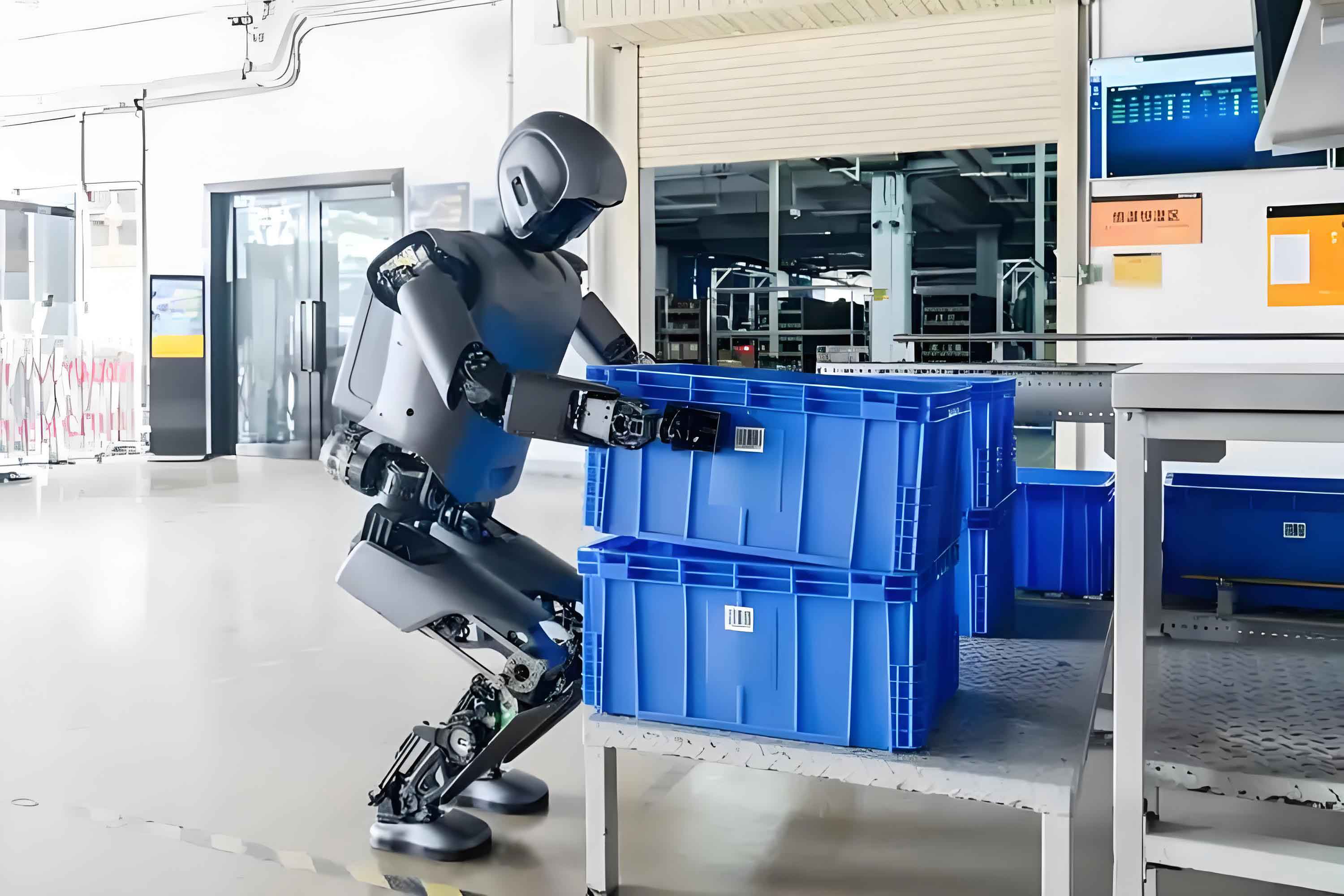
To illustrate the integration, I often use a table that compares the key characteristics of hydraulic and pneumatic transmission in intelligent robot applications. This helps students visualize the trade-offs and select appropriate systems for specific tasks.
| Characteristic | Hydraulic Transmission in Intelligent Robots | Pneumatic Transmission in Intelligent Robots |
|---|---|---|
| Power Density | High, suitable for heavy-duty intelligent robots | Moderate, ideal for lightweight intelligent robots |
| Response Time | Slower due to fluid inertia | Faster, enabling agile movements in intelligent robots |
| Control Precision | High, with advanced servo systems for intelligent robots | Lower, but sufficient for many intelligent robot tasks |
| Cost | Higher initial investment | Lower, making it accessible for diverse intelligent robot projects |
| Maintenance | Requires regular fluid management | Simpler, with less frequent upkeep |
The fusion of these transmission systems with intelligent robot technology involves advanced control strategies. For instance, in hydraulic systems, proportional-integral-derivative (PID) controllers are used to regulate pressure and flow, enhancing the performance of intelligent robots. The transfer function of a PID controller can be represented as $$ G(s) = K_p + \frac{K_i}{s} + K_d s $$, where \( K_p \), \( K_i \), and \( K_d \) are tuning parameters. In pneumatic systems, fuzzy logic or neural networks may be employed to adapt to varying loads in intelligent robots, reflecting the trend toward智能化. By incorporating such concepts into the curriculum, students learn to design and optimize transmission systems for intelligent robots, moving beyond rote memorization.
However, achieving this integration in teaching requires innovative approaches. One effective method is leveraging advanced technology to辅助教学. In my classes, I utilize virtual simulation platforms that allow students to experiment with hydraulic and pneumatic systems in a risk-free environment. These platforms, often based on software like MATLAB/Simulink or LabVIEW, enable students to model intelligent robot components and test control algorithms. For example, a virtual hydraulic circuit for an intelligent robot arm can be simulated to study the effects of valve adjustments on motion accuracy. The dynamics of such a system can be described by differential equations, such as $$ \frac{dP}{dt} = \frac{Q}{C} – \frac{P}{R} $$, where \( Q \) is the flow rate, \( C \) is the capacitance, and \( R \) is the resistance. Through simulations, students gain hands-on experience without the need for expensive physical labs, fostering a deeper understanding of how hydraulic and pneumatic transmission powers intelligent robots.
Another key aspect of reform is project-based learning combined with teamwork. I design projects where students work in groups to develop functional prototypes of intelligent robots that incorporate hydraulic or pneumatic systems. For instance, a recent project involved building a small-scale intelligent robot for object sorting using pneumatic actuators. Students had to apply principles like the continuity equation $$ Q = A \cdot v $$, where \( v \) is the velocity, to size components and ensure efficient operation. This approach mirrors real-world engineering challenges, where collaboration and problem-solving are essential. The table below summarizes the benefits of this teaching method in the context of intelligent robots.
| Teaching Method | Benefits for Hydraulic and Pneumatic Transmission Education | Impact on Intelligent Robot Skills |
|---|---|---|
| Project-Based Learning | Encourages practical application of theoretical knowledge | Develops design and integration abilities for intelligent robots |
| Team Collaboration | Enhances communication and分工 skills | Prepares students for multidisciplinary intelligent robot projects |
| Virtual Simulations | Provides safe, repeatable实验 opportunities | Allows testing of intelligent robot control strategies without hardware risks |
| Real-World Case Studies | Connects concepts to industry trends | Inspires innovation in intelligent robot applications |
In addition to simulations, I incorporate data analysis and machine learning techniques to reflect the智能化 of modern intelligent robots. For example, students might collect pressure and flow data from a pneumatic system in an intelligent robot and use regression models to predict performance. The relationship can be expressed as $$ y = \beta_0 + \beta_1 x_1 + \beta_2 x_2 + \epsilon $$, where \( y \) is the output force, \( x_1 \) and \( x_2 \) are input pressures, and \( \epsilon \) is the error term. This not only reinforces transmission principles but also introduces students to the data-driven decision-making prevalent in intelligent robot development.
Despite the progress, challenges remain in implementing these reforms. Resource constraints, such as limited access to advanced software or hardware for intelligent robot projects, can hinder hands-on learning. To address this, I advocate for open-source tools and cloud-based platforms that democratize access. Moreover, faculty training is crucial to ensure educators can effectively guide students through the complexities of hydraulic and pneumatic transmission in intelligent robots. Continuous professional development programs can help instructors stay updated on the latest trends, such as the integration of IoT sensors in intelligent robots for predictive maintenance of transmission systems.
Looking ahead, the future of hydraulic and pneumatic transmission teaching in the age of intelligent robots is bright. I envision a curriculum that seamlessly blends traditional engineering fundamentals with emerging technologies like artificial intelligence and robotics. For instance, students might explore how reinforcement learning algorithms can optimize the energy efficiency of hydraulic systems in autonomous intelligent robots. The reward function in such algorithms could be defined as $$ R = \sum_{t} ( – \alpha E_t + \beta P_t ) $$, where \( E_t \) is energy consumption and \( P_t \) is performance at time \( t \), with weights \( \alpha \) and \( \beta \). This interdisciplinary approach will prepare students to contribute to the next generation of intelligent robots that are more adaptive, efficient, and sustainable.
In conclusion, reforming the teaching mode of hydraulic and pneumatic transmission is essential to keep pace with the advancements in intelligent robot technology. By integrating theoretical concepts with practical applications, leveraging technology for辅助教学, and fostering collaborative learning, we can equip students with the skills needed to innovate in this dynamic field. The journey requires ongoing effort and adaptation, but the potential benefits—such as producing engineers who can design intelligent robots that transform industries—make it worthwhile. As we move forward, I am committed to refining these approaches and sharing insights with the broader educational community to drive progress in intelligent robot education.
To further elaborate, let’s consider the mathematical modeling of a hydraulic system in an intelligent robot. The force generated by a hydraulic cylinder can be derived from the pressure difference across its piston. If \( P_1 \) and \( P_2 \) are the pressures on either side, and \( A_1 \) and \( A_2 \) are the respective areas, the net force is $$ F = P_1 A_1 – P_2 A_2 $$. This equation is fundamental for students designing intelligent robots that require precise force control. Similarly, in pneumatic systems, the flow rate through a valve can be modeled using the orifice equation $$ Q = C_d A \sqrt{\frac{2 \Delta P}{\rho}} $$, where \( C_d \) is the discharge coefficient, \( A \) is the area, \( \Delta P \) is the pressure drop, and \( \rho \) is the density. By mastering these formulas, students can optimize the performance of intelligent robots for specific tasks.
Another area of focus is the control of hybrid systems that combine hydraulic and pneumatic elements in intelligent robots. For example, an intelligent robot might use hydraulic actuators for heavy lifting and pneumatic grippers for delicate handling. The overall system dynamics can be represented by state-space equations: $$ \dot{x} = Ax + Bu $$, $$ y = Cx + Du $$, where \( x \) is the state vector (e.g., pressures and positions), \( u \) is the input (e.g., valve commands), and \( y \) is the output (e.g., robot motion). Teaching these advanced concepts prepares students for the complexity of modern intelligent robots, where multiple transmission systems work in harmony.
In terms of assessment, I have shifted from traditional exams to competency-based evaluations that mirror real-world scenarios. Students might be tasked with troubleshooting a faulty hydraulic circuit in an intelligent robot or designing a pneumatic control system for a new intelligent robot application. These assessments emphasize critical thinking and creativity, aligning with the needs of the intelligent robot industry. Moreover, I encourage students to participate in competitions or internships focused on intelligent robots, providing them with exposure to cutting-edge practices.
The role of industry collaboration cannot be overstated. By partnering with companies that develop intelligent robots, we can bring real-world案例 into the classroom. Guest lectures from engineers working on intelligent robot projects, site visits to manufacturing plants using intelligent robots, and joint research initiatives all enrich the learning experience. For instance, students might analyze data from an intelligent robot deployed in a warehouse to improve its pneumatic conveyance system, applying statistical tools like hypothesis testing with $$ t = \frac{\bar{x} – \mu}{s/\sqrt{n}} $$ to validate improvements.
Finally, I reflect on the ethical and societal implications of intelligent robots powered by hydraulic and pneumatic transmission. As educators, we must discuss topics such as safety standards, environmental impact, and the future of work. For example, the energy consumption of hydraulic systems in intelligent robots raises questions about sustainability, prompting students to explore greener alternatives like electro-hydraulic hybrids. By fostering a holistic perspective, we ensure that graduates not only excel technically but also contribute responsibly to the development of intelligent robots.
In summary, the reform of hydraulic and pneumatic transmission teaching is a continuous journey that adapts to the evolving landscape of intelligent robot technology. Through innovative methods, interdisciplinary integration, and a focus on practical skills, we can prepare students to lead in the era of intelligent robots. I am excited to see how these efforts will shape the next generation of engineers and the intelligent robots they create.