
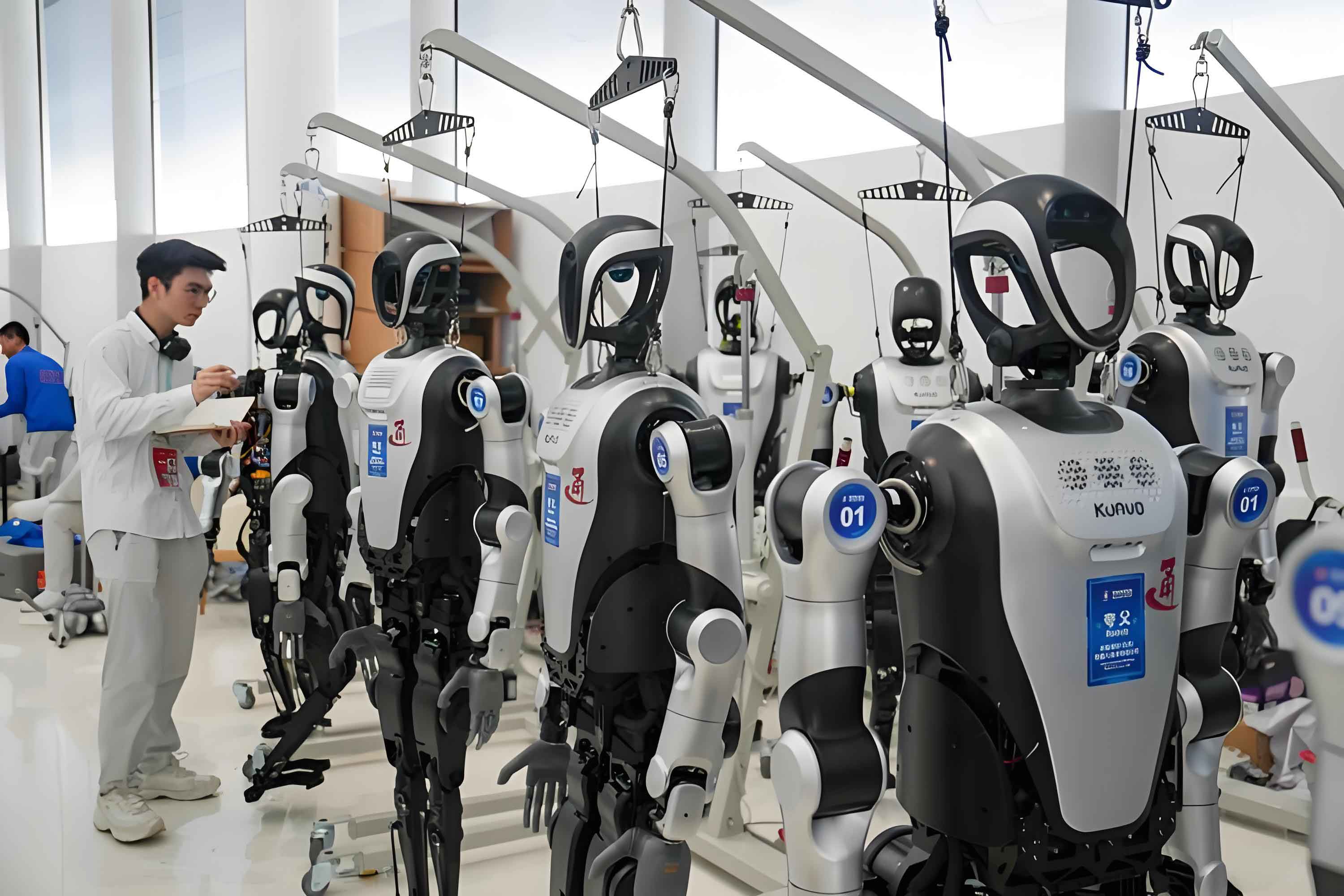
The rapid evolution of artificial intelligence and biomimetic technologies has propelled the humanoid robot from controlled laboratory environments into the fabric of our daily lives. Their integration into sectors such as healthcare, domestic service, and public security presents a paradigm shift, promising unprecedented efficiency and novel forms of interaction. However, this very promise is intertwined with profound legal and ethical quandaries. The anthropomorphic design and autonomous decision-making capabilities of humanoid robots raise acute concerns regarding data privacy, algorithmic bias, liability attribution, and the erosion of fundamental social values. Existing legal frameworks globally exhibit a reactive lag, struggling to contend with an entity that blurs the line between advanced tool and simulated agent. This analysis, therefore, stems from the pressing need to construct a theoretically sound and pragmatically viable regulatory model. The central thesis is that the principle of proportionality, with its structured four-step test, offers a critical methodological framework for navigating this complex terrain. By applying this principle, we can aspire to develop a graded and classified regulatory approach that mitigates the risks of a “technological leviathan” while fostering an environment conducive to responsible innovation, thereby informing the adaptive transformation of legal systems for the intelligent age.
The Multifaceted Conflict of Interests in Humanoid Robot Proliferation
The scaling of humanoid robot applications is not merely a technical or commercial event; it is a socio-economic phenomenon that catalyzes deep-seated conflicts among competing values and stakeholder interests. As these machines transition from industrial floors to intimate spaces like homes and hospitals, the spectrum of conflict widens significantly. We can categorize these tensions into several core dichotomies, as summarized in the table below.
| Conflict Dimension | Core Tension | Stakeholders Involved | Primary Risks |
|---|---|---|---|
| Labor & Economic Efficiency | Workforce displacement vs. Productivity gains and cost reduction. | Employees, Unions, Corporations, Policymakers. | Structural unemployment, skill gaps, increased inequality, social instability. |
| Privacy & Data Utilization | Individual data protection vs. Data-driven functionality and commercial value. | Individual citizens, Data subjects, Tech companies, Advertisers. | Mass surveillance, sensitive data leaks, opaque algorithmic profiling, loss of autonomy. |
| Public Safety & Technological Innovation | Risk mitigation and harm prevention vs. Unhindered R&D and market competitiveness. | General Public, Regulators, Security agencies, Robotics firms, Researchers. | Physical harm from malfunctions or hacking, ethical breaches in autonomous decisions, stifled innovation. |
| Social Ethics & Human Dignity | Preservation of human values and relationships vs. Functional utility of anthropomorphic agents. | Society at large, Ethicists, Families, Vulnerable groups (children, elderly). | Objectification, erosion of empathy, distortion of social bonds, moral confusion. |
The first conflict, between labor rights and economic efficiency, is perhaps the most immediately tangible. The automation potential of humanoid robots threatens to disrupt labor markets, particularly in service and manufacturing sectors. The economic benefit for firms—lower costs and higher output—directly contrasts with the social cost of potential mass unemployment and the devaluation of certain human skills.
The second conflict revolves around the insatiable data appetite of intelligent systems. A humanoid robot operating in a home or public space continuously collects a myriad of data points: visual feeds, vocal interactions, biometric information, and behavioral patterns. The tension lies between leveraging this data for personalized service and algorithmic improvement, and protecting individuals from privacy invasions and the potential for manipulation. This creates a fundamental trade-off, expressible in a conceptual formula where societal benefit is weighed against privacy cost:
$$ \text{Net Benefit} = \mathcal{F}(\text{Data Utility}, \text{Innovation Gain}) – \mathcal{G}(\text{Privacy Intrusion}, \text{Risk of Misuse}) $$
Where $\mathcal{F}$ and $\mathcal{G}$ are functions representing the aggregated benefits and costs, respectively.
The third conflict, between public safety and innovation, presents a classic regulatory dilemma. Strict safety and security mandates (e.g., rigorous pre-market testing, algorithmic transparency requirements, kill-switch mandates) may dampen the pace of innovation and increase time-to-market. Conversely, a permissive “innovation-first” stance elevates the risk of physical harm, security breaches, and unethical outcomes. Regulators must find an equilibrium point that does not disproportionately sacrifice one value for the other.
Interest Balancing: The Foundational Approach to Regulation
Given this landscape of competing and often incommensurable interests, a simplistic, binary regulatory approach (complete prohibition vs. total laissez-faire) is destined to fail. Instead, the theory of interest balancing must be explicitly integrated into the governance of humanoid robot proliferation. This theory provides a dynamic and contextual framework for identifying, comparing, and reconciling conflicting claims in the process of rule-making and application.
The Core of Interest Balancing Theory
The theory operates on two fundamental pillars. The first is the systematic identification and comparison of plural interests. It necessitates mapping the entire ecosystem of stakeholders—from developers and manufacturers to end-users, workers, ethicists, and the broader public—and understanding their respective claims. This is not a static list but requires continuous engagement through participatory mechanisms like public hearings, expert panels, and multi-stakeholder forums. The goal is to assign relative weights to these interests based on criteria such as their fundamentality (e.g., bodily integrity vs. commercial profit), the severity of potential harm, and the possibility of finding synergistic solutions.
The second pillar is dynamic adaptability and elastic adjustmenthumanoid robot technology means that today’s balanced solution may become obsolete or unfair tomorrow. Therefore, legal and regulatory frameworks must incorporate feedback loops and revision mechanisms. This can be achieved through sunset clauses, mandatory periodic review processes, and regulatory sandboxes that allow for real-world testing under supervised conditions. The governing principle can be modeled as an iterative function:
$$ R_{t+1} = B(R_t, I_t, S_t, \epsilon_t) $$
Where $R_{t+1}$ represents the regulatory stance at time $t+1$, which is a function $B$ (the balancing function) of the previous regulation $R_t$, new information or inputs $I_t$, shifting societal values $S_t$, and emerging technological evidence $\epsilon_t$.
Proportionality as the Primary Tool for Balancing
While interest balancing provides the overarching philosophical framework, the principle of proportionality offers the essential, concrete analytical tool for its implementation. Proportionality ensures that any regulatory measure restricting an interest (e.g., commercial freedom, innovation) is justified and finely tuned. Its modern, widely accepted structure involves a four-stage test that sequentially questions the legitimacy and design of the intervention. This test will serve as the scaffold for our proposed regulatory analysis of humanoid robot普及.
- Legitimate Aim: Does the regulation pursue a constitutionally or socially legitimate objective (e.g., protecting life, privacy, public order)?
- Suitability (Appropriateness): Is the chosen regulatory measure rationally connected to and capable of achieving that legitimate aim?
- Necessity: Among all measures that could equally achieve the aim, does this one impose the least restrictive burden on the affected rights or interests?
- Proportionality stricto sensu (Balancing): Does the overall benefit achieved by the measure outweigh the detriment it causes to the restricted interest? Does it strike a fair balance?
Legitimate Aim: Circumscribing the Application Scenarios for Humanoid Robots
The first filter of proportionality demands that the very deployment of a humanoid robot in a given context must serve a legitimate purpose. This transcends mere technical feasibility or economic gain; it requires a value-laden inquiry rooted in ethics and law. The core mandate is that humanoid robot applications must align with the meta-principle of “technology for good,” serving humanity and its fundamental values.
This legitimacy check originates from a dual foundation: moral philosophy and positive law. From a moral standpoint, the anthropomorphism of these machines triggers profound questions about human dignity, autonomy, and social relations. Long-term, intimate interaction with a humanoid robot may risk emotional substitution, blurring the lines of moral responsibility and potentially leading to the objectification of human counterparts. Therefore, applications must be scrutinized for their impact on human flourishing. A simple ethical calculus can be proposed:
$$ \text{Legitimacy Score (L)} = w_1 \cdot V_{\text{promotion}} – w_2 \cdot V_{\text{erosion}} $$
Here, $V_{\text{promotion}}$ represents promoted values (safety, health, companionship for the isolated), $V_{\text{erosion}}$ represents eroded values (privacy, authentic empathy, human agency), and $w_1$, $w_2$ are ethical weightings assigned through democratic deliberation.
Legally, this moral imperative must be translated into concrete norms. This involves prohibitions on applications inherently malevolent or excessively risky. For instance:
| Scenario Type | Legitimacy Assessment | Legal/Policy Implication |
|---|---|---|
| Combat/Offensive Military | High risk of violating international humanitarian law, devaluing human life. Legitimacy highly suspect. | International moratorium or ban under specific treaties; strict national export controls. |
| Intimate Companion (replacing human bonds) | High risk of psychological dependency and social atrophy. Legitimacy conditional on safeguards. | Heavy regulation, mandatory counseling warnings, age restrictions, “non-isolation” protocols. |
| Public Surveillance & Policing | Legitimate aim of public safety, but high risk to privacy and freedom of assembly. | Strict necessity and proportionality test per operation; bans on certain functions (e.g., emotion recognition for pre-crime). |
| Medical Surgery Assistant | Clear legitimate aim (patient health). High technical safety threshold required. | Rigorous certification as medical device; “human-in-the-loop” requirement for critical decisions. |
| Industrial Manufacturing & Logistics | Legitimate aim of productivity and handling hazardous tasks. | Focus on workplace safety standards, human-robot collaboration protocols, retraining programs. |
Thus, the legitimate aim stage acts as a critical gatekeeper, excluding humanoid robot deployments that are inherently contrary to human dignity or public safety, and subjecting all others to the following tiers of scrutiny.
Proportionality Control in Specific Application Scenarios
For deployments that pass the legitimate aim test, regulation must then conform to the three operational sub-principles of proportionality: suitability, necessity, and balancing.
Suitability: Assessing the Effectiveness of Humanoid Robot Proliferation
The suitability prong asks: Is the decision to deploy humanoid robots at scale in a specific domain a rational and effective means to achieve the stated legitimate aim? This involves a critical analysis of the “why here?” question. We must move beyond techno-optimism to ask if the anthropomorphic form is genuinely advantageous. The argument for the humanoid robot‘s suitability often hinges on two factors: the high cost of re-engineering human-centric environments, and the intuitive nature of human-robot interaction. However, suitability requires evidence. A proposed metric for sectoral suitability could be:
$$ S_{\text{sector}} = \frac{E_{\text{humanoid}} – E_{\text{non-humanoid}}}{C_{\text{adaptation}} + R_{\text{social}}} $$
Where $S_{\text{sector}}$ is the suitability score for a sector, $E$ represents effectiveness gains, $C_{\text{adaptation}}$ is the cost of adapting the environment, and $R_{\text{social}}$ is a quantified social risk factor. A high positive score indicates strong suitability.
This assessment necessitates robust ex-ante impact evaluations. Before widespread rollout, mandated assessments should be conducted:
- Algorithmic Impact Assessment (AIA): Evaluating the fairness, accountability, and transparency of the decision-making algorithms.
- Data Protection Impact Assessment (DPIA): Identifying and mitigating risks to personal data privacy and security.
- Socio-Economic Impact Assessment: Modeling effects on employment, necessary skills training, and community dynamics.
Only if these assessments demonstrate a clear, net-positive pathway to achieving the sector’s legitimate aims (e.g., improved healthcare outcomes, efficient disaster response) should规模化 application be deemed “suitable.”
Necessity: Identifying the Minimal Intervention Path
Assuming suitability is established, the necessity test demands: Among all regulatory and design options that can achieve the legitimate aim with equal effectiveness, are we choosing the one that least infringes on other rights and interests? For humanoid robots, this is crucial in mitigating their unique “anthropomorphic trap.”
The greatest necessity-driven restrictions should target the specific risks amplified by the human-like form. To prevent the erosion of human subjectivity and privacy, regulators should enforce design and deployment constraints that are minimally burdensome yet maximally protective. Consider the following hierarchy of interventions for a caregiving humanoid robot:
| Regulatory Option | Restrictiveness | Effectiveness in Protecting Dignity/Privacy | Necessity Test Verdict |
|---|---|---|---|
| Ban on caregiving robots. | Extreme | High, but eliminates all benefits. | Fails. Less restrictive options exist. |
| Mandate non-humanoid form factor. | High | High (reduces emotional attachment risk). | May fail if humanoid form is proven uniquely suitable for task. |
| Strict functional limits (no intimate care, conversation limits). | Moderate | Moderate to High. | Strong candidate if equally effective. |
| Transparency mandates (“I am a robot”), data local processing, user-controlled data sharing. | Low to Moderate | Moderate (preserves user autonomy and understanding). | Likely PASSES as a necessary, minimal set of restrictions. |
The necessity principle argues for layering the last option—minimal transparency and user-control mandates—first, before escalating to more intrusive functional bans, unless a clear and present danger is demonstrated. It pushes for “privacy-by-design” and “ethics-by-design” as default, necessary standards rather than afterthoughts.
Proportionality Stricto Sensu: The Final Balancing Act
The final stage is a holistic judgment: Do the overall benefits of allowing the scaled application of humanoid robots in a certain manner (post-necessity restrictions) outweigh the residual costs and risks? This is not a scientific formula but a deliberative judgment on societal priorities. It directly confronts the tension between an absolutist “precautionary principle” and a utilitarian “innovation principle.”
We must reject the notion of “zero-risk” as both illusory and paralyzing. The pursuit of absolute safety would entail prohibitive costs and stifle the development of beneficial technologies. The relevant equation here is one of dynamic equilibrium:
$$ \frac{d(\text{Innovation Benefit})}{dt} \propto \mathcal{H}(\text{Controlled Risk}) $$
Where the rate of beneficial innovation is a function $\mathcal{H}$ of a level of risk that is actively managed and kept within socially acceptable bounds. The goal of regulation is not to eliminate $\text{Risk}$ but to optimize this function.
Therefore, at this stage, regulators must explicitly weigh factors such as:
- The magnitude of the public good (e.g., solving caregiver shortages for an aging population).
- The severity and probability of remaining risks (e.g., a 0.1% chance of a critical software bug causing physical harm).
- The availability of redress mechanisms (e.g., insurance schemes, clear liability rules).
- The adaptability of society and the potential for mitigating risks over time through learning and improved technology.
A decision to permit a scaled application signifies that, on balance, the societal gain in well-being, efficiency, or problem-solving capacity justifies the carefully managed and minimized set of accompanying risks. It embraces a model of “regulated innovation” or “permissioned evolution.”
Conclusion: Toward an Adaptive Legal Framework
The disruptive trajectory of humanoid robot technology necessitates a fundamental shift from ex-post liability models to ex-ante, process-oriented governance. The principle of proportionality, as elaborated through its four-step test, provides the structured analytical spine for this new governance paradigm. It moves us beyond reaction and toward guided, responsible development.
The future requires concretizing this analytical framework into tangible institutions and rules. Key recommendations include:
- Enact a Specialized Law: A “Humanoid Robot Development and Governance Act” should codify the proportionality test, mandate the tiered impact assessments, and establish clear, sector-specific regulatory sandboxes.
- Establish a Multidisciplinary Oversight Body: A regulatory agency equipped with technical, legal, and ethical expertise should oversee the proportionality analyses and compliance.
- Develop a Dynamic Risk Classification Matrix: A living document that classifies humanoid robot applications based on their “risk score,” which determines the intensity of regulatory scrutiny. The score could be a composite index:
$$ \text{Risk Score} = \alpha \cdot \text{Physical Risk} + \beta \cdot \text{Privacy Risk} + \gamma \cdot \text{Socio-Economic Risk} + \delta \cdot \text{Ethical Risk} $$
where $\alpha, \beta, \gamma, \delta$ are calibrated weights. - Foster International Regulatory Cooperation: Given the global nature of the technology, harmonizing core principles (like the application of proportionality) is essential to prevent regulatory arbitrage and ensure a baseline of safety and ethics.
In conclusion, the challenge of governing humanoid robots is ultimately about governing ourselves and our values in an age of intelligent machines. By embedding the principle of proportionality into the heart of our legal and regulatory systems, we can strive to locate that elusive “golden mean”—a dynamic equilibrium where the immense promise of humanoid robotics is realized not at the expense of human dignity, security, and social cohesion, but in their enduring service.