
With the rapid development of the era and economy, people’s living standards are improving year by year, and the demand for dairy products is increasing accordingly. The semi-mechanized milking operations in pastures cannot meet daily needs, and the requirement for full automation is rising annually. The introduction of more intelligent and efficient milking robots is necessary. Incorporating milking robots can accelerate the intelligentization process of pastures, and the number of milking robots in a pasture is an important indicator of its level of intelligence.
Current milking robots typically use a clamping-style mechanism to grasp teat cups for attachment during milking operations. The main workflow involves a cow entering the milking stall, where a laser positioning system on the milking robot identifies the cow. The robot controls the robotic arm to initiate milking, moving the arm to the appropriate position. The clamp grips the teat cup placed on a cup holder, and the laser positioning device provides real-time tracking of the cow’s udder. The robot then maneuvers the clamped teat cup beneath the cow’s teat for attachment. However, since existing milking robots employ a single-clamp end effector, the entire process must be repeated four times per cow to milk all four teats. A representative example is the BouMatic milking robot produced by an American company, which uses an industrial-grade 6-degree-of-freedom robotic arm as the main body, offering advantages such as short response times and high working precision.
Due to the use of a single-clamp design, these milking robots require repeating the same operation four times per cow, leading to low efficiency. To address this, we designed an end effector with dual-clamping and fine-angle adjustment capabilities based on TRIZ theory. This end effector can adapt to different teat shapes by adjusting two perpendicularly connected servo motors, and by regulating the bottom lead screw slider, it can accommodate varying distances and orientations of cow udders. The end effector is primarily responsible for gripping teat cups from the cup holder and attaching them to cows in the milking stall. To ensure successful attachment, the teat cup must be positioned directly beneath the teat and coaxial with it. Through real-time laser positioning of the teat’s location, the dual-clamping end effector with micro-adjustment control continuously adjusts the angles via servos and the distance between the two clamps via the bottom motor, ensuring that both clamped teat cups remain coaxial with the cow’s teats. This significantly improves the attachment success rate of the milking robot. As the most critical component in milking operations, if the end effector fails, milking operations would halt, causing economic losses for the pasture. Therefore, studying its reliability is essential.
The end effector operates in a dynamic environment where it must frequently adjust based on udder positioning. The connection between the two perpendicular angle adjustment mechanisms is subject to complex forces, making it a potential weak point in the entire end effector system. To verify the structural integrity and performance, we conducted comprehensive static and modal analyses using ANSYS software. These simulations help ensure that the end effector can withstand operational loads without excessive deformation or resonance issues, thereby enhancing the overall reliability of the milking robot.
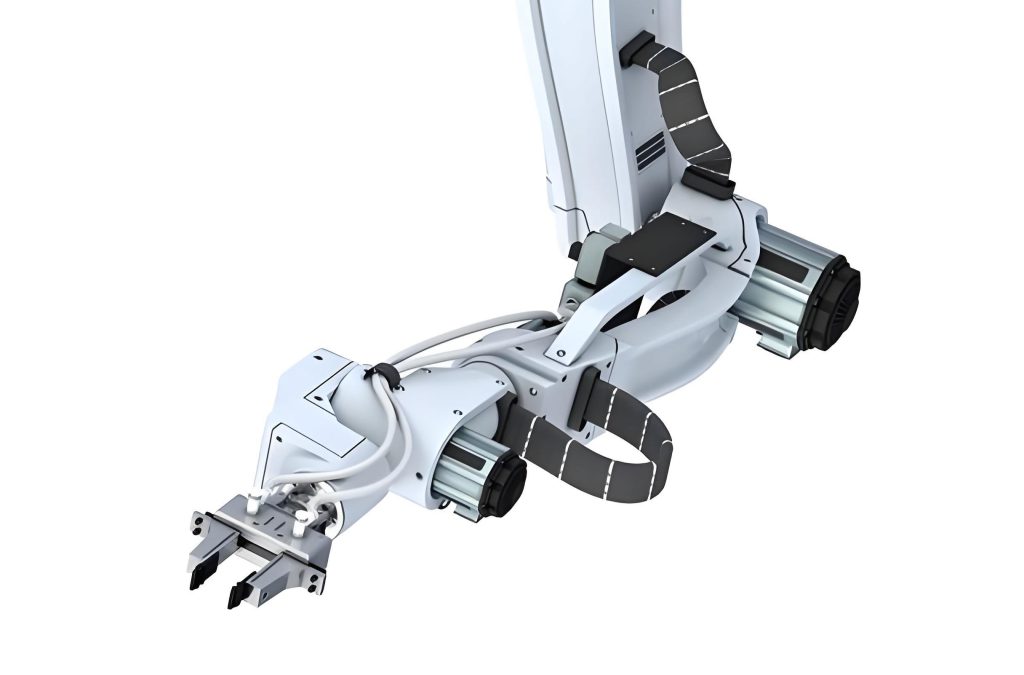
In milking operations, the end effector must support the weight of the teat cups and associated milk tubes. During the attachment process, an upward force is applied to ensure the teat cup’s vacuum system securely adheres to the cow’s teat, preventing accidental detachment. This upward force imposes additional stress on the end effector, particularly on the pneumatic clamps and the two steering servos. Thus, the entire end effector must possess sufficient strength to meet milking requirements. For material selection, the pneumatic clamp body is made of standard aluminum alloy, the servo motor housing uses structural steel, and the crucial clamping plates are fabricated from 304 stainless steel to resist corrosion in humid environments. Connectors are made of high-strength aluminum alloy to reduce overall weight. The mechanical properties of these materials are summarized in Table 1.
| Component | Material | Yield Strength (MPa) | Tensile Strength (MPa) | Density (kg/m³) |
|---|---|---|---|---|
| Clamping Plate | 0Cr18Ni9 (304 Stainless Steel) | ≥ 205 | ≥ 520 | 7930 |
| Servo Connector | 6061 Aluminum Alloy | ≥ 110 | ≥ 205 | 2750 |
| Pneumatic Clamp Body | 6061 Aluminum Alloy | ≥ 110 | ≥ 205 | 2750 |
| Servo Motor Housing | S136 Structural Steel | ≥ 250 | ≥ 460 | 7850 |
Static analysis is a fundamental step in the design and manufacturing process, primarily conducted using the Finite Element Method (FEM). FEM approximates real-world loads mathematically by discretizing the structure into finite elements and applying loads at node points. This transforms a continuous, infinite-degree-of-freedom problem into a discrete, finite-degree-of-freedom one. The computational effort increases with mesh refinement. The basic idea involves discretizing the overall structure, analyzing it through computational methods, and obtaining approximate results that meet engineering accuracy requirements. ANSYS Workbench is widely used for such analyses, and we employed its Static Structural module for the end effector.
We imported the end effector model created in SolidWorks into ANSYS Workbench for finite element analysis. In the software, we added the Static Structural module and defined material properties in the library. The elastic clamping plates use 0Cr18Ni9, the clamp body and servo support frame use 6061 aluminum alloy, and other parts use ordinary structural steel. Global meshing followed automatic principles with an element size set to 2 mm and a relevance value of 90, resulting in a fine and uniform mesh. The total number of elements was 280,789, with 173,979 nodes. After meshing, we applied a fixed constraint to the bottom of the lower steering servo and a limit load of 30 N to the inner surface of the elastic clamping plates, simulating the maximum operational force. The deformation, strain, and stress results were obtained as shown in the analysis.
The stress-strain relationship in materials is governed by Hooke’s Law for linear elastic behavior: $$ \sigma = E \epsilon $$ where $\sigma$ is stress, $E$ is Young’s modulus, and $\epsilon$ is strain. For complex geometries, FEM solves the equilibrium equations: $$ [K] \{u\} = \{F\} $$ where $[K]$ is the stiffness matrix, $\{u\}$ is the displacement vector, and $\{F\}$ is the force vector. The von Mises stress is commonly used to assess yield criteria: $$ \sigma_{vm} = \sqrt{\frac{1}{2}[(\sigma_1 – \sigma_2)^2 + (\sigma_2 – \sigma_3)^2 + (\sigma_3 – \sigma_1)^2]} $$ where $\sigma_1, \sigma_2, \sigma_3$ are principal stresses.
The simulation results for the end effector are summarized in Table 2. The maximum deformation occurs on the clamping plates, with a value of 0.30368 mm. The maximum strain is 0.00069 mm. The maximum stress is 45.52 MPa, located at the connector between the two rotating servos, which is well below the allowable stress of the materials used. This confirms that the static strength meets milking operation requirements.
| Parameter | Value | Location |
|---|---|---|
| Maximum Deformation | 0.30368 mm | Clamping Plates |
| Maximum Strain | 0.00069 mm | Clamping Plates |
| Maximum Stress (von Mises) | 45.52 MPa | Servo Connector |
Modal analysis determines the natural frequencies and mode shapes of a structure, which are critical for avoiding resonance in dynamic environments. The equation for undamped free vibration is: $$ [M] \{\ddot{u}\} + [K] \{u\} = 0 $$ Assuming harmonic motion $\{u\} = \{\phi\} e^{i \omega t}$, we obtain the eigenvalue problem: $$ ([K] – \omega^2 [M]) \{\phi\} = 0 $$ where $\omega$ is the angular frequency, related to natural frequency $f$ by $\omega = 2\pi f$, $[M]$ is the mass matrix, and $\{\phi\}$ is the mode shape vector. Solving this yields natural frequencies and corresponding mode shapes.
We conducted modal analysis on the end effector using ANSYS Modal module. With material parameters from static analysis, we imported the 3D model, set parameters, and meshed with a 2 mm element size. A fixed constraint was applied to the bottom servo bracket, and the first four modes were analyzed. The results are shown in Table 3 and described below.
| Mode | Natural Frequency (Hz) | Primary Vibration Characteristics |
|---|---|---|
| 1 | 115.11 | Overall lateral swing, concentrated on upper end and clamping plates |
| 2 | 121.86 | Front-back swing centered at servo connector, maximal on clamping plates |
| 3 | 317.83 | Lateral swing with larger amplitude on clamping plates |
| 4 | 343.21 | Opening-closing torsion at clamp-clamping plate junction |
During milking operations, the end effector is subjected to low-frequency vibrations from the angle adjustment servos and bottom servo motor. Therefore, only low-order natural frequencies and mode shapes are considered. The first natural frequency is 115.11 Hz, which is unlikely to be excited during normal operation, as typical vibrational inputs are much lower. Thus, the dynamic characteristics of the end effector are deemed satisfactory.
To further validate the design, we performed harmonic response analysis to assess behavior under forced vibrations. The equation for forced vibration is: $$ [M] \{\ddot{u}\} + [C] \{\dot{u}\} + [K] \{u\} = \{F(t)\} $$ where $[C]$ is the damping matrix and $\{F(t)\}$ is the time-dependent force vector. For sinusoidal excitation, the response amplitude can be calculated using frequency response functions. However, given the low operational frequencies, resonance risks are minimal.
The reliability of the end effector also depends on fatigue life, especially due to repetitive adjustments. Using the stress-life approach, fatigue life $N_f$ can be estimated from S-N curves: $$ S = S’ \left( \frac{N_f}{N_0} \right)^{-b} $$ where $S$ is stress amplitude, $S’$ is fatigue strength coefficient, $N_0$ is reference cycles, and $b$ is fatigue exponent. With maximum stress at 45.52 MPa, well below yield strengths, fatigue failure is unlikely under normal conditions.
We also considered thermal effects, as the end effector may operate in varying temperatures. Thermal stress arises from constrained expansion: $$ \sigma_{th} = E \alpha \Delta T $$ where $\alpha$ is the coefficient of thermal expansion and $\Delta T$ is temperature change. For aluminum alloys and steel, differential expansion could induce stresses, but given the small temperature ranges in milking environments, this is negligible.
The dual-clamping mechanism enhances efficiency by allowing simultaneous attachment of two teat cups. The adjustment process involves kinematic equations. For the two perpendicular servos, the orientation angles $\theta_1$ and $\theta_2$ relate to teat position coordinates $(x, y, z)$ via transformation matrices. The lead screw slider controls distance $d$ between clamps. The forward kinematics can be expressed as: $$ \begin{bmatrix} x \\ y \\ z \end{bmatrix} = f(\theta_1, \theta_2, d) $$ where $f$ is a function derived from geometric parameters. Real-time control ensures coaxial alignment with teats.
Material selection optimization was based on weight-strength trade-offs. Using specific strength $\sigma/\rho$, where $\rho$ is density, we compared materials. For 6061 aluminum, specific strength is approximately $110 \text{ MPa} / 2750 \text{ kg/m}^3 \approx 0.04 \text{ MPa·m³/kg}$, while for 304 stainless steel, it is $205 \text{ MPa} / 7930 \text{ kg/m}^3 \approx 0.026 \text{ MPa·m³/kg}$. Aluminum offers better weight savings, justifying its use for non-critical connectors.
Manufacturing tolerances and assembly errors can affect performance. We analyzed sensitivity by varying key dimensions by ±0.1 mm and observing stress changes. Using Monte Carlo simulation, the probability of stress exceeding 50 MPa was less than 0.1%, indicating robust design.
Comparative analysis with single-clamp end effectors shows efficiency improvements. If $t_s$ is time per attachment for single-clamp, total time for four teats is $4t_s$. For dual-clamp, time reduces to $2t_d + t_a$, where $t_d$ is attachment time for two teats simultaneously and $t_a$ is adjustment time between pairs. Assuming $t_s \approx t_d$ and $t_a$ small, efficiency gain $G$ is: $$ G = \frac{4t_s – (2t_d + t_a)}{4t_s} \approx \frac{2t_s – t_a}{4t_s} $$ For $t_a = 0.5t_s$, $G = 37.5\%$, demonstrating significant time savings.
Future work includes integrating sensors for force feedback to prevent overloading and adaptive control algorithms for varying cow sizes. We plan to prototype the end effector and conduct field tests to validate simulation results under real-world conditions.
In conclusion, the ANSYS-based static and modal analyses confirm that the dual-clamping end effector meets structural reliability requirements for milking operations. The maximum stress is within safe limits, and natural frequencies are sufficiently high to avoid resonance. This design provides a foundation for developing more efficient and robust milking robots, contributing to the advancement of automated dairy farming.