
The pursuit of high reliability in precision power transmission components is paramount, especially within the demanding field of industrial robotics. Among these components, the Rotary Vector (RV) reducer stands out due to its compact structure, high reduction ratio, exceptional torsional rigidity, and positioning accuracy. Its operational integrity is critical for the performance and longevity of robotic systems. However, conducting a precise reliability analysis for the RV reducer presents significant challenges. The system’s complexity, involving interactions between multiple sub-assemblies like planetary gears and cycloidal drives, often leads to situations where historical failure data is incomplete, vague, or partially known. Traditional binary-state Fault Tree Analysis (FTA) struggles to model the multi-state nature of component degradation (e.g., no fault, partial wear, complete failure) and the inherent uncertainties in failure probabilities and logical relationships between events.
To address these limitations, this article develops an advanced reliability analysis model by integrating T-S fuzzy fault tree theory with Bayesian Networks (BN). The proposed model adeptly handles the fuzziness in failure data, the multi-state characteristics of components, and the uncertain causal logic within the RV reducer system. This integrated approach, a Fuzzy Bayesian Network (FBN), facilitates both forward reasoning for reliability prediction and backward inference for diagnostic analysis, offering a more robust framework for reliability assessment under uncertainty.
The core methodology involves constructing a T-S fuzzy fault tree based on identified failure modes and expert knowledge, which is then systematically mapped into a Fuzzy Bayesian Network model. This mapping preserves the logical structure while incorporating probabilistic reasoning. Finally, importance measures are calculated within the BN framework to identify the most critical components affecting the overall system reliability. This analysis provides vital data-driven insights for enhancing the design robustness and formulating effective preventive maintenance strategies for the RV reducer.
Theoretical Framework: From T-S Fuzzy Fault Trees to Bayesian Networks
The foundation of our model lies in the synergy between T-S fuzzy fault trees and Bayesian Networks. A T-S fuzzy fault tree extends conventional FTA by allowing events to exist in multiple discrete states (e.g., 0: Normal, 1: Degraded, 2: Failed) and by defining the relationship between input (basic event) states and output (intermediate/top event) states using fuzzy “if-then” rules rather than deterministic Boolean gates (like AND/OR). This is crucial for modeling the progressive failure of mechanical components like gears and bearings in an RV reducer.
A Bayesian Network, conversely, is a probabilistic graphical model represented by a directed acyclic graph (DAG). Nodes in the graph represent random variables (system state, component states), and directed edges between nodes represent conditional dependencies. The strength of these dependencies is quantified using Conditional Probability Tables (CPTs). The BN is characterized by the joint probability distribution of all nodes, which factorizes conveniently due to the conditional independence assumptions implied by the graph structure:
$$ P(X_1, X_2, …, X_n) = \prod_{i=1}^{n} P(X_i | \text{Pa}(X_i)) $$
where \( \text{Pa}(X_i) \) denotes the parent nodes of \( X_i \). This structure makes BNs powerful for both predictive (forward) and diagnostic (backward) reasoning using Bayes’ theorem:
$$ P(B_i | A) = \frac{P(A | B_i) P(B_i)}{P(A)} = \frac{P(A | B_i) P(B_i)}{\sum_{j=1}^{n} P(A | B_j) P(B_j)} $$
The mapping from a T-S fuzzy fault tree to a BN is a structured, three-step process, as summarized in the table below:
| Mapping Phase | Description |
|---|---|
| 1. Structural Mapping | The hierarchical tree structure of the T-S FTA is directly translated into a DAG. Basic events become root nodes, intermediate events become child nodes, and the top event becomes the ultimate leaf node. The directed edges flow from basic/intermediate events to their immediate parent event in the fault tree. |
| 2. Parameter Mapping | The fuzzy “if-then” rules of each T-S gate define the conditional relationship between a parent node and its children. The set of all rules for a given gate is used to populate the Conditional Probability Table (CPT) of the corresponding parent node in the BN. This quantitatively encodes the uncertain failure logic. |
| 3. State Definition | The multi-state definitions (e.g., {0, 1, 2}) for all events in the T-S model are carried over directly to the corresponding nodes in the BN, enabling analysis beyond simple working/failed binary states. |
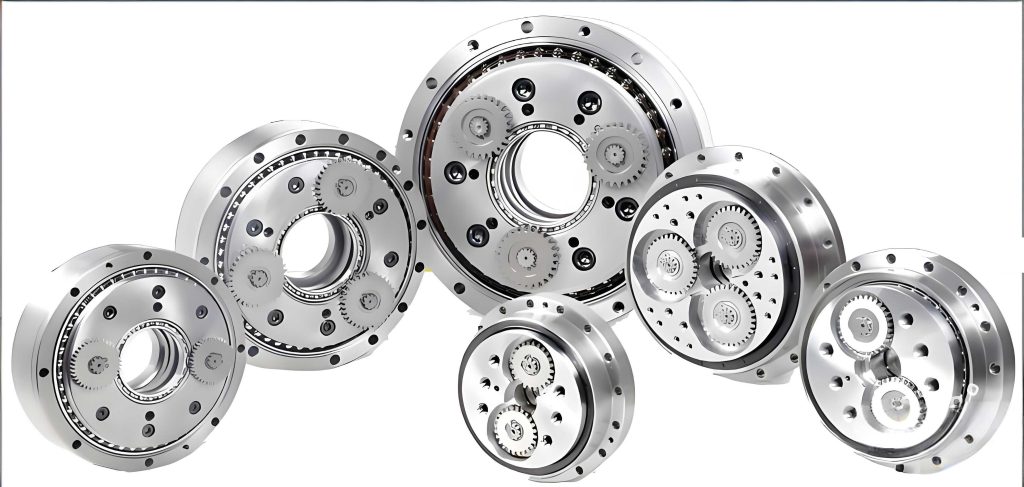
The operational principle of the RV reducer is critical for understanding its failure modes. As illustrated in the figure, the system comprises two primary stages. The first stage is a planetary gear train. An input sun gear, connected to the servo motor, drives multiple planet gears. The second stage is a cycloidal-pin gear mechanism. The planet gears are mounted on crankshafts, which eccentrically drive cycloidal disks (or RV gears). These disks mesh with a static ring of pin gears housed in the casing. The unique motion of the cycloidal disks—a combination of revolution and rotation—is translated into a reduced output rotation via the crankshafts, which are connected to the output flange. This compact, high-ratio mechanism involves numerous precision components like gears, bearings, and shafts, each susceptible to specific failure modes.
Reliability Analysis Metrics within the Fuzzy Bayesian Framework
Once the Fuzzy Bayesian Network model for the RV reducer is established, we can perform probabilistic inference to calculate key reliability metrics. Let \( X = (X_1, X_2, …, X_n) \) represent the set of root nodes (basic components) in the BN, each with possible fault states \( x_i^{a_i} \). Let \( T \) represent the top event node (system failure) with possible states \( T^q \). Due to the fuzziness of input data, the failure probability of a root node is often expressed as an interval \( P(X_i = x_i^{a_i}) = [\text{Bel}(x_i^{a_i}), \text{Pl}(x_i^{a_i})] \), where Bel (Belief) and Pl (Plausibility) are measures from evidence theory representing the lower and upper bounds of probability, respectively.
Through BN inference (e.g., using the variable elimination or junction tree algorithm), we can compute the system’s failure probability interval:
$$ P(T = T^q) = [\text{Bel}(T = T^q), \text{Pl}(T = T^q)] $$
More importantly, we can calculate importance measures that identify which components most significantly impact system reliability. Two vital measures are:
1. Probability Importance (Birnbaum Importance): This measure quantifies the sensitivity of the system failure probability to changes in the reliability of a specific component. For root node \( X_i \) in state \( x_i^{a_i} \) causing top event state \( T^q \), it is defined as:
$$ I_{Pr}^{T^q}(X_i = x_i^{a_i}) = P(T = T^q | X_i = x_i^{a_i}) – P(T = T^q | X_i = 0) $$
Here, \( P(T = T^q | X_i = x_i^{a_i}) \) is the conditional probability of system failure given component \( i \) is in fault state \( a_i \), and \( P(T = T^q | X_i = 0) \) is the probability given component \( i \) is fully operational (state 0). A higher value indicates a greater influence of that component’s failure on the system.
2. Criticality Importance: This measure refines the probability importance by considering the likelihood of the component’s failure itself. It represents the percentage change in system failure probability resulting from a percentage change in the component’s reliability. It is calculated as:
$$ I_{Cr}^{T^q}(X_i = x_i^{a_i}) = \frac{P(X_i = x_i^{a_i}) \cdot I_{Pr}^{T^q}(X_i = x_i^{a_i})}{P(T = T^q)} $$
The criticality importance is particularly useful for prioritizing maintenance efforts, as it highlights components that are both influential and prone to failure.
Case Study: Fuzzy Bayesian Network Modeling of an RV Reducer
We now apply the described methodology to conduct a detailed reliability analysis of a specific RV reducer model. The first step is to define the system’s boundary and identify all relevant failure modes through FMECA (Failure Mode, Effects, and Criticality Analysis) and expert consultation. The top event (G) is defined as “RV Reducer fails to perform its intended function.” Key intermediate failure events include:
- M1: Crankshaft Assembly Fault
- M2: Planetary Gear Train Fault
- M3: Cycloidal Disk (RV Gear) Fault
- M4: Bearing System Fault
These intermediate events are further decomposed into basic component faults. For instance, M2 (Planetary Gear Fault) can be caused by gear tooth bending fatigue (x4), pitting (x5), scuffing (x6), or wear (x7). A comprehensive fault tree is constructed, linking these events through appropriate T-S fuzzy gates to represent the uncertain propagation of failures. The identified basic events for the RV reducer, along with their estimated fuzzy failure rates (expressed in failures per 10,000 hours of operation), are listed in the following table.
| Fault Code | Component & Failure Mode | Fuzzy Failure Rate (×10⁻⁴) |
|---|---|---|
| x1 | Crankshaft: Bending Deformation | 1.7 |
| x2 | Crankshaft: Fracture | 1.8 |
| x3 | Pin Gear: Tooth Breakage | 2.5 |
| x4 | Planetary Gear: Tooth Fracture | 1.8 |
| x5 | Planetary Gear: Surface Pitting | 1.5 |
| x6 | Planetary Gear: Surface Scuffing | 0.8 |
| x7 | Planetary Gear: Surface Wear | 1.3 |
| x8 | Housing/Casing: Plastic Deformation | 2.5 |
| x9 | Cycloidal Disk: Surface Pitting | 1.8 |
| x10 | Cycloidal Disk: Fatigue Fracture | 2.0 |
| x11 | Cycloidal Disk: Tooth Wear | 0.8 |
| x12 | Bearing: Scuffing | 0.8 |
| x13 | Bearing: Fatigue Spalling | 1.5 |
| x14 | Bearing: Abrasive Wear | 1.2 |
The next crucial step is defining the T-S fuzzy rules. We assign three states to each event: State 0 (Normal/No Fault), State 1 (Minor Fault/Degradation), and State 2 (Severe Fault/Catastrophic Failure). The rules for a T-S gate describe the probability distribution of the output event’s state given the states of all input events. For example, consider an intermediate event \( M_1 \) (Crankshaft Fault) which has two basic inputs: \( x_1 \) (Bending) and \( x_2 \) (Fracture). A set of expert-defined T-S rules for this gate might be:
| Rule # | Input: \( x_1 \) State | Input: \( x_2 \) State | Output: \( P(M_1=0) \) | Output: \( P(M_1=1) \) | Output: \( P(M_1=2) \) |
|---|---|---|---|---|---|
| 1 | 0 | 0 | 1.0 | 0.0 | 0.0 |
| 2 | 0 | 1 | 0.0 | 0.7 | 0.3 |
| 3 | 0 | 2 | 0.0 | 0.2 | 0.8 |
| 4 | 1 | 0 | 0.1 | 0.8 | 0.1 |
| 5 | 1 | 1 | 0.0 | 0.5 | 0.5 |
| 6 | 1 | 2 | 0.0 | 0.1 | 0.9 |
| 7 | 2 | 0 | 0.0 | 0.3 | 0.7 |
| 8 | 2 | 1 | 0.0 | 0.1 | 0.9 |
| 9 | 2 | 2 | 0.0 | 0.0 | 1.0 |
Rule 1 states: IF \( x_1 \) is Normal (0) AND \( x_2 \) is Normal (0), THEN \( M_1 \) is certainly Normal (probability 1.0 for state 0). Rule 9 states: IF both inputs are in Severe Fault state (2), THEN \( M_1 \) is certainly in Severe Fault state (2). The intermediary rules capture the uncertain, graded impact of partial failures. This entire rule table is directly used to populate the Conditional Probability Table (CPT) for node \( M_1 \) in the corresponding Bayesian Network. This process is repeated for every gate in the fault tree to fully parameterize the Fuzzy BN model.
With the complete BN model built—structure defined by the fault tree hierarchy and parameters defined by the T-S rules and prior failure rates from Table 1—we perform probabilistic inference. Using algorithms designed for BNs, we calculate the overall probability of the top event \( G \) (RV reducer failure) being in State 2 (complete failure). More importantly, we compute the Probability Importance and Criticality Importance for each basic component \( x_i \) being in its severe fault state (State 2). The results are ranked and presented below.
| Rank | Component (Fault Mode) | Fault Code | Probability Importance (I_Pr) |
|---|---|---|---|
| 1 | Housing Plastic Deformation | x8 | 0.142 |
| 2 | Cycloidal Disk Fatigue Fracture | x10 | 0.138 |
| 3 | Pin Gear Tooth Breakage | x3 | 0.135 |
| 4 | Crankshaft Fracture | x2 | 0.121 |
| 5 | Planetary Gear Tooth Fracture | x4 | 0.118 |
| 6 | Cycloidal Disk Surface Pitting | x9 | 0.115 |
| 7 | Bearing Fatigue Spalling | x13 | 0.098 |
| 8 | Crankshaft Bending | x1 | 0.095 |
| 9 | Planetary Gear Surface Pitting | x5 | 0.088 |
| 10 | Bearing Abrasive Wear | x14 | 0.082 |
| 11 | Planetary Gear Surface Wear | x7 | 0.076 |
| 12 | Bearing Scuffing | x12 | 0.065 |
| 13 | Cycloidal Disk Tooth Wear | x11 | 0.060 |
| 14 | Planetary Gear Surface Scuffing | x6 | 0.055 |
| Rank | Component (Fault Mode) | Fault Code | Criticality Importance (I_Cr) |
|---|---|---|---|
| 1 | Pin Gear Tooth Breakage | x3 | 0.211 |
| 2 | Housing Plastic Deformation | x8 | 0.209 |
| 3 | Cycloidal Disk Fatigue Fracture | x10 | 0.173 |
| 4 | Crankshaft Fracture | x2 | 0.136 |
| 5 | Planetary Gear Tooth Fracture | x4 | 0.132 |
| 6 | Cycloidal Disk Surface Pitting | x9 | 0.130 |
| 7 | Bearing Fatigue Spalling | x13 | 0.092 |
| 8 | Planetary Gear Surface Pitting | x5 | 0.083 |
| 9 | Crankshaft Bending | x1 | 0.080 |
| 10 | Bearing Abrasive Wear | x14 | 0.062 |
| 11 | Planetary Gear Surface Wear | x7 | 0.061 |
| 12 | Bearing Scuffing | x12 | 0.033 |
| 13 | Cycloidal Disk Tooth Wear | x11 | 0.030 |
| 14 | Planetary Gear Surface Scuffing | x6 | 0.028 |
Discussion and Implications for RV Reducer Design & Maintenance
The importance analysis derived from the Fuzzy Bayesian Network model provides clear, actionable insights. The Probability Importance (Table 3) indicates which component faults, if they occur, would cause the largest absolute increase in the likelihood of total RV reducer failure. Here, housing plastic deformation (x8) and cycloidal disk fatigue fracture (x10) rank highest. This suggests that the structural integrity of the casing and the core cycloidal gears are paramount; their severe failure almost guarantees system shutdown. This aligns with the RV reducer’s design principle where the housing provides critical alignment and the cycloidal disks are the primary torque-transmitting elements.
The Criticality Importance (Table 4) offers a slightly different but complementary perspective by also factoring in how likely the component is to fail. Notably, pin gear tooth breakage (x3) rises to the top rank. Although its individual effect (Probability Importance) is slightly less than housing deformation, its higher inherent failure rate (2.5 ×10⁻⁴, see Table 1) makes it the most significant contributor to system failure risk overall. This highlights a critical vulnerability: the static pin gears, which absorb significant cyclic loading from the meshing cycloidal disks, are a high-probability, high-impact failure point.
The results strongly suggest that to enhance the reliability of the RV reducer, design improvements and maintenance policies should be prioritized according to these importance rankings. Specifically:
- Design Focus: Material selection, heat treatment, and geometric optimization for the pin gears (x3), housing (x8), and cycloidal disks (x9, x10) should be given utmost priority. Enhancing the fatigue strength and wear resistance of these components will yield the greatest return on investment for system reliability.
- Condition Monitoring & Preventive Maintenance: Inspection and monitoring schedules should be tailored to the criticality of components. Vibration analysis and oil debris monitoring can be targeted to detect early signs of pin gear pitting/spalling (x3), bearing fatigue (x13), and gear tooth wear (x5, x7, x11). The crankshafts (x1, x2), while ranked slightly lower, are also vital and should be included in regular inspections due to their role in transferring motion between stages.
- Diagnostic Guidance: In the event of an RV reducer failure, the importance rankings provide a logical troubleshooting sequence. Technicians should first investigate the high-criticality components like the pin gear set and cycloidal disks before moving to planetary gears and bearings.
This Fuzzy Bayesian Network approach successfully overcomes the key limitations of traditional methods when applied to the RV reducer. By utilizing T-S rules, it gracefully handles the lack of precise failure data and the multi-state nature of degradation. The Bayesian network framework then enables powerful quantitative inference, moving beyond qualitative fault tree analysis to compute precise importance measures even with fuzzy inputs.
Conclusion
This article has presented a comprehensive and practical framework for the reliability analysis of complex mechanical systems like the RV reducer under conditions of data uncertainty and multi-state failures. The integration of T-S fuzzy fault tree modeling with Bayesian Network inference creates a robust Fuzzy Bayesian Network model. This model effectively translates expert knowledge and vague failure data into a quantifiable probabilistic graphical model.
The case study on the RV reducer demonstrates the method’s effectiveness. By constructing the FBN model, performing inference, and calculating Probability and Criticality Importance measures, we identified the pin gear tooth breakage, housing deformation, and cycloidal disk fatigue fracture as the most critical failure modes affecting overall system reliability. These findings provide concrete, data-supported guidance for engineers focused on improving the design, manufacturing, and maintenance of RV reducers. The proposed methodology is not limited to RV reducers but can be generically applied to other complex multi-state systems in robotics, aerospace, and heavy machinery where reliability analysis is crucial but precise failure data is scarce. Future work could involve dynamically updating the BN model with real-time sensor data from operating RV reducers, transitioning from a static reliability assessment to a dynamic health prognosis system.