
The continuous growth of global fruit and vegetable production has intensified the demand for efficient and cost-effective harvesting solutions. Traditional manual picking, which remains predominant in many regions, faces significant challenges due to labor shortages, rising costs, and an aging workforce. In this context, robotic harvesting systems present a promising alternative. The end effector, which is the device mounted on the robotic arm responsible for the physical interaction with, detachment of, and handling of the produce, is a critical component whose performance directly dictates the success and viability of the entire harvesting robot. Therefore, in-depth research and development of effective and reliable end effectors are paramount. This article provides a comprehensive analysis of the current state of fruit and vegetable picking end effectors, systematically classifying their working principles, discussing their key technologies, and outlining future development trends towards intelligent and efficient harvesting systems.
1. Introduction and Significance
The mechanization and automation of agricultural processes are central to the development of precision agriculture. Harvesting, being one of the most labor-intensive and time-sensitive operations, stands to benefit immensely from robotic solutions. While industrial robots operate in structured environments, agricultural robots must contend with highly unstructured, variable, and often harsh field conditions. The target objects—fruits and vegetables—vary widely in size, shape, texture, firmness, and spatial arrangement (e.g., occluded by leaves, growing in clusters). The primary function of a harvesting end effector is to safely, securely, and efficiently detach the target fruit from the plant without causing damage to the produce itself or the surrounding plant structure.
The performance metrics for a picking end effector are multi-faceted and include:
• Success Rate: The percentage of successful picks (fruit detached and secured) per attempt.
• Cycle Time: The time required for a single pick-and-place cycle.
• Damage Rate: The incidence of bruising, cutting, or other damage to the fruit or plant.
• Adaptability: The ability to handle variations in fruit size, shape, and pose.
• Payload-to-Weight Ratio: The weight of the fruit it can handle relative to its own mass, crucial for manipulator dynamics.
The design of an end effector is a complex interplay of mechanical engineering, materials science, and control theory. The choice of gripping method, detachment mechanism, and actuation technology are fundamental decisions that define its capabilities and limitations.
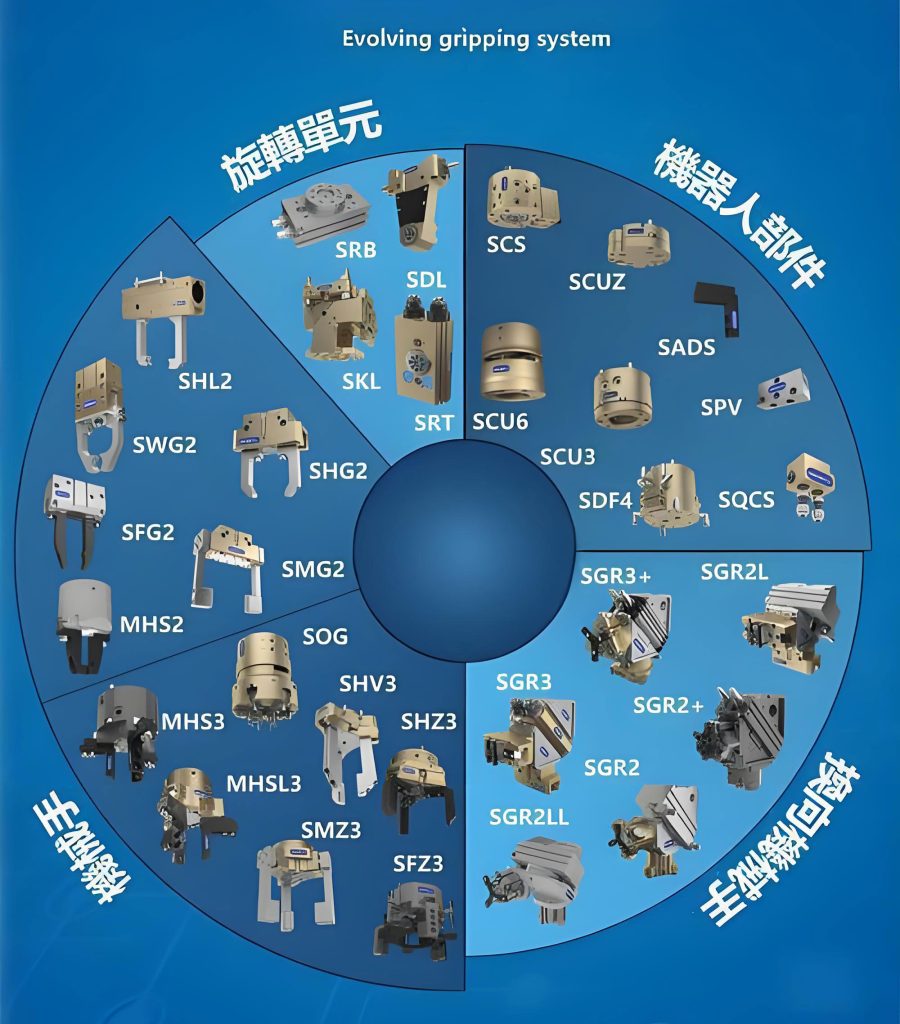
2. Classification of Picking End Effectors by Grasping Method
The initial contact and secure hold on the fruit are achieved through various grasping strategies. These can be broadly classified into three main categories: gripping, suction-based, and hybrid suction-gripping methods.
2.1 Gripping End Effectors
This is the most common and intuitive approach, inspired by the human hand. The end effector uses two or more fingers or surfaces to apply a clamping force on the fruit. They can be further subdivided:
• Rigid Grippers: Employ hard materials (metal, hard plastic) and have deterministic kinematics. They are simple and robust but offer limited adaptability and pose a higher risk of damage to delicate produce. Examples include two-fingered parallel grippers or custom-shaped jaws conforming to a specific fruit type.
$$ F_{grip} \geq \mu \cdot m \cdot g \cdot S_f $$
Where \(F_{grip}\) is the required gripping force, \(\mu\) is the coefficient of friction, \(m\) is the fruit mass, \(g\) is gravity, and \(S_f\) is a safety factor.
• Flexible/Soft Grippers: Utilize compliant materials (silicone, rubber, fabric) or articulated structures with passive compliance. They can conform to irregular shapes, distribute contact pressure more evenly, and significantly reduce damage. Underactuated and tendon-driven designs are popular in this category, as they can adapt to an object’s geometry with a single actuator. For a simple underactuated finger with a rotational spring at the joint, the torque relation can be modeled as:
$$ \tau_a = k (\theta_d – \theta) + J \ddot{\theta} $$
Where \(\tau_a\) is the applied tendon torque, \(k\) is the spring constant, \(\theta_d\) is the desired angle, \(\theta\) is the actual angle, and \(J\) is the inertia.
2.2 Suction-Based End Effectors
This method uses a vacuum pump to create negative pressure at an interface (a suction cup) attached to the fruit’s surface. The detachment force is generated primarily by atmospheric pressure. The holding force for a suction cup can be approximated by:
$$ F_{suction} = \Delta P \cdot A \cdot \eta $$
Where \(\Delta P\) is the pressure differential, \(A\) is the effective area of the cup seal, and \(\eta\) is an efficiency factor accounting for seal quality and surface porosity.
Suction end effectors are highly effective for fruits with a relatively smooth, large, and non-porous surface (e.g., apples, citrus, tomatoes). They allow for very fast fruit acquisition without the need for precise finger positioning around the fruit. A major challenge is sealing effectively on rough, curved, or irregular surfaces. Furthermore, they require a continuous vacuum supply, adding to system complexity.
2.3 Hybrid Suction-Gripping End Effectors
These systems combine the advantages of both previous methods. Typically, a suction device first makes contact and pulls the fruit into a stable position or away from foliage. Subsequently, a gripping mechanism (often simpler than a full dexterous gripper) closes to secure the fruit firmly. This approach is particularly useful for:
• Fruits growing in dense clusters, where a pure gripper might collide with neighboring fruits.
• Ensuring a very secure hold before applying a detachment action like twisting or pulling.
• Situations where the fruit’s orientation needs to be corrected after initial contact.
The sequence of operations adds to the cycle time but can improve reliability in complex environments.
| Grasping Method | Key Advantages | Key Disadvantages | Typical Applications |
|---|---|---|---|
| Gripping (Rigid) | Simple, strong, high grip force, good controllability. | Poor adaptability, high risk of damage, requires precise positioning. | Robust fruits (e.g., some citrus, melons in structured settings). |
| Gripping (Flexible) | Excellent adaptability, low damage risk, can handle shape variations. | More complex design/control, lower maximum grip force, potential durability issues. | Delicate fruits (e.g., strawberries, peaches, raspberries). |
| Suction-Based | Very fast acquisition, minimal need for enveloping, gentle initial contact. | Requires smooth sealing surface, sensitive to surface defects/porosity, needs vacuum system. | Fruits with large, smooth surfaces (e.g., apples, tomatoes, bell peppers). |
| Hybrid (Suction+Grip) | High reliability in cluttered environments, secure hold, can reorient fruit. | Increased mechanical complexity, longer cycle time, higher weight/cost. | Cluster fruits (e.g., grapes, cherry tomatoes), fruits with short stems. |
3. Classification by Fruit Detachment Method
Once the fruit is securely held, it must be separated from the plant. The detachment strategy is chosen based on the biomechanical properties of the fruit’s stem (peduncle).
3.1 External Cutting Tools
This method employs a dedicated cutting device such as a scissors mechanism, a rotating blade, a reciprocating saw, or even a laser cutter to sever the stem. It is the most universal method and is necessary for fruits with tough, fibrous stems that cannot be easily broken by bending or twisting (e.g., apples, citrus, mangoes). The cutting force can be significant and must be considered in the end effector design. For a simple scissor cutting mechanism, the required force at the handle \(F_h\) to generate a cutting force \(F_c\) at the blade is:
$$ F_h = F_c \cdot \frac{d_c}{d_h} $$
Where \(d_c\) and \(d_h\) are the distances from the pivot to the cutting point and handle force point, respectively.
3.2 Stem Breakage via Manipulation
This method uses the motion of the robotic arm or the end effector itself to break the fruit from the stem. Common motions include a sharp pull (applying tensile force), a twist (applying torsional force), or a bend-and-snap (applying a bending moment). This approach is mechanically simpler as it requires no additional cutting actuator. However, it is only suitable for fruits with an abscission layer or a naturally brittle stem (e.g., some peppers, cucumbers, kiwifruit). The success of this method depends critically on accurate knowledge of the fruit’s detachment characteristics. The tensile force required for pulling can be modeled as:
$$ F_{pull} \geq \sigma_t \cdot A_s $$
Where \(\sigma_t\) is the ultimate tensile strength of the stem tissue and \(A_s\) is the cross-sectional area of the stem.
| Detachment Method | Mechanism | Requirements | Challenges |
|---|---|---|---|
| External Cutting | Scissors, blades, saws, lasers sever the stem. | Stem must be accessible to the tool; tool must be sharp and robust. | Tool positioning accuracy; potential for crushing stem before cut; blade maintenance. |
| Pulling | Linear retraction of end effector to apply tensile force. | Stem must have lower tensile strength than fruit skin strength. | Risk of pulling off entire cluster or damaging plant; requires controlled force. |
| Twisting | Rotation of end effector about the stem axis to apply shear/torsion. | Existence of a weak abscission layer that fails under torsion. | Determining optimal twist angle and speed; avoiding fruit spin in gripper. |
4. Actuation Methods for End Effectors
The choice of actuator directly impacts the end effector‘s weight, speed, force, and complexity. The three primary actuation methods are:
4.1 Electric Motor Actuation
Electric motors (DC, stepper, servo) are the most common actuators. They offer excellent precision, programmability, and ease of control. Rotary motion is typically converted to linear motion via lead screws, gears, or four-bar linkages. However, motors and their associated gearboxes can be relatively heavy and bulky for their power output, which is a significant drawback for a device mounted on the end of a robot arm where mass is critical. The torque \(\tau_m\) required from a motor to achieve a desired gripping force \(F_g\) through a lead screw mechanism is:
$$ \tau_m = F_g \cdot \frac{p}{2\pi \eta} $$
Where \(p\) is the lead screw pitch and \(\eta\) is the mechanical efficiency.
4.2 Pneumatic Actuation
Pneumatic cylinders are lightweight, can produce high forces quickly, and are relatively low-cost. They are ideal for providing a fast, strong, single-degree-of-freedom motion, such as closing a scissor mechanism or a simple gripper. The main drawbacks are the need for a compressed air supply (a hose trailing to the robot), less precise control over intermediate positions compared to servos, and potential energy inefficiency. The force exerted by a pneumatic cylinder is:
$$ F_{cyl} = P \cdot A_{piston} $$
Where \(P\) is the gauge pressure and \(A_{piston}\) is the effective piston area.
4.3 Hybrid and Novel Actuation
Many advanced end effectors use a combination of actuation methods to optimize performance. For example, a gripper might use a servo motor for precise, adaptive finger positioning and a pneumatic cylinder for a powerful, fast-cutting action. Other emerging technologies include:
• Shape Memory Alloys (SMAs): Wires that contract when heated, enabling very compact, silent actuators, though they have slow response times and low efficiency.
• Soft Fluidic Actuators: Chambers made of elastic material that expand or bend when pressurized with air/fluid, creating natural compliant motion ideal for soft grippers.
• Tendon-Driven Mechanisms: Using cables pulled by remotely located motors to reduce weight at the end effector itself.
| Actuation Type | Advantages | Disadvantages | Typical Use in End Effector |
|---|---|---|---|
| Electric Motor | High precision, good programmability, clean, no external lines needed for low-power units. | Can be heavy and bulky for high torque, slower peak force delivery. | Precision finger positioning, adaptive gripping, continuous rotation for twisting. |
| Pneumatic | High power-to-weight ratio, very fast action, simple, robust. | Requires air compressor/hoses, less precise positioning, noisy, energy loss. | Fast scissor cutting, simple jaw closure, suction cup vacuum generation. |
| Hybrid (Motor+Pneumatic) | Combines precision of motors with speed/power of pneumatics. | Increased system complexity, requires both electrical and pneumatic infrastructure. | Complex end effectors with separate gripping and cutting functions. |
5. Current Challenges and Analysis
Despite significant research progress, the widespread adoption of picking robots with specialized end effectors is hindered by several persistent challenges:
5.1 Low Harvesting Efficiency: The cycle time for a single fruit pick, including visual recognition, arm movement, grasping, detachment, and placement, often ranges from several seconds to over 20 seconds. This is still far slower than a skilled human picker, especially for fruits that are easy to locate and reach. The sequential operations of many end effectors (position, grip, then cut) contribute to this delay. The overall efficiency \(E\) of a harvesting system can be loosely framed as:
$$ E = \frac{N_{success}}{T_{total}} $$
Where \(N_{success}\) is the number of successfully harvested fruits and \(T_{total}\) is the total operation time. Maximizing \(E\) requires minimizing individual cycle time and maximizing success rate simultaneously.
5.2 Poor Generalizability (Lack of Versatility): Most research prototypes are designed and optimized for one specific type of fruit. An end effector that works well for a spherical apple may fail completely on an elongated cucumber or a cluster of grapes. This lack of versatility increases cost and complexity for farmers growing multiple crops. Designing a universal or multi-crop end effector is a major open challenge.
5.3 End-Effector Weight and Dexterity Trade-off: A lightweight end effector is essential for allowing the use of smaller, faster, and more energy-efficient robotic arms. However, adding features for adaptability (more degrees of freedom), sensing, and powerful cutting often increases mass. Striking the right balance is difficult.
5.4 Damage to Produce and Plant: Ensuring zero damage is critical for marketability and storage life. Grippers can bruise soft fruit, suction cups can mark surfaces, and cutting tools can nick the fruit if not positioned perfectly. Furthermore, aggressive picking actions can damage nearby buds, leaves, or branches, affecting future yields.
5.5 Operation in Unstructured Environments: Leaves, branches, varying lighting, wind, and the natural clustering of fruit create a highly complex workspace. The end effector must be able to navigate these obstacles, which often requires sophisticated vision systems, tactile feedback, and reactive control strategies that are still areas of active research.
| Challenge | Description | Potential Mitigation Strategies |
|---|---|---|
| Efficiency | Cycle time too long compared to human labor. | Parallel actuation, faster cutting mechanisms (e.g., pneumatics), optimized arm trajectories, multi-arm systems. |
| Versatility | One end-effector for one crop; high cost per crop. | Research into reconfigurable or underactuated grippers, tool-changing systems on the robot arm. |
| Weight | Heavy end effectors limit arm speed and payload. | Use of lightweight composites, tendon-driven designs, soft robotics, and efficient actuator placement. |
| Damage | Bruising, cutting, or marking of fruit during harvest. | Compliant materials, force/tactile sensing with closed-loop control, non-contact cutting (laser), optimized detachment dynamics. |
| Environment | Dealing with occlusion, clustering, and plant variability. | Advanced vision (3D, multispectral), sensor fusion (vision+tactile), AI-based planning, protective casings on end effector. |
6. Future Trends and Prospects
The future development of fruit and vegetable picking end effectors is directed by the need to overcome the aforementioned challenges. Key trends point towards more intelligent, adaptive, and integrated systems:
6.1 Lightweight and Simplified Design: There is a strong push towards end effectors with minimal mass and mechanical complexity. Underactuated designs, where one actuator controls multiple joints or fingers, are a prime example. These grippers can envelope an object adaptively without complex control algorithms, reducing weight and cost. The principle of underactuation can be expressed by comparing degrees of freedom (DOF) and actuators:
$$ N_{actuators} < N_{DOF} $$
This inequality allows for passive adaptation to object geometry.
6.2 Enhanced Adaptability through Soft Robotics and Compliance: The use of soft, deformable materials and structures will continue to grow. Soft robotic grippers inherently distribute contact forces, minimize stress concentrations, and safely interact with unpredictable environments. Incorporating variable stiffness materials or jamming structures can allow a soft gripper to transition from a compliant state for grasping to a rigid state for secure holding and manipulation.
6.3 Increased Intelligence and Sensory Feedback: The next generation of end effectors will be equipped with a suite of sensors. Tactile sensors and force/torque sensors will provide real-time feedback on grip force, slip detection, and stem contact, enabling closed-loop control to prevent damage. Depth cameras or miniature LiDAR integrated into the end effector itself can provide local 3D perception to guide final approach and detachment in occluded areas.
6.4 Versatile and Multi-Functional End Effectors: Research will focus on designs capable of handling a broader range of produce. This could involve modular end effectors with interchangeable tips (suction cup, soft fingers, cutting tool) or truly polymorphic grippers that can change their grasp strategy based on the perceived object. The concept of a “universal” agricultural end effector, while ambitious, drives innovation in adaptive mechanisms.
6.5 Integration with Advanced Perception and AI: The end effector will not operate in isolation. Its performance is tightly coupled with the robot’s vision system and planning algorithms. Advances in deep learning for fruit detection, ripeness classification, and stem localization will allow the end effector to be guided more accurately. Furthermore, AI can be used to optimize the entire picking strategy—selecting the best fruit to pick first, planning a collision-free path for the end effector, and choosing the most appropriate detachment method based on learned models of fruit-stem mechanics.
7. Conclusion
The development of effective and reliable end effectors is a cornerstone in the realization of commercially viable fruit and vegetable harvesting robots. This analysis has systematically reviewed the fundamental approaches to grasping and detachment, the actuation technologies that drive them, and the significant challenges that remain. While no single design has emerged as a perfect solution, the trajectory of research is clear: future end effectors must be lighter, smarter, more adaptive, and less damaging. The convergence of soft robotics, advanced sensing, lightweight materials, and artificial intelligence promises to produce a new class of dexterous end effectors capable of operating autonomously in the demanding and variable environment of agricultural fields. The progress in this domain will not only accelerate the adoption of robotic harvesters but also play a crucial role in ensuring sustainable, efficient, and cost-effective food production for the future.