
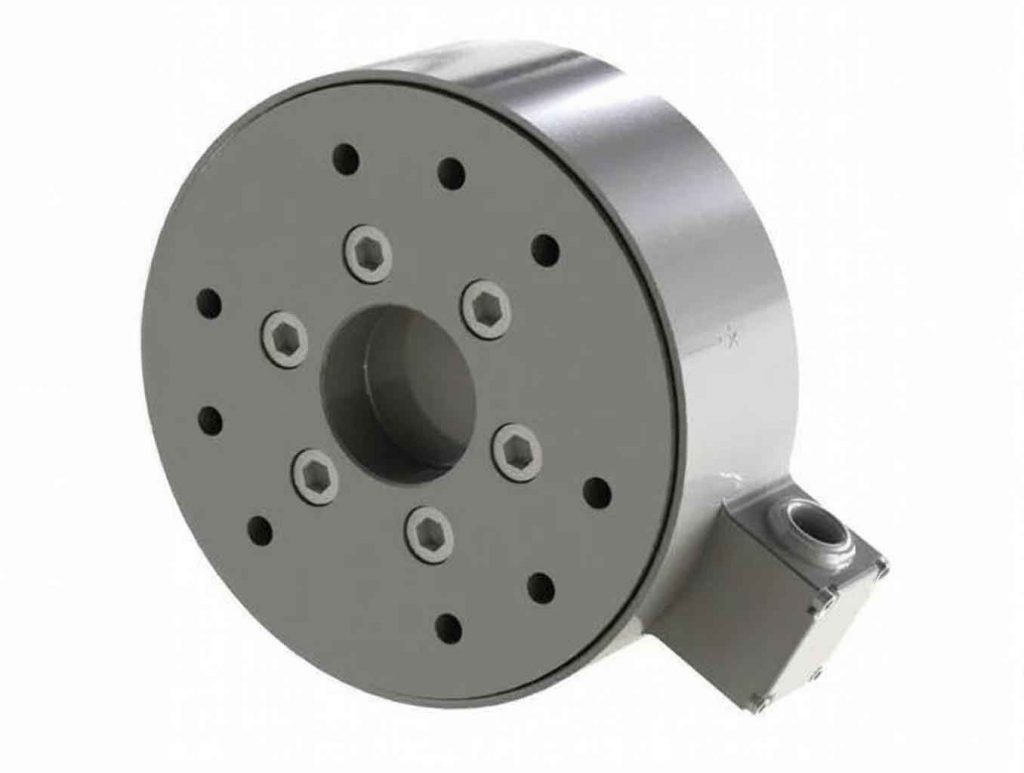
In our laboratory, we have developed an advanced calibration system for six-axis force sensors, which are critical components in robotics for precise force and torque measurements. These sensors often suffer from significant inter-axis coupling errors due to manufacturing imperfections, strain gauge misalignment, and other factors. Traditional calibration methods face challenges such as inaccurate loading, high measurement errors, and low system integration. To address these issues, we designed a calibration system that enables bidirectional calibration of all six characteristic directions of a six-axis force sensor in a single setup. By leveraging virtual instrumentation technology, we created analytical software capable of real-time data display, analysis, and storage, enhancing calibration accuracy and efficiency.
The calibration system comprises four main components: the experimental platform, loading mechanism, data acquisition unit, and analytical software. The six-axis force sensor is mounted on the calibration platform, where the loading system applies calibrated loads in the Fx, Fy, Fz, Mx, My, and Mz directions. The sensor converts mechanical signals into electrical outputs, which are processed through amplification, filtering, and isolation before being digitized by the data acquisition system. The analytical software then handles real-time curve visualization, data processing, and storage. This integrated approach minimizes errors and improves reliability.
In the hardware design, accurate loading of uniaxial forces and moments is crucial for reliable calibration of the six-axis force sensor. For axial forces, the application point must coincide with the origin of the reference plane, and the direction should align with the coordinate axes. For moments, the force should lie within the reference plane. Traditional systems often exhibit significant deviations in force direction and position. Our calibration platform features a worktable with three perpendicular T-slots, allowing adjustable mounting of components via T-blocks and bolts. The six-axis force sensor is installed at the center of a rotary table, with a loading disc attached to its top. Surrounding支架 groups support pulley systems for precise load application.
To apply loads, a string connects the loading ring to standard weights via pulleys, enabling controlled force application in specific directions. A standard force sensor integrated into the string measures the actual load, compensating for friction losses between the string and pulleys—a common source of error in traditional methods where weight mass is equated directly to force. The rotary table allows for bidirectional calibration by rotating the sensor, ensuring comprehensive testing. Prior to calibration, the platform is calibrated for force direction and application point using tools like水平仪 and height micrometers. For instance, in the Fx direction calibration, the worktable is leveled, pulley height is adjusted to match the sensor’s reference plane, and a plumb line ensures alignment with the X-axis through the origin.
The data acquisition system handles weak differential signals from the six-axis force sensor and standard sensor. We designed a high-gain amplification circuit followed by an active low-pass filter to condition the signals. A NI USB-6210 multifunction data acquisition card, powered via USB, is employed with 16 analog input channels, a sampling rate of 250 kS/s per channel, and selectable voltage ranges (±0.2 V to ±10 V). This card interfaces seamlessly with LabVIEW, the virtual instrumentation software we used for development, providing drivers and controls that accelerate system integration and ensure accurate signal processing.
The analytical software, developed in LabVIEW, facilitates real-time acquisition, display, and analysis of signals from the six-axis force sensor and standard sensor. It supports simultaneous input from up to eight channels, incorporating filtering and processing capabilities. The software includes configuration and display modules: the configuration module sets hardware parameters (e.g., channel selection, sampling frequency, voltage range), data processing parameters (e.g., filtering methods, sensor coefficients), and graph parameters (e.g., sample points, voltage, and pressure ranges). Upon system initiation, data is collected, appended to files, and stored for post-processing. This allows for detailed analysis of each channel’s output throughout the calibration process, leading to accurate calibration results.
To model the behavior of the six-axis force sensor, we use a linear relationship between the applied forces and moments and the output voltages. The output vector $\mathbf{V}$ is given by:
$$ \mathbf{V} = \mathbf{C} \mathbf{F} $$
where $\mathbf{V} = [V_1, V_2, V_3, V_4, V_5, V_6]^T$ represents the voltage outputs from the six channels, $\mathbf{F} = [F_x, F_y, F_z, M_x, M_y, M_z]^T$ is the vector of applied forces and moments, and $\mathbf{C}$ is the calibration matrix that characterizes the sensor’s response, including coupling effects. The goal of calibration is to determine $\mathbf{C}$ accurately through controlled loading experiments.
Coupling errors arise due to non-ideal interactions between axes. The error model can be expressed as:
$$ \mathbf{V} = \mathbf{C}_\text{ideal} \mathbf{F} + \mathbf{E} $$
where $\mathbf{E}$ is the error vector accounting for cross-talk. To minimize $\mathbf{E}$, we apply loads in each direction independently and use least-squares estimation to compute $\mathbf{C}$. For each loading direction, we collect multiple data points under varying loads, and the calibration matrix is derived from:
$$ \mathbf{C} = \mathbf{V} \mathbf{F}^T (\mathbf{F} \mathbf{F}^T)^{-1} $$
This approach reduces the impact of noise and coupling, improving the accuracy of the six-axis force sensor measurements.
In our loading mechanism, the force applied via the pulley system is calculated based on the standard sensor reading. If $F_\text{std}$ is the force measured by the standard sensor, and $\theta$ is the angle of the string relative to the sensor axis, the effective force on the six-axis force sensor can be adjusted for directional components. For example, in the Fx direction, the force is approximately $F_\text{std}$ if alignment is perfect, but in practice, we account for small deviations using vector analysis.
The filtering process in the data acquisition system uses a second-order active low-pass filter with a cutoff frequency $f_c$ set to eliminate high-frequency noise. The transfer function $H(s)$ is given by:
$$ H(s) = \frac{\omega_c^2}{s^2 + 2\zeta\omega_c s + \omega_c^2} $$
where $\omega_c = 2\pi f_c$ and $\zeta$ is the damping ratio. This ensures that only relevant signal components are processed, enhancing the signal-to-noise ratio for the six-axis force sensor outputs.
We conducted extensive tests to validate the system performance. The following table summarizes key parameters of our calibration system for the six-axis force sensor:
| Parameter | Value | Description |
|---|---|---|
| Load Range | 0-500 N (Forces), 0-50 Nm (Moments) | Maximum applicable loads in each direction |
| Accuracy | ±0.1% FS | Full-scale accuracy of standard sensor |
| Sampling Rate | 250 kS/s | Per channel, adjustable in software |
| Voltage Range | ±10 V | Selectable for input channels |
| Filter Cutoff | 100 Hz | Low-pass filter cutoff frequency |
Another table compares our system with traditional methods, highlighting improvements for the six-axis force sensor calibration:
| Aspect | Traditional System | Our System |
|---|---|---|
| Loading Accuracy | Low due to friction ignored | High with standard sensor compensation |
| Bidirectional Calibration | Requires reassembly | Achieved in single setup via rotary table |
| Data Integration | Separate units | Integrated software and hardware |
| Error Reduction | High coupling errors | Minimized through precise alignment |
The software architecture in LabVIEW includes multiple subVIs for configuration, data acquisition, and analysis. The main program flow initializes parameters, starts acquisition, processes data in real-time, and saves results. Data is stored in TDMS (Technical Data Management Streaming) format for efficient handling. The analysis module computes the calibration matrix $\mathbf{C}$ by solving the overdetermined system using matrix operations. For instance, with $n$ loading points, we form matrices $\mathbf{V}_\text{all}$ and $\mathbf{F}_\text{all}$, and compute:
$$ \mathbf{C} = \mathbf{V}_\text{all} \mathbf{F}_\text{all}^T (\mathbf{F}_\text{all} \mathbf{F}_\text{all}^T)^{-1} $$
This is implemented in LabVIEW using linear algebra functions, ensuring robust and fast computation.
In terms of performance, we evaluated the system using a reference six-axis force sensor with known characteristics. The relative error for each axis was calculated as:
$$ \text{Error} = \frac{|\mathbf{F}_\text{measured} – \mathbf{F}_\text{applied}|}{|\mathbf{F}_\text{applied}|} \times 100\% $$
Results showed errors below 0.5% for forces and 1% for moments, demonstrating high accuracy. The system’s repeatability was tested through multiple calibration cycles, with standard deviations less than 0.1% of the full scale, confirming reliability for industrial applications involving six-axis force sensors.
Future enhancements could include automated loading mechanisms and machine learning algorithms for real-time error correction. However, the current system already offers a significant advancement in six-axis force sensor calibration by combining precise mechanical design with virtual instrumentation. Our experiments validate that this approach reduces calibration time, improves accuracy, and provides a user-friendly interface, making it suitable for research and industrial use.
In conclusion, our calibration system for six-axis force sensors effectively addresses the limitations of traditional methods. By integrating a robust hardware platform with advanced software, we achieve accurate bidirectional loading and minimal coupling errors. The use of virtual instrumentation streamlines the calibration process, and the system’s performance meets the demanding requirements of modern robotics and automation. This research underscores the importance of holistic design in sensor calibration and opens avenues for further innovation in six-axis force sensor applications.