
In the field of precision mechanical transmission systems, the planetary roller screw mechanism stands out as a highly efficient and reliable component for converting rotary motion into linear motion. This mechanism is particularly valued in applications requiring high load capacity, stiffness, and accuracy, such as aerospace, robotics, and industrial machinery. My research focuses on analyzing the static contact characteristics of the planetary roller screw drive pair, leveraging contact shape function analysis and Hertz contact theory to develop a robust model for contact force distribution. This work aims to enhance the design and optimization of planetary roller screw systems, providing insights that can improve performance and durability.
The planetary roller screw drive pair consists of a threaded screw, multiple rollers arranged circumferentially around the screw, and a nut that houses these rollers. Unlike ball screws, the planetary roller screw utilizes rollers with or without thread leads, depending on the design specifications. In this study, I consider a configuration where the rollers are without thread leads, simplifying the contact analysis while maintaining general applicability. The contact between the screw and rollers is critical, as it directly influences the transmission efficiency, load distribution, and lifespan of the planetary roller screw. Understanding the contact behavior through mathematical modeling is essential for predictive maintenance and design improvements.
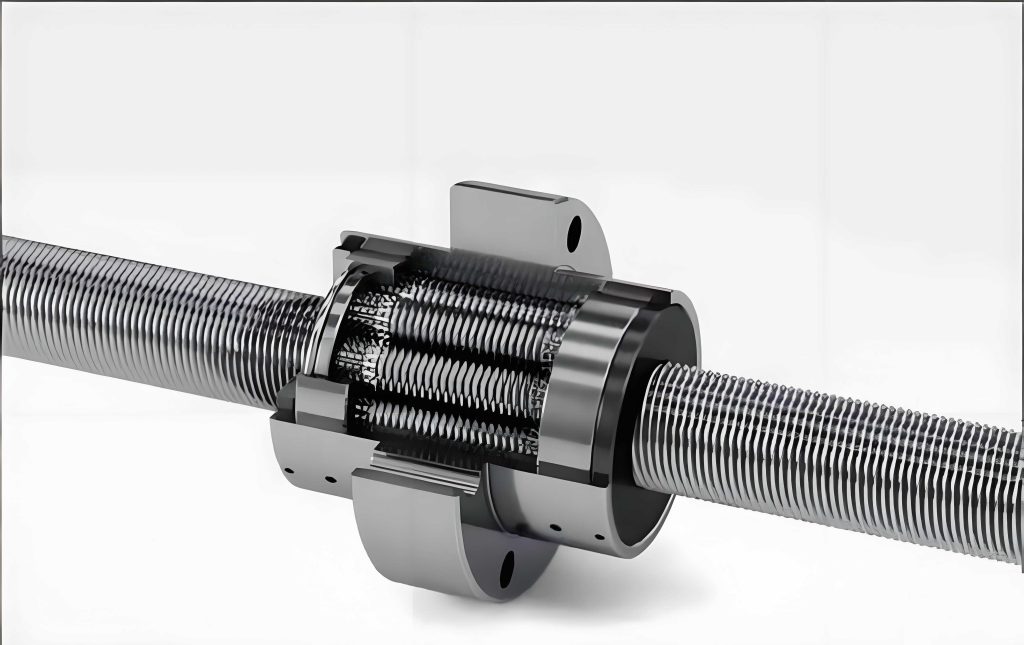
To begin, I delve into the geometric relationships within the planetary roller screw drive pair. The rollers are evenly distributed around the screw axis, and each roller contacts the screw along a helical path. By establishing coordinate systems for both the screw and roller, I can derive the contact surface equations. For a roller without thread leads, modeled in cylindrical coordinates, any point on the roller contact surface can be expressed with parameters such as radial distance and angular position. Transforming this point into the screw’s coordinate system accounts for the screw’s thread lead angle, enabling the analysis of the contact profile.
The contact shape function describes the gap or interference between the screw and roller surfaces in the direction perpendicular to the contact. Through mathematical derivation, I find that for any cross-section equidistant from the roller center, the shape function adheres to a quadratic form. This is a key insight, as it simplifies the subsequent contact analysis using Hertz theory. The quadratic coefficients depend on geometric parameters like thread lead angle, roller radius, and screw dimensions, which are summarized in Table 1 for reference.
| Parameter | Symbol | Value (Example) | Description |
|---|---|---|---|
| Screw minor diameter | \( s_1 \) | 10 mm | Minor diameter of screw thread |
| Screw major diameter | \( s_3 \) | 12 mm | Major diameter of screw thread |
| Roller minor diameter | \( g_1 \) | 8 mm | Minor diameter of roller thread |
| Roller major diameter | \( g_3 \) | 10 mm | Major diameter of roller thread |
| Distance between centers | \( d \) | 20 mm | Distance from screw center to roller center |
| Thread lead angle | \( \psi \) | 5° | Lead angle of screw thread |
| Roller profile angle | \( k \) | 30° | Angle defining roller tooth shape |
| Screw profile angle | \( j \) | 30° | Angle defining screw tooth shape |
The shape function \( \Delta z \) represents the vertical distance between corresponding points on the screw and roller surfaces in the transformed coordinate system. Based on the derivations, it can be approximated as:
$$ \Delta z \approx \cos \psi \cdot \cos k \cdot (a y^2 + b y + c) $$
where \( a \), \( b \), and \( c \) are coefficients derived from geometric parameters. For instance, coefficient \( a \) is given by:
$$ a = \frac{\sin^2 \psi \cdot \cos^2 \psi}{2(d – r)} + \frac{1}{24 r (d – r)} + \frac{\tan j}{2} $$
Here, \( r \) is the radial distance from the roller center, and other symbols are as defined in Table 1. The quadratic nature of the shape function is validated through numerical fitting, with a high correlation coefficient (e.g., 0.99974), confirming the accuracy of this model for the planetary roller screw. This finding is crucial because it allows the application of Hertz contact theory, which assumes a parabolic contact profile, to analyze the contact stresses and forces in the planetary roller screw drive pair.
Moving to the contact model, I focus on a two-dimensional cross-section perpendicular to the roller radial direction. In this plane, the contact between the screw and roller can be treated as a line contact problem, amenable to Hertzian analysis. By aligning the coordinate axes appropriately and assuming initial contact conditions, the shape function simplifies to:
$$ \Delta z = \cos \psi \cdot \cos k \cdot a x^2 $$
where \( x \) is the coordinate along the contact width. According to Hertz theory, the contact pressure distribution \( p(x) \) for a line contact is:
$$ p(x) = \frac{2 P(r)}{\pi B} \sqrt{1 – \left( \frac{x}{B} \right)^2} $$
In this equation, \( P(r) \) is the line load per unit length along the roller radial direction, \( B \) is the half-contact width, and \( E^* \) is the equivalent elastic modulus. The half-contact width \( B \) is derived as:
$$ B = \left[ \frac{2 P(r)}{\pi \cos \psi \cdot \cos k \cdot a E^*} \right]^{1/2} $$
At the contact edges, the surfaces are just touching without deformation, leading to the condition \( \Delta z = \delta \) at \( x = B \), where \( \delta \) is the approach of the two bodies. This gives:
$$ \delta = a B^2 = \frac{\pi P(r)}{E^*} $$
Combining these equations, the line load \( P(r) \) can be expressed as a function of the radial distance \( r \):
$$ P(r) = \frac{2 E^*}{\pi} \cos \psi \cdot \cos k \cdot \left( \frac{b^2}{4a} – c \right) $$
Here, \( b \) and \( c \) are the other coefficients from the shape function, dependent on \( r \). To obtain the total contact force \( F \) between the screw and roller, I integrate \( P(r) \) over the radial contact zone from \( r = g_1 \) to \( r = g_3 \):
$$ F = \int_{g_1}^{g_3} P(r) \, dr $$
This integration accounts for the varying contact conditions along the roller profile, providing a comprehensive model for the static contact force in the planetary roller screw. The model highlights how geometric parameters influence the contact behavior, enabling designers to optimize the planetary roller screw for specific load requirements.
To validate the contact model, I conducted a case study with a planetary roller screw drive pair subjected to a nominal load of approximately 55 N per contact surface. Using the derived equations, I calculated key contact parameters such as maximum contact depth, half-width, and stress. The results are summarized in Table 2, alongside comparative data from finite element analysis (FEA) performed using ANSYS software. The close agreement between the analytical model and FEA results underscores the reliability of the proposed approach.
| Parameter | Analytical Model | FEA Result | Relative Error |
|---|---|---|---|
| Maximum Contact Depth | 0.00011 mm | 0.00012 mm | -8.3% |
| Half-Contact Width | 0.059 mm | 0.062 mm | -4.8% |
| Maximum Contact Stress | 229.9 MPa | 235.7 MPa | -2.5% |
The analytical model predicts a maximum contact stress of 229.9 MPa, while FEA yields 235.7 MPa, resulting in a relative error of only -2.5%. This minor discrepancy may arise from assumptions in the Hertz theory, such as homogeneity and isotropy of materials, or from simplifications in the shape function. Nonetheless, the consistency validates the use of Hertz contact theory for static contact analysis of planetary roller screw systems. Additionally, the contact pressure distribution across the roller surface was found to closely follow a quadratic pattern, further confirming the shape function’s quadratic characteristic.
Beyond static analysis, the developed model serves as a foundation for dynamic studies of planetary roller screw drive pairs. For instance, by incorporating time-varying loads or thermal effects, one can explore how contact stresses evolve during operation, potentially leading to fatigue or wear. The planetary roller screw’s performance under dynamic conditions is critical for applications like aircraft actuators or precision manufacturing equipment, where reliability is paramount. Future work could extend this model to include factors such as lubrication, surface roughness, and multi-roller interactions, which are essential for a holistic understanding of planetary roller screw behavior.
In practice, the contact model can guide the design optimization of planetary roller screw components. For example, by adjusting parameters like thread lead angle or roller profile angle, engineers can minimize contact stresses, thereby enhancing the lifespan of the planetary roller screw. Table 3 presents a sensitivity analysis, showing how variations in key geometric parameters affect the maximum contact stress. This information is invaluable for tailoring planetary roller screw designs to specific operational environments.
| Parameter Change | Effect on Maximum Contact Stress | Recommendation |
|---|---|---|
| Increase screw lead angle \( \psi \) | Decreases stress due to better load distribution | Use moderate lead angles (5°-10°) for balance |
| Increase roller radius \( r \) | Reduces stress by increasing contact area | Optimize roller size within space constraints |
| Decrease center distance \( d \) | Increases stress due to higher contact pressure | Ensure adequate clearance for assembly |
| Adjust profile angles \( j, k \) | Alters stress concentration; optimal at 30° | Standardize angles for manufacturing ease |
The quadratic shape function also has implications for manufacturing tolerances. Since the contact profile is sensitive to geometric inaccuracies, tight control during production of planetary roller screw parts is necessary to avoid deviations that could amplify contact stresses. Advanced machining techniques, such as grinding or honing, can achieve the required precision for planetary roller screw components, ensuring consistent performance across batches.
In conclusion, my research demonstrates that the contact shape function for a planetary roller screw drive pair exhibits a quadratic characteristic in cross-sections perpendicular to the roller radial direction. This allows the application of Hertz contact theory to model static contact forces and stresses accurately. The analytical results align well with finite element simulations, validating the proposed approach. This work not only advances the theoretical understanding of planetary roller screw mechanisms but also provides practical tools for design and optimization. By leveraging these insights, engineers can develop more reliable and efficient planetary roller screw systems for high-demand applications, ultimately contributing to technological progress in precision engineering.
Looking ahead, further investigations could explore the effects of dynamic loading, thermal expansion, and material nonlinearities on planetary roller screw contact behavior. Additionally, experimental validation through physical testing would strengthen the model’s credibility. As the demand for high-performance transmission systems grows, continued research into planetary roller screw technology will remain vital, driving innovations that enhance efficiency and durability in mechanical systems worldwide.