
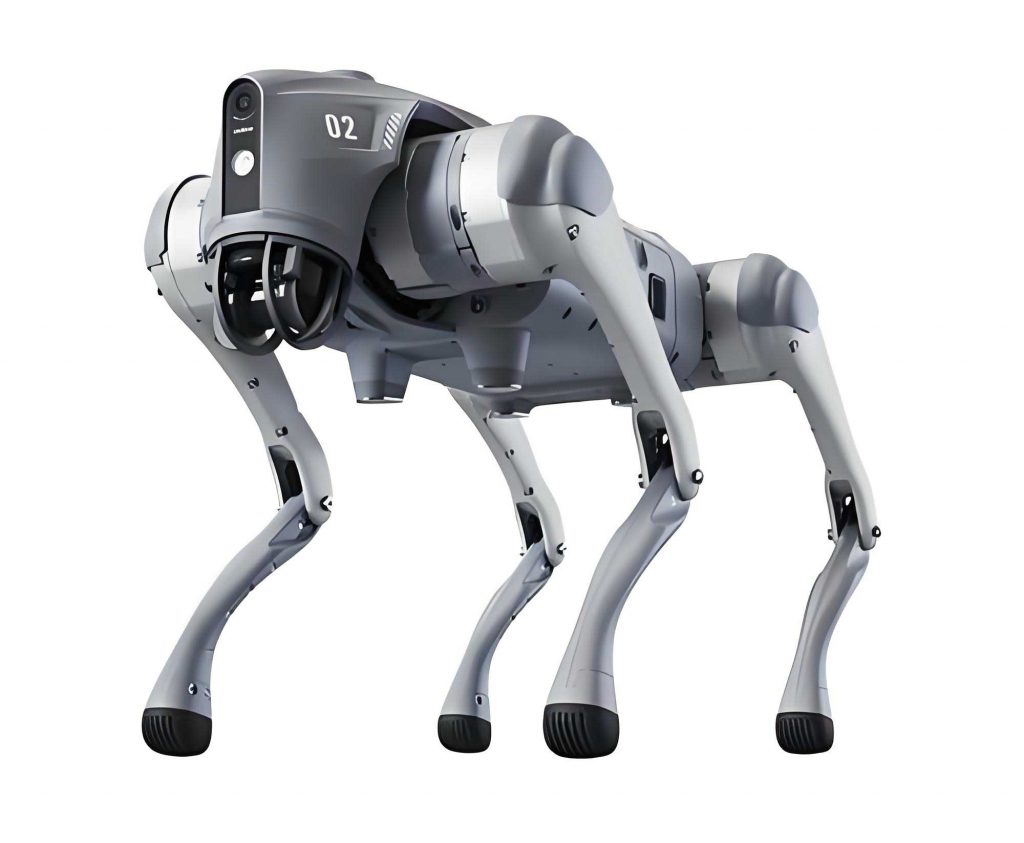
In recent years, I have focused on developing advanced robotic systems for challenging environments, such as construction tunnels, where traditional robots struggle with adaptability and efficiency. My work centers on quadruped robots, often referred to as robot dogs, which offer superior terrain navigation compared to wheeled or tracked systems. Existing quadruped robot designs face limitations: hydraulic-driven systems are bulky and energy-inefficient, while electric-driven ones lack the robustness for high-load applications. To address this, I designed a novel electro-hydraulic leg for a quadruped robot, combining the high power density of hydraulics with the precision of electric motors. This hybrid approach aims to enhance the robot dog’s performance in rugged terrains, ensuring reliable foot trajectory tracking—a critical aspect for stability and obstacle avoidance. In this article, I present my comprehensive study on the foot trajectory tracking characteristics of this electro-hydraulic quadruped robot, detailing the mechanical design, kinematic modeling, simulation, and experimental validation. My goal is to provide insights that can inform dynamic control strategies for quadruped robots in complex environments, ultimately improving their operational capabilities.
The core of my research involves a 3-degree-of-freedom (DOF) leg design for the quadruped robot. The hip yaw and hip pitch joints are driven by brushless DC motors, while the knee joint employs a motor-hydraulic cylinder composite drive. This configuration allows for a compact structure with improved power density and durability. The leg’s dimensions are inspired by canine anatomy, optimizing it for natural movement patterns. Key parameters include a hip joint length of 50 mm, thigh length of 400 mm, and shank length of 400 mm. To model the leg’s kinematics, I used the Denavit-Hartenberg (D-H) method, which provides a systematic approach to describing the spatial geometry of robotic mechanisms. The D-H parameters are summarized in Table 1, defining the relationships between consecutive links based on length, twist angle, offset, and joint angle.
| Link i | Length li-1 (mm) | Twist Angle αi-1 (°) | Offset di (mm) | Joint Angle θi (°) |
|---|---|---|---|---|
| 1 | 0 | 0 | 0 | 0 |
| 2 | 50 | -90 | 0 | -45 |
| 3 | 400 | 0 | 0 | 90 |
| 4 | 400 | 0 | 0 | 0 |
Using the D-H method, I derived the forward kinematics equations to compute the foot-end position (px, py, pz) based on the joint angles. For planar motion in the X-Z plane, with the Y-direction displacement set to zero, the equations are as follows:
$$ p_x = l_3 \sin(\theta_2 + \theta_3) + l_2 \sin \theta_2 $$
$$ p_y = 0 $$
$$ p_z = \cos \theta_1 (l_1 + l_2 \cos \theta_2 + l_3 \cos(\theta_2 + \theta_3)) $$
Here, θ1, θ2, and θ3 represent the hip yaw, hip pitch, and knee joint angles, respectively, while l1, l2, and l3 are the link lengths. For the knee joint, which uses a hydraulic cylinder, I established a geometric relationship to relate the cylinder length c to the knee angle θ3:
$$ c = \sqrt{a^2 + b^2 + 2ab \cos(\theta_3 + e)} $$
In this equation, a and b are design distances from the hydraulic cylinder attachment points to the shank axis, and e is a constant based on the installation geometry. The inverse kinematics, which determine the joint angles from the foot-end position, are crucial for trajectory control. For the quadruped robot, the inverse kinematics can be expressed as:
$$ \theta_1 = 0 $$
$$ \theta_2 = -\arccos\left( \frac{d^2 + l_2^2 – l_3^2}{2d l_2} \right) + \arcsin\left( \frac{p_x}{d} \right) $$
$$ \theta_3 = \pi – \arccos\left( \frac{l_2^2 + l_3^2 – d^2}{2 l_2 l_3} \right) $$
$$ d = \sqrt{p_x^2 + p_y^2 + (p_z + l_1)^2} $$
These equations enable precise control of the robot dog’s foot position, which is essential for stable locomotion. To evaluate the trajectory tracking performance, I planned a sinusoidal foot trajectory under the trot gait—a common gait for quadruped robots due to its speed and stability. The trot gait parameters are listed in Table 2, including a stride length of 250 mm, step height of 60 mm, duty cycle of 0.5, and a cycle period of 1 second. The foot trajectory is divided into swing and stance phases, with the swing phase involving an elliptical path and the stance phase a linear retraction.
| Gait Parameter | Value |
|---|---|
| Stride Length S (mm) | 250 |
| Step Height H (mm) | 60 |
| Duty Cycle | 0.5 |
| Cycle Period T (s) | 1 |
| X-offset from O0 (mm) | 0 |
| Z-offset from O0 (mm) | -615.69 |
| Sampling Time (ms) | 50 |
The planned foot trajectory equations for the swing and stance phases are as follows. For the swing phase (0 ≤ t < T/2):
$$ x_{sw}(t) = \frac{S}{4} \sin\left( \frac{2\pi}{T} t – \frac{\pi}{2} \right) + x_0 $$
$$ z_{sw}(t) = H \sin\left( \frac{2\pi}{T} t \right) + z_0 $$
For the stance phase (T/2 ≤ t ≤ T):
$$ x_{st}(t) = S – \frac{S}{T} t $$
$$ z_{st}(t) = z_0 $$
Here, t is the time variable, and x0 and z0 are the initial offsets from the world coordinate system O0. This trajectory ensures smooth and periodic motion, which is vital for the quadruped robot to maintain balance and reduce mechanical stress. To validate the kinematic model, I implemented it in MATLAB using the Robotics Toolbox. The virtual model of the leg, as shown below, confirmed the initial foot position at (0, -615.69) mm, matching the design specifications. The inverse kinematics were computed to generate joint angle profiles, which were then fed into the model to simulate the foot trajectory. The results showed perfect alignment between the planned and simulated trajectories, verifying the accuracy of the mathematical model for the robot dog.
Following the simulation, I built an experimental platform to test the leg’s performance under real-world conditions. The platform included a single leg mounted on a slider-guide mechanism, allowing motion in the X and Z directions. I conducted tests under three driving modes for the knee joint: pure motor drive, pure hydraulic drive, and electro-hydraulic composite drive. In the composite mode, the motor was used for leg lifting during the swing phase, and the hydraulic cylinder for lowering and stance phases. Data on joint angles and hydraulic displacements were collected using Ethernet-based control modules, with the hip pitch motor controlled via CAN bus and the hydraulic system via a proportional servo valve. The experimental setup enabled precise measurement of actual actuator responses, which were used to compute the foot trajectory using the forward kinematics equations.
The results from the experiments revealed significant differences in tracking performance across the driving modes. For the hip pitch joint, all modes exhibited small errors (less than 1°), indicating robust control. However, the knee joint showed varying behaviors: in pure motor drive, the tracking error was minimal (under 0.5°) with no noticeable lag; in pure hydraulic drive, errors reached up to 1.5 mm with a 100 ms delay due to valve dead zones; and in electro-hydraulic composite drive, motor-driven lifting had errors below 0.4°, while hydraulic-driven phases had errors under 0.5 mm with a 20 ms lag. The computed foot trajectories, derived from the actual data, demonstrated that pure motor drive achieved the best tracking, with maximum point errors below 7 mm. Electro-hydraulic drive performed moderately well, with accurate key points but some degradation during mode transitions, whereas pure hydraulic drive was the least effective due to control bandwidth mismatches. This highlights the importance of optimized drive selection for enhancing the quadruped robot’s locomotion in demanding environments.
In conclusion, my research on the electro-hydraulic quadruped robot has demonstrated the feasibility of a hybrid drive system for improved foot trajectory tracking. The D-H-based kinematic model proved accurate in simulations, and the experimental tests validated the leg’s ability to follow planned trajectories under different driving modes. The robot dog’s performance was optimal with pure motor drive, but the electro-hydraulic approach offers a balanced solution for applications requiring both precision and power. Future work will focus on refining the mode-switching strategy to minimize transition effects and extending this to full-body control of the quadruped robot. This study contributes to the advancement of legged robotics, providing a foundation for developing more adaptive and efficient robot dogs for industrial and exploration tasks.