
The field of search and rescue operations is inherently dangerous, often involving environments that are unstable, toxic, or otherwise inaccessible to human responders. In recent decades, the development of rescue robotics has emerged as a critical technological frontier aimed at mitigating risks to human life and enhancing the efficiency of response missions. This article delves into the research and design of key technologies specifically for rescue robots, with a focused exploration on a bionic robot system inspired by the spider’s remarkable adaptability and mobility. These robotic systems are typically equipped with multi-spectral sensors, communication payloads, and mission-specific tools, enabling them to serve as force multipliers that can penetrate hazardous zones for tasks such as reconnaissance, victim localization, and initial aid delivery.
The core of this work is the proposition and systematic elaboration of a bionic robot framework modeled after arachnid morphology and locomotion principles. We detail the integrated design of its hardware and software architecture, a high-performance hydraulic actuation system, sophisticated motion planning algorithms for collective operation, a neural network model for swarm intelligence, and obstacle navigation strategies based on virtual force fields. The objective is to contribute to the foundational technologies that will enable the next generation of autonomous, resilient, and effective bionic robot teams for complex disaster response.
State of Research and Development
The pursuit of robotic solutions for rescue operations has a significant history in several technologically advanced nations. Pioneering work in the United States, Germany, and Japan since the 1980s has yielded a diverse array of platforms tailored for various scenarios, from military medevac to subterranean exploration. These early initiatives established foundational paradigms in mobility, sensing, and remote operation. In contrast, systematic research and development in this domain began somewhat later domestically but has since accelerated at a remarkable pace. Notably, during a recent national five-year plan, “rescue robot” projects were elevated to a high-priority status within major national science and technology programs. This catalyzed concerted efforts from leading research institutes and universities, resulting in innovative prototypes such as transformable rubble-search robots, robotic life-detection instruments, and rotary-wing unmanned aerial systems for disaster assessment. This burgeoning ecosystem sets the stage for the advanced, bio-inspired concepts discussed herein.
Core Research Components for the Bionic Spider System
The development of the proposed bionic robot system is structured around five interconnected research pillars. Each addresses a fundamental challenge in creating a capable, autonomous, and cooperative rescue platform.
1. Integrated Hardware-Software System Framework Design
The initial phase involves a comparative analysis and synthesis of existing robotic platforms to inform the architecture of our bionic robot. We evaluate the merits and limitations of bipedal, quadrupedal, wheeled, and tracked locomotion schemes against the constraints of post-disaster environments—uneven rubble, constrained passages, and slippery surfaces. The hexapod (six-legged) configuration, inspired by spiders, offers a compelling compromise between stability, redundancy, and terrain adaptability. A failure in one leg does not critically impede mobility, a crucial feature for reliability in harsh conditions.
The system framework is designed with four integrated layers: the mechanical architecture (the robot’s body and legs), the main onboard control system (the “brain”), a remote server-based monitoring interface (for mission command), and a mobile terminal interface (for field operator interaction). This design ensures robust, low-latency communication and control. The software layer integrates algorithms for path planning and obstacle avoidance, creating a cohesive model for distributed rescue robot systems. Key design considerations are summarized below:
| Layer | Primary Components | Key Design Objective |
|---|---|---|
| Mechanical Architecture | Chassis, Hexapod Leg Assemblies, Sensor Mounts | Maximize stability, payload capacity, and kinematic dexterity |
| Onboard Control System | Microcontroller/SoC, Motor Drivers, Communication Module | Execute real-time motion control and sensor data processing |
| Server Monitoring Interface | Mission Planning Software, Data Logging, Swarm Coordination Algorithms | Provide high-level mission oversight and collective strategy |
| Mobile Terminal Interface | Tactile Control App, Real-Time Video Feed, Telemetry Display | Enable direct human intervention and situational awareness |
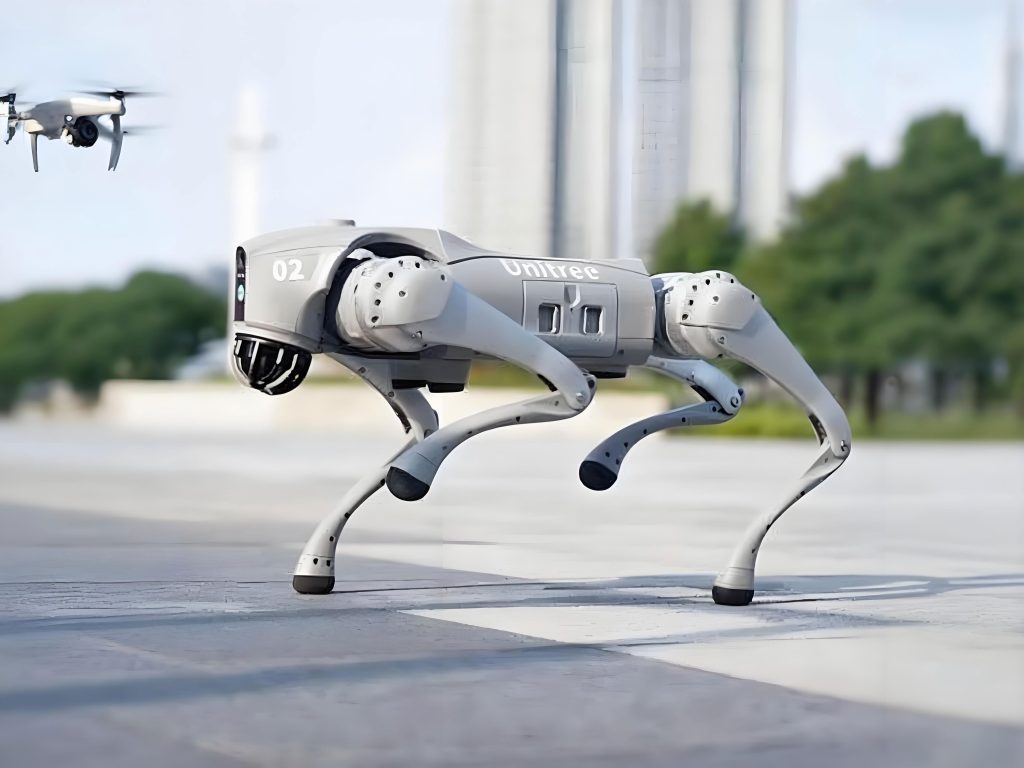
2. High-Power-Density Hydraulic Actuation and Transmission System
To achieve the high mobility and explosive power necessary for overcoming obstacles or performing rapid maneuvers, the bionic robot employs a custom hydraulic actuation system. The design moves beyond traditional electric servos by focusing on power density—delivering high force from a compact package. A key innovation is the integration of the actuator cylinder and control valve into a single, modular joint unit. This “cylinder-valve integration” minimizes fluid passage length, reducing lag and potential failure points.
The system incorporates an energy storage and pressure intensification module, allowing the robot to accumulate hydraulic energy and release it in a controlled burst for high-power tasks. The core challenge lies in the precise spatiotemporal control of this energy conversion. We research high-speed force/position hybrid servo-control techniques to manage the joint’s response under heavy loads and impact conditions. Furthermore, to ensure longevity, we investigate seal and lubrication optimization methods to counteract the detrimental effects of high-pressure, dynamic operation. The transmission is iteratively optimized, potentially utilizing multi-linkage mechanisms to amplify force or range of motion at the end-effector (foot). The dynamic model for a single hydraulic leg joint can be simplified as:
$$ \tau_h = P \cdot A_p – B_v \dot{\theta} – J \ddot{\theta} $$
Where \( \tau_h \) is the output torque at the joint, \( P \) is the controlled hydraulic pressure, \( A_p \) is the piston area, \( B_v \) is the viscous damping coefficient, \( \dot{\theta} \) and \( \ddot{\theta} \) are the joint angular velocity and acceleration, and \( J \) is the inertia.
3. Collective Motion Planning and Control in Complex Environments
Coordinating a swarm of bionic robot units in an unstructured environment requires advanced bio-inspired control theories. We base our approach on multi-element coupled models, analyzing the kinematic parameters of biological collectives like ant colonies or flocks of birds. From these observations, we extract and define characteristic “motion primitives” or patterns (e.g., serpentine traversal, phalanx advance, rotating perimeter defense).
Performance metrics such as collective speed, energy efficiency, and area coverage are established. The research then focuses on creating a mapping between these motion pattern parameters and the resulting swarm performance. Using real-time state feedback from the robot swarm (positions, velocities, sensor readings), the system can dynamically adjust and optimize the planned trajectory online. This process generates servo-control commands that directly drive the high-mobility motions of the entire collective. A simplified cost function for swarm movement optimization might be:
$$ C_{swarm} = \alpha \cdot \sum_{i=1}^{N} (E_i) + \beta \cdot T_{mission} + \gamma \cdot \sum_{i=1}^{N} \sum_{j \neq i}^{N} ( \frac{1}{d_{ij}^2} ) $$
Here, \( C_{swarm} \) is the total cost to minimize, \( E_i \) is the energy consumption of robot \( i \), \( T_{mission} \) is the total mission time, \( d_{ij} \) is the distance between robots \( i \) and \( j \) (promoting dispersion to maximize coverage), and \( \alpha, \beta, \gamma \) are weighting coefficients.
4. Multi-Modal Swarm Neural Network System Model
To endow the bionic robot collective with adaptive and reactive intelligence, we construct an artificial neural network model inspired by biological systems. This model abstracts the information-processing functions of neural networks, creating interconnected nodes where each node represents a specific activation function. The connections between nodes carry weighted signals, forming the basis of the network’s “memory” and learning capability.
The swarm-level neural network enables basic stress responses and emergent behaviors. For instance, the sudden detection of a toxic gas leak by one robot can propagate through the network, triggering an avoidance reconfiguration in the entire swarm. The network’s output—the collective action—is modulated by the connection weights and activation functions, which can be tuned through training. This architecture enhances both individual robot reactivity and the synergistic coordination of the group, allowing them to perform complex tasks like distributed sensor coverage or cooperative payload transport. A simple model for a neuron in this network is:
$$ y_k = \phi \left( \sum_{j=1}^{m} w_{kj} x_j + b_k \right) $$
Where \( y_k \) is the output of neuron \( k \), \( \phi \) is the activation function (e.g., sigmoid, ReLU), \( w_{kj} \) are the connection weights from inputs \( x_j \), and \( b_k \) is the bias term. In the swarm context, inputs \( x_j \) could be sensor data or status signals from neighboring robots.
5. Virtual Force Field Path Planning and Obstacle Avoidance
Navigation in cluttered, dynamic rescue scenes is managed through an artificial potential field algorithm. In this model, the target destination generates an attractive virtual force field, while obstacles generate repulsive fields. The bionic robot moves under the influence of the combined force vector, effectively “rolling downhill” on a potential surface towards the goal while being pushed away from hazards.
We combine this method with grid-based environmental mapping for robustness. The robot or swarm constructs a virtual force field based on sensor data, performing real-time risk assessment of the environment. The algorithm is further optimized to exhibit self-exciting reactions and autonomous learning capabilities, akin to a nervous system learning from past encounters. For a robot at position \( \vec{q} \), the total virtual force \( \vec{F}_{total} \) is:
$$ \vec{F}_{total}(\vec{q}) = \vec{F}_{att}(\vec{q}) + \sum_{i} \vec{F}_{rep, i}(\vec{q}) $$
The attractive force from a goal at \( \vec{q}_{goal} \) is often modeled as a conic well: \( \vec{F}_{att}(\vec{q}) = -k_{att} \cdot (\vec{q} – \vec{q}_{goal}) \). The repulsive force from an obstacle \( i \) within a threshold distance \( \rho_0 \) is: \( \vec{F}_{rep, i}(\vec{q}) = k_{rep} \cdot \left( \frac{1}{d_i(\vec{q})} – \frac{1}{\rho_0} \right) \cdot \frac{1}{d_i^2(\vec{q})} \cdot \frac{\partial d_i(\vec{q})}{\partial \vec{q}} \) if \( d_i(\vec{q}) \leq \rho_0 \), and zero otherwise, where \( d_i(\vec{q}) \) is the distance to obstacle \( i \).
Technical Challenges and Key Breakthroughs
The realization of this advanced bionic robot system confronts several non-trivial technical hurdles, each representing a focal point for innovation.
| Challenge Area | Specific Hurdle | Proposed Research Approach |
|---|---|---|
| System Design & Environmental Adaptation | Ensuring reliable operation in extreme conditions (debris, water, dust). Maintaining communication and control integrity. | Robust mechanical design with sealed compartments. Multi-modal communication protocols (mesh radio, acoustic). Adaptive gait algorithms for unstable terrain. |
| Swarm Neural Intelligence | Creating a scalable, trainable neural model that enables emergent, context-aware swarm behaviors. | Implementation of decentralized neural network architectures (e.g., Graph Neural Networks). Reinforcement learning for collective strategy optimization in simulation before real-world deployment. |
| Multi-Agent Control Laws | Formulating control rules that blend artificial potential fields with decentralized biological motion patterns for efficient, collision-free swarm movement. | Development of a “Central Pattern Generator (CPG)”-inspired virtual model for basic locomotion rhythms, superimposed with potential-field-based navigation directives. Study of bio-collective data to inform interaction rules. |
The first major challenge lies in the fundamental design and environmental hardening of the bionic robot. Rescue sites are unpredictably complex, demanding exceptional robustness from both hardware and software. Research must address mechanical integrity under shock loads, sensor performance in low-visibility conditions, and wireless communication reliability amidst interference. The second core challenge is the synthesis of a credible artificial neural system for the swarm. This involves moving beyond pre-programmed reactions to developing a model capable of distributed learning and adapting its collective behavior based on shared experiences, thereby improving mission effectiveness over time. The third pivotal challenge is the fusion of artificial potential field navigation with decentralized, bio-inspired control laws. The goal is to derive a unified control framework that allows the bionic robot collective to move with the fluid, efficient, and adaptive cohesion observed in animal groups, while rigorously avoiding obstacles and optimizing their search pattern.
Conclusion and Forward Outlook
The comprehensive research into the motion control and swarm intelligence of bionic robot systems, as outlined in this article, represents a significant step toward next-generation autonomous rescue platforms. By integrating biomimetic mechanical design, high-density hydraulic actuation, advanced neural network models, and intelligent navigation algorithms, we aim to create robots that are not merely tools, but cooperative agents capable of operating effectively in the most challenging scenarios imaginable. The successful development of these key technologies has the potential to profoundly impact the field of emergency response, reducing risk to human responders and increasing the chances of saving lives in the critical early hours following a disaster. It is through such interdisciplinary, focused research that the vision of capable, resilient, and intelligent bionic robot teams can transition from concept to life-saving reality.